 Add to Chrome
 Add to Firefox
 Add to Edge
Conversational Human Audio-visual Talking Dialogue Generation
Jul 02, 2026
Large-scale dyadic interactive audio-visual dialogue (DIAD) datasets provide fundamental data resources for developing humanoid interactive virtual agents and digital humans. However, collecting such data is time-consuming, expensive, and ethically sensitive. To address this, we propose CHAT, a new dyadic interactive audio-visual dialogue generation (DIADG) framework that generates diverse, paired, and mutually responsive speech-face dialogue clips from a single textual prompt. CHAT unifies large language models and talking face models with interactive audio and facial behaviour refinement modules, enabling the generation of aligned dyadic dialogue clips with diverse contents and facial identities. Experiments show that CHAT outperforms existing related methods designed for similar tasks under both objective and subjective evaluations. Moreover, our synthesised CHAT-AVD-50k dataset serves as effective pre-training data for downstream interactive head generation, consistently improving PerFRDiff and ReactDiff on REACT 2024. CHAT offers a scalable alternative to the costly and ethically sensitive collection of real dyadic interaction data.

Learning Personalised Human Internal Cognition from External Expressive Behaviours for Real Personality Recognition
Jul 31, 2025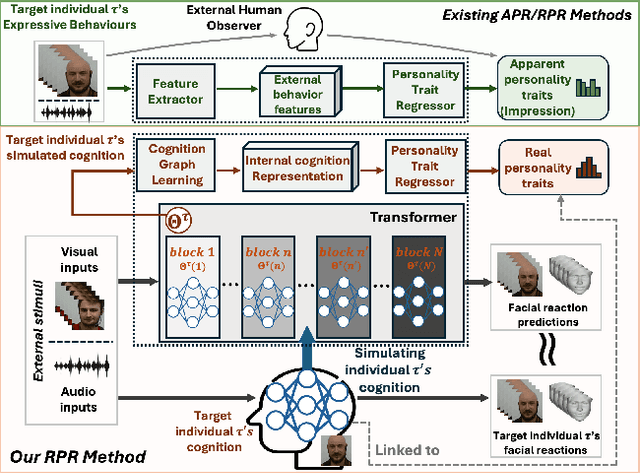
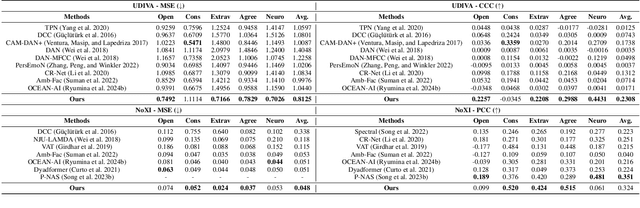
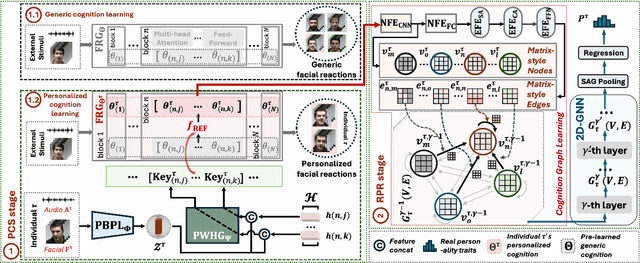
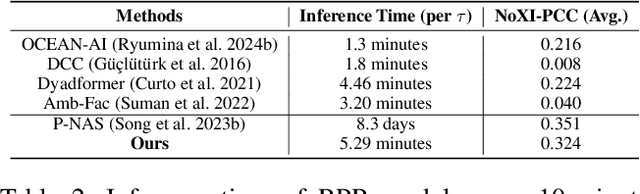
Automatic real personality recognition (RPR) aims to evaluate human real personality traits from their expressive behaviours. However, most existing solutions generally act as external observers to infer observers' personality impressions based on target individuals' expressive behaviours, which significantly deviate from their real personalities and consistently lead to inferior recognition performance. Inspired by the association between real personality and human internal cognition underlying the generation of expressive behaviours, we propose a novel RPR approach that efficiently simulates personalised internal cognition from easy-accessible external short audio-visual behaviours expressed by the target individual. The simulated personalised cognition, represented as a set of network weights that enforce the personalised network to reproduce the individual-specific facial reactions, is further encoded as a novel graph containing two-dimensional node and edge feature matrices, with a novel 2D Graph Neural Network (2D-GNN) proposed for inferring real personality traits from it. To simulate real personality-related cognition, an end-to-end strategy is designed to jointly train our cognition simulation, 2D graph construction, and personality recognition modules.