 Add to Chrome
 Add to Firefox
 Add to Edge
CodeGRAG: Extracting Composed Syntax Graphs for Retrieval Augmented Cross-Lingual Code Generation
May 03, 2024
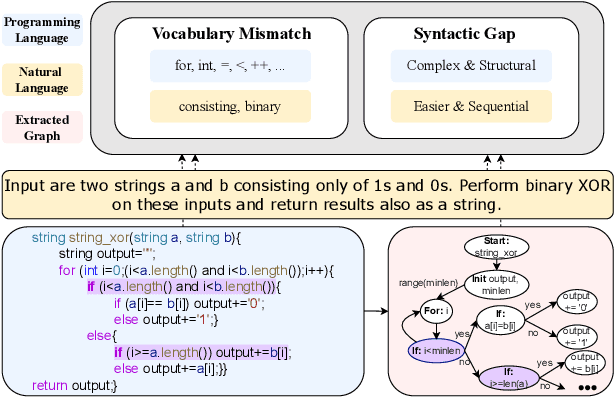
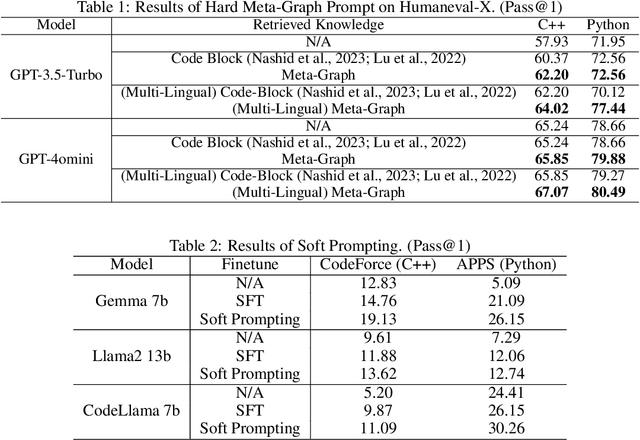
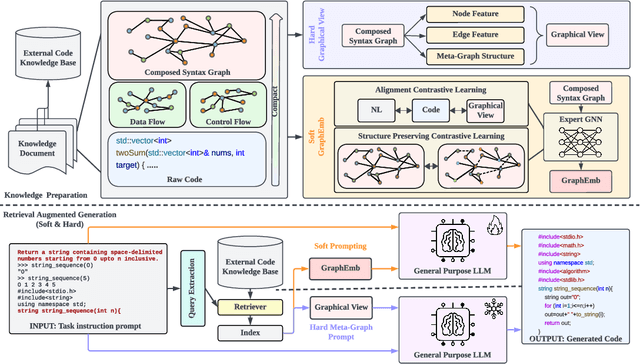
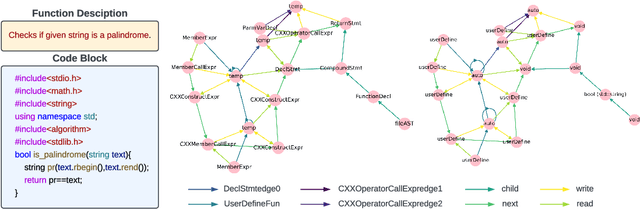
Utilizing large language models to generate codes has shown promising meaning in software development revolution. Despite the intelligence shown by the general large language models, their specificity in code generation can still be improved due to the syntactic gap and mismatched vocabulary existing among natural language and different programming languages. In addition, programming languages are inherently logical and complex, making them hard to be correctly generated. Existing methods rely on multiple prompts to the large language model to explore better solutions, which is expensive. In this paper, we propose Syntax Graph Retrieval Augmented Code Generation (CodeGRAG) to enhance the performance of LLMs in single-round code generation tasks. CodeGRAG extracts and summarizes the control flow and data flow of code blocks to fill the gap between programming languages and natural language. The extracted external structural knowledge models the inherent flows of code blocks, which can facilitate LLMs for better understanding of code syntax and serve as a bridge among different programming languages. CodeGRAG significantly improves the code generation ability of LLMs and can even offer performance gain for cross-lingual code generation, e.g., C++ for Python.

DiarizationLM: Speaker Diarization Post-Processing with Large Language Models
Jan 16, 2024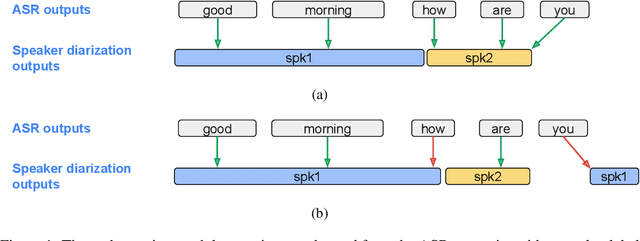



In this paper, we introduce DiarizationLM, a framework to leverage large language models (LLM) to post-process the outputs from a speaker diarization system. Various goals can be achieved with the proposed framework, such as improving the readability of the diarized transcript, or reducing the word diarization error rate (WDER). In this framework, the outputs of the automatic speech recognition (ASR) and speaker diarization systems are represented as a compact textual format, which is included in the prompt to an optionally finetuned LLM. The outputs of the LLM can be used as the refined diarization results with the desired enhancement. As a post-processing step, this framework can be easily applied to any off-the-shelf ASR and speaker diarization systems without retraining existing components. Our experiments show that a finetuned PaLM 2-S model can reduce the WDER by rel. 55.5% on the Fisher telephone conversation dataset, and rel. 44.9% on the Callhome English dataset.
Empirical Study of Large Language Models as Automated Essay Scoring Tools in English Composition__Taking TOEFL Independent Writing Task for Example
Jan 07, 2024Large language models have demonstrated exceptional capabilities in tasks involving natural language generation, reasoning, and comprehension. This study aims to construct prompts and comments grounded in the diverse scoring criteria delineated within the official TOEFL guide. The primary objective is to assess the capabilities and constraints of ChatGPT, a prominent representative of large language models, within the context of automated essay scoring. The prevailing methodologies for automated essay scoring involve the utilization of deep neural networks, statistical machine learning techniques, and fine-tuning pre-trained models. However, these techniques face challenges when applied to different contexts or subjects, primarily due to their substantial data requirements and limited adaptability to small sample sizes. In contrast, this study employs ChatGPT to conduct an automated evaluation of English essays, even with a small sample size, employing an experimental approach. The empirical findings indicate that ChatGPT can provide operational functionality for automated essay scoring, although the results exhibit a regression effect. It is imperative to underscore that the effective design and implementation of ChatGPT prompts necessitate a profound domain expertise and technical proficiency, as these prompts are subject to specific threshold criteria. Keywords: ChatGPT, Automated Essay Scoring, Prompt Learning, TOEFL Independent Writing Task
GMOCAT: A Graph-Enhanced Multi-Objective Method for Computerized Adaptive Testing
Oct 11, 2023Computerized Adaptive Testing(CAT) refers to an online system that adaptively selects the best-suited question for students with various abilities based on their historical response records. Most CAT methods only focus on the quality objective of predicting the student ability accurately, but neglect concept diversity or question exposure control, which are important considerations in ensuring the performance and validity of CAT. Besides, the students' response records contain valuable relational information between questions and knowledge concepts. The previous methods ignore this relational information, resulting in the selection of sub-optimal test questions. To address these challenges, we propose a Graph-Enhanced Multi-Objective method for CAT (GMOCAT). Firstly, three objectives, namely quality, diversity and novelty, are introduced into the Scalarized Multi-Objective Reinforcement Learning framework of CAT, which respectively correspond to improving the prediction accuracy, increasing the concept diversity and reducing the question exposure. We use an Actor-Critic Recommender to select questions and optimize three objectives simultaneously by the scalarization function. Secondly, we utilize the graph neural network to learn relation-aware embeddings of questions and concepts. These embeddings are able to aggregate neighborhood information in the relation graphs between questions and concepts. We conduct experiments on three real-world educational datasets, and show that GMOCAT not only outperforms the state-of-the-art methods in the ability prediction, but also achieve superior performance in improving the concept diversity and alleviating the question exposure. Our code is available at https://github.com/justarter/GMOCAT.
Towards Word-Level End-to-End Neural Speaker Diarization with Auxiliary Network
Sep 15, 2023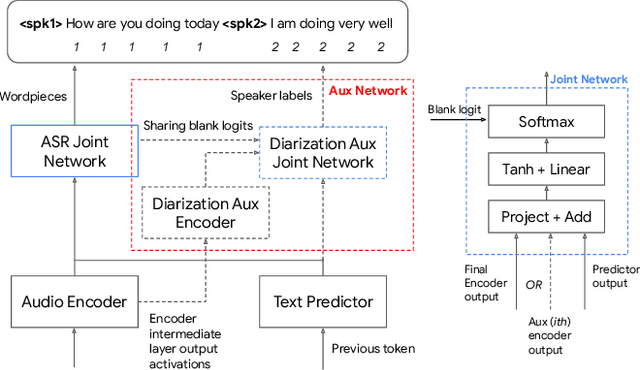
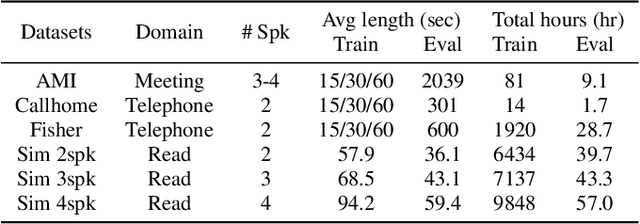
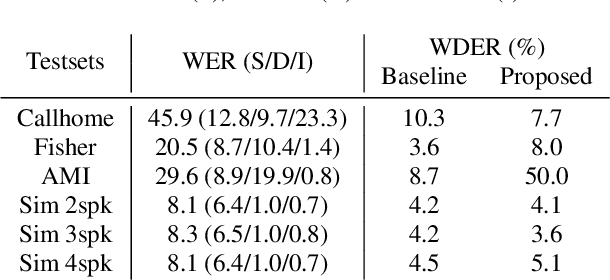

While standard speaker diarization attempts to answer the question "who spoken when", most of relevant applications in reality are more interested in determining "who spoken what". Whether it is the conventional modularized approach or the more recent end-to-end neural diarization (EEND), an additional automatic speech recognition (ASR) model and an orchestration algorithm are required to associate the speaker labels with recognized words. In this paper, we propose Word-level End-to-End Neural Diarization (WEEND) with auxiliary network, a multi-task learning algorithm that performs end-to-end ASR and speaker diarization in the same neural architecture. That is, while speech is being recognized, speaker labels are predicted simultaneously for each recognized word. Experimental results demonstrate that WEEND outperforms the turn-based diarization baseline system on all 2-speaker short-form scenarios and has the capability to generalize to audio lengths of 5 minutes. Although 3+speaker conversations are harder, we find that with enough in-domain training data, WEEND has the potential to deliver high quality diarized text.
A Comprehensive Survey on Deep Learning Techniques in Educational Data Mining
Sep 09, 2023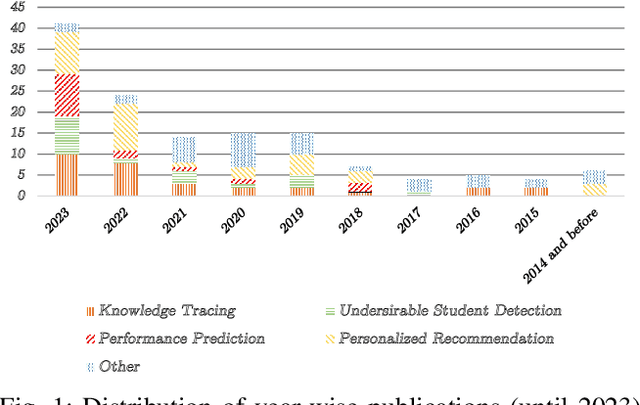
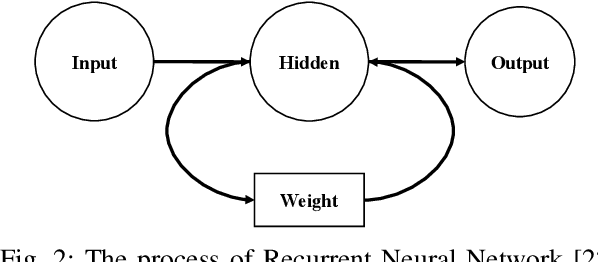
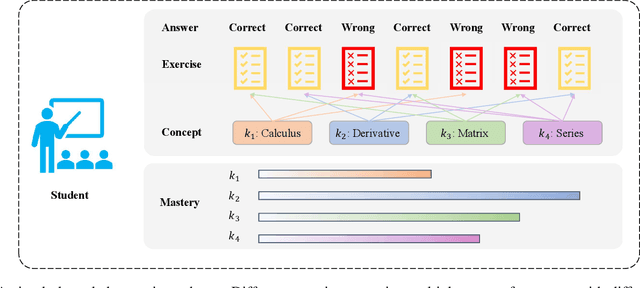
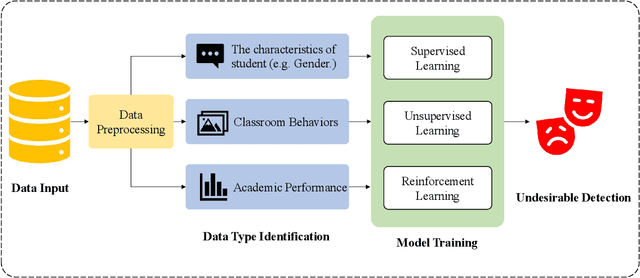
Educational Data Mining (EDM) has emerged as a vital field of research, which harnesses the power of computational techniques to analyze educational data. With the increasing complexity and diversity of educational data, Deep Learning techniques have shown significant advantages in addressing the challenges associated with analyzing and modeling this data. This survey aims to systematically review the state-of-the-art in EDM with Deep Learning. We begin by providing a brief introduction to EDM and Deep Learning, highlighting their relevance in the context of modern education. Next, we present a detailed review of Deep Learning techniques applied in four typical educational scenarios, including knowledge tracing, undesirable student detecting, performance prediction, and personalized recommendation. Furthermore, a comprehensive overview of public datasets and processing tools for EDM is provided. Finally, we point out emerging trends and future directions in this research area.
Set-to-Sequence Ranking-based Concept-aware Learning Path Recommendation
Jun 07, 2023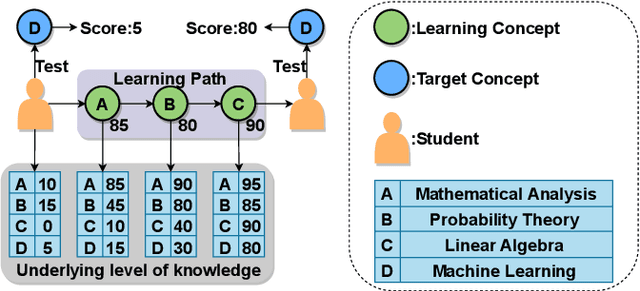
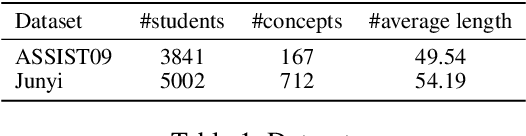
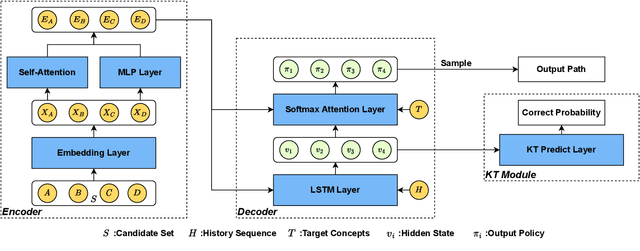
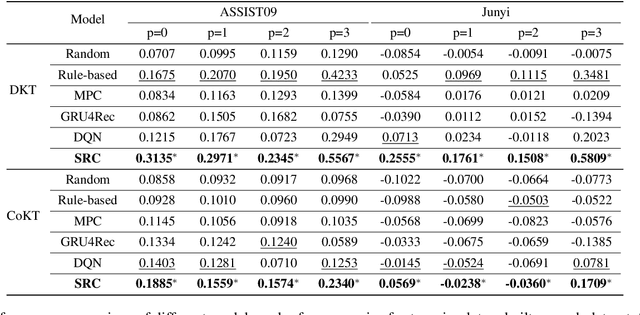
With the development of the online education system, personalized education recommendation has played an essential role. In this paper, we focus on developing path recommendation systems that aim to generating and recommending an entire learning path to the given user in each session. Noticing that existing approaches fail to consider the correlations of concepts in the path, we propose a novel framework named Set-to-Sequence Ranking-based Concept-aware Learning Path Recommendation (SRC), which formulates the recommendation task under a set-to-sequence paradigm. Specifically, we first design a concept-aware encoder module which can capture the correlations among the input learning concepts. The outputs are then fed into a decoder module that sequentially generates a path through an attention mechanism that handles correlations between the learning and target concepts. Our recommendation policy is optimized by policy gradient. In addition, we also introduce an auxiliary module based on knowledge tracing to enhance the model's stability by evaluating students' learning effects on learning concepts. We conduct extensive experiments on two real-world public datasets and one industrial dataset, and the experimental results demonstrate the superiority and effectiveness of SRC. Code will be available at https://gitee.com/mindspore/models/tree/master/research/recommend/SRC.
DeSAM: Decoupling Segment Anything Model for Generalizable Medical Image Segmentation
Jun 01, 2023Deep learning based automatic medical image segmentation models often suffer from domain shift, where the models trained on a source domain do not generalize well to other unseen domains. As a vision foundation model with powerful generalization capabilities, Segment Anything Model (SAM) shows potential for improving the cross-domain robustness of medical image segmentation. However, SAM and its fine-tuned models performed significantly worse in fully automatic mode compared to when given manual prompts. Upon further investigation, we discovered that the degradation in performance was related to the coupling effect of poor prompts and mask segmentation. In fully automatic mode, the presence of inevitable poor prompts (such as points outside the mask or boxes significantly larger than the mask) can significantly mislead mask generation. To address the coupling effect, we propose the decoupling SAM (DeSAM). DeSAM modifies SAM's mask decoder to decouple mask generation and prompt embeddings while leveraging pre-trained weights. We conducted experiments on publicly available prostate cross-site datasets. The results show that DeSAM improves dice score by an average of 8.96% (from 70.06% to 79.02%) compared to previous state-of-the-art domain generalization method. Moreover, DeSAM can be trained on personal devices with entry-level GPU since our approach does not rely on tuning the heavyweight image encoder. The code is publicly available at https://github.com/yifangao112/DeSAM.
Rethinking k-means from manifold learning perspective
May 12, 2023Although numerous clustering algorithms have been developed, many existing methods still leverage k-means technique to detect clusters of data points. However, the performance of k-means heavily depends on the estimation of centers of clusters, which is very difficult to achieve an optimal solution. Another major drawback is that it is sensitive to noise and outlier data. In this paper, from manifold learning perspective, we rethink k-means and present a new clustering algorithm which directly detects clusters of data without mean estimation. Specifically, we construct distance matrix between data points by Butterworth filter such that distance between any two data points in the same clusters equals to a small constant, while increasing the distance between other data pairs from different clusters. To well exploit the complementary information embedded in different views, we leverage the tensor Schatten p-norm regularization on the 3rd-order tensor which consists of indicator matrices of different views. Finally, an efficient alternating algorithm is derived to optimize our model. The constructed sequence was proved to converge to the stationary KKT point. Extensive experimental results indicate the superiority of our proposed method.
Multi-View Clustering via Semi-non-negative Tensor Factorization
Mar 29, 2023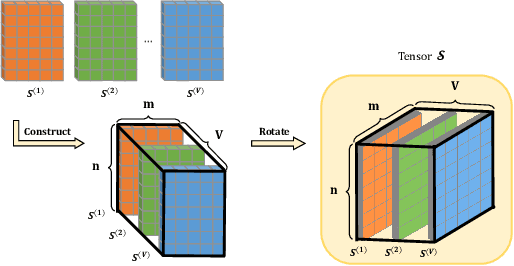
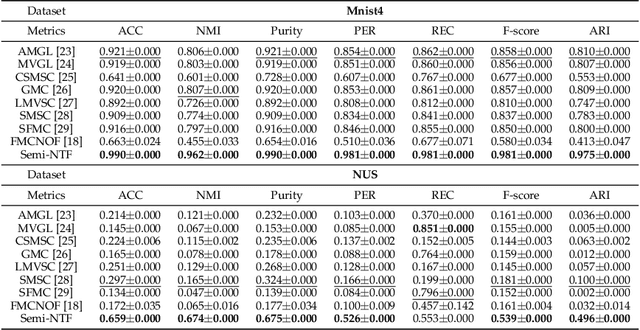
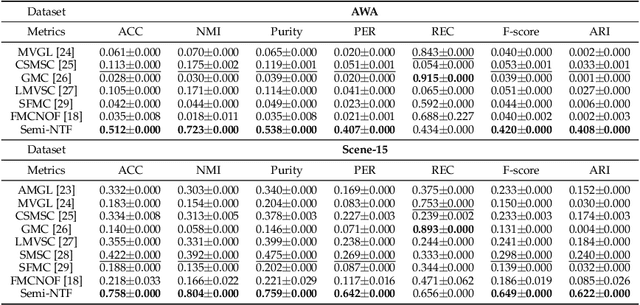
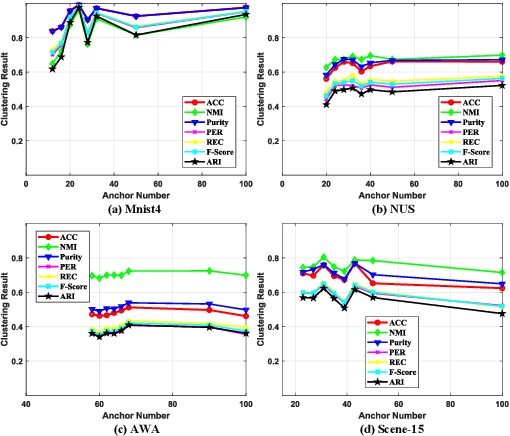
Multi-view clustering (MVC) based on non-negative matrix factorization (NMF) and its variants have received a huge amount of attention in recent years due to their advantages in clustering interpretability. However, existing NMF-based multi-view clustering methods perform NMF on each view data respectively and ignore the impact of between-view. Thus, they can't well exploit the within-view spatial structure and between-view complementary information. To resolve this issue, we present semi-non-negative tensor factorization (Semi-NTF) and develop a novel multi-view clustering based on Semi-NTF with one-side orthogonal constraint. Our model directly performs Semi-NTF on the 3rd-order tensor which is composed of anchor graphs of views. Thus, our model directly considers the between-view relationship. Moreover, we use the tensor Schatten p-norm regularization as a rank approximation of the 3rd-order tensor which characterizes the cluster structure of multi-view data and exploits the between-view complementary information. In addition, we provide an optimization algorithm for the proposed method and prove mathematically that the algorithm always converges to the stationary KKT point. Extensive experiments on various benchmark datasets indicate that our proposed method is able to achieve satisfactory clustering performance.