 Add to Chrome
 Add to Firefox
 Add to Edge
Not Search, But Scan: Benchmarking MLLMs on Scan-Oriented Academic Paper Reasoning
Mar 27, 2026
With the rapid progress of multimodal large language models (MLLMs), AI already performs well at literature retrieval and certain reasoning tasks, serving as a capable assistant to human researchers, yet it remains far from autonomous research. The fundamental reason is that current work on academic paper reasoning is largely confined to a search-oriented paradigm centered on pre-specified targets, with reasoning grounded in relevance retrieval, which struggles to support researcher-style full-document understanding, reasoning, and verification. To bridge this gap, we propose \textbf{ScholScan}, a new benchmark for academic paper reasoning. ScholScan introduces a scan-oriented task setting that asks models to read and cross-check entire papers like human researchers, scanning the document to identify consistency issues. The benchmark comprises 1,800 carefully annotated questions drawn from nine error categories across 13 natural-science domains and 715 papers, and provides detailed annotations for evidence localization and reasoning traces, together with a unified evaluation protocol. We assessed 15 models across 24 input configurations and conducted a fine-grained analysis of MLLM capabilities for all error categories. Across the board, retrieval-augmented generation (RAG) methods yield no significant improvements, revealing systematic deficiencies of current MLLMs on scan-oriented tasks and underscoring the challenge posed by ScholScan. We expect ScholScan to be the leading and representative work of the scan-oriented task paradigm.

THEMIS: Towards Holistic Evaluation of MLLMs for Scientific Paper Fraud Forensics
Mar 26, 2026We present THEMIS, a novel multi-task benchmark designed to comprehensively evaluate multimodal large language models (MLLMs) on visual fraud reasoning within real-world academic scenarios. Compared to existing benchmarks, THEMIS introduces three major advances. (1) Real-World Scenarios and Complexity: Our benchmark comprises over 4,000 questions spanning seven scenarios, derived from authentic retracted-paper cases and carefully curated multimodal synthetic data. With 60.47% complex-texture images, THEMIS bridges the critical gap between existing benchmarks and the complexity of real-world academic fraud. (2) Fraud-Type Diversity and Granularity: THEMIS systematically covers five challenging fraud types and introduces 16 fine-grained manipulation operations. On average, each sample undergoes multiple stacked manipulation operations, with the diversity and difficulty of these manipulations demanding a high level of visual fraud reasoning from the models. (3) Multi-Dimensional Capability Evaluation: We establish a mapping from fraud types to five core visual fraud reasoning capabilities, thereby enabling an evaluation that reveals the distinct strengths and specific weaknesses of different models across these core capabilities. Experiments on 16 leading MLLMs show that even the best-performing model, GPT-5, achieves an overall performance of only 56.15%, demonstrating that our benchmark presents a stringent test. We expect THEMIS to advance the development of MLLMs for complex, real-world fraud reasoning tasks.
FinMMDocR: Benchmarking Financial Multimodal Reasoning with Scenario Awareness, Document Understanding, and Multi-Step Computation
Dec 31, 2025We introduce FinMMDocR, a novel bilingual multimodal benchmark for evaluating multimodal large language models (MLLMs) on real-world financial numerical reasoning. Compared to existing benchmarks, our work delivers three major advancements. (1) Scenario Awareness: 57.9% of 1,200 expert-annotated problems incorporate 12 types of implicit financial scenarios (e.g., Portfolio Management), challenging models to perform expert-level reasoning based on assumptions; (2) Document Understanding: 837 Chinese/English documents spanning 9 types (e.g., Company Research) average 50.8 pages with rich visual elements, significantly surpassing existing benchmarks in both breadth and depth of financial documents; (3) Multi-Step Computation: Problems demand 11-step reasoning on average (5.3 extraction + 5.7 calculation steps), with 65.0% requiring cross-page evidence (2.4 pages average). The best-performing MLLM achieves only 58.0% accuracy, and different retrieval-augmented generation (RAG) methods show significant performance variations on this task. We expect FinMMDocR to drive improvements in MLLMs and reasoning-enhanced methods on complex multimodal reasoning tasks in real-world scenarios.
FinMMR: Make Financial Numerical Reasoning More Multimodal, Comprehensive, and Challenging
Aug 06, 2025We present FinMMR, a novel bilingual multimodal benchmark tailored to evaluate the reasoning capabilities of multimodal large language models (MLLMs) in financial numerical reasoning tasks. Compared to existing benchmarks, our work introduces three significant advancements. (1) Multimodality: We meticulously transform existing financial reasoning benchmarks, and construct novel questions from the latest Chinese financial research reports. FinMMR comprises 4.3K questions and 8.7K images spanning 14 categories, including tables, bar charts, and ownership structure charts. (2) Comprehensiveness: FinMMR encompasses 14 financial subdomains, including corporate finance, banking, and industry analysis, significantly exceeding existing benchmarks in financial domain knowledge breadth. (3) Challenge: Models are required to perform multi-step precise numerical reasoning by integrating financial knowledge with the understanding of complex financial images and text. The best-performing MLLM achieves only 53.0% accuracy on Hard problems. We believe that FinMMR will drive advancements in enhancing the reasoning capabilities of MLLMs in real-world scenarios.
PNeSM: Arbitrary 3D Scene Stylization via Prompt-Based Neural Style Mapping
Mar 13, 20243D scene stylization refers to transform the appearance of a 3D scene to match a given style image, ensuring that images rendered from different viewpoints exhibit the same style as the given style image, while maintaining the 3D consistency of the stylized scene. Several existing methods have obtained impressive results in stylizing 3D scenes. However, the models proposed by these methods need to be re-trained when applied to a new scene. In other words, their models are coupled with a specific scene and cannot adapt to arbitrary other scenes. To address this issue, we propose a novel 3D scene stylization framework to transfer an arbitrary style to an arbitrary scene, without any style-related or scene-related re-training. Concretely, we first map the appearance of the 3D scene into a 2D style pattern space, which realizes complete disentanglement of the geometry and appearance of the 3D scene and makes our model be generalized to arbitrary 3D scenes. Then we stylize the appearance of the 3D scene in the 2D style pattern space via a prompt-based 2D stylization algorithm. Experimental results demonstrate that our proposed framework is superior to SOTA methods in both visual quality and generalization.
DiarizationLM: Speaker Diarization Post-Processing with Large Language Models
Jan 16, 2024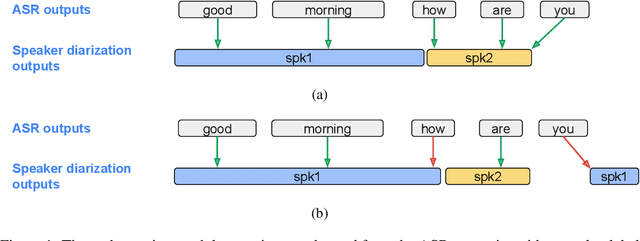



In this paper, we introduce DiarizationLM, a framework to leverage large language models (LLM) to post-process the outputs from a speaker diarization system. Various goals can be achieved with the proposed framework, such as improving the readability of the diarized transcript, or reducing the word diarization error rate (WDER). In this framework, the outputs of the automatic speech recognition (ASR) and speaker diarization systems are represented as a compact textual format, which is included in the prompt to an optionally finetuned LLM. The outputs of the LLM can be used as the refined diarization results with the desired enhancement. As a post-processing step, this framework can be easily applied to any off-the-shelf ASR and speaker diarization systems without retraining existing components. Our experiments show that a finetuned PaLM 2-S model can reduce the WDER by rel. 55.5% on the Fisher telephone conversation dataset, and rel. 44.9% on the Callhome English dataset.
ArtBank: Artistic Style Transfer with Pre-trained Diffusion Model and Implicit Style Prompt Bank
Dec 11, 2023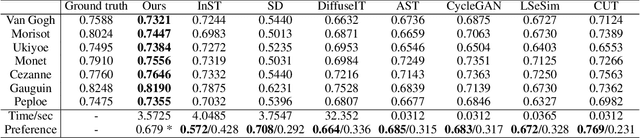
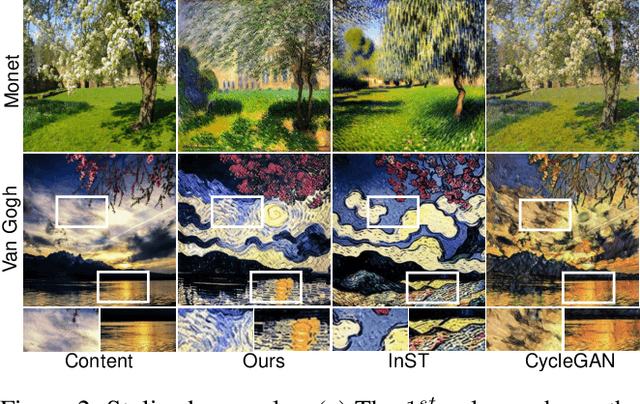


Artistic style transfer aims to repaint the content image with the learned artistic style. Existing artistic style transfer methods can be divided into two categories: small model-based approaches and pre-trained large-scale model-based approaches. Small model-based approaches can preserve the content strucuture, but fail to produce highly realistic stylized images and introduce artifacts and disharmonious patterns; Pre-trained large-scale model-based approaches can generate highly realistic stylized images but struggle with preserving the content structure. To address the above issues, we propose ArtBank, a novel artistic style transfer framework, to generate highly realistic stylized images while preserving the content structure of the content images. Specifically, to sufficiently dig out the knowledge embedded in pre-trained large-scale models, an Implicit Style Prompt Bank (ISPB), a set of trainable parameter matrices, is designed to learn and store knowledge from the collection of artworks and behave as a visual prompt to guide pre-trained large-scale models to generate highly realistic stylized images while preserving content structure. Besides, to accelerate training the above ISPB, we propose a novel Spatial-Statistical-based self-Attention Module (SSAM). The qualitative and quantitative experiments demonstrate the superiority of our proposed method over state-of-the-art artistic style transfer methods.
Towards Word-Level End-to-End Neural Speaker Diarization with Auxiliary Network
Sep 15, 2023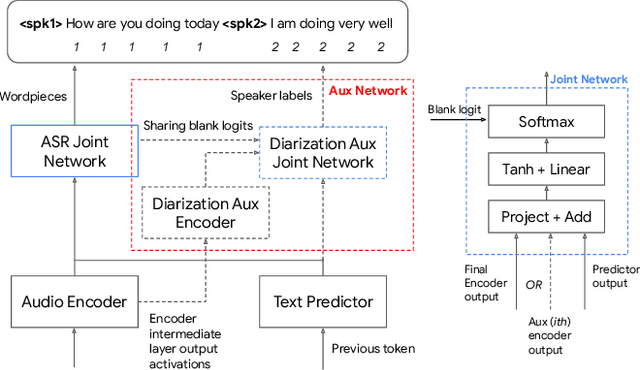
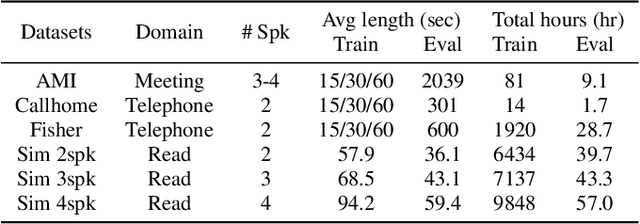
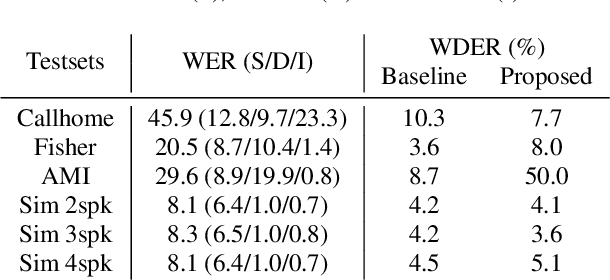

While standard speaker diarization attempts to answer the question "who spoken when", most of relevant applications in reality are more interested in determining "who spoken what". Whether it is the conventional modularized approach or the more recent end-to-end neural diarization (EEND), an additional automatic speech recognition (ASR) model and an orchestration algorithm are required to associate the speaker labels with recognized words. In this paper, we propose Word-level End-to-End Neural Diarization (WEEND) with auxiliary network, a multi-task learning algorithm that performs end-to-end ASR and speaker diarization in the same neural architecture. That is, while speech is being recognized, speaker labels are predicted simultaneously for each recognized word. Experimental results demonstrate that WEEND outperforms the turn-based diarization baseline system on all 2-speaker short-form scenarios and has the capability to generalize to audio lengths of 5 minutes. Although 3+speaker conversations are harder, we find that with enough in-domain training data, WEEND has the potential to deliver high quality diarized text.
USM-SCD: Multilingual Speaker Change Detection Based on Large Pretrained Foundation Models
Sep 14, 2023We introduce a multilingual speaker change detection model (USM-SCD) that can simultaneously detect speaker turns and perform ASR for 96 languages. This model is adapted from a speech foundation model trained on a large quantity of supervised and unsupervised data, demonstrating the utility of fine-tuning from a large generic foundation model for a downstream task. We analyze the performance of this multilingual speaker change detection model through a series of ablation studies. We show that the USM-SCD model can achieve more than 75% average speaker change detection F1 score across a test set that consists of data from 96 languages. On American English, the USM-SCD model can achieve an 85.8% speaker change detection F1 score across various public and internal test sets, beating the previous monolingual baseline model by 21% relative. We also show that we only need to fine-tune one-quarter of the trainable model parameters to achieve the best model performance. The USM-SCD model exhibits state-of-the-art ASR quality compared with a strong public ASR baseline, making it suitable to handle both tasks with negligible additional computational cost.
Selective inference using randomized group lasso estimators for general models
Jun 24, 2023Selective inference methods are developed for group lasso estimators for use with a wide class of distributions and loss functions. The method includes the use of exponential family distributions, as well as quasi-likelihood modeling for overdispersed count data, for example, and allows for categorical or grouped covariates as well as continuous covariates. A randomized group-regularized optimization problem is studied. The added randomization allows us to construct a post-selection likelihood which we show to be adequate for selective inference when conditioning on the event of the selection of the grouped covariates. This likelihood also provides a selective point estimator, accounting for the selection by the group lasso. Confidence regions for the regression parameters in the selected model take the form of Wald-type regions and are shown to have bounded volume. The selective inference method for grouped lasso is illustrated on data from the national health and nutrition examination survey while simulations showcase its behaviour and favorable comparison with other methods.