 Add to Chrome
 Add to Firefox
 Add to Edge
Library Reachability in LSR-Synth: How Anti-Memorization Design Changes the Measurement of Symbolic Discovery
Jul 30, 2026
Existing benchmarks for scientific equation discovery are largely composed of well-known equations available in the public domain, making it difficult to determine whether a model is discovering laws from data or merely recalling answers from its training corpus. LSR-Synth mitigates this problem by introducing novel synthetic terms into established scientific mechanisms and filtering the resulting tasks for novelty, solvability, and scientific plausibility. This paper examines a narrower measurement question: can these tasks further distinguish scientific priors supplied by language models from conventional operator search that does not access task semantics? We construct a semantics-free baseline using a fixed vocabulary with publicly documented provenance, and assess the role of candidate coverage through semantic blinding, library weakening, and matched operator-family knockouts. Under the current task snapshot, search budget, and scoring protocol, the fixed vocabulary already covers most tasks, while language-model-generated candidates rarely expand the set of solvable instances. Their marginal contribution becomes substantial only when vocabulary coverage is selectively disrupted. Strict out-of-distribution evaluation lowers the absolute success rates of all methods but does not alter this relationship. These findings neither invalidate LSR-Synth's controls against memorization of complete formulas nor imply that language-model priors are generally unhelpful. Rather, they support a more limited conclusion: most current tasks remain suitable for evaluating the fitting and recombination of previously unseen expressions, but are insufficient on their own to identify contributions from priors beyond a fixed search space.

Rotatable Antenna-Enabled Near-Field Integrated Sensing and Communication
Jun 11, 2026In this paper, we propose leveraging rotatable antennas (RAs) to enhance near-field communication and sensing by exploiting a new orientation-domain spatial degree-of-freedom (DoF) provided by element-wise antenna rotation. Specifically, we investigate an RA-enabled near-field integrated sensing and communication (ISAC) system with sub-connected hybrid beamforming, where each transmit RA can independently adjust its boresight direction under a practical rotation constraint. A spherical-wave channel model incorporating orientation-dependent antenna gains is established to characterize multi-user communication and target sensing in the presence of clutters. Based on this model, a weighted communication-sensing utility maximization problem is formulated by jointly optimizing the receive beamformer, digital beamformer, analog beamformer, and RA boresight directions. To solve the resulting non-convex problem, an alternating optimization algorithm is developed by combining fractional programming, Riemannian optimization, and a spherical-cap Frank--Wolfe-based boresight update. To further understand the impact of RA rotation on near-field sensing, we derive a closed-form root Cramer--Rao bound (RCRB) expression. Simulation results demonstrate the convergence and effectiveness of the proposed algorithm. It is shown that the RA-enabled hybrid design can match or even outperform the fully-digital FPA benchmark in some regimes, indicating that the orientation-domain DoF introduced by element-wise rotation can compensate for limited RF chains. The RCRB and beampattern results further show that RA rotation improves off-broadside sensing accuracy, enhances range-domain focusing, and suppresses same-angle clutters in the near field.
Video Streaming Thinking: VideoLLMs Can Watch and Think Simultaneously
Mar 12, 2026Online Video Large Language Models (VideoLLMs) play a critical role in supporting responsive, real-time interaction. Existing methods focus on streaming perception, lacking a synchronized logical reasoning stream. However, directly applying test-time scaling methods incurs unacceptable response latency. To address this trade-off, we propose Video Streaming Thinking (VST), a novel paradigm for streaming video understanding. It supports a thinking while watching mechanism, which activates reasoning over incoming video clips during streaming. This design improves timely comprehension and coherent cognition while preserving real-time responsiveness by amortizing LLM reasoning latency over video playback. Furthermore, we introduce a comprehensive post-training pipeline that integrates VST-SFT, which structurally adapts the offline VideoLLM to causal streaming reasoning, and VST-RL, which provides end-to-end improvement through self-exploration in a multi-turn video interaction environment. Additionally, we devise an automated training-data synthesis pipeline that uses video knowledge graphs to generate high-quality streaming QA pairs, with an entity-relation grounded streaming Chain-of-Thought to enforce multi-evidence reasoning and sustained attention to the video stream. Extensive evaluations show that VST-7B performs strongly on online benchmarks, e.g. 79.5% on StreamingBench and 59.3% on OVO-Bench. Meanwhile, VST remains competitive on offline long-form or reasoning benchmarks. Compared with Video-R1, VST responds 15.7 times faster and achieves +5.4% improvement on VideoHolmes, demonstrating higher efficiency and strong generalization across diverse video understanding tasks. Code, data, and models will be released at https://github.com/1ranGuan/VST.
MSTAR: Box-free Multi-query Scene Text Retrieval with Attention Recycling
Jun 12, 2025Scene text retrieval has made significant progress with the assistance of accurate text localization. However, existing approaches typically require costly bounding box annotations for training. Besides, they mostly adopt a customized retrieval strategy but struggle to unify various types of queries to meet diverse retrieval needs. To address these issues, we introduce Muti-query Scene Text retrieval with Attention Recycling (MSTAR), a box-free approach for scene text retrieval. It incorporates progressive vision embedding to dynamically capture the multi-grained representation of texts and harmonizes free-style text queries with style-aware instructions. Additionally, a multi-instance matching module is integrated to enhance vision-language alignment. Furthermore, we build the Multi-Query Text Retrieval (MQTR) dataset, the first benchmark designed to evaluate the multi-query scene text retrieval capability of models, comprising four query types and 16k images. Extensive experiments demonstrate the superiority of our method across seven public datasets and the MQTR dataset. Notably, MSTAR marginally surpasses the previous state-of-the-art model by 6.4% in MAP on Total-Text while eliminating box annotation costs. Moreover, on the MQTR benchmark, MSTAR significantly outperforms the previous models by an average of 8.5%. The code and datasets are available at https://github.com/yingift/MSTAR.
PDF-WuKong: A Large Multimodal Model for Efficient Long PDF Reading with End-to-End Sparse Sampling
Oct 08, 2024Document understanding is a challenging task to process and comprehend large amounts of textual and visual information. Recent advances in Large Language Models (LLMs) have significantly improved the performance of this task. However, existing methods typically focus on either plain text or a limited number of document images, struggling to handle long PDF documents with interleaved text and images, especially in academic papers. In this paper, we introduce PDF-WuKong, a multimodal large language model (MLLM) which is designed to enhance multimodal question-answering (QA) for long PDF documents. PDF-WuKong incorporates a sparse sampler that operates on both text and image representations, significantly improving the efficiency and capability of the MLLM. The sparse sampler is integrated with the MLLM's image encoder and selects the paragraphs or diagrams most pertinent to user queries for processing by the language model. To effectively train and evaluate our model, we construct PaperPDF, a dataset consisting of a broad collection of academic papers sourced from arXiv, multiple strategies are proposed to generate automatically 1M QA pairs along with their corresponding evidence sources. Experimental results demonstrate the superiority and high efficiency of our approach over other models on the task of long multimodal PDF understanding, surpassing proprietary products by an average of 8.6% on F1. Our code and dataset will be released at https://github.com/yh-hust/PDF-Wukong.
Contrastive Diffuser: Planning Towards High Return States via Contrastive Learning
Feb 06, 2024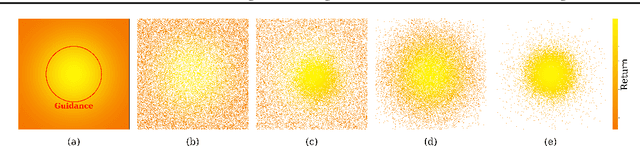
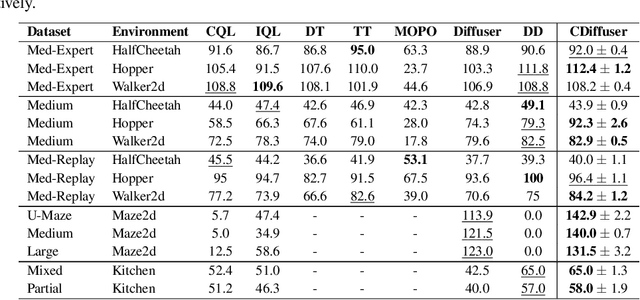
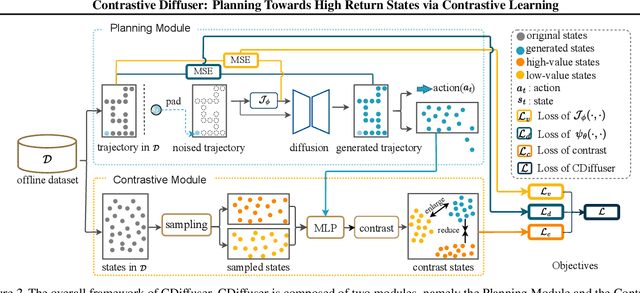
Applying diffusion models in reinforcement learning for long-term planning has gained much attention recently. Several diffusion-based methods have successfully leveraged the modeling capabilities of diffusion for arbitrary distributions. These methods generate subsequent trajectories for planning and have demonstrated significant improvement. However, these methods are limited by their plain base distributions and their overlooking of the diversity of samples, in which different states have different returns. They simply leverage diffusion to learn the distribution of offline dataset, generate the trajectories whose states share the same distribution with the offline dataset. As a result, the probability of these models reaching the high-return states is largely dependent on the dataset distribution. Even equipped with the guidance model, the performance is still suppressed. To address these limitations, in this paper, we propose a novel method called CDiffuser, which devises a return contrast mechanism to pull the states in generated trajectories towards high-return states while pushing them away from low-return states to improve the base distribution. Experiments on 14 commonly used D4RL benchmarks demonstrate the effectiveness of our proposed method.
GMOCAT: A Graph-Enhanced Multi-Objective Method for Computerized Adaptive Testing
Oct 11, 2023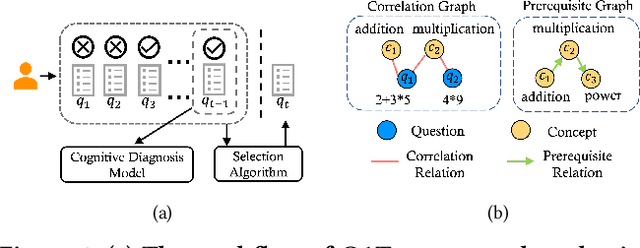
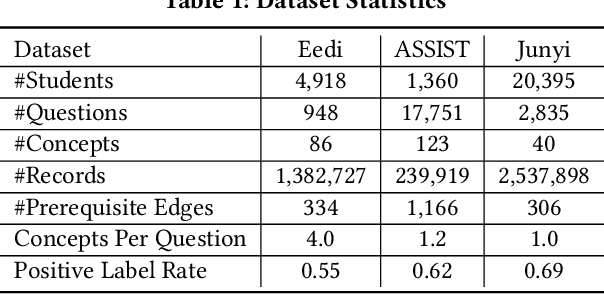
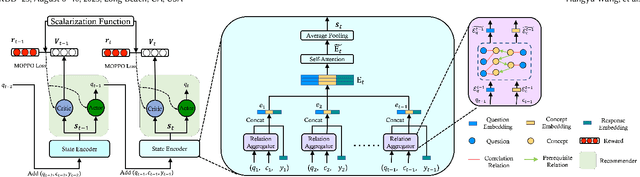
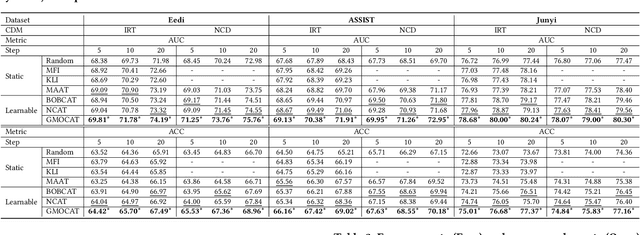
Computerized Adaptive Testing(CAT) refers to an online system that adaptively selects the best-suited question for students with various abilities based on their historical response records. Most CAT methods only focus on the quality objective of predicting the student ability accurately, but neglect concept diversity or question exposure control, which are important considerations in ensuring the performance and validity of CAT. Besides, the students' response records contain valuable relational information between questions and knowledge concepts. The previous methods ignore this relational information, resulting in the selection of sub-optimal test questions. To address these challenges, we propose a Graph-Enhanced Multi-Objective method for CAT (GMOCAT). Firstly, three objectives, namely quality, diversity and novelty, are introduced into the Scalarized Multi-Objective Reinforcement Learning framework of CAT, which respectively correspond to improving the prediction accuracy, increasing the concept diversity and reducing the question exposure. We use an Actor-Critic Recommender to select questions and optimize three objectives simultaneously by the scalarization function. Secondly, we utilize the graph neural network to learn relation-aware embeddings of questions and concepts. These embeddings are able to aggregate neighborhood information in the relation graphs between questions and concepts. We conduct experiments on three real-world educational datasets, and show that GMOCAT not only outperforms the state-of-the-art methods in the ability prediction, but also achieve superior performance in improving the concept diversity and alleviating the question exposure. Our code is available at https://github.com/justarter/GMOCAT.