 Add to Chrome
 Add to Firefox
 Add to Edge
X-MOBILITY: End-To-End Generalizable Navigation via World Modeling
Oct 23, 2024


General-purpose navigation in challenging environments remains a significant problem in robotics, with current state-of-the-art approaches facing myriad limitations. Classical approaches struggle with cluttered settings and require extensive tuning, while learning-based methods face difficulties generalizing to out-of-distribution environments. This paper introduces X-Mobility, an end-to-end generalizable navigation model that overcomes existing challenges by leveraging three key ideas. First, X-Mobility employs an auto-regressive world modeling architecture with a latent state space to capture world dynamics. Second, a diverse set of multi-head decoders enables the model to learn a rich state representation that correlates strongly with effective navigation skills. Third, by decoupling world modeling from action policy, our architecture can train effectively on a variety of data sources, both with and without expert policies: off-policy data allows the model to learn world dynamics, while on-policy data with supervisory control enables optimal action policy learning. Through extensive experiments, we demonstrate that X-Mobility not only generalizes effectively but also surpasses current state-of-the-art navigation approaches. Additionally, X-Mobility also achieves zero-shot Sim2Real transferability and shows strong potential for cross-embodiment generalization.

OAH-Net: A Deep Neural Network for Hologram Reconstruction of Off-axis Digital Holographic Microscope
Oct 17, 2024


Off-axis digital holographic microscopy is a high-throughput, label-free imaging technology that provides three-dimensional, high-resolution information about samples, particularly useful in large-scale cellular imaging. However, the hologram reconstruction process poses a significant bottleneck for timely data analysis. To address this challenge, we propose a novel reconstruction approach that integrates deep learning with the physical principles of off-axis holography. We initialized part of the network weights based on the physical principle and then fine-tuned them via weakly supersized learning. Our off-axis hologram network (OAH-Net) retrieves phase and amplitude images with errors that fall within the measurement error range attributable to hardware, and its reconstruction speed significantly surpasses the microscope's acquisition rate. Crucially, OAH-Net demonstrates remarkable external generalization capabilities on unseen samples with distinct patterns and can be seamlessly integrated with other models for downstream tasks to achieve end-to-end real-time hologram analysis. This capability further expands off-axis holography's applications in both biological and medical studies.
ExpGest: Expressive Speaker Generation Using Diffusion Model and Hybrid Audio-Text Guidance
Oct 12, 2024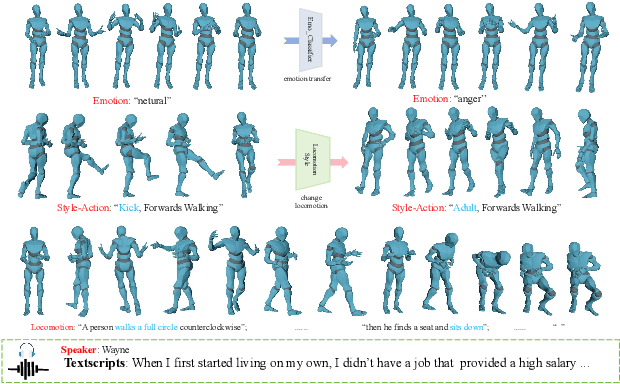
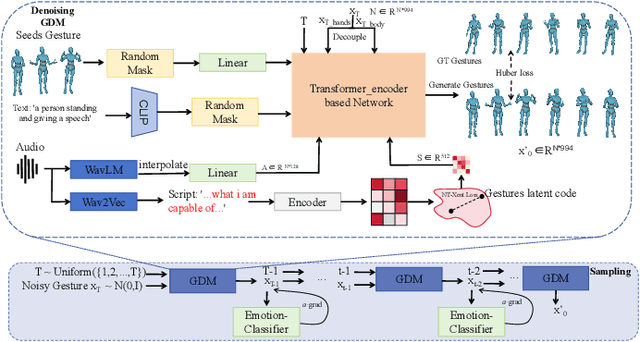

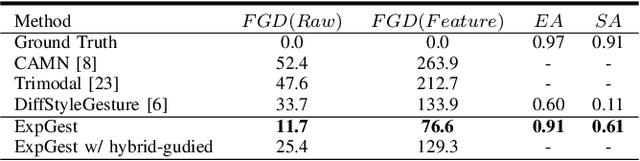
Existing gesture generation methods primarily focus on upper body gestures based on audio features, neglecting speech content, emotion, and locomotion. These limitations result in stiff, mechanical gestures that fail to convey the true meaning of audio content. We introduce ExpGest, a novel framework leveraging synchronized text and audio information to generate expressive full-body gestures. Unlike AdaIN or one-hot encoding methods, we design a noise emotion classifier for optimizing adversarial direction noise, avoiding melody distortion and guiding results towards specified emotions. Moreover, aligning semantic and gestures in the latent space provides better generalization capabilities. ExpGest, a diffusion model-based gesture generation framework, is the first attempt to offer mixed generation modes, including audio-driven gestures and text-shaped motion. Experiments show that our framework effectively learns from combined text-driven motion and audio-induced gesture datasets, and preliminary results demonstrate that ExpGest achieves more expressive, natural, and controllable global motion in speakers compared to state-of-the-art models.
ReinDiffuse: Crafting Physically Plausible Motions with Reinforced Diffusion Model
Oct 09, 2024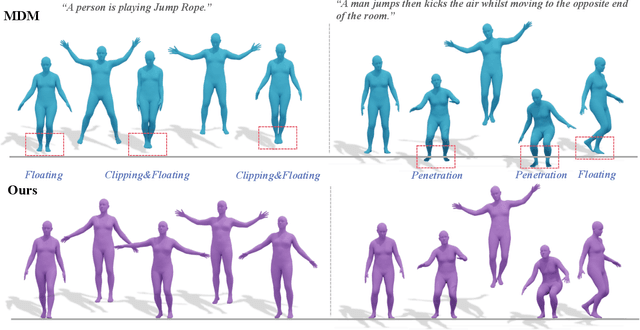
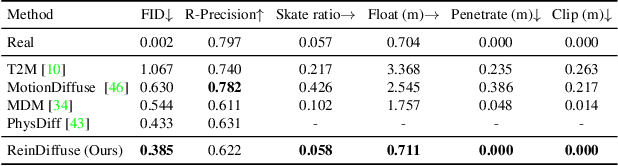
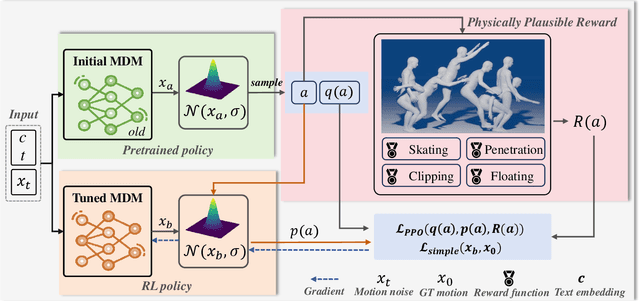
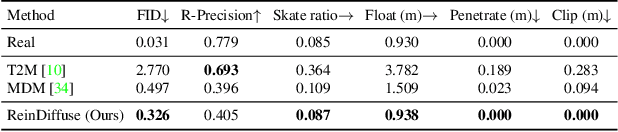
Generating human motion from textual descriptions is a challenging task. Existing methods either struggle with physical credibility or are limited by the complexities of physics simulations. In this paper, we present \emph{ReinDiffuse} that combines reinforcement learning with motion diffusion model to generate physically credible human motions that align with textual descriptions. Our method adapts Motion Diffusion Model to output a parameterized distribution of actions, making them compatible with reinforcement learning paradigms. We employ reinforcement learning with the objective of maximizing physically plausible rewards to optimize motion generation for physical fidelity. Our approach outperforms existing state-of-the-art models on two major datasets, HumanML3D and KIT-ML, achieving significant improvements in physical plausibility and motion quality. Project: \url{https://reindiffuse.github.io/}
Is the MMI Criterion Necessary for Interpretability? Degenerating Non-causal Features to Plain Noise for Self-Rationalization
Oct 08, 2024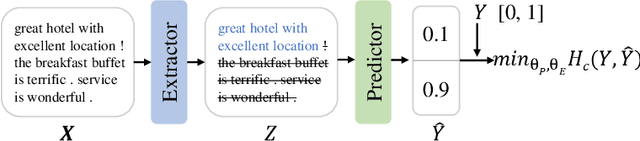
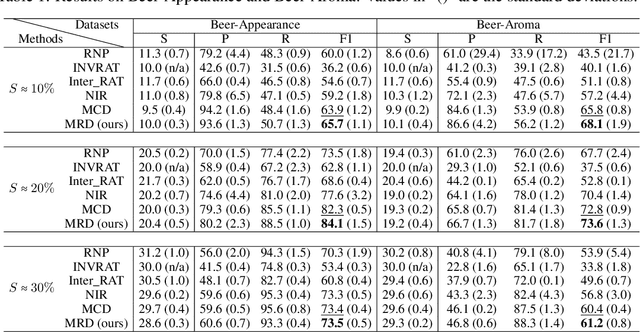
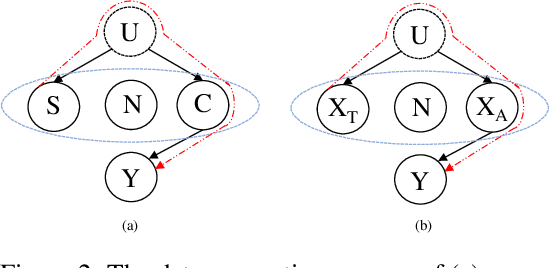
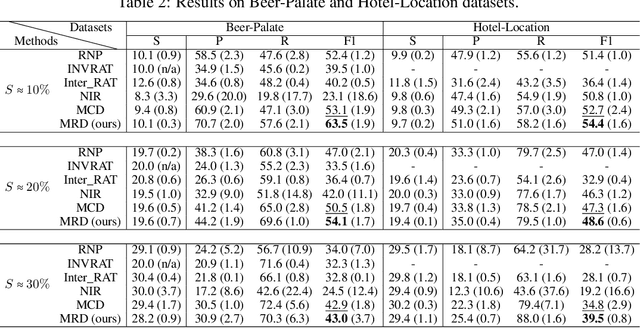
An important line of research in the field of explainability is to extract a small subset of crucial rationales from the full input. The most widely used criterion for rationale extraction is the maximum mutual information (MMI) criterion. However, in certain datasets, there are spurious features non-causally correlated with the label and also get high mutual information, complicating the loss landscape of MMI. Although some penalty-based methods have been developed to penalize the spurious features (e.g., invariance penalty, intervention penalty, etc) to help MMI work better, these are merely remedial measures. In the optimization objectives of these methods, spurious features are still distinguished from plain noise, which hinders the discovery of causal rationales. This paper aims to develop a new criterion that treats spurious features as plain noise, allowing the model to work on datasets rich in spurious features as if it were working on clean datasets, thereby making rationale extraction easier. We theoretically observe that removing either plain noise or spurious features from the input does not alter the conditional distribution of the remaining components relative to the task label. However, significant changes in the conditional distribution occur only when causal features are eliminated. Based on this discovery, the paper proposes a criterion for \textbf{M}aximizing the \textbf{R}emaining \textbf{D}iscrepancy (MRD). Experiments on six widely used datasets show that our MRD criterion improves rationale quality (measured by the overlap with human-annotated rationales) by up to $10.4\%$ as compared to several recent competitive MMI variants. Code: \url{https://github.com/jugechengzi/Rationalization-MRD}.
The Dawn of Video Generation: Preliminary Explorations with SORA-like Models
Oct 07, 2024High-quality video generation, encompassing text-to-video (T2V), image-to-video (I2V), and video-to-video (V2V) generation, holds considerable significance in content creation to benefit anyone express their inherent creativity in new ways and world simulation to modeling and understanding the world. Models like SORA have advanced generating videos with higher resolution, more natural motion, better vision-language alignment, and increased controllability, particularly for long video sequences. These improvements have been driven by the evolution of model architectures, shifting from UNet to more scalable and parameter-rich DiT models, along with large-scale data expansion and refined training strategies. However, despite the emergence of DiT-based closed-source and open-source models, a comprehensive investigation into their capabilities and limitations remains lacking. Furthermore, the rapid development has made it challenging for recent benchmarks to fully cover SORA-like models and recognize their significant advancements. Additionally, evaluation metrics often fail to align with human preferences.
Unlearnable 3D Point Clouds: Class-wise Transformation Is All You Need
Oct 04, 2024Traditional unlearnable strategies have been proposed to prevent unauthorized users from training on the 2D image data. With more 3D point cloud data containing sensitivity information, unauthorized usage of this new type data has also become a serious concern. To address this, we propose the first integral unlearnable framework for 3D point clouds including two processes: (i) we propose an unlearnable data protection scheme, involving a class-wise setting established by a category-adaptive allocation strategy and multi-transformations assigned to samples; (ii) we propose a data restoration scheme that utilizes class-wise inverse matrix transformation, thus enabling authorized-only training for unlearnable data. This restoration process is a practical issue overlooked in most existing unlearnable literature, \ie, even authorized users struggle to gain knowledge from 3D unlearnable data. Both theoretical and empirical results (including 6 datasets, 16 models, and 2 tasks) demonstrate the effectiveness of our proposed unlearnable framework. Our code is available at \url{https://github.com/CGCL-codes/UnlearnablePC}
Improving Fuzzy Rule Classifier with Brain Storm Optimization and Rule Modification
Oct 02, 2024The expanding complexity and dimensionality in the search space can adversely affect inductive learning in fuzzy rule classifiers, thus impacting the scalability and accuracy of fuzzy systems. This research specifically addresses the challenge of diabetic classification by employing the Brain Storm Optimization (BSO) algorithm to propose a novel fuzzy system that redefines rule generation for this context. An exponential model is integrated into the standard BSO algorithm to enhance rule derivation, tailored specifically for diabetes-related data. The innovative fuzzy system is then applied to classification tasks involving diabetic datasets, demonstrating a substantial improvement in classification accuracy, as evidenced by our experiments.
Evaluation of OpenAI o1: Opportunities and Challenges of AGI
Sep 27, 2024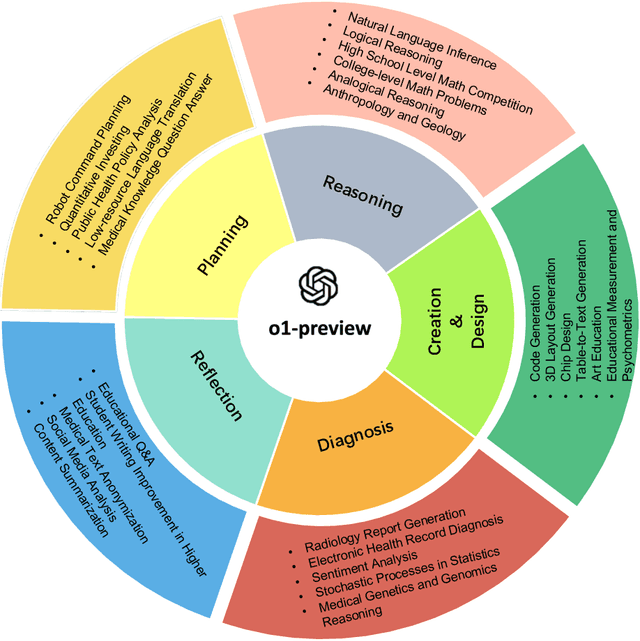
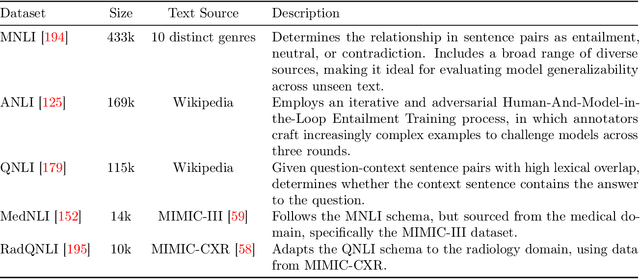


This comprehensive study evaluates the performance of OpenAI's o1-preview large language model across a diverse array of complex reasoning tasks, spanning multiple domains, including computer science, mathematics, natural sciences, medicine, linguistics, and social sciences. Through rigorous testing, o1-preview demonstrated remarkable capabilities, often achieving human-level or superior performance in areas ranging from coding challenges to scientific reasoning and from language processing to creative problem-solving. Key findings include: -83.3% success rate in solving complex competitive programming problems, surpassing many human experts. -Superior ability in generating coherent and accurate radiology reports, outperforming other evaluated models. -100% accuracy in high school-level mathematical reasoning tasks, providing detailed step-by-step solutions. -Advanced natural language inference capabilities across general and specialized domains like medicine. -Impressive performance in chip design tasks, outperforming specialized models in areas such as EDA script generation and bug analysis. -Remarkable proficiency in anthropology and geology, demonstrating deep understanding and reasoning in these specialized fields. -Strong capabilities in quantitative investing. O1 has comprehensive financial knowledge and statistical modeling skills. -Effective performance in social media analysis, including sentiment analysis and emotion recognition. The model excelled particularly in tasks requiring intricate reasoning and knowledge integration across various fields. While some limitations were observed, including occasional errors on simpler problems and challenges with certain highly specialized concepts, the overall results indicate significant progress towards artificial general intelligence.
Retrospective Comparative Analysis of Prostate Cancer In-Basket Messages: Responses from Closed-Domain LLM vs. Clinical Teams
Sep 26, 2024In-basket message interactions play a crucial role in physician-patient communication, occurring during all phases (pre-, during, and post) of a patient's care journey. However, responding to these patients' inquiries has become a significant burden on healthcare workflows, consuming considerable time for clinical care teams. To address this, we introduce RadOnc-GPT, a specialized Large Language Model (LLM) powered by GPT-4 that has been designed with a focus on radiotherapeutic treatment of prostate cancer with advanced prompt engineering, and specifically designed to assist in generating responses. We integrated RadOnc-GPT with patient electronic health records (EHR) from both the hospital-wide EHR database and an internal, radiation-oncology-specific database. RadOnc-GPT was evaluated on 158 previously recorded in-basket message interactions. Quantitative natural language processing (NLP) analysis and two grading studies with clinicians and nurses were used to assess RadOnc-GPT's responses. Our findings indicate that RadOnc-GPT slightly outperformed the clinical care team in "Clarity" and "Empathy," while achieving comparable scores in "Completeness" and "Correctness." RadOnc-GPT is estimated to save 5.2 minutes per message for nurses and 2.4 minutes for clinicians, from reading the inquiry to sending the response. Employing RadOnc-GPT for in-basket message draft generation has the potential to alleviate the workload of clinical care teams and reduce healthcare costs by producing high-quality, timely responses.