 Add to Chrome
 Add to Firefox
 Add to Edge
Exposing Functional Fusion: A New Class of Strategic Backdoor in Dynamic Prompt Architectures
May 19, 2026
Existing ViT backdoor attacks based on backbone-overwriting full-tuning are computationally expensive and inflict performance degradation. This has forced adversaries towards the Visual Parameter-Efficient Fine-Tuning (PEFT) paradigm, dominated by adapter-based (e.g., LoRA) and prompt-based (e.g., VPT) approaches. While adapter security has seen initial study, the risks of the burgeoning prompt-based ecosystem remain critically unexplored. We fill this critical gap, exposing how the evolution of VPT towards dynamic and context-aware architectures can facilitate a far more dangerous and emergent threat. This vulnerability arises even though these dynamic modules unlock superior benign performance. We propose VIPER, an attack framework built on a lightweight, dynamic Visual Prompt Generator (VPG) that demonstrates this vulnerability. Critically, this dynamic architecture enables Functional Fusion: an emergent phenomenon where malicious logic and benign task utility are tightly fused into the same sparse, high-magnitude parameter core. This fusion creates a formidable ``hostage" dilemma, as pruning the attack necessarily destroys the benign performance. Comprehensive evaluations show VIPER effectively addresses the attacker's trilemma: VIPER not only achieves state-of-the-art performance on clean data, but also maintains near-100% ASR even under 90% VPG-module pruning (where LoRA attacks collapse), while adding only an imperceptible 0.06ms (1.16%) of inference latency. VIPER's results, driven by Functional Fusion, expose a new, paradigm-level risk in dynamic prompt architectures.

Rel-Zero: Harnessing Patch-Pair Invariance for Robust Zero-Watermarking Against AI Editing
Mar 18, 2026Recent advancements in diffusion-based image editing pose a significant threat to the authenticity of digital visual content. Traditional embedding-based watermarking methods often introduce perceptible perturbations to maintain robustness, inevitably compromising visual fidelity. Meanwhile, existing zero-watermarking approaches, typically relying on global image features, struggle to withstand sophisticated manipulations. In this work, we uncover a key observation: while individual image patches undergo substantial alterations during AI-based editing, the relational distance between patch pairs remains relatively invariant. Leveraging this property, we propose Relational Zero-Watermarking (Rel-Zero), a novel framework that requires no modification to the original image but derives a unique zero-watermark from these editing-invariant patch relations. By grounding the watermark in intrinsic structural consistency rather than absolute appearance, Rel-Zero provides a non-invasive yet resilient mechanism for content authentication. Extensive experiments demonstrate that Rel-Zero achieves substantially improved robustness across diverse editing models and manipulations compared to prior zero-watermarking approaches.
MLRecon: Robust Markerless Freehand 3D Ultrasound Reconstruction via Coarse-to-Fine Pose Estimation
Mar 01, 2026Freehand 3D ultrasound (US) reconstruction promises volumetric imaging with the flexibility of standard 2D probes, yet existing tracking paradigms face a restrictive trilemma: marker-based systems demand prohibitive costs, inside-out methods require intrusive sensor attachment, and sensorless approaches suffer from severe cumulative drift. To overcome these limitations, we present MLRecon, a robust markerless 3D US reconstruction framework delivering drift-resilient 6D probe pose tracking using a single commodity RGB-D camera. Leveraging the generalization power of vision foundation models, our pipeline enables continuous markerless tracking of the probe, augmented by a vision-guided divergence detector that autonomously monitors tracking integrity and triggers failure recovery to ensure uninterrupted scanning. Crucially, we further propose a dual-stage pose refinement network that explicitly disentangles high-frequency jitter from low-frequency bias, effectively denoising the trajectory while maintaining the kinematic fidelity of operator maneuvers. Experiments demonstrate that MLRecon significantly outperforms competing sensorless and sensor-aided methods, achieving average position errors as low as 0.88 mm on complex trajectories and yielding high-quality 3D reconstructions with sub-millimeter mean surface accuracy. This establishes a new benchmark for low-cost, accessible volumetric US imaging in resource-limited clinical settings.
LiNeXt: Revisiting LiDAR Completion with Efficient Non-Diffusion Architectures
Nov 13, 20253D LiDAR scene completion from point clouds is a fundamental component of perception systems in autonomous vehicles. Previous methods have predominantly employed diffusion models for high-fidelity reconstruction. However, their multi-step iterative sampling incurs significant computational overhead, limiting its real-time applicability. To address this, we propose LiNeXt-a lightweight, non-diffusion network optimized for rapid and accurate point cloud completion. Specifically, LiNeXt first applies the Noise-to-Coarse (N2C) Module to denoise the input noisy point cloud in a single pass, thereby obviating the multi-step iterative sampling of diffusion-based methods. The Refine Module then takes the coarse point cloud and its intermediate features from the N2C Module to perform more precise refinement, further enhancing structural completeness. Furthermore, we observe that LiDAR point clouds exhibit a distance-dependent spatial distribution, being densely sampled at proximal ranges and sparsely sampled at distal ranges. Accordingly, we propose the Distance-aware Selected Repeat strategy to generate a more uniformly distributed noisy point cloud. On the SemanticKITTI dataset, LiNeXt achieves a 199.8x speedup in inference, reduces Chamfer Distance by 50.7%, and uses only 6.1% of the parameters compared with LiDiff. These results demonstrate the superior efficiency and effectiveness of LiNeXt for real-time scene completion.
RWKV-PCSSC: Exploring RWKV Model for Point Cloud Semantic Scene Completion
Nov 13, 2025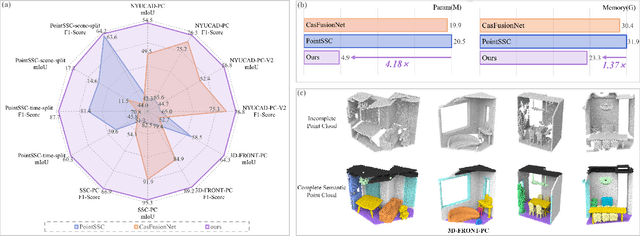

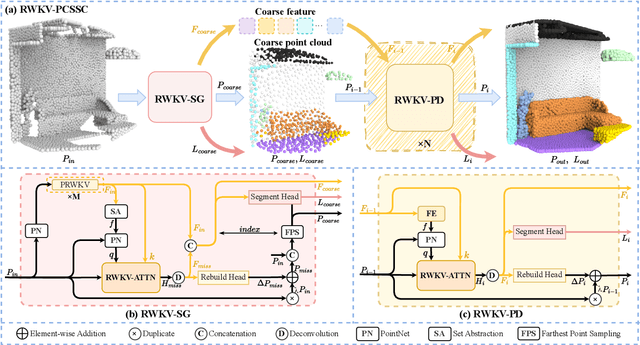
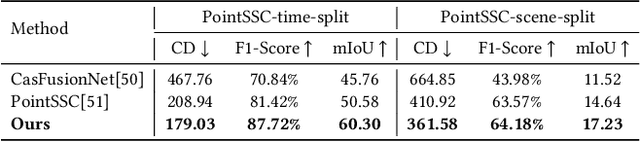
Semantic Scene Completion (SSC) aims to generate a complete semantic scene from an incomplete input. Existing approaches often employ dense network architectures with a high parameter count, leading to increased model complexity and resource demands. To address these limitations, we propose RWKV-PCSSC, a lightweight point cloud semantic scene completion network inspired by the Receptance Weighted Key Value (RWKV) mechanism. Specifically, we introduce a RWKV Seed Generator (RWKV-SG) module that can aggregate features from a partial point cloud to produce a coarse point cloud with coarse features. Subsequently, the point-wise feature of the point cloud is progressively restored through multiple stages of the RWKV Point Deconvolution (RWKV-PD) modules. By leveraging a compact and efficient design, our method achieves a lightweight model representation. Experimental results demonstrate that RWKV-PCSSC reduces the parameter count by 4.18$\times$ and improves memory efficiency by 1.37$\times$ compared to state-of-the-art methods PointSSC. Furthermore, our network achieves state-of-the-art performance on established indoor (SSC-PC, NYUCAD-PC) and outdoor (PointSSC) scene dataset, as well as on our proposed datasets (NYUCAD-PC-V2, 3D-FRONT-PC).
* 13 pages, 8 figures, published to ACM MM
DeepTracer: Tracing Stolen Model via Deep Coupled Watermarks
Nov 12, 2025Model watermarking techniques can embed watermark information into the protected model for ownership declaration by constructing specific input-output pairs. However, existing watermarks are easily removed when facing model stealing attacks, and make it difficult for model owners to effectively verify the copyright of stolen models. In this paper, we analyze the root cause of the failure of current watermarking methods under model stealing scenarios and then explore potential solutions. Specifically, we introduce a robust watermarking framework, DeepTracer, which leverages a novel watermark samples construction method and a same-class coupling loss constraint. DeepTracer can incur a high-coupling model between watermark task and primary task that makes adversaries inevitably learn the hidden watermark task when stealing the primary task functionality. Furthermore, we propose an effective watermark samples filtering mechanism that elaborately select watermark key samples used in model ownership verification to enhance the reliability of watermarks. Extensive experiments across multiple datasets and models demonstrate that our method surpasses existing approaches in defending against various model stealing attacks, as well as watermark attacks, and achieves new state-of-the-art effectiveness and robustness.
Value-Aligned Prompt Moderation via Zero-Shot Agentic Rewriting for Safe Image Generation
Nov 12, 2025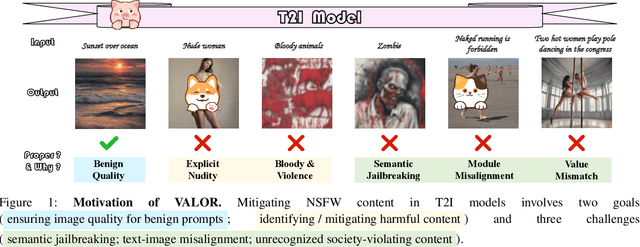
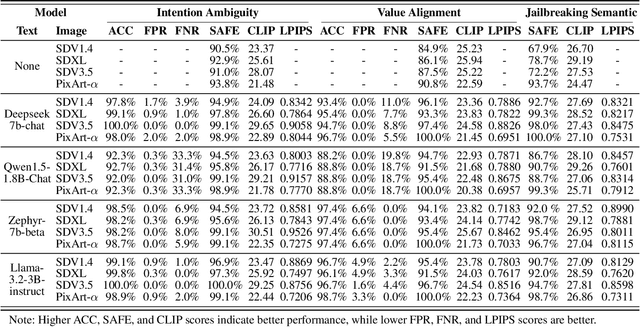
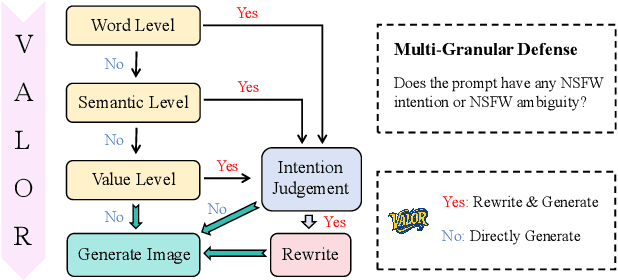
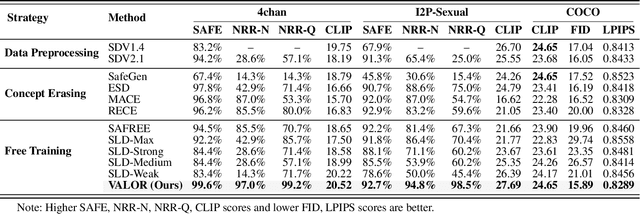
Generative vision-language models like Stable Diffusion demonstrate remarkable capabilities in creative media synthesis, but they also pose substantial risks of producing unsafe, offensive, or culturally inappropriate content when prompted adversarially. Current defenses struggle to align outputs with human values without sacrificing generation quality or incurring high costs. To address these challenges, we introduce VALOR (Value-Aligned LLM-Overseen Rewriter), a modular, zero-shot agentic framework for safer and more helpful text-to-image generation. VALOR integrates layered prompt analysis with human-aligned value reasoning: a multi-level NSFW detector filters lexical and semantic risks; a cultural value alignment module identifies violations of social norms, legality, and representational ethics; and an intention disambiguator detects subtle or indirect unsafe implications. When unsafe content is detected, prompts are selectively rewritten by a large language model under dynamic, role-specific instructions designed to preserve user intent while enforcing alignment. If the generated image still fails a safety check, VALOR optionally performs a stylistic regeneration to steer the output toward a safer visual domain without altering core semantics. Experiments across adversarial, ambiguous, and value-sensitive prompts show that VALOR significantly reduces unsafe outputs by up to 100.00% while preserving prompt usefulness and creativity. These results highlight VALOR as a scalable and effective approach for deploying safe, aligned, and helpful image generation systems in open-world settings.
A Support-Set Algorithm for Optimization Problems with Nonnegative and Orthogonal Constraints
Nov 05, 2025In this paper, we investigate optimization problems with nonnegative and orthogonal constraints, where any feasible matrix of size $n \times p$ exhibits a sparsity pattern such that each row accommodates at most one nonzero entry. Our analysis demonstrates that, by fixing the support set, the global solution of the minimization subproblem for the proximal linearization of the objective function can be computed in closed form with at most $n$ nonzero entries. Exploiting this structural property offers a powerful avenue for dramatically enhancing computational efficiency. Guided by this insight, we propose a support-set algorithm preserving strictly the feasibility of iterates. A central ingredient is a strategically devised update scheme for support sets that adjusts the placement of nonzero entries. We establish the global convergence of the support-set algorithm to a first-order stationary point, and show that its iteration complexity required to reach an $\epsilon$-approximate first-order stationary point is $O (\epsilon^{-2})$. Numerical results are strongly in favor of our algorithm in real-world applications, including nonnegative PCA, clustering, and community detection.
AILoRA: Function-Aware Asymmetric Initialization for Low-Rank Adaptation of Large Language Models
Oct 09, 2025Parameter-efficient finetuning (PEFT) aims to mitigate the substantial computational and memory overhead involved in adapting large-scale pretrained models to diverse downstream tasks. Among numerous PEFT strategies, Low-Rank Adaptation (LoRA) has emerged as one of the most widely adopted approaches due to its robust empirical performance and low implementation complexity. In practical deployment, LoRA is typically applied to the $W^Q$ and $W^V$ projection matrices of self-attention modules, enabling an effective trade-off between model performance and parameter efficiency. While LoRA has achieved considerable empirical success, it still encounters challenges such as suboptimal performance and slow convergence. To address these limitations, we introduce \textbf{AILoRA}, a novel parameter-efficient method that incorporates function-aware asymmetric low-rank priors. Our empirical analysis reveals that the projection matrices $W^Q$ and $W^V$ in the self-attention mechanism exhibit distinct parameter characteristics, stemming from their functional differences. Specifically, $W^Q$ captures task-specific semantic space knowledge essential for attention distributions computation, making its parameters highly sensitive to downstream task variations. In contrast, $W^V$ encodes token-level feature representations that tend to remain stable across tasks and layers. Leveraging these insights, AILoRA performs a function-aware initialization by injecting the principal components of $W^Q$ to retain task-adaptive capacity, and the minor components of $W^V$ to preserve generalizable feature representations. This asymmetric initialization strategy enables LoRA modules to better capture the specialized roles of attention parameters, thereby enhancing both finetuning performance and convergence efficiency.
Comet: Accelerating Private Inference for Large Language Model by Predicting Activation Sparsity
May 12, 2025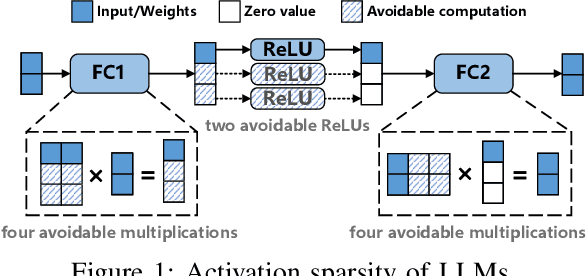
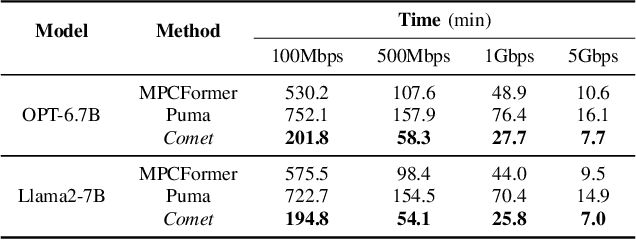
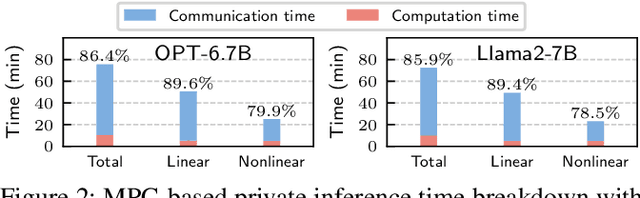
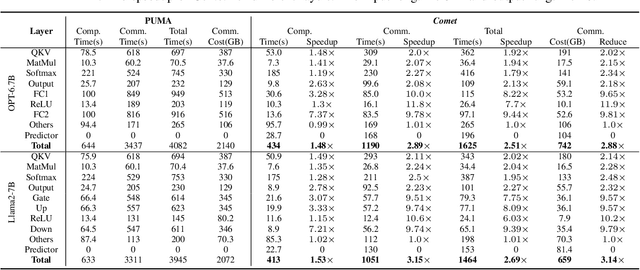
With the growing use of large language models (LLMs) hosted on cloud platforms to offer inference services, privacy concerns about the potential leakage of sensitive information are escalating. Secure multi-party computation (MPC) is a promising solution to protect the privacy in LLM inference. However, MPC requires frequent inter-server communication, causing high performance overhead. Inspired by the prevalent activation sparsity of LLMs, where most neuron are not activated after non-linear activation functions, we propose an efficient private inference system, Comet. This system employs an accurate and fast predictor to predict the sparsity distribution of activation function output. Additionally, we introduce a new private inference protocol. It efficiently and securely avoids computations involving zero values by exploiting the spatial locality of the predicted sparse distribution. While this computation-avoidance approach impacts the spatiotemporal continuity of KV cache entries, we address this challenge with a low-communication overhead cache refilling strategy that merges miss requests and incorporates a prefetching mechanism. Finally, we evaluate Comet on four common LLMs and compare it with six state-of-the-art private inference systems. Comet achieves a 1.87x-2.63x speedup and a 1.94x-2.64x communication reduction.