 Add to Chrome
 Add to Firefox
 Add to Edge
Multi-Aggregator Time-Warping Heterogeneous Graph Neural Network for Personalized Micro-Video Recommendation
Jan 05, 2025


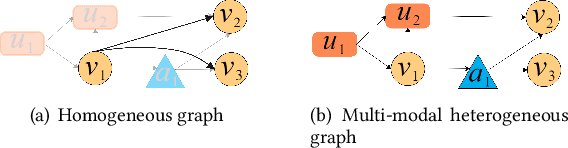
Micro-video recommendation is attracting global attention and becoming a popular daily service for people of all ages. Recently, Graph Neural Networks-based micro-video recommendation has displayed performance improvement for many kinds of recommendation tasks. However, the existing works fail to fully consider the characteristics of micro-videos, such as the high timeliness of news nature micro-video recommendation and sequential interactions of frequently changed interests. In this paper, a novel Multi-aggregator Time-warping Heterogeneous Graph Neural Network (MTHGNN) is proposed for personalized news nature micro-video recommendation based on sequential sessions, where characteristics of micro-videos are comprehensively studied, users' preference is mined via multi-aggregator, the temporal and dynamic changes of users' preference are captured, and timeliness is considered. Through the comparison with the state-of-the-arts, the experimental results validate the superiority of our MTHGNN model.

ZeroFlow: Overcoming Catastrophic Forgetting is Easier than You Think
Jan 03, 2025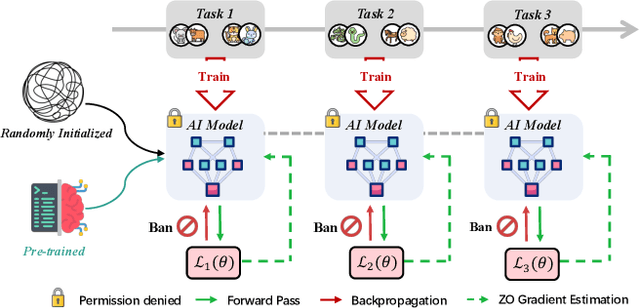


Backpropagation provides a generalized configuration for overcoming catastrophic forgetting. Like, SGD and Adam are commonly used for weight updates in continual learning and continual pre-training. In practice, permission to access gradient information is not always granted (the gradient ban), such as black-box APIs, hardware limitations, and non-differentiable systems. To bridge this gap, we introduce the first benchmark ZeroFlow to evaluate gradient-free optimization algorithms for overcoming forgetting. This benchmark examines a suite of forward pass methods across multiple methods, forgetting scenarios, and datasets. We find that forward passes alone are enough to overcome forgetting. Our findings reveal new optimization principles that highlight the potential of forward-pass in mitigating forgetting, managing task conflicts, and reducing memory demands, alongside novel enhancements that further mitigate forgetting with just one forward pass. This work provides essential insights and tools for advancing forward pass methods to overcome forgetting.
Exploring Structured Semantic Priors Underlying Diffusion Score for Test-time Adaptation
Jan 01, 2025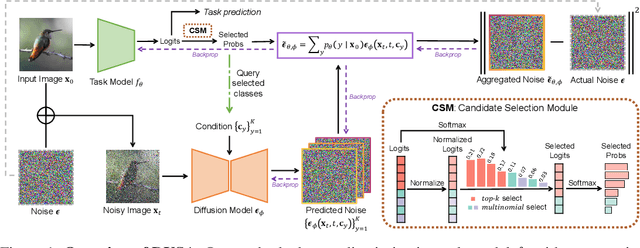
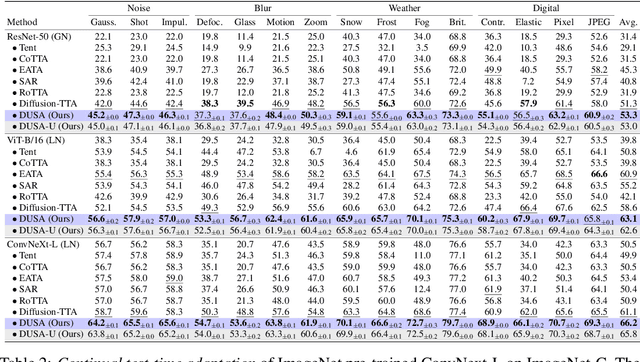

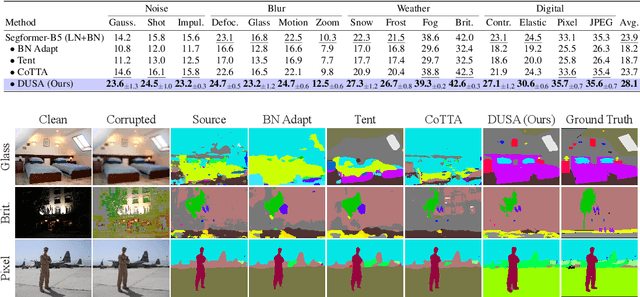
Capitalizing on the complementary advantages of generative and discriminative models has always been a compelling vision in machine learning, backed by a growing body of research. This work discloses the hidden semantic structure within score-based generative models, unveiling their potential as effective discriminative priors. Inspired by our theoretical findings, we propose DUSA to exploit the structured semantic priors underlying diffusion score to facilitate the test-time adaptation of image classifiers or dense predictors. Notably, DUSA extracts knowledge from a single timestep of denoising diffusion, lifting the curse of Monte Carlo-based likelihood estimation over timesteps. We demonstrate the efficacy of our DUSA in adapting a wide variety of competitive pre-trained discriminative models on diverse test-time scenarios. Additionally, a thorough ablation study is conducted to dissect the pivotal elements in DUSA. Code is publicly available at https://github.com/BIT-DA/DUSA.
Ultra-Low Complexity On-Orbit Compression for Remote Sensing Imagery via Block Modulated Imaging
Dec 24, 2024The growing field of remote sensing faces a challenge: the ever-increasing size and volume of imagery data are exceeding the storage and transmission capabilities of satellite platforms. Efficient compression of remote sensing imagery is a critical solution to alleviate these burdens on satellites. However, existing compression methods are often too computationally expensive for satellites. With the continued advancement of compressed sensing theory, single-pixel imaging emerges as a powerful tool that brings new possibilities for on-orbit image compression. However, it still suffers from prolonged imaging times and the inability to perform high-resolution imaging, hindering its practical application. This paper advances the study of compressed sensing in remote sensing image compression, proposing Block Modulated Imaging (BMI). By requiring only a single exposure, BMI significantly enhances imaging acquisition speeds. Additionally, BMI obviates the need for digital micromirror devices and surpasses limitations in image resolution. Furthermore, we propose a novel decoding network specifically designed to reconstruct images compressed under the BMI framework. Leveraging the gated 3D convolutions and promoting efficient information flow across stages through a Two-Way Cross-Attention module, our decoding network exhibits demonstrably superior reconstruction performance. Extensive experiments conducted on multiple renowned remote sensing datasets unequivocally demonstrate the efficacy of our proposed method. To further validate its practical applicability, we developed and tested a prototype of the BMI-based camera, which has shown promising potential for on-orbit image compression. The code is available at https://github.com/Johnathan218/BMNet.
AdaCo: Overcoming Visual Foundation Model Noise in 3D Semantic Segmentation via Adaptive Label Correction
Dec 24, 2024
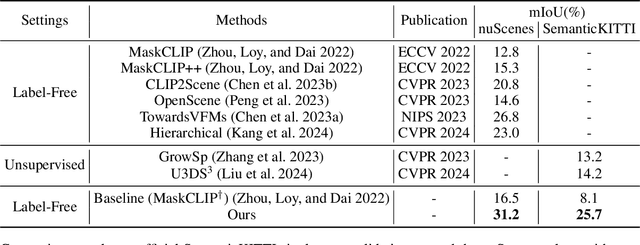

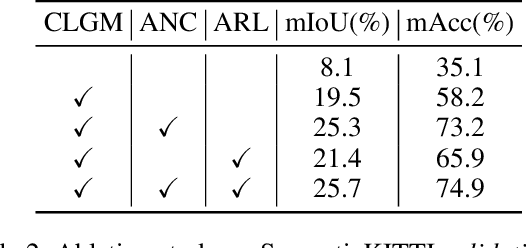
Recently, Visual Foundation Models (VFMs) have shown a remarkable generalization performance in 3D perception tasks. However, their effectiveness in large-scale outdoor datasets remains constrained by the scarcity of accurate supervision signals, the extensive noise caused by variable outdoor conditions, and the abundance of unknown objects. In this work, we propose a novel label-free learning method, Adaptive Label Correction (AdaCo), for 3D semantic segmentation. AdaCo first introduces the Cross-modal Label Generation Module (CLGM), providing cross-modal supervision with the formidable interpretive capabilities of the VFMs. Subsequently, AdaCo incorporates the Adaptive Noise Corrector (ANC), updating and adjusting the noisy samples within this supervision iteratively during training. Moreover, we develop an Adaptive Robust Loss (ARL) function to modulate each sample's sensitivity to noisy supervision, preventing potential underfitting issues associated with robust loss. Our proposed AdaCo can effectively mitigate the performance limitations of label-free learning networks in 3D semantic segmentation tasks. Extensive experiments on two outdoor benchmark datasets highlight the superior performance of our method.
Generating Unseen Nonlinear Evolution in Sea Surface Temperature Using a Deep Learning-Based Latent Space Data Assimilation Framework
Dec 18, 2024

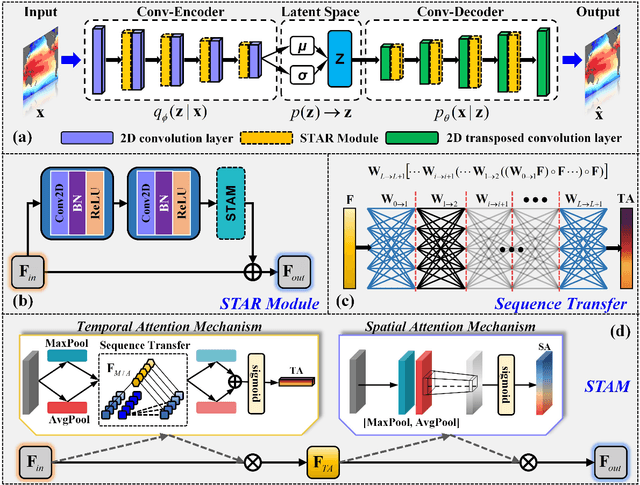

Advances in data assimilation (DA) methods have greatly improved the accuracy of Earth system predictions. To fuse multi-source data and reconstruct the nonlinear evolution missing from observations, geoscientists are developing future-oriented DA methods. In this paper, we redesign a purely data-driven latent space DA framework (DeepDA) that employs a generative artificial intelligence model to capture the nonlinear evolution in sea surface temperature. Under variational constraints, DeepDA embedded with nonlinear features can effectively fuse heterogeneous data. The results show that DeepDA remains highly stable in capturing and generating nonlinear evolutions even when a large amount of observational information is missing. It can be found that when only 10% of the observation information is available, the error increase of DeepDA does not exceed 40%. Furthermore, DeepDA has been shown to be robust in the fusion of real observations and ensemble simulations. In particular, this paper provides a mechanism analysis of the nonlinear evolution generated by DeepDA from the perspective of physical patterns, which reveals the inherent explainability of our DL model in capturing multi-scale ocean signals.
NPC: Neural Predictive Control for Fuel-Efficient Autonomous Trucks
Dec 18, 2024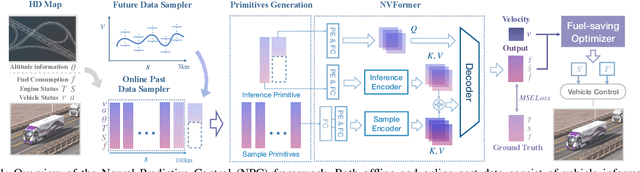
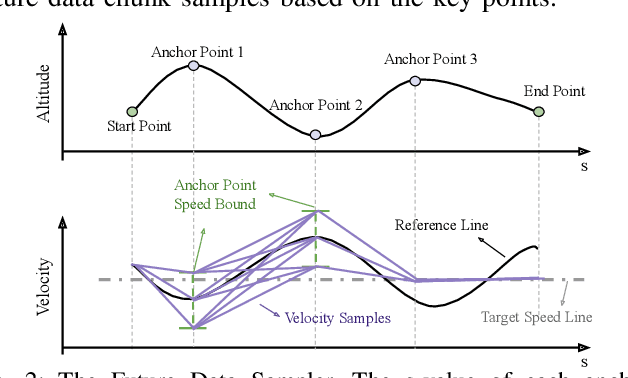
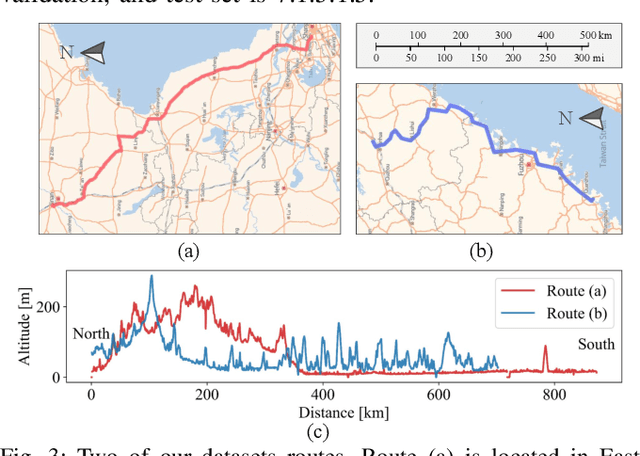
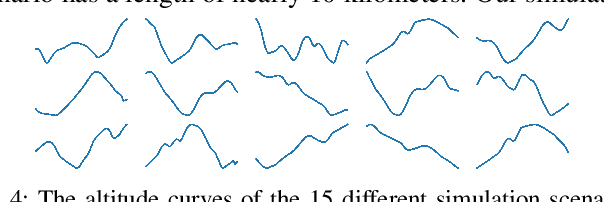
Fuel efficiency is a crucial aspect of long-distance cargo transportation by oil-powered trucks that economize on costs and decrease carbon emissions. Current predictive control methods depend on an accurate model of vehicle dynamics and engine, including weight, drag coefficient, and the Brake-specific Fuel Consumption (BSFC) map of the engine. We propose a pure data-driven method, Neural Predictive Control (NPC), which does not use any physical model for the vehicle. After training with over 20,000 km of historical data, the novel proposed NVFormer implicitly models the relationship between vehicle dynamics, road slope, fuel consumption, and control commands using the attention mechanism. Based on the online sampled primitives from the past of the current freight trip and anchor-based future data synthesis, the NVFormer can infer optimal control command for reasonable fuel consumption. The physical model-free NPC outperforms the base PCC method with 2.41% and 3.45% more significant fuel saving in simulation and open-road highway testing, respectively.
* 7 pages, 6 figures, for associated mpeg file, see https://www.youtube.com/watch?v=hqgpj7LhiL4
GoHD: Gaze-oriented and Highly Disentangled Portrait Animation with Rhythmic Poses and Realistic Expression
Dec 13, 2024
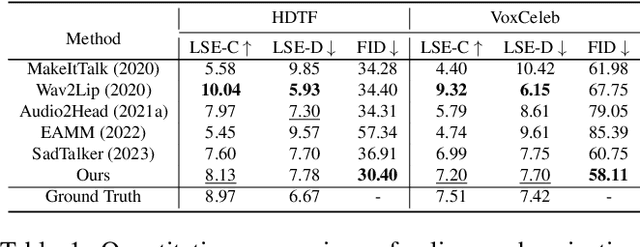
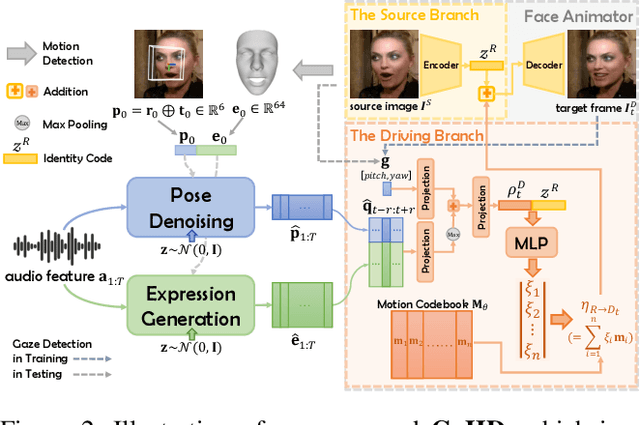
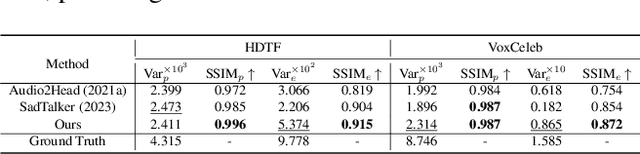
Audio-driven talking head generation necessitates seamless integration of audio and visual data amidst the challenges posed by diverse input portraits and intricate correlations between audio and facial motions. In response, we propose a robust framework GoHD designed to produce highly realistic, expressive, and controllable portrait videos from any reference identity with any motion. GoHD innovates with three key modules: Firstly, an animation module utilizing latent navigation is introduced to improve the generalization ability across unseen input styles. This module achieves high disentanglement of motion and identity, and it also incorporates gaze orientation to rectify unnatural eye movements that were previously overlooked. Secondly, a conformer-structured conditional diffusion model is designed to guarantee head poses that are aware of prosody. Thirdly, to estimate lip-synchronized and realistic expressions from the input audio within limited training data, a two-stage training strategy is devised to decouple frequent and frame-wise lip motion distillation from the generation of other more temporally dependent but less audio-related motions, e.g., blinks and frowns. Extensive experiments validate GoHD's advanced generalization capabilities, demonstrating its effectiveness in generating realistic talking face results on arbitrary subjects.
Dynamic Contrastive Knowledge Distillation for Efficient Image Restoration
Dec 12, 2024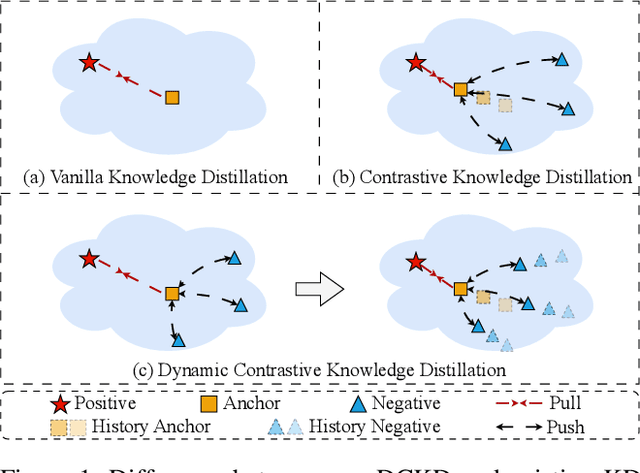
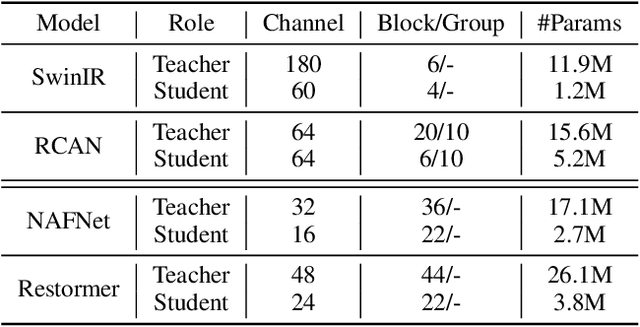
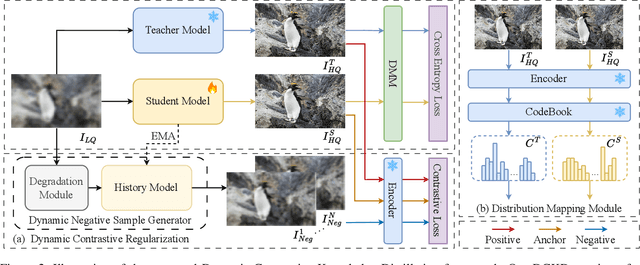
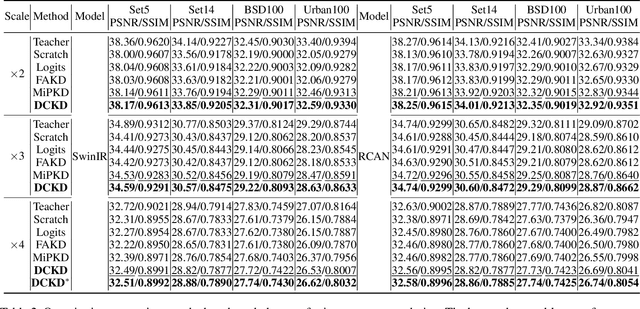
Knowledge distillation (KD) is a valuable yet challenging approach that enhances a compact student network by learning from a high-performance but cumbersome teacher model. However, previous KD methods for image restoration overlook the state of the student during the distillation, adopting a fixed solution space that limits the capability of KD. Additionally, relying solely on L1-type loss struggles to leverage the distribution information of images. In this work, we propose a novel dynamic contrastive knowledge distillation (DCKD) framework for image restoration. Specifically, we introduce dynamic contrastive regularization to perceive the student's learning state and dynamically adjust the distilled solution space using contrastive learning. Additionally, we also propose a distribution mapping module to extract and align the pixel-level category distribution of the teacher and student models. Note that the proposed DCKD is a structure-agnostic distillation framework, which can adapt to different backbones and can be combined with methods that optimize upper-bound constraints to further enhance model performance. Extensive experiments demonstrate that DCKD significantly outperforms the state-of-the-art KD methods across various image restoration tasks and backbones.
InternLM-XComposer2.5-OmniLive: A Comprehensive Multimodal System for Long-term Streaming Video and Audio Interactions
Dec 12, 2024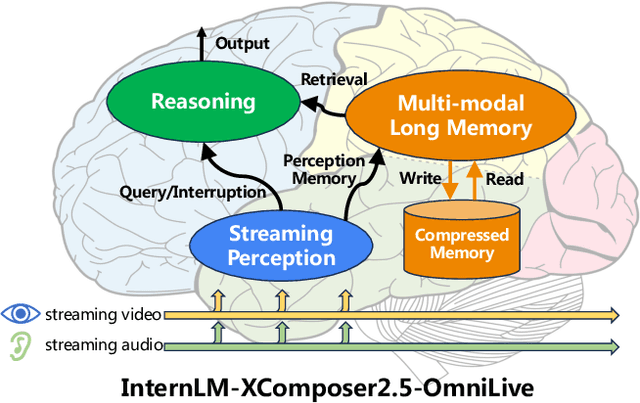


Creating AI systems that can interact with environments over long periods, similar to human cognition, has been a longstanding research goal. Recent advancements in multimodal large language models (MLLMs) have made significant strides in open-world understanding. However, the challenge of continuous and simultaneous streaming perception, memory, and reasoning remains largely unexplored. Current MLLMs are constrained by their sequence-to-sequence architecture, which limits their ability to process inputs and generate responses simultaneously, akin to being unable to think while perceiving. Furthermore, relying on long contexts to store historical data is impractical for long-term interactions, as retaining all information becomes costly and inefficient. Therefore, rather than relying on a single foundation model to perform all functions, this project draws inspiration from the concept of the Specialized Generalist AI and introduces disentangled streaming perception, reasoning, and memory mechanisms, enabling real-time interaction with streaming video and audio input. The proposed framework InternLM-XComposer2.5-OmniLive (IXC2.5-OL) consists of three key modules: (1) Streaming Perception Module: Processes multimodal information in real-time, storing key details in memory and triggering reasoning in response to user queries. (2) Multi-modal Long Memory Module: Integrates short-term and long-term memory, compressing short-term memories into long-term ones for efficient retrieval and improved accuracy. (3) Reasoning Module: Responds to queries and executes reasoning tasks, coordinating with the perception and memory modules. This project simulates human-like cognition, enabling multimodal large language models to provide continuous and adaptive service over time.