 Add to Chrome
 Add to Firefox
 Add to Edge
Hierarchical Federated Transfer Learning in Digital Twin-Based Vehicular Networks
Aug 12, 2026
In recent research on the Digital Twin-based Vehicular Ad hoc Network(DT-VANET), Federated Learning (FL) has shown its ability to provide data privacy. However, Federated learning struggles to adequately train a global model when confronted with data heterogeneity and data sparsity among vehicles, which ensure suboptimal accuracy in making precise predictions for different vehicle types. To address these challenges, this paper combines Federated Transfer Learning (FTL) to conduct vehicle clustering related to types of vehicles and proposes a novel Hierarchical Federated Transfer Learning (HFTL). We construct a framework for DT-VANET, along with two algorithms designed for cloud server model updates and intra-cluster federated transfer learning, to improve the accuracy of the global model. In addition, we developed a data quality score-based mechanism to prevent the global model from being affected by malicious vehicles. Lastly, detailed experiments on real-world datasets are conducted, considering different performance metrics that verify the effectiveness and efficiency of our algorithm.

Seeing What Matters: Lesion-Aware High-Resolution Patch Discovery and Fusion for Chest X-ray Report Generation
Jul 08, 2026Despite rapid advances in chest X-ray (CXR) foundation models, most radiology report generation (RRG) systems still rely on heavily downsampled inputs (e.g., 256x256) due to the fixed visual token budgets of pretrained vision encoders, suppressing subtle yet clinically important cues present in native-resolution images. However, enabling high-resolution (high-res) perception remains challenging: naive tiling causes prohibitive token inflation, while global compression suppresses subtle lesions and degrades diagnostic fidelity. Inspired by radiologists' workflow, localizing suspicious regions before detailed high-res assessment. We propose Lesion-Aware High-Resolution Patch Discovery and Fusion for Chest X-ray Reporting (LePaX), the first RRG framework that enables efficient high-res CXR perception (up to 1920x1920) without increasing the vision-token count. LePaX formulates high-res perception as a constrained spatial resolution allocation problem under a fixed token budget and introduces two key components: Learnable Spatial Resolution Allocation (LSRA), which learns a spatial utility map that adaptively allocates limited high-res capacity to diagnostically relevant regions, enabling targeted extraction of high-res patches from native CXRs; and Global-Regional Fusion (GRF), which performs token-preserving region-to-global refinement by projecting high-resolution regional evidence back onto the global feature grid through spatially aligned resolution write-back, avoiding token inflation. Experiments on multiple CXR benchmarks demonstrate that LePaX consistently improves both clinical and linguistic metrics while enabling native-resolution CXR perception with over 10x fewer visual tokens than naive high-res tiling.
CCS: Clinical Consensus Selection for Radiology Report Generation
May 28, 2026Radiology report generation (RRG) is commonly formulated as a single-path generation task, where a multimodal large language model (MLLM) produces one decoded report as the final output. While recent progress has largely been driven by scaling training data, model capacity, and retrieval mechanisms, improving report quality at inference time remains underexplored. In this work, we observe that fixed radiology MLLMs often generate clinically stronger reports elsewhere in their candidate pool than the one selected by default decoding, suggesting that inference-time decision making remains an overlooked bottleneck. To address this, we propose Clinical Consensus Selection (CCS), a decoder-agnostic inference-time selection framework that samples multiple candidate reports and selects the one with the highest clinical consensus across the rollout pool. CCS unifies text-based utilities with a radiology-adapted utility computed by an image--report-trained multimodal embedder, which measures candidate agreement beyond surface-level textual similarity. Across three datasets and multiple radiology MLLMs, CCS consistently improves inference-time performance over single-path decoding and generic Best-of-N baselines, with particularly clear gains on clinical metrics. Further analysis shows that image-grounded utility forms a selection axis distinct from textual consensus and that substantial headroom remains for improving RRG at inference time.
A Review of Longitudinal Radiology Report Generation: Dataset Composition, Methods, and Performance Evaluation
Oct 14, 2025Chest Xray imaging is a widely used diagnostic tool in modern medicine, and its high utilization creates substantial workloads for radiologists. To alleviate this burden, vision language models are increasingly applied to automate Chest Xray radiology report generation (CXRRRG), aiming for clinically accurate descriptions while reducing manual effort. Conventional approaches, however, typically rely on single images, failing to capture the longitudinal context necessary for producing clinically faithful comparison statements. Recently, growing attention has been directed toward incorporating longitudinal data into CXR RRG, enabling models to leverage historical studies in ways that mirror radiologists diagnostic workflows. Nevertheless, existing surveys primarily address single image CXRRRG and offer limited guidance for longitudinal settings, leaving researchers without a systematic framework for model design. To address this gap, this survey provides the first comprehensive review of longitudinal radiology report generation (LRRG). Specifically, we examine dataset construction strategies, report generation architectures alongside longitudinally tailored designs, and evaluation protocols encompassing both longitudinal specific measures and widely used benchmarks. We further summarize LRRG methods performance, alongside analyses of different ablation studies, which collectively highlight the critical role of longitudinal information and architectural design choices in improving model performance. Finally, we summarize five major limitations of current research and outline promising directions for future development, aiming to lay a foundation for advancing this emerging field.
Quantum Cognition-Inspired EEG-based Recommendation via Graph Neural Networks
Jan 05, 2025


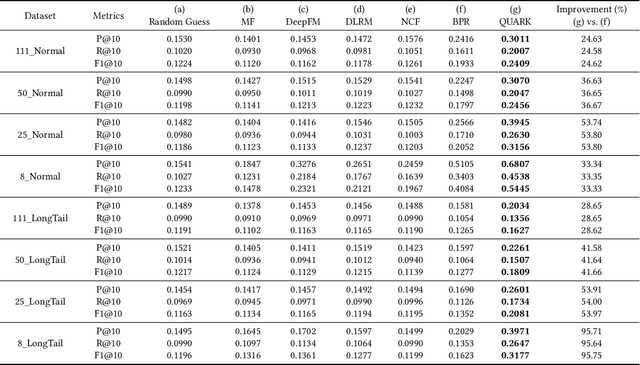
Current recommendation systems recommend goods by considering users' historical behaviors, social relations, ratings, and other multi-modals. Although outdated user information presents the trends of a user's interests, no recommendation system can know the users' real-time thoughts indeed. With the development of brain-computer interfaces, it is time to explore next-generation recommenders that show users' real-time thoughts without delay. Electroencephalography (EEG) is a promising method of collecting brain signals because of its convenience and mobility. Currently, there is only few research on EEG-based recommendations due to the complexity of learning human brain activity. To explore the utility of EEG-based recommendation, we propose a novel neural network model, QUARK, combining Quantum Cognition Theory and Graph Convolutional Networks for accurate item recommendations. Compared with the state-of-the-art recommendation models, the superiority of QUARK is confirmed via extensive experiments.
Multi-Aggregator Time-Warping Heterogeneous Graph Neural Network for Personalized Micro-Video Recommendation
Jan 05, 2025

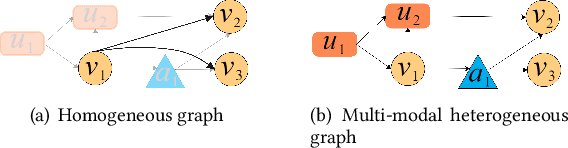
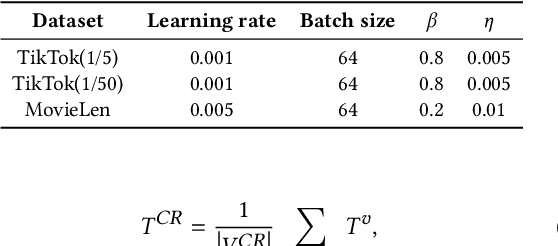
Micro-video recommendation is attracting global attention and becoming a popular daily service for people of all ages. Recently, Graph Neural Networks-based micro-video recommendation has displayed performance improvement for many kinds of recommendation tasks. However, the existing works fail to fully consider the characteristics of micro-videos, such as the high timeliness of news nature micro-video recommendation and sequential interactions of frequently changed interests. In this paper, a novel Multi-aggregator Time-warping Heterogeneous Graph Neural Network (MTHGNN) is proposed for personalized news nature micro-video recommendation based on sequential sessions, where characteristics of micro-videos are comprehensively studied, users' preference is mined via multi-aggregator, the temporal and dynamic changes of users' preference are captured, and timeliness is considered. Through the comparison with the state-of-the-arts, the experimental results validate the superiority of our MTHGNN model.
ER2Score: LLM-based Explainable and Customizable Metric for Assessing Radiology Reports with Reward-Control Loss
Nov 26, 2024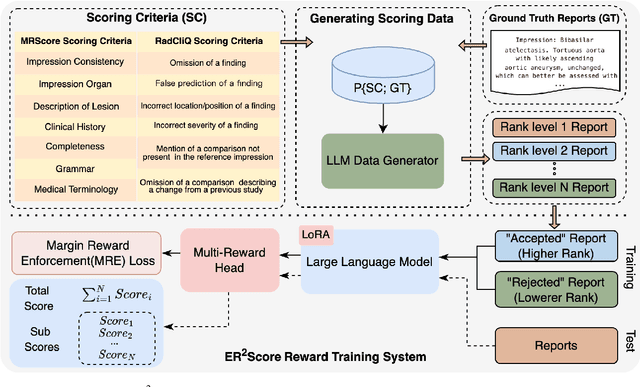
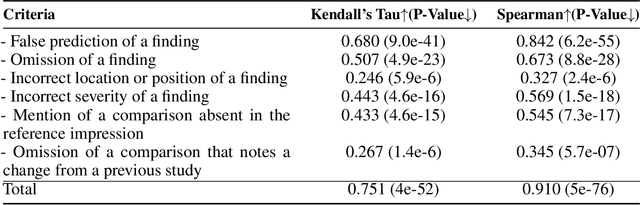
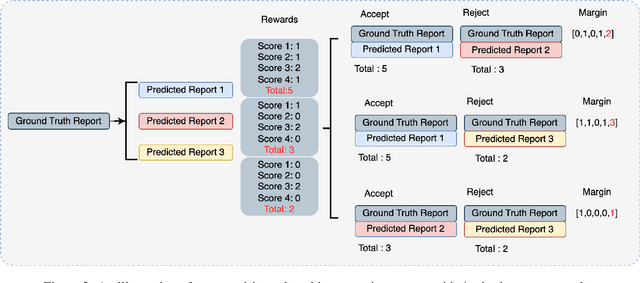

Automated radiology report generation (R2Gen) has advanced significantly, introducing challenges in accurate evaluation due to its complexity. Traditional metrics often fall short by relying on rigid word-matching or focusing only on pathological entities, leading to inconsistencies with human assessments. To bridge this gap, we introduce ER2Score, an automatic evaluation metric designed specifically for R2Gen. Our metric utilizes a reward model, guided by our margin-based reward enforcement loss, along with a tailored training data design that enables customization of evaluation criteria to suit user-defined needs. It not only scores reports according to user-specified criteria but also provides detailed sub-scores, enhancing interpretability and allowing users to adjust the criteria between different aspects of reports. Leveraging GPT-4, we designed an easy-to-use data generation pipeline, enabling us to produce extensive training data based on two distinct scoring systems, each containing reports of varying quality along with corresponding scores. These GPT-generated reports are then paired as accepted and rejected samples through our pairing rule to train an LLM towards our fine-grained reward model, which assigns higher rewards to the report with high quality. Our reward-control loss enables this model to simultaneously output multiple individual rewards corresponding to the number of evaluation criteria, with their summation as our final ER2Score. Our experiments demonstrate ER2Score's heightened correlation with human judgments and superior performance in model selection compared to traditional metrics. Notably, our model provides both an overall score and individual scores for each evaluation item, enhancing interpretability. We also demonstrate its flexible training across various evaluation systems.
KARGEN: Knowledge-enhanced Automated Radiology Report Generation Using Large Language Models
Sep 09, 2024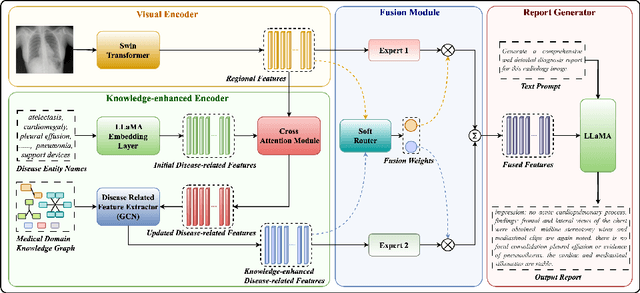
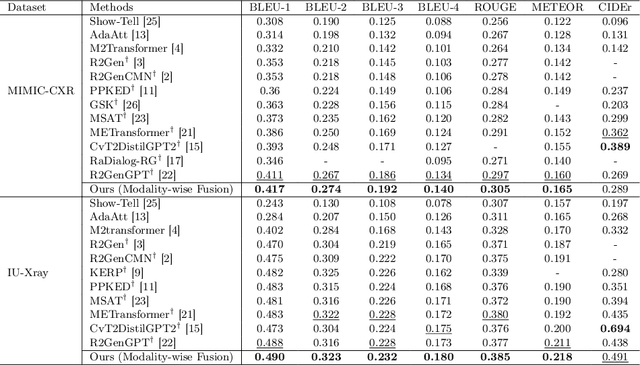
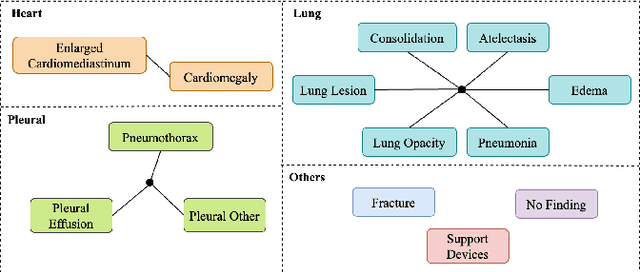
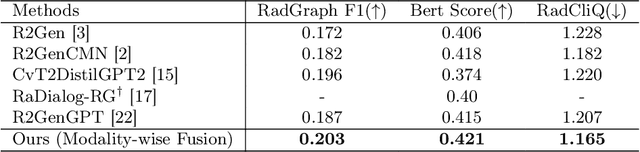
Harnessing the robust capabilities of Large Language Models (LLMs) for narrative generation, logical reasoning, and common-sense knowledge integration, this study delves into utilizing LLMs to enhance automated radiology report generation (R2Gen). Despite the wealth of knowledge within LLMs, efficiently triggering relevant knowledge within these large models for specific tasks like R2Gen poses a critical research challenge. This paper presents KARGEN, a Knowledge-enhanced Automated radiology Report GENeration framework based on LLMs. Utilizing a frozen LLM to generate reports, the framework integrates a knowledge graph to unlock chest disease-related knowledge within the LLM to enhance the clinical utility of generated reports. This is achieved by leveraging the knowledge graph to distill disease-related features in a designed way. Since a radiology report encompasses both normal and disease-related findings, the extracted graph-enhanced disease-related features are integrated with regional image features, attending to both aspects. We explore two fusion methods to automatically prioritize and select the most relevant features. The fused features are employed by LLM to generate reports that are more sensitive to diseases and of improved quality. Our approach demonstrates promising results on the MIMIC-CXR and IU-Xray datasets.
MRScore: Evaluating Radiology Report Generation with LLM-based Reward System
Apr 27, 2024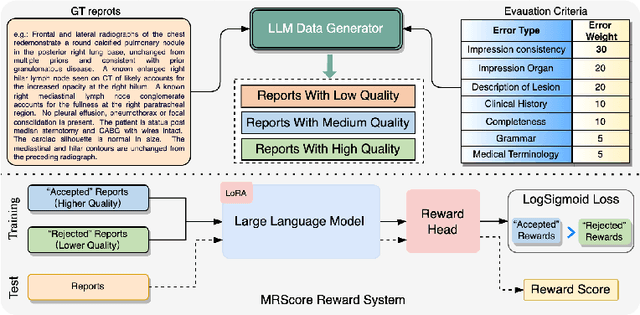
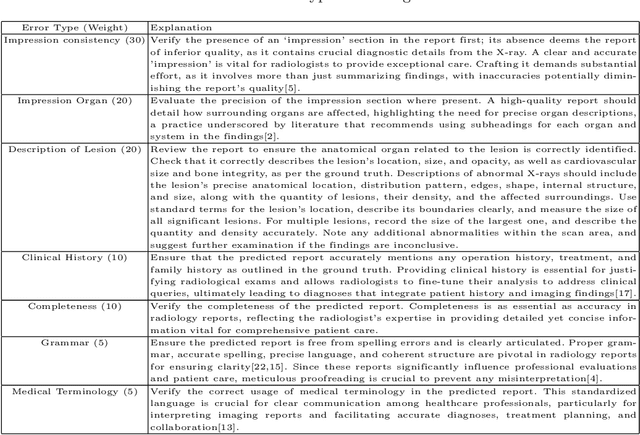
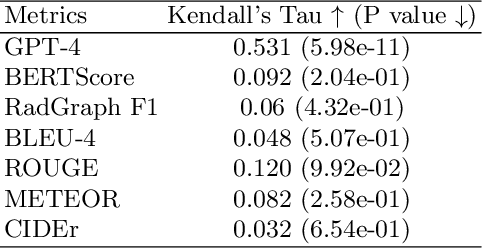
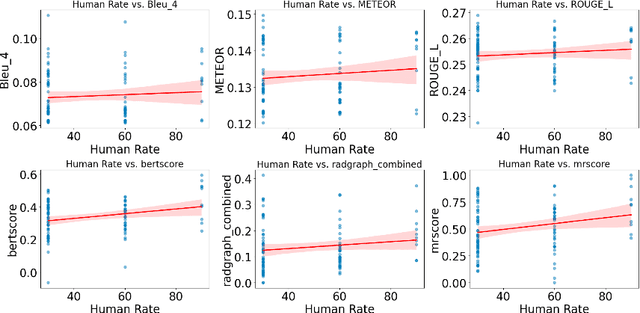
In recent years, automated radiology report generation has experienced significant growth. This paper introduces MRScore, an automatic evaluation metric tailored for radiology report generation by leveraging Large Language Models (LLMs). Conventional NLG (natural language generation) metrics like BLEU are inadequate for accurately assessing the generated radiology reports, as systematically demonstrated by our observations within this paper. To address this challenge, we collaborated with radiologists to develop a framework that guides LLMs for radiology report evaluation, ensuring alignment with human analysis. Our framework includes two key components: i) utilizing GPT to generate large amounts of training data, i.e., reports with different qualities, and ii) pairing GPT-generated reports as accepted and rejected samples and training LLMs to produce MRScore as the model reward. Our experiments demonstrate MRScore's higher correlation with human judgments and superior performance in model selection compared to traditional metrics. Our code and datasets will be available on GitHub.
Security Risks Concerns of Generative AI in the IoT
Mar 29, 2024In an era where the Internet of Things (IoT) intersects increasingly with generative Artificial Intelligence (AI), this article scrutinizes the emergent security risks inherent in this integration. We explore how generative AI drives innovation in IoT and we analyze the potential for data breaches when using generative AI and the misuse of generative AI technologies in IoT ecosystems. These risks not only threaten the privacy and efficiency of IoT systems but also pose broader implications for trust and safety in AI-driven environments. The discussion in this article extends to strategic approaches for mitigating these risks, including the development of robust security protocols, the multi-layered security approaches, and the adoption of AI technological solutions. Through a comprehensive analysis, this article aims to shed light on the critical balance between embracing AI advancements and ensuring stringent security in IoT, providing insights into the future direction of these intertwined technologies.