 Add to Chrome
 Add to Firefox
 Add to Edge
An Empirical Study of Training Pixel-Space Text-to-Image Diffusion Models
Aug 17, 2026
This paper investigates an increasingly important topic in generative modeling: pixel-space diffusion models. Although numerous studies have explored this topic, most focus on small-scale or class-conditional settings. Consequently, a practical recipe for training pixel-space models that rival or exceed well-established latent-space counterparts remains elusive. Through a comprehensive empirical study, we first observe that direct large-scale pre-training in pixel space converges substantially more slowly than in latent space. This observation motivates a latent-to-pixel strategy that acquires generative priors efficiently in latent space and transitions to pixel space during post-training. We then systematically investigate the key design choices governing this transition, including weight initialization, data composition, prediction target, decoder architecture, and noise schedule, and identify a practical recipe that makes the resulting pixel-space models match or outperform their latent-space counterparts while delivering 3.18 to 4.75 times end-to-end inference speedups. We hope that our findings provide useful empirical insights and practical guidelines for future research on pixel-space generation.

StreamTalk: Streaming Co-Speech Gesture Generation with Key-Pose Anchoring
Aug 03, 2026Real-time co-speech gesture generation must produce 3D motion clip by clip as speech arrives. Existing streaming methods are open-loop: each clip depends on past context, but the model cannot check or correct its trajectory. Small errors therefore accumulate and cause drift over long sequences. We observe that this failure is mainly caused by the lack of a forward constraint rather than poor short-clip quality. A plausible key pose at the end of each clip provides a destination anchor that limits drift. Based on this observation, we propose StreamTalk, a closed-loop framework with a periodic generate-retrieve-refine cycle. Streaming Pose-Guided Generation first predicts a coarse clip, retrieves a plausible tail pose from a speaker-specific motion database, and refines the clip using this pose before continuing to the next window. During training, Stochastic Anchor Masking randomly masks pose and translation frames, teaching the model to recover complete motion from sparse boundary conditions. A part-aware DiT separates hand, body, and translation streams to reduce interference between global displacement and local articulation. On BEAT2, StreamTalk achieves state-of-the-art FGD, reduces long-horizon drift relative to open-loop baselines, and runs in real time at 76 FPS. Project page: https://xiangyue-zhang.github.io/StreamTalk/.
Qwen-UI-Agent Technical Report: Toward Next-Generation Real-World Centric Foundation GUI Agents
Jul 30, 2026GUI agents have the potential to become a general purpose executor over existing digital devices. To advance them toward real-world use, we envision agents that operate reliably on real devices, execute workflows across platforms, combine GUI interaction with CLI execution, complete long-horizon tasks, proactively initiate useful services, and autonomously improve their capabilities with minimal human effort. Guided by this vision, we present Qwen-UI-Agent, a real-world centric foundation GUI agent spanning mobile, computer-use, web, and DeepSearch environments. Qwen-UI-Agent combines diverse sandbox environments with a large-scale real-device mobile runtime. Its unified action space interleaves GUI operations with CLI execution and generates batched actions in a single model turn. An AutoResearch-style data flywheel uses agents to construct tasks and environments, diagnose failures, and plan subsequent iterations. Online RL supports training on trajectories exceeding 100 turns, with over 10,000 concurrent environments accelerating rollout. A lightweight harness layer supports proactive service initiation and stateful workflows across mobile and computer. Across a broad suite of evaluations, Qwen-UI-Agent sets state-of-the-art performance on mobile-use benchmarks while delivering competitive performance on computer- and browser-use tasks against frontier models, including Opus 4.8, Gemini 3.1 Pro, and GPT-5.6 Sol. On mobile use, it achieves 82.1% on MobileWorld, 92.2% on MobileWorld-Real, and 97.5% on AndroidDaily. On computer use, it achieves 79.5% on OSWorld-Verified and a 40.0% partial-progress score on OSWorld-v2. On browser use and GUI grounding, it achieves 73.6% on WebArena and 81.5% on ScreenSpot-Pro, respectively.
FA-LAM: Focus-Aware Large Avatar Model for One-Shot 4D Animatable Gaussian Head
Jul 23, 2026We propose FA-LAM, a Focus-Aware Large Avatar Model for one-shot animatable Gaussian head creation, while simultaneously enabling static 3D and dynamic 4D full-head recovery. The core of our method lies in a thorough analysis of the attention mechanisms and the entangled reconstruction and animation training pipeline adopted by prior state-of-the-art approaches. Our analysis identifies two main factors that compromise the quality of 3D full-head generation: (1) incorrect and noisy attention activations, and (2) conflicts between the tasks of reconstruction and animation. To address the first issue, we introduce a symmetric and semantic attention regularization strategy that leverages the inherent semantics and structural symmetry of human heads. To disentangle the objectives of reconstruction and animation, we develop a novel dual-phase training pipeline that separates the model's capabilities for large-view hallucination and animation into distinct modules. Moreover, we enhance our model to support multi-view and streaming 4D reconstruction in an efficient and memory-friendly manner through a core autoregressive modification with tailored visibility-aware token fusion. Collectively, these innovations enable FA-LAM to reconstruct animatable Gaussian full heads with superior quality, particularly in fine facial regions and large viewing angles.
Omni-Decision: A Progressive Evidence-State Agent System for Omni-Modal QA
Jul 13, 2026Omni-modal evidence-seeking QA requires agents to answer questions whose evidence is sparsely distributed across videos, audio, images, web pages, and computation results. Existing agentic multimodal systems often leave evidence in scratchpads, tool trajectories, or free-form histories, making it difficult to track what has been grounded, what remains missing, and when the evidence is sufficient to answer. We propose Omni-Decision, a training-free evidence-state system that turns omni-modal QA into a query-scoped evidence-closure process. For each query, Omni-Decision maintains a structured evidence state containing confirmed evidence, unresolved conflicts, fact and computation dependencies, and open evidence needs. A shared state view conditions planning, evidence acquisition, validation, repair, and finalization. Heterogeneous observations from media, web, computation, and verification modules are normalized, judged, and committed through deterministic state updates. This design enables targeted evidence acquisition, preserves sparse cross-modal cues, and provides inspectable control over repair and stopping. Omni-Decision achieves 45.6% accuracy on OmniGAIA and 58.3% on WorldSense, improving over the baselines by +27.3 and +30.2 percentage points, respectively. No-state ablations and trajectory audits further support the role of explicit evidence-state control in multi-step omni-modal evidence seeking.
What Memory Do GUI Agents Really Need? From Passive Records to Active Task-Driving States
Jun 30, 2026Mobile GUI agents increasingly face long-horizon tasks that require reading, updating, and reusing task-relevant data across pages and applications. Existing memory methods treat memory largely as passive storage, where past observations are accumulated and retrieved when needed. Yet retrieving a value does not reveal its current role in the workflow. The agent must still infer from accumulated records whether the value should be used now, has already been used, or must wait for a later dependency. This implicit reconstruction becomes unreliable in long trajectories with similar fields, repeated values, distractors, and outdated states, causing repeated or missed operations. We propose Active Task Driving Memory (ATMem), which shifts GUI-agent memory from passive storage to an actively maintained execution state. ATMem maintains task-relevant information as a continually updated execution state that links each value to its role and current status, enabling action selection based on the current workflow state. We therefore introduce \textbf{STR-GRPO}, an online reinforcement learning method that learns to use ATMem selectively according to its contribution to task completion. STR-GRPO contrasts memory-on and memory-off rollouts to estimate when memory use improves execution, while memory-cost-aware reward discourages costly memory usage that does not improve execution. To evaluate whether agents can complete all in-scope work while avoiding out-of-scope actions over long-horizon execution, we build a challenging mobile benchmark. From a list of near identical entries, agents must act on every entry that satisfies the instruction and reject entries that violate its constraints.
One Forward Beats Two: InnerZoom for Accurate and Efficient GUI Grounding
Jun 29, 2026MLLM-based GUI grounding methods commonly formulate target localization as autoregressive coordinate generation, enabling models to leverage the strong instruction-following and semantic understanding capabilities of MLLMs. However, this formulation requires the model to retain region-level target evidence while decoding coordinate tokens with the spatial precision demanded by GUI clicking. Our diagnostic analysis reveals that target-region awareness emerges in intermediate decoder layers but is neither retained nor translated into the final coordinate prediction. Existing ZoomIn-style methods address this issue through an external crop-and-rerun pass, which improves localization but increases end-to-end latency and computational cost. To retain the accuracy benefits of two-pass zooming without this extra cost, we propose InnerZoom, a single-forward framework for cross-layer evidence bridging. InnerZoom transforms target-related cues from the original forward pass into a compact cross-layer evidence state, then preserves, refines, and reinjects this state throughout later decoding layers to guide coordinate prediction. Extensive experimental results suggest that InnerZoom-4B achieves state-of-the-art performance on all six GUI grounding benchmarks, obtaining 64.7 on OSWorld-G, 40.2 on UI-Vision, 73.1 on OSWorld-GR, and 87.6 on MMBench-GUI, surpassing the previous best results by 4.1, 3.2, 2.9, and 2.3 points, respectively. Under a controlled 4B setting, InnerZoom improves the same SFT+RL baseline by 5.3 points on average and outperforms two-pass ZoomIn by 1.3 points on average, while reducing end-to-end latency by up to 31.8% and TFLOPs by about 29%. Code and models will be publicly available.
D-OPSD: On-Policy Self-Distillation for Continuously Tuning Step-Distilled Diffusion Models
May 06, 2026The landscape of high-performance image generation models is currently shifting from the inefficient multi-step ones to the efficient few-step counterparts (e.g, Z-Image-Turbo and FLUX.2-klein). However, these models present significant challenges for directly continuous supervised fine-tuning. For example, applying the commonly used fine-tuning technique would compromises their inherent few-step inference capability. To address this, we propose D-OPSD, a novel training paradigm for step-distilled diffusion models that enables on-policy learning during supervised fine-tuning. We first find that the modern diffusion model where the LLM/VLM serves as the encoder can inherit its encoder's in-context capabilities. This enables us to make the training as an on-policy self-distillation process. Specifically, during training, we make the model acts as both the teacher and the student with different contexts, where the student is conditioned only on the text feature, while the teacher is conditioned on the multimodal feature of both the text prompt and the target image. Training minimizes the two predicted distributions over the student's own roll-outs. By optimized on the model's own trajectory and under it's own supervision, D-OPSD enables the model to learn new concept, style, etc. without sacrificing the original few-step capacity.
OMG-Avatar: One-shot Multi-LOD Gaussian Head Avatar
Mar 02, 2026We propose OMG-Avatar, a novel One-shot method that leverages a Multi-LOD (Level-of-Detail) Gaussian representation for animatable 3D head reconstruction from a single image in 0.2s. Our method enables LOD head avatar modeling using a unified model that accommodates diverse hardware capabilities and inference speed requirements. To capture both global and local facial characteristics, we employ a transformer-based architecture for global feature extraction and projection-based sampling for local feature acquisition. These features are effectively fused under the guidance of a depth buffer, ensuring occlusion plausibility. We further introduce a coarse-to-fine learning paradigm to support Level-of-Detail functionality and enhance the perception of hierarchical details. To address the limitations of 3DMMs in modeling non-head regions such as the shoulders, we introduce a multi-region decomposition scheme in which the head and shoulders are predicted separately and then integrated through cross-region combination. Extensive experiments demonstrate that OMG-Avatar outperforms state-of-the-art methods in reconstruction quality, reenactment performance, and computational efficiency.
MAI-UI Technical Report: Real-World Centric Foundation GUI Agents
Dec 26, 2025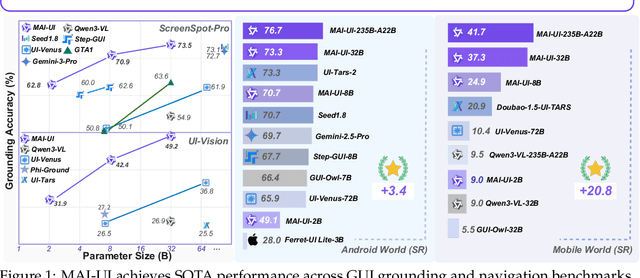
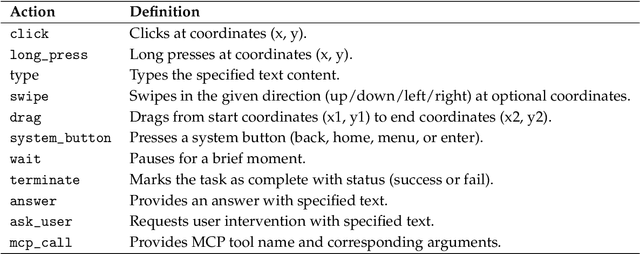
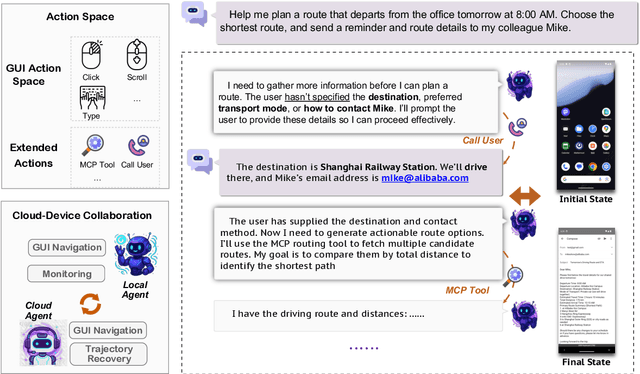
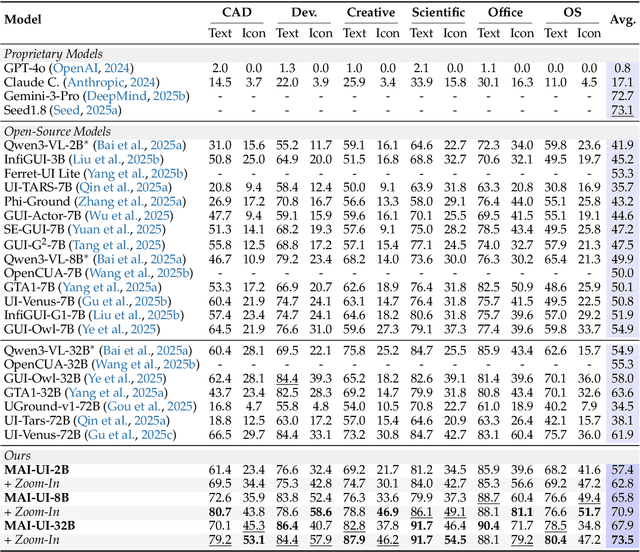
The development of GUI agents could revolutionize the next generation of human-computer interaction. Motivated by this vision, we present MAI-UI, a family of foundation GUI agents spanning the full spectrum of sizes, including 2B, 8B, 32B, and 235B-A22B variants. We identify four key challenges to realistic deployment: the lack of native agent-user interaction, the limits of UI-only operation, the absence of a practical deployment architecture, and brittleness in dynamic environments. MAI-UI addresses these issues with a unified methodology: a self-evolving data pipeline that expands the navigation data to include user interaction and MCP tool calls, a native device-cloud collaboration system routes execution by task state, and an online RL framework with advanced optimizations to scale parallel environments and context length. MAI-UI establishes new state-of-the-art across GUI grounding and mobile navigation. On grounding benchmarks, it reaches 73.5% on ScreenSpot-Pro, 91.3% on MMBench GUI L2, 70.9% on OSWorld-G, and 49.2% on UI-Vision, surpassing Gemini-3-Pro and Seed1.8 on ScreenSpot-Pro. On mobile GUI navigation, it sets a new SOTA of 76.7% on AndroidWorld, surpassing UI-Tars-2, Gemini-2.5-Pro and Seed1.8. On MobileWorld, MAI-UI obtains 41.7% success rate, significantly outperforming end-to-end GUI models and competitive with Gemini-3-Pro based agentic frameworks. Our online RL experiments show significant gains from scaling parallel environments from 32 to 512 (+5.2 points) and increasing environment step budget from 15 to 50 (+4.3 points). Finally, the native device-cloud collaboration system improves on-device performance by 33%, reduces cloud model calls by over 40%, and preserves user privacy.