 Add to Chrome
 Add to Firefox
 Add to Edge
Gene Expression-Informed Jointly Controlled Generative Modeling for Precision Molecular Design
Jul 13, 2026
Precision molecular design aims to discover personalized drug candidates through joint control of multiple conditions, such as biological relevance and molecular design strategies. Biological relevance reflects cellular functional states under disease or perturbation conditions, while molecular design strategies provide complementary guidance in terms of structural intentions and property optimization. In this study, we propose JoPMol, a jointly controlled precision molecular generative model that integrates biological states encoded by gene expression profiles with molecular structure information expressed in text, and chemical properties quantified by numerical values within a unified modeling framework. This formulation enables coordinated generation and optimization of candidate molecules under joint condition control. Experimental results show that JoPMol outperforms state-of-the-art methods across multiple evaluation metrics. Moreover, JoPMol demonstrates strong generalization ability in both transfer tasks and biologically grounded simulation scenarios, validating its effectiveness for precision molecular design. The source code is publicly available at https://github.com/hala-yh/JoPMol.

Uncovering Latent Depression Severity for Binary Depression Detection via Advantage-weighting Ranking
Jul 07, 2026Automatic depression detection using audio-visual data faces significant challenges, particularly in disentangling overlapping feature distributions and establishing robust decision boundaries. To address this, we propose a fine-grained multimodal framework featuring a temporal encoder and a mutual transformer to facilitate deep cross-modal fusion. Our core contribution is the Binary Advantage-weighting Ranking Loss, which optimizes the latent space distribution through two complementary mechanisms: Advantage-weighted Separation, which mines hard pairs by computing a pairwise prediction difference matrix and dynamically weighting them based on their difficulty; and Advantage-weighted Compactness, which minimizes intra-class variance to force features to cluster around their respective class centers. Extensive experiments on D-vlog and LMVD demonstrate that our model reconstructs the latent ordinal structure by prioritizing hard pairs, thereby achieving state-of-the-art performance.
Discrete-WAM: Unified Discrete Vision-Action Token Editing for World-Policy Learning
Jun 04, 2026Autonomous driving requires reasoning about how ego actions shape the evolution of the surrounding world. However, most end-to-end methods rely on direct state-to-action mappings, capturing correlations without explicitly modeling action-conditioned dynamics. Conversely, continuous-latent world models often lack compositional structure for causal reasoning across counterfactual futures. We introduce Discrete-WAM, a unified latent vision-action world policy that represents future visual states and ego actions as aligned discrete tokens, enabling compositional causal reasoning across alternative futures. Built upon this unified discrete alignment, Discrete-WAM establishes a shared discrete diffusion framework with unified generative tasks, jointly formulating world modeling, world-action policy, and hierarchical decision-enabled policy, supporting compositional generalization across diverse driving scenarios. Experiments on large-scale autonomous-driving benchmarks show that Discrete-WAM achieves competitive performance while supporting controllable generation and counterfactual reasoning, offering a principled path toward more reliable decision-making.
Capture-Calibrate-Coach: A Graph-Based Framework for Knowledge Monitoring Estimation and Adaptive Feedback
May 25, 2026Effective learning support requires understanding not only what learners know but also how accurately they perceive their own understanding. This metacognitive dimension, known as knowledge monitoring, fundamentally influences self-regulated learning, yet this dimension remains underexplored in current systems. This paper introduces the Capture-Calibrate-Coach (3C) framework for adaptive learning support. The Capture phase extracts learners' perceived knowledge states from open-ended self-reports to construct a heterogeneous graph linking learners and knowledge concepts. The Calibrate phase applies a heterogeneous graph neural network to infer latent perceived states for concepts not explicitly mentioned, enabling systematic knowledge monitoring assessment. The Coach phase classifies learners into five metacognitive patterns and delivers personalized feedback addressing both knowledge gaps and calibration errors. Evaluation with 684 students demonstrates 85.21% AUC in predicting latent perceived states, significantly outperforming baseline methods. A user study with 47 participants shows positive reception of feedback quality, with participants particularly valuing concrete feedback on knowledge gaps and actionable study guidance. These findings advance AI-based learning support toward metacognitive teammates that foster accurate self-awareness while supporting knowledge growth.
OneVL: One-Step Latent Reasoning and Planning with Vision-Language Explanation
Apr 20, 2026Chain-of-Thought (CoT) reasoning has become a powerful driver of trajectory prediction in VLA-based autonomous driving, yet its autoregressive nature imposes a latency cost that is prohibitive for real-time deployment. Latent CoT methods attempt to close this gap by compressing reasoning into continuous hidden states, but consistently fall short of their explicit counterparts. We suggest that this is due to purely linguistic latent representations compressing a symbolic abstraction of the world, rather than the causal dynamics that actually govern driving. Thus, we present OneVL (One-step latent reasoning and planning with Vision-Language explanations), a unified VLA and World Model framework that routes reasoning through compact latent tokens supervised by dual auxiliary decoders. Alongside a language decoder that reconstructs text CoT, we introduce a visual world model decoder that predicts future-frame tokens, forcing the latent space to internalize the causal dynamics of road geometry, agent motion, and environmental change. A three-stage training pipeline progressively aligns these latents with trajectory, language, and visual objectives, ensuring stable joint optimization. At inference, the auxiliary decoders are discarded and all latent tokens are prefilled in a single parallel pass, matching the speed of answer-only prediction. Across four benchmarks, OneVL becomes the first latent CoT method to surpass explicit CoT, delivering state-of-the-art accuracy at answer-only latency, and providing direct evidence that tighter compression, when guided in both language and world-model supervision, produces more generalizable representations than verbose token-by-token reasoning. Project Page: https://xiaomi-embodied-intelligence.github.io/OneVL
GRCF: Two-Stage Groupwise Ranking and Calibration Framework for Multimodal Sentiment Analysis
Jan 14, 2026Most Multimodal Sentiment Analysis research has focused on point-wise regression. While straightforward, this approach is sensitive to label noise and neglects whether one sample is more positive than another, resulting in unstable predictions and poor correlation alignment. Pairwise ordinal learning frameworks emerged to address this gap, capturing relative order by learning from comparisons. Yet, they introduce two new trade-offs: First, they assign uniform importance to all comparisons, failing to adaptively focus on hard-to-rank samples. Second, they employ static ranking margins, which fail to reflect the varying semantic distances between sentiment groups. To address this, we propose a Two-Stage Group-wise Ranking and Calibration Framework (GRCF) that adapts the philosophy of Group Relative Policy Optimization (GRPO). Our framework resolves these trade-offs by simultaneously preserving relative ordinal structure, ensuring absolute score calibration, and adaptively focusing on difficult samples. Specifically, Stage 1 introduces a GRPO-inspired Advantage-Weighted Dynamic Margin Ranking Loss to build a fine-grained ordinal structure. Stage 2 then employs an MAE-driven objective to align prediction magnitudes. To validate its generalizability, we extend GRCF to classification tasks, including multimodal humor detection and sarcasm detection. GRCF achieves state-of-the-art performance on core regression benchmarks, while also showing strong generalizability in classification tasks.
Cross Modal Fine-Grained Alignment via Granularity-Aware and Region-Uncertain Modeling
Nov 19, 2025Fine-grained image-text alignment is a pivotal challenge in multimodal learning, underpinning key applications such as visual question answering, image captioning, and vision-language navigation. Unlike global alignment, fine-grained alignment requires precise correspondence between localized visual regions and textual tokens, often hindered by noisy attention mechanisms and oversimplified modeling of cross-modal relationships. In this work, we identify two fundamental limitations of existing approaches: the lack of robust intra-modal mechanisms to assess the significance of visual and textual tokens, leading to poor generalization in complex scenes; and the absence of fine-grained uncertainty modeling, which fails to capture the one-to-many and many-to-one nature of region-word correspondences. To address these issues, we propose a unified approach that incorporates significance-aware and granularity-aware modeling and region-level uncertainty modeling. Our method leverages modality-specific biases to identify salient features without relying on brittle cross-modal attention, and represents region features as a mixture of Gaussian distributions to capture fine-grained uncertainty. Extensive experiments on Flickr30K and MS-COCO demonstrate that our approach achieves state-of-the-art performance across various backbone architectures, significantly enhancing the robustness and interpretability of fine-grained image-text alignment.
Beyond Cosine Similarity Magnitude-Aware CLIP for No-Reference Image Quality Assessment
Nov 13, 2025Recent efforts have repurposed the Contrastive Language-Image Pre-training (CLIP) model for No-Reference Image Quality Assessment (NR-IQA) by measuring the cosine similarity between the image embedding and textual prompts such as "a good photo" or "a bad photo." However, this semantic similarity overlooks a critical yet underexplored cue: the magnitude of the CLIP image features, which we empirically find to exhibit a strong correlation with perceptual quality. In this work, we introduce a novel adaptive fusion framework that complements cosine similarity with a magnitude-aware quality cue. Specifically, we first extract the absolute CLIP image features and apply a Box-Cox transformation to statistically normalize the feature distribution and mitigate semantic sensitivity. The resulting scalar summary serves as a semantically-normalized auxiliary cue that complements cosine-based prompt matching. To integrate both cues effectively, we further design a confidence-guided fusion scheme that adaptively weighs each term according to its relative strength. Extensive experiments on multiple benchmark IQA datasets demonstrate that our method consistently outperforms standard CLIP-based IQA and state-of-the-art baselines, without any task-specific training.
Disentangling Bias by Modeling Intra- and Inter-modal Causal Attention for Multimodal Sentiment Analysis
Aug 07, 2025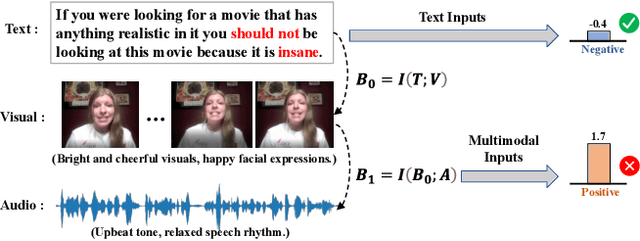
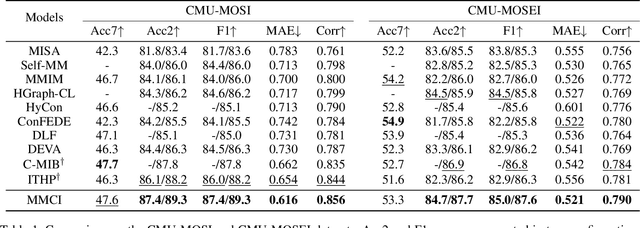
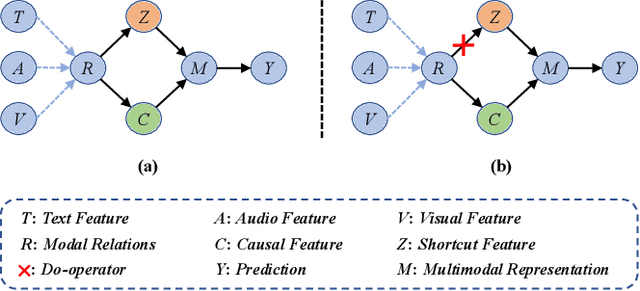
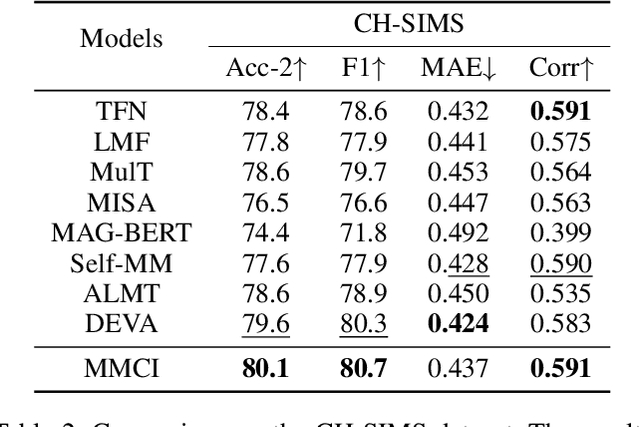
Multimodal sentiment analysis (MSA) aims to understand human emotions by integrating information from multiple modalities, such as text, audio, and visual data. However, existing methods often suffer from spurious correlations both within and across modalities, leading models to rely on statistical shortcuts rather than true causal relationships, thereby undermining generalization. To mitigate this issue, we propose a Multi-relational Multimodal Causal Intervention (MMCI) model, which leverages the backdoor adjustment from causal theory to address the confounding effects of such shortcuts. Specifically, we first model the multimodal inputs as a multi-relational graph to explicitly capture intra- and inter-modal dependencies. Then, we apply an attention mechanism to separately estimate and disentangle the causal features and shortcut features corresponding to these intra- and inter-modal relations. Finally, by applying the backdoor adjustment, we stratify the shortcut features and dynamically combine them with the causal features to encourage MMCI to produce stable predictions under distribution shifts. Extensive experiments on several standard MSA datasets and out-of-distribution (OOD) test sets demonstrate that our method effectively suppresses biases and improves performance.
Towards Explainable Fusion and Balanced Learning in Multimodal Sentiment Analysis
Apr 16, 2025Multimodal Sentiment Analysis (MSA) faces two critical challenges: the lack of interpretability in the decision logic of multimodal fusion and modality imbalance caused by disparities in inter-modal information density. To address these issues, we propose KAN-MCP, a novel framework that integrates the interpretability of Kolmogorov-Arnold Networks (KAN) with the robustness of the Multimodal Clean Pareto (MCPareto) framework. First, KAN leverages its univariate function decomposition to achieve transparent analysis of cross-modal interactions. This structural design allows direct inspection of feature transformations without relying on external interpretation tools, thereby ensuring both high expressiveness and interpretability. Second, the proposed MCPareto enhances robustness by addressing modality imbalance and noise interference. Specifically, we introduce the Dimensionality Reduction and Denoising Modal Information Bottleneck (DRD-MIB) method, which jointly denoises and reduces feature dimensionality. This approach provides KAN with discriminative low-dimensional inputs to reduce the modeling complexity of KAN while preserving critical sentiment-related information. Furthermore, MCPareto dynamically balances gradient contributions across modalities using the purified features output by DRD-MIB, ensuring lossless transmission of auxiliary signals and effectively alleviating modality imbalance. This synergy of interpretability and robustness not only achieves superior performance on benchmark datasets such as CMU-MOSI, CMU-MOSEI, and CH-SIMS v2 but also offers an intuitive visualization interface through KAN's interpretable architecture.