 Add to Chrome
 Add to Firefox
 Add to Edge
PathMem: Toward Cognition-Aligned Memory Transformation for Pathology MLLMs
Mar 10, 2026
Computational pathology demands both visual pattern recognition and dynamic integration of structured domain knowledge, including taxonomy, grading criteria, and clinical evidence. In practice, diagnostic reasoning requires linking morphological evidence with formal diagnostic and grading criteria. Although multimodal large language models (MLLMs) demonstrate strong vision language reasoning capabilities, they lack explicit mechanisms for structured knowledge integration and interpretable memory control. As a result, existing models struggle to consistently incorporate pathology-specific diagnostic standards during reasoning. Inspired by the hierarchical memory process of human pathologists, we propose PathMem, a memory-centric multimodal framework for pathology MLLMs. PathMem organizes structured pathology knowledge as a long-term memory (LTM) and introduces a Memory Transformer that models the dynamic transition from LTM to working memory (WM) through multimodal memory activation and context-aware knowledge grounding, enabling context-aware memory refinement for downstream reasoning. PathMem achieves SOTA performance across benchmarks, improving WSI-Bench report generation (12.8% WSI-Precision, 10.1% WSI-Relevance) and open-ended diagnosis by 9.7% and 8.9% over prior WSI-based models.

WSI-LLaVA: A Multimodal Large Language Model for Whole Slide Image
Dec 03, 2024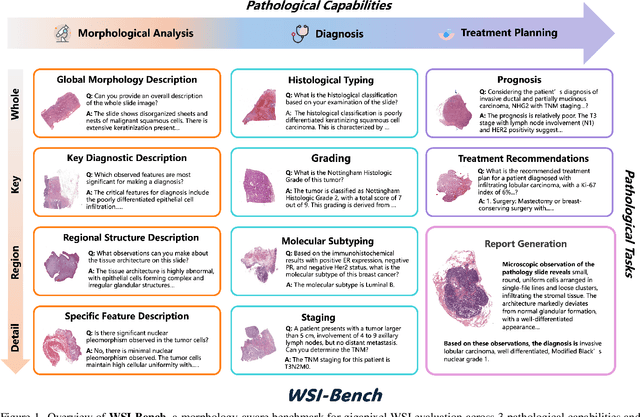


Recent advancements in computational pathology have produced patch-level Multi-modal Large Language Models (MLLMs), but these models are limited by their inability to analyze whole slide images (WSIs) comprehensively and their tendency to bypass crucial morphological features that pathologists rely on for diagnosis. To address these challenges, we first introduce WSI-Bench, a large-scale morphology-aware benchmark containing 180k VQA pairs from 9,850 WSIs across 30 cancer types, designed to evaluate MLLMs' understanding of morphological characteristics crucial for accurate diagnosis. Building upon this benchmark, we present WSI-LLaVA, a novel framework for gigapixel WSI understanding that employs a three-stage training approach: WSI-text alignment, feature space alignment, and task-specific instruction tuning. To better assess model performance in pathological contexts, we develop two specialized WSI metrics: WSI-Precision and WSI-Relevance. Experimental results demonstrate that WSI-LLaVA outperforms existing models across all capability dimensions, with a significant improvement in morphological analysis, establishing a clear correlation between morphological understanding and diagnostic accuracy.