 Add to Chrome
 Add to Firefox
 Add to Edge
HART: Efficient Visual Generation with Hybrid Autoregressive Transformer
Oct 14, 2024
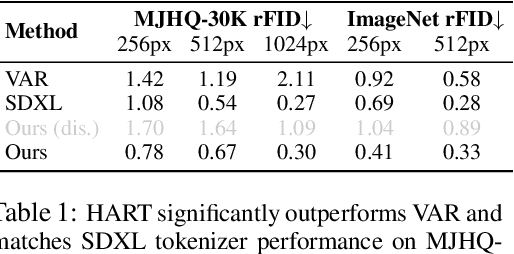


We introduce Hybrid Autoregressive Transformer (HART), an autoregressive (AR) visual generation model capable of directly generating 1024x1024 images, rivaling diffusion models in image generation quality. Existing AR models face limitations due to the poor image reconstruction quality of their discrete tokenizers and the prohibitive training costs associated with generating 1024px images. To address these challenges, we present the hybrid tokenizer, which decomposes the continuous latents from the autoencoder into two components: discrete tokens representing the big picture and continuous tokens representing the residual components that cannot be represented by the discrete tokens. The discrete component is modeled by a scalable-resolution discrete AR model, while the continuous component is learned with a lightweight residual diffusion module with only 37M parameters. Compared with the discrete-only VAR tokenizer, our hybrid approach improves reconstruction FID from 2.11 to 0.30 on MJHQ-30K, leading to a 31% generation FID improvement from 7.85 to 5.38. HART also outperforms state-of-the-art diffusion models in both FID and CLIP score, with 4.5-7.7x higher throughput and 6.9-13.4x lower MACs. Our code is open sourced at https://github.com/mit-han-lab/hart.

VILA-U: a Unified Foundation Model Integrating Visual Understanding and Generation
Sep 06, 2024


VILA-U is a Unified foundation model that integrates Video, Image, Language understanding and generation. Traditional visual language models (VLMs) use separate modules for understanding and generating visual content, which can lead to misalignment and increased complexity. In contrast, VILA-U employs a single autoregressive next-token prediction framework for both tasks, eliminating the need for additional components like diffusion models. This approach not only simplifies the model but also achieves near state-of-the-art performance in visual language understanding and generation. The success of VILA-U is attributed to two main factors: the unified vision tower that aligns discrete visual tokens with textual inputs during pretraining, which enhances visual perception, and autoregressive image generation can achieve similar quality as diffusion models with high-quality dataset. This allows VILA-U to perform comparably to more complex models using a fully token-based autoregressive framework.
LongVILA: Scaling Long-Context Visual Language Models for Long Videos
Aug 21, 2024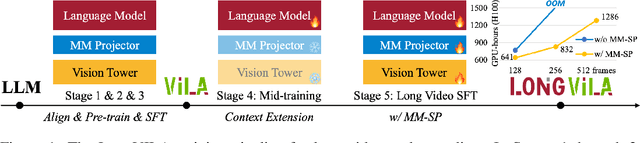

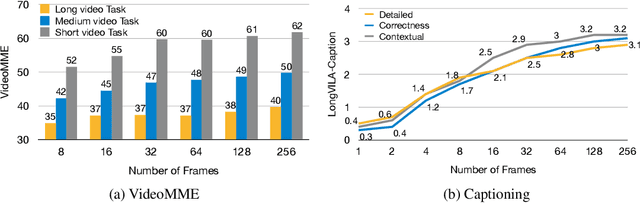
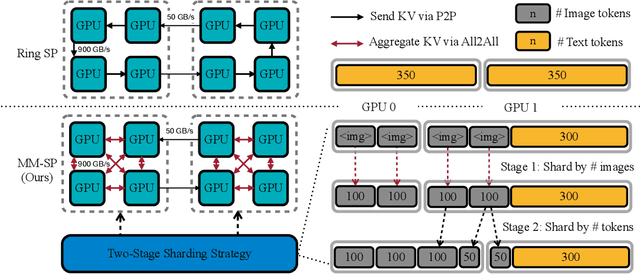
Long-context capability is critical for multi-modal foundation models, especially for long video understanding. We introduce LongVILA, a full-stack solution for long-context visual-language models by co-designing the algorithm and system. For model training, we upgrade existing VLMs to support long video understanding by incorporating two additional stages, i.e., long context extension and long supervised fine-tuning. However, training on long video is computationally and memory intensive. We introduce the long-context Multi-Modal Sequence Parallelism (MM-SP) system that efficiently parallelizes long video training and inference, enabling 2M context length training on 256 GPUs without any gradient checkpointing. LongVILA efficiently extends the number of video frames of VILA from 8 to 1024, improving the long video captioning score from 2.00 to 3.26 (out of 5), achieving 99.5% accuracy in 1400-frame (274k context length) video needle-in-a-haystack. LongVILA-8B demonstrates consistent accuracy improvements on long videos in the VideoMME benchmark as the number of frames increases. Besides, MM-SP is 2.1x - 5.7x faster than ring sequence parallelism and 1.1x - 1.4x faster than Megatron with context parallelism + tensor parallelism. Moreover, it seamlessly integrates with Hugging Face Transformers.
Wolf: Captioning Everything with a World Summarization Framework
Jul 26, 2024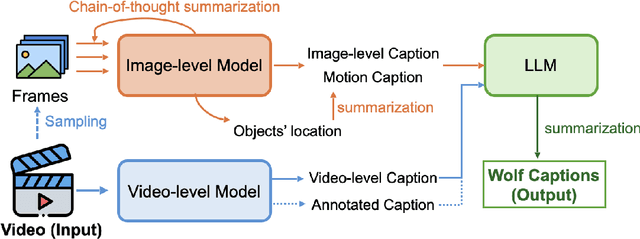
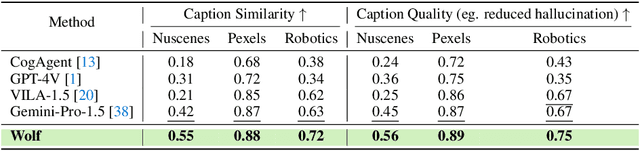
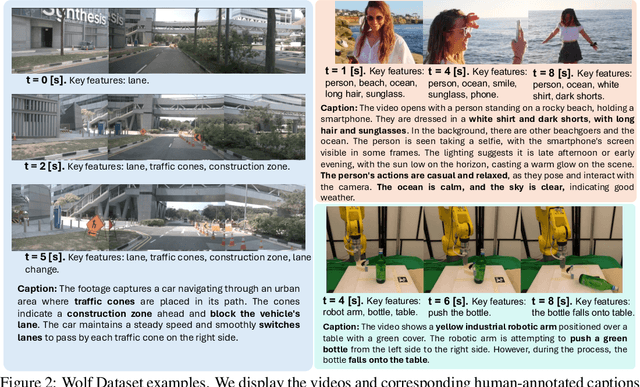
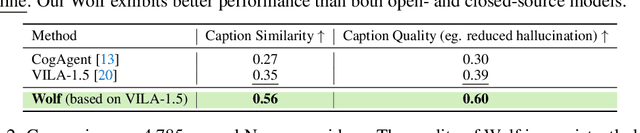
We propose Wolf, a WOrLd summarization Framework for accurate video captioning. Wolf is an automated captioning framework that adopts a mixture-of-experts approach, leveraging complementary strengths of Vision Language Models (VLMs). By utilizing both image and video models, our framework captures different levels of information and summarizes them efficiently. Our approach can be applied to enhance video understanding, auto-labeling, and captioning. To evaluate caption quality, we introduce CapScore, an LLM-based metric to assess the similarity and quality of generated captions compared to the ground truth captions. We further build four human-annotated datasets in three domains: autonomous driving, general scenes, and robotics, to facilitate comprehensive comparisons. We show that Wolf achieves superior captioning performance compared to state-of-the-art approaches from the research community (VILA1.5, CogAgent) and commercial solutions (Gemini-Pro-1.5, GPT-4V). For instance, in comparison with GPT-4V, Wolf improves CapScore both quality-wise by 55.6% and similarity-wise by 77.4% on challenging driving videos. Finally, we establish a benchmark for video captioning and introduce a leaderboard, aiming to accelerate advancements in video understanding, captioning, and data alignment. Leaderboard: https://wolfv0.github.io/leaderboard.html.
Sparse Refinement for Efficient High-Resolution Semantic Segmentation
Jul 26, 2024Semantic segmentation empowers numerous real-world applications, such as autonomous driving and augmented/mixed reality. These applications often operate on high-resolution images (e.g., 8 megapixels) to capture the fine details. However, this comes at the cost of considerable computational complexity, hindering the deployment in latency-sensitive scenarios. In this paper, we introduce SparseRefine, a novel approach that enhances dense low-resolution predictions with sparse high-resolution refinements. Based on coarse low-resolution outputs, SparseRefine first uses an entropy selector to identify a sparse set of pixels with high entropy. It then employs a sparse feature extractor to efficiently generate the refinements for those pixels of interest. Finally, it leverages a gated ensembler to apply these sparse refinements to the initial coarse predictions. SparseRefine can be seamlessly integrated into any existing semantic segmentation model, regardless of CNN- or ViT-based. SparseRefine achieves significant speedup: 1.5 to 3.7 times when applied to HRNet-W48, SegFormer-B5, Mask2Former-T/L and SegNeXt-L on Cityscapes, with negligible to no loss of accuracy. Our "dense+sparse" paradigm paves the way for efficient high-resolution visual computing.
$VILA^2$: VILA Augmented VILA
Jul 24, 2024Visual language models (VLMs) have rapidly progressed, driven by the success of large language models (LLMs). While model architectures and training infrastructures advance rapidly, data curation remains under-explored. When data quantity and quality become a bottleneck, existing work either directly crawls more raw data from the Internet that does not have a guarantee of data quality or distills from black-box commercial models (e.g., GPT-4V / Gemini) causing the performance upper bounded by that model. In this work, we introduce a novel approach that includes a self-augment step and a specialist-augment step to iteratively improve data quality and model performance. In the self-augment step, a VLM recaptions its own pretraining data to enhance data quality, and then retrains from scratch using this refined dataset to improve model performance. This process can iterate for several rounds. Once self-augmentation saturates, we employ several specialist VLMs finetuned from the self-augmented VLM with domain-specific expertise, to further infuse specialist knowledge into the generalist VLM through task-oriented recaptioning and retraining. With the combined self-augmented and specialist-augmented training, we introduce $VILA^2$ (VILA-augmented-VILA), a VLM family that consistently improves the accuracy on a wide range of tasks over prior art, and achieves new state-of-the-art results on MMMU leaderboard among open-sourced models.
Quest: Query-Aware Sparsity for Efficient Long-Context LLM Inference
Jun 16, 2024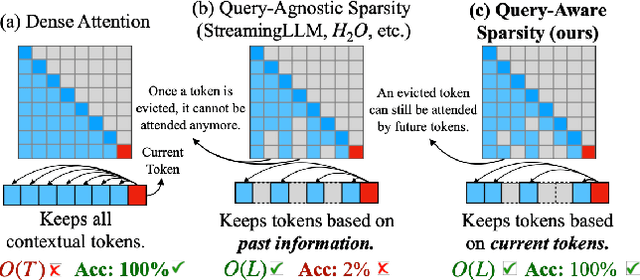
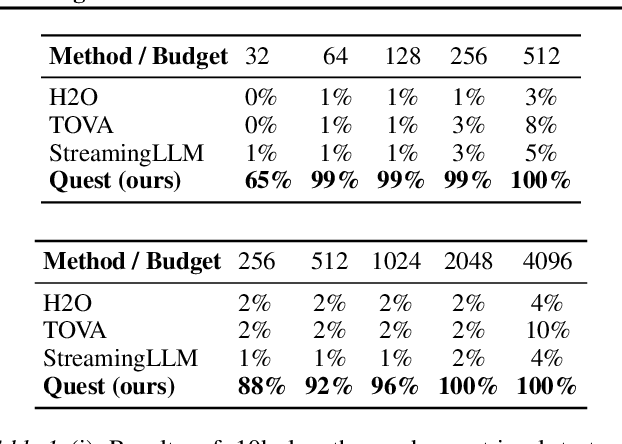
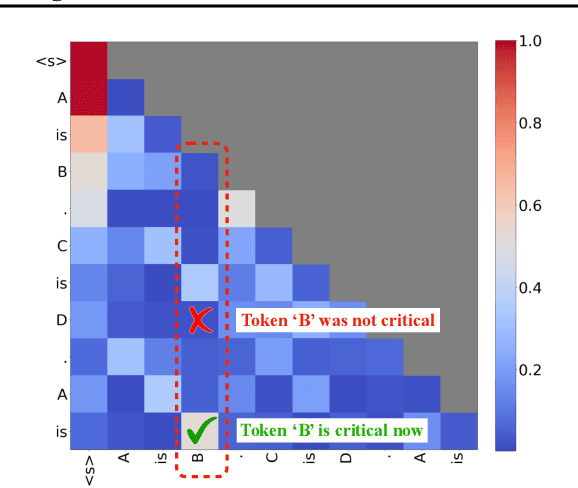

As the demand for long-context large language models (LLMs) increases, models with context windows of up to 128K or 1M tokens are becoming increasingly prevalent. However, long-context LLM inference is challenging since the inference speed decreases significantly as the sequence length grows. This slowdown is primarily caused by loading a large KV cache during self-attention. Previous works have shown that a small portion of critical tokens will dominate the attention outcomes. However, we observe the criticality of a token highly depends on the query. To this end, we propose Quest, a query-aware KV cache selection algorithm. Quest keeps track of the minimal and maximal Key values in KV cache pages and estimates the criticality of a given page using Query vectors. By only loading the Top-K critical KV cache pages for attention, Quest significantly speeds up self-attention without sacrificing accuracy. We show that Quest can achieve up to 2.23x self-attention speedup, which reduces inference latency by 7.03x while performing well on tasks with long dependencies with negligible accuracy loss. Code is available at http://github.com/mit-han-lab/Quest .
X-VILA: Cross-Modality Alignment for Large Language Model
May 29, 2024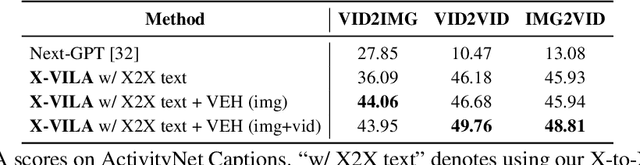
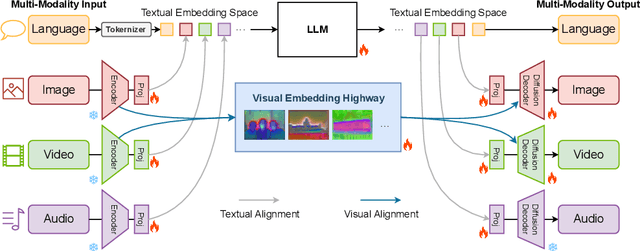

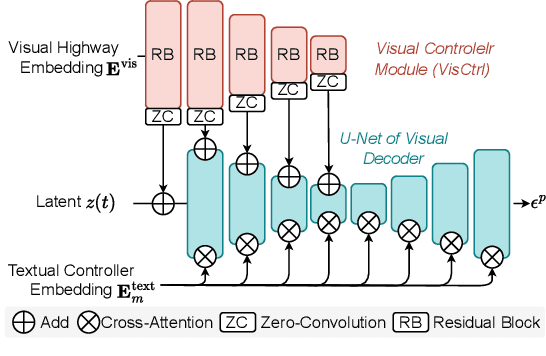
We introduce X-VILA, an omni-modality model designed to extend the capabilities of large language models (LLMs) by incorporating image, video, and audio modalities. By aligning modality-specific encoders with LLM inputs and diffusion decoders with LLM outputs, X-VILA achieves cross-modality understanding, reasoning, and generation. To facilitate this cross-modality alignment, we curate an effective interleaved any-to-any modality instruction-following dataset. Furthermore, we identify a significant problem with the current cross-modality alignment method, which results in visual information loss. To address the issue, we propose a visual alignment mechanism with a visual embedding highway module. We then introduce a resource-efficient recipe for training X-VILA, that exhibits proficiency in any-to-any modality conversation, surpassing previous approaches by large margins. X-VILA also showcases emergent properties across modalities even in the absence of similar training data. The project will be made open-source.
QServe: W4A8KV4 Quantization and System Co-design for Efficient LLM Serving
May 07, 2024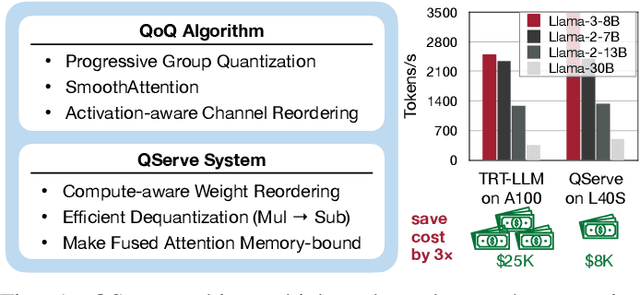
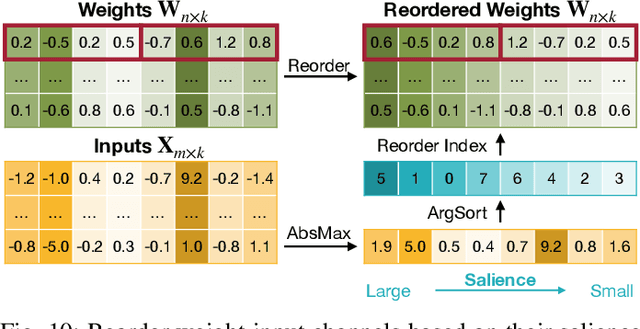
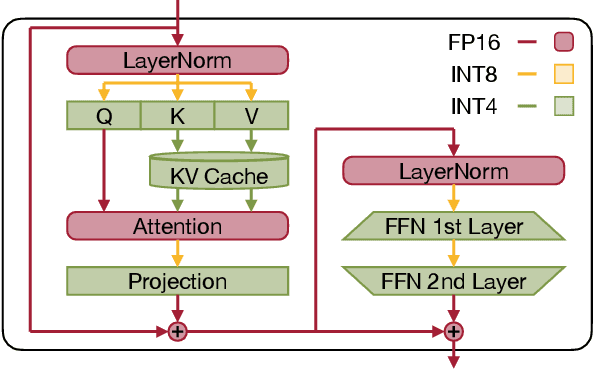
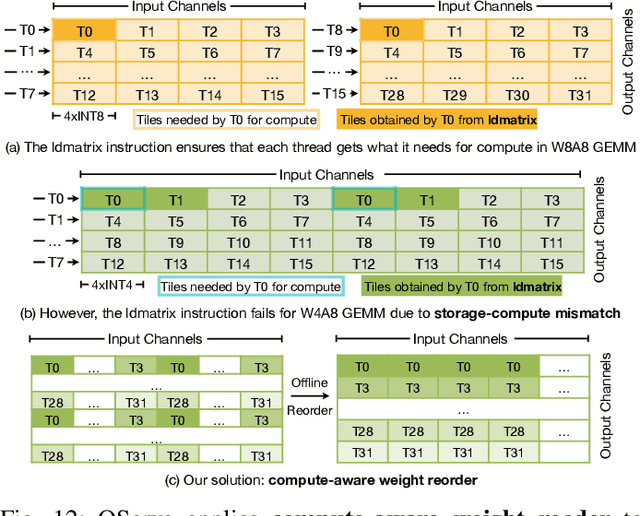
Quantization can accelerate large language model (LLM) inference. Going beyond INT8 quantization, the research community is actively exploring even lower precision, such as INT4. Nonetheless, state-of-the-art INT4 quantization techniques only accelerate low-batch, edge LLM inference, failing to deliver performance gains in large-batch, cloud-based LLM serving. We uncover a critical issue: existing INT4 quantization methods suffer from significant runtime overhead (20-90%) when dequantizing either weights or partial sums on GPUs. To address this challenge, we introduce QoQ, a W4A8KV4 quantization algorithm with 4-bit weight, 8-bit activation, and 4-bit KV cache. QoQ stands for quattuor-octo-quattuor, which represents 4-8-4 in Latin. QoQ is implemented by the QServe inference library that achieves measured speedup. The key insight driving QServe is that the efficiency of LLM serving on GPUs is critically influenced by operations on low-throughput CUDA cores. Building upon this insight, in QoQ algorithm, we introduce progressive quantization that can allow low dequantization overhead in W4A8 GEMM. Additionally, we develop SmoothAttention to effectively mitigate the accuracy degradation incurred by 4-bit KV quantization. In the QServe system, we perform compute-aware weight reordering and take advantage of register-level parallelism to reduce dequantization latency. We also make fused attention memory-bound, harnessing the performance gain brought by KV4 quantization. As a result, QServe improves the maximum achievable serving throughput of Llama-3-8B by 1.2x on A100, 1.4x on L40S; and Qwen1.5-72B by 2.4x on A100, 3.5x on L40S, compared to TensorRT-LLM. Remarkably, QServe on L40S GPU can achieve even higher throughput than TensorRT-LLM on A100. Thus, QServe effectively reduces the dollar cost of LLM serving by 3x. Code is available at https://github.com/mit-han-lab/qserve.
Condition-Aware Neural Network for Controlled Image Generation
Apr 01, 2024
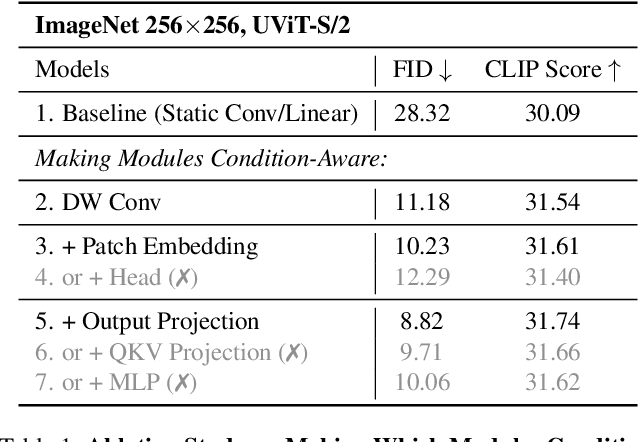


We present Condition-Aware Neural Network (CAN), a new method for adding control to image generative models. In parallel to prior conditional control methods, CAN controls the image generation process by dynamically manipulating the weight of the neural network. This is achieved by introducing a condition-aware weight generation module that generates conditional weight for convolution/linear layers based on the input condition. We test CAN on class-conditional image generation on ImageNet and text-to-image generation on COCO. CAN consistently delivers significant improvements for diffusion transformer models, including DiT and UViT. In particular, CAN combined with EfficientViT (CaT) achieves 2.78 FID on ImageNet 512x512, surpassing DiT-XL/2 while requiring 52x fewer MACs per sampling step.