 Add to Chrome
 Add to Firefox
 Add to Edge
MODE: Modality-Decomposed Expert-Level Mixed-Precision Quantization for MoE Multimodal LLMs
Jun 15, 2026
Mixture-of-Experts Multimodal Large Language Models (MoE-MLLMs) offer remarkable performance but incur prohibitive GPU memory costs, making compression essential. Among PTQ methods, expert-level mixed-precision quantization has proven effective for MoE-LLMs, yet suffers notable degradation on MoE-MLLMs due to two overlooked biases in expert importance estimation. (1) At the cross-modal level, the numerical dominance of vision tokens causes expert selection frequency to be dominated by vision tokens, masking experts that are critical to the text modality; (2) at the intra-vision level, the large proportion of redundant vision tokens further skew frequency statistics, obscuring experts critical for informative visual content. To bridge gaps, we propose MODE, a modality-decomposed expert-level mixed-precision quantization framework for MoE-MLLMs that decomposes expert selection frequency by modality, filters redundant vision tokens to obtain denoised visual frequency, and further evaluates quantization sensitivity per modality as a complementary signal to frequency-based estimation. These signals are integrated into an Integer Linear Programming formulation to assign per-expert bit-widths under a given budget. Extensive experiments show that MODE is particularly well-suited for MoE-MLLMs, limiting average performance loss to within 2.9% at W3A16, with larger gains at the extreme 2-bit setting.

Where to Refine, When to Stop: Rethinking Redundancy via Latent Discrepancy for Efficient Visual Autoregressive Generation
May 29, 2026Visual Autoregressive (VAR) models deliver high-quality image generation but suffer from significant inference latency at high resolutions. Recent acceleration approaches most rely on heuristic measures with layer features to prune tokens. Such heuristics are sensitive to complex contextual semantics, leading to inaccurate identification of redundant computation and poor adaptability across prompts. We rethink redundancy in VAR from the perspective of its impact on pixel-space generation and introduce Latent Discrepancy. This unified metric quantifies a token's contribution by measuring the change in model states during generation. Our analysis shows that redundancy is more accurately identified when guided by image latent or pixel-space signals. We further observed that in classifier-free guidance (CFG), the convergence trend of the discrepancy between conditional and unconditional branches exhibits high dynamics with different prompts. Based on these findings, we propose LD-Pruning (Latent Discrepancy Pruning), a training-free framework that removes redundancy via latent discrepancy by integrating decoding-free region selection and adaptive unconditional-branch skipping. Extensive experiments show that LD-Pruning substantially reduces inference latency while maintaining high generation quality, achieving up to 2.35x speedup on Infinity-8B.
Hide to Guide: Learning via Semantic Masking
May 24, 2026Reinforcement learning with verifiable rewards (RLVR) has become a powerful paradigm for improving language models on reasoning-intensive tasks, but its effectiveness is often limited by exploration. For example, models often fail on hard problems, leaving little useful reward signal. External expert traces offer a natural source of guidance, yet they may also expose reward-relevant content along the critical path to the verifier target, such as final answers, intermediate values, executable implementations, or answer-related entities. This content can create an unintended reward hacking channel, allowing the policy to obtain reward by copying the trace rather than learning the underlying reasoning or agentic behavior. Existing guided-RL methods reduce this risk by using partial trajectories, but they mainly control how much expert information is shown heuristically rather than which parts should be hidden. To this end, we propose Semantic Masked Expert Policy Optimization (SMEPO), a fine-grained semantic masking strategy for expert-guided RLVR. Instead of truncating traces coarsely or revealing them unchanged, SMEPO masks reward-relevant semantic spans along the critical path while preserving the expert's decomposition, plan, and procedural structure. This turns hard problems from reasoning from scratch into a fill-in-the-blank process: the policy can follow the expert's problem-solving route, but must still reconstruct the missing values, code, or entities by itself. SMEPO is simple to apply and requires no changes to the reward function or RL objective. Across diverse domains, including math, code, and agentic search, SMEPO improves accuracy by up to 3.2 points over GRPO and reduces training time by up to 4.2x. The code is available at https://github.com/mit-han-lab/SMEPO.
Stable Asynchrony: Variance-Controlled Off-Policy RL for LLMs
Feb 19, 2026Reinforcement learning (RL) is widely used to improve large language models on reasoning tasks, and asynchronous RL training is attractive because it increases end-to-end throughput. However, for widely adopted critic-free policy-gradient methods such as REINFORCE and GRPO, high asynchrony makes the policy-gradient estimator markedly $\textbf{higher variance}$: training on stale rollouts creates heavy-tailed importance ratios, causing a small fraction of samples to dominate updates. This amplification makes gradients noisy and learning unstable relative to matched on-policy training. Across math and general reasoning benchmarks, we find collapse is reliably predicted by effective sample size (ESS) and unstable gradient norms. Motivated by this diagnosis, we propose $\textbf{V}$ariance $\textbf{C}$ontrolled $\textbf{P}$olicy $\textbf{O}$ptimization ($\textbf{VCPO}$), a general stabilization method for REINFORCE/GRPO-style algorithms that (i) scales learning rate based on effective sample size to dampen unreliable updates, and (ii) applies a closed-form minimum-variance baseline for the off-policy setting, avoiding an auxiliary value model and adding minimal overhead. Empirically, VCPO substantially improves robustness for asynchronous training across math, general reasoning, and tool-use tasks, outperforming a broad suite of baselines spanning masking/clipping stabilizers and algorithmic variants. This reduces long-context, multi-turn training time by 2.5$\times$ while matching synchronous performance, demonstrating that explicit control of policy-gradient variance is key for reliable asynchronous RL at scale.
ForeAct: Steering Your VLA with Efficient Visual Foresight Planning
Feb 12, 2026Vision-Language-Action (VLA) models convert high-level language instructions into concrete, executable actions, a task that is especially challenging in open-world environments. We present Visual Foresight Planning (ForeAct), a general and efficient planner that guides a VLA step-by-step using imagined future observations and subtask descriptions. With an imagined future observation, the VLA can focus on visuo-motor inference rather than high-level semantic reasoning, leading to improved accuracy and generalization. Our planner comprises a highly efficient foresight image generation module that predicts a high-quality 640$\times$480 future observation from the current visual input and language instruction within only 0.33s on an H100 GPU, together with a vision-language model that reasons over the task and produces subtask descriptions for both the generator and the VLA. Importantly, state-of-the-art VLAs can integrate our planner seamlessly by simply augmenting their visual inputs, without any architectural modification. The foresight generator is pretrained on over 1 million multi-task, cross-embodiment episodes, enabling it to learn robust embodied dynamics. We evaluate our framework on a benchmark that consists of 11 diverse, multi-step real-world tasks. It achieves an average success rate of 87.4%, demonstrating a +40.9% absolute improvement over the $π_0$ baseline (46.5%) and a +30.3% absolute improvement over $π_0$ augmented with textual subtask guidance (57.1%).
IntraSlice: Towards High-Performance Structural Pruning with Block-Intra PCA for LLMs
Feb 02, 2026Large Language Models (LLMs) achieve strong performance across diverse tasks but face deployment challenges due to their massive size. Structured pruning offers acceleration benefits but leads to significant performance degradation. Recent PCA-based pruning methods have alleviated this issue by retaining key activation components, but are only applied between modules in order to fuse the transformation matrix, which introduces extra parameters and severely disrupts activation distributions due to residual connections. To address these issues, we propose IntraSlice, a framework that applies block-wise module-intra PCA compression pruning. By leveraging the structural characteristics of Transformer modules, we design an approximate PCA method whose transformation matrices can be fully fused into the model without additional parameters. We also introduce a PCA-based global pruning ratio estimator that further considers the distribution of compressed activations, building on conventional module importance. We validate our method on Llama2, Llama3, and Phi series across various language benchmarks. Experimental results demonstrate that our approach achieves superior compression performance compared to recent baselines at the same compression ratio or inference speed.
Borrowing from anything: A generalizable framework for reference-guided instance editing
Dec 17, 2025Reference-guided instance editing is fundamentally limited by semantic entanglement, where a reference's intrinsic appearance is intertwined with its extrinsic attributes. The key challenge lies in disentangling what information should be borrowed from the reference, and determining how to apply it appropriately to the target. To tackle this challenge, we propose GENIE, a Generalizable Instance Editing framework capable of achieving explicit disentanglement. GENIE first corrects spatial misalignments with a Spatial Alignment Module (SAM). Then, an Adaptive Residual Scaling Module (ARSM) learns what to borrow by amplifying salient intrinsic cues while suppressing extrinsic attributes, while a Progressive Attention Fusion (PAF) mechanism learns how to render this appearance onto the target, preserving its structure. Extensive experiments on the challenging AnyInsertion dataset demonstrate that GENIE achieves state-of-the-art fidelity and robustness, setting a new standard for disentanglement-based instance editing.
RoboNeuron: A Modular Framework Linking Foundation Models and ROS for Embodied AI
Dec 11, 2025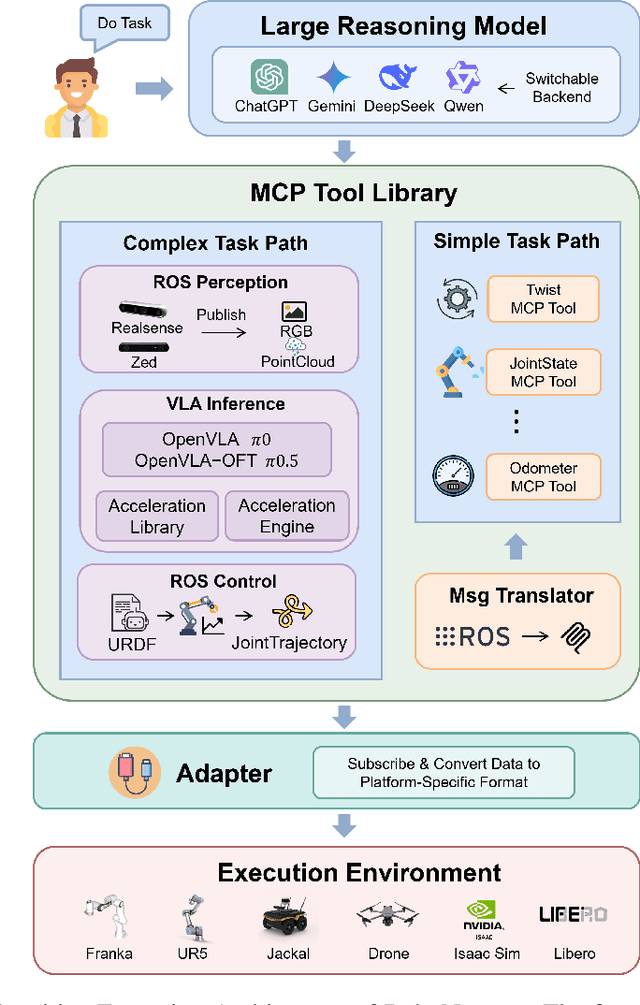
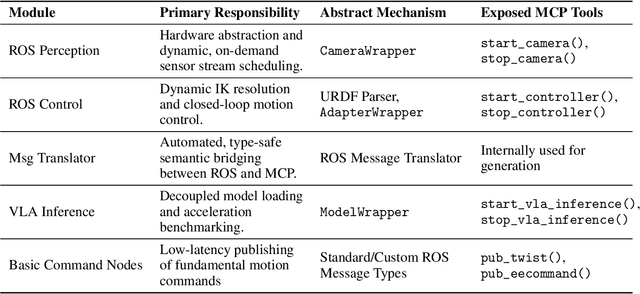
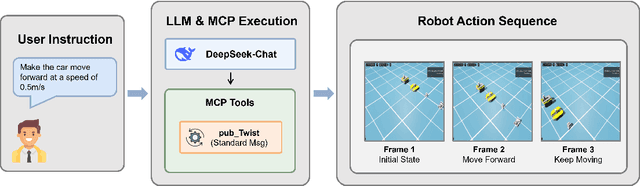
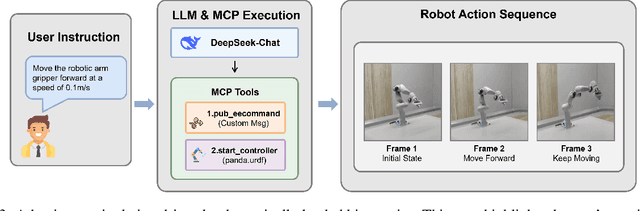
Current embodied AI systems face severe engineering impediments, primarily characterized by poor cross-scenario adaptability, rigid inter-module coupling, and fragmented inference acceleration. To overcome these limitations, we propose RoboNeuron, a universal deployment framework for embodied intelligence. RoboNeuron is the first framework to deeply integrate the cognitive capabilities of Large Language Models (LLMs) and Vision-Language-Action (VLA) models with the real-time execution backbone of the Robot Operating System (ROS). We utilize the Model Context Protocol (MCP) as a semantic bridge, enabling the LLM to dynamically orchestrate underlying robotic tools. The framework establishes a highly modular architecture that strictly decouples sensing, reasoning, and control by leveraging ROS's unified communication interfaces. Crucially, we introduce an automated tool to translate ROS messages into callable MCP functions, significantly streamlining development. RoboNeuron significantly enhances cross-scenario adaptability and component flexibility, while establishing a systematic platform for horizontal performance benchmarking, laying a robust foundation for scalable real-world embodied applications.
Scaling RL to Long Videos
Jul 10, 2025We introduce a full-stack framework that scales up reasoning in vision-language models (VLMs) to long videos, leveraging reinforcement learning. We address the unique challenges of long video reasoning by integrating three critical components: (1) a large-scale dataset, LongVideo-Reason, comprising 52K long video QA pairs with high-quality reasoning annotations across diverse domains such as sports, games, and vlogs; (2) a two-stage training pipeline that extends VLMs with chain-of-thought supervised fine-tuning (CoT-SFT) and reinforcement learning (RL); and (3) a training infrastructure for long video RL, named Multi-modal Reinforcement Sequence Parallelism (MR-SP), which incorporates sequence parallelism and a vLLM-based engine tailored for long video, using cached video embeddings for efficient rollout and prefilling. In experiments, LongVILA-R1-7B achieves strong performance on long video QA benchmarks such as VideoMME. It also outperforms Video-R1-7B and even matches Gemini-1.5-Pro across temporal reasoning, goal and purpose reasoning, spatial reasoning, and plot reasoning on our LongVideo-Reason-eval benchmark. Notably, our MR-SP system achieves up to 2.1x speedup on long video RL training. LongVILA-R1 demonstrates consistent performance gains as the number of input video frames scales. LongVILA-R1 marks a firm step towards long video reasoning in VLMs. In addition, we release our training system for public availability that supports RL training on various modalities (video, text, and audio), various models (VILA and Qwen series), and even image and video generation models. On a single A100 node (8 GPUs), it supports RL training on hour-long videos (e.g., 3,600 frames / around 256k tokens).
LServe: Efficient Long-sequence LLM Serving with Unified Sparse Attention
Feb 20, 2025Large language models (LLMs) have shown remarkable potential in processing long sequences, yet efficiently serving these long-context models remains challenging due to the quadratic computational complexity of attention in the prefilling stage and the large memory footprint of the KV cache in the decoding stage. To address these issues, we introduce LServe, an efficient system that accelerates long-sequence LLM serving via hybrid sparse attention. This method unifies different hardware-friendly, structured sparsity patterns for both prefilling and decoding attention into a single framework, where computations on less important tokens are skipped block-wise. LServe demonstrates the compatibility of static and dynamic sparsity in long-context LLM attention. This design enables multiplicative speedups by combining these optimizations. Specifically, we convert half of the attention heads to nearly free streaming heads in both the prefilling and decoding stages. Additionally, we find that only a constant number of KV pages is required to preserve long-context capabilities, irrespective of context length. We then design a hierarchical KV page selection policy that dynamically prunes KV pages based on query-centric similarity. On average, LServe accelerates LLM prefilling by up to 2.9x and decoding by 1.3-2.1x over vLLM, maintaining long-context accuracy. Code is released at https://github.com/mit-han-lab/omniserve.