 Add to Chrome
 Add to Firefox
 Add to Edge
Hide to Guide: Learning via Semantic Masking
May 24, 2026
Reinforcement learning with verifiable rewards (RLVR) has become a powerful paradigm for improving language models on reasoning-intensive tasks, but its effectiveness is often limited by exploration. For example, models often fail on hard problems, leaving little useful reward signal. External expert traces offer a natural source of guidance, yet they may also expose reward-relevant content along the critical path to the verifier target, such as final answers, intermediate values, executable implementations, or answer-related entities. This content can create an unintended reward hacking channel, allowing the policy to obtain reward by copying the trace rather than learning the underlying reasoning or agentic behavior. Existing guided-RL methods reduce this risk by using partial trajectories, but they mainly control how much expert information is shown heuristically rather than which parts should be hidden. To this end, we propose Semantic Masked Expert Policy Optimization (SMEPO), a fine-grained semantic masking strategy for expert-guided RLVR. Instead of truncating traces coarsely or revealing them unchanged, SMEPO masks reward-relevant semantic spans along the critical path while preserving the expert's decomposition, plan, and procedural structure. This turns hard problems from reasoning from scratch into a fill-in-the-blank process: the policy can follow the expert's problem-solving route, but must still reconstruct the missing values, code, or entities by itself. SMEPO is simple to apply and requires no changes to the reward function or RL objective. Across diverse domains, including math, code, and agentic search, SMEPO improves accuracy by up to 3.2 points over GRPO and reduces training time by up to 4.2x. The code is available at https://github.com/mit-han-lab/SMEPO.

Lightning OPD: Efficient Post-Training for Large Reasoning Models with Offline On-Policy Distillation
Apr 14, 2026On-policy distillation (OPD) has emerged as an efficient post-training paradigm for large language models. However, standard OPD requires a live teacher inference server throughout training, resulting in substantial infrastructure overhead. In this work, we investigate whether on-policy distillation can be performed offline. A natural approach is to precompute teacher log-probabilities once over SFT rollouts and reuse them during training. In practice, however, this offline variant fails to reliably match the performance of standard OPD. To understand this discrepancy, we identify a previously overlooked condition that is critical for any OPD pipeline, which we term teacher consistency. This condition requires that the same teacher model be used for both supervised fine-tuning and OPD. We show that violating teacher consistency introduces an irreducible gradient bias, causing both offline and online OPD to converge to a suboptimal fixed point regardless of training duration. Building on this insight, we propose Lightning OPD, an offline on-policy distillation framework that enforces teacher consistency by precomputing teacher log-probabilities over SFT rollouts. This design eliminates the need for a live teacher server entirely. We further show that, under teacher consistency, Lightning OPD shares the same optimum as standard OPD, with bounded gradient discrepancy and an implicit regularization effect that helps prevent policy drift. Extensive experiments on mathematical reasoning and code generation demonstrate that Lightning OPD achieves state-of-the-art performance with significantly improved efficiency. Starting from an SFT-initialized Qwen3-8B-Base model, Lightning OPD reaches 69.9% on AIME 2024 in just 30 GPU hours, achieving a 4.0x speedup over standard OPD and substantially lowering the barrier to entry for academic research on LLM post-training.
EgoVLA: Learning Vision-Language-Action Models from Egocentric Human Videos
Jul 16, 2025Real robot data collection for imitation learning has led to significant advancements in robotic manipulation. However, the requirement for robot hardware in the process fundamentally constrains the scale of the data. In this paper, we explore training Vision-Language-Action (VLA) models using egocentric human videos. The benefit of using human videos is not only for their scale but more importantly for the richness of scenes and tasks. With a VLA trained on human video that predicts human wrist and hand actions, we can perform Inverse Kinematics and retargeting to convert the human actions to robot actions. We fine-tune the model using a few robot manipulation demonstrations to obtain the robot policy, namely EgoVLA. We propose a simulation benchmark called Isaac Humanoid Manipulation Benchmark, where we design diverse bimanual manipulation tasks with demonstrations. We fine-tune and evaluate EgoVLA with Isaac Humanoid Manipulation Benchmark and show significant improvements over baselines and ablate the importance of human data. Videos can be found on our website: https://rchalyang.github.io/EgoVLA
CoT-VLA: Visual Chain-of-Thought Reasoning for Vision-Language-Action Models
Mar 27, 2025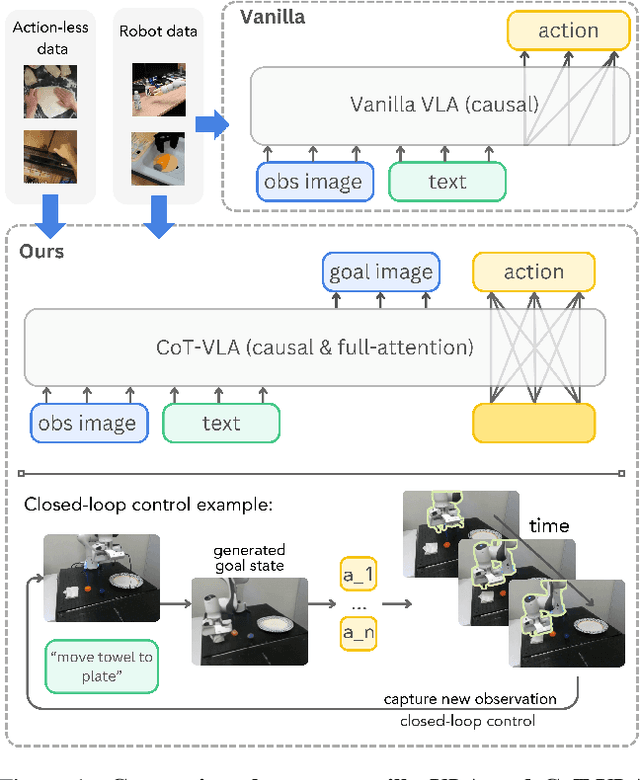

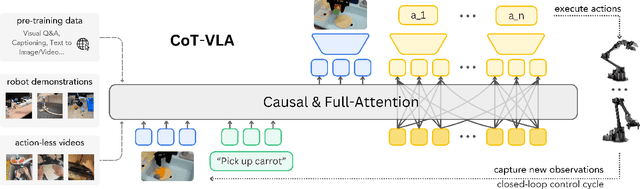
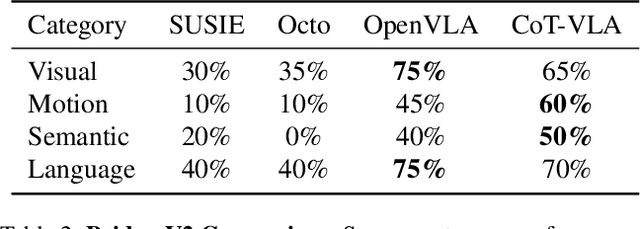
Vision-language-action models (VLAs) have shown potential in leveraging pretrained vision-language models and diverse robot demonstrations for learning generalizable sensorimotor control. While this paradigm effectively utilizes large-scale data from both robotic and non-robotic sources, current VLAs primarily focus on direct input--output mappings, lacking the intermediate reasoning steps crucial for complex manipulation tasks. As a result, existing VLAs lack temporal planning or reasoning capabilities. In this paper, we introduce a method that incorporates explicit visual chain-of-thought (CoT) reasoning into vision-language-action models (VLAs) by predicting future image frames autoregressively as visual goals before generating a short action sequence to achieve these goals. We introduce CoT-VLA, a state-of-the-art 7B VLA that can understand and generate visual and action tokens. Our experimental results demonstrate that CoT-VLA achieves strong performance, outperforming the state-of-the-art VLA model by 17% in real-world manipulation tasks and 6% in simulation benchmarks. Project website: https://cot-vla.github.io/
* Project website: https://cot-vla.github.io/
HART: Efficient Visual Generation with Hybrid Autoregressive Transformer
Oct 14, 2024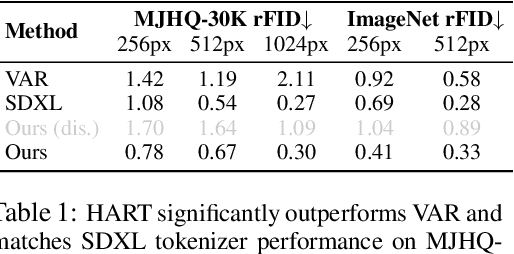


We introduce Hybrid Autoregressive Transformer (HART), an autoregressive (AR) visual generation model capable of directly generating 1024x1024 images, rivaling diffusion models in image generation quality. Existing AR models face limitations due to the poor image reconstruction quality of their discrete tokenizers and the prohibitive training costs associated with generating 1024px images. To address these challenges, we present the hybrid tokenizer, which decomposes the continuous latents from the autoencoder into two components: discrete tokens representing the big picture and continuous tokens representing the residual components that cannot be represented by the discrete tokens. The discrete component is modeled by a scalable-resolution discrete AR model, while the continuous component is learned with a lightweight residual diffusion module with only 37M parameters. Compared with the discrete-only VAR tokenizer, our hybrid approach improves reconstruction FID from 2.11 to 0.30 on MJHQ-30K, leading to a 31% generation FID improvement from 7.85 to 5.38. HART also outperforms state-of-the-art diffusion models in both FID and CLIP score, with 4.5-7.7x higher throughput and 6.9-13.4x lower MACs. Our code is open sourced at https://github.com/mit-han-lab/hart.
VILA-U: a Unified Foundation Model Integrating Visual Understanding and Generation
Sep 06, 2024


VILA-U is a Unified foundation model that integrates Video, Image, Language understanding and generation. Traditional visual language models (VLMs) use separate modules for understanding and generating visual content, which can lead to misalignment and increased complexity. In contrast, VILA-U employs a single autoregressive next-token prediction framework for both tasks, eliminating the need for additional components like diffusion models. This approach not only simplifies the model but also achieves near state-of-the-art performance in visual language understanding and generation. The success of VILA-U is attributed to two main factors: the unified vision tower that aligns discrete visual tokens with textual inputs during pretraining, which enhances visual perception, and autoregressive image generation can achieve similar quality as diffusion models with high-quality dataset. This allows VILA-U to perform comparably to more complex models using a fully token-based autoregressive framework.