 Add to Chrome
 Add to Firefox
 Add to Edge
SpatialCLI: Learning to Reason With Spatial Tools, Then Without Them
Jul 30, 2026
Vision-language models (VLMs) are increasingly used in embodied agents to interpret visual inputs, reason about spatial relationships, and make task-level decisions based on that reasoning. However, a fundamental capability mismatch remains: general VLMs can reason about the overall task but often miss the visual details that determine success, while specialist vision models can capture those details but cannot translate them into task-level decisions. In this work, we propose SpatialCLI, a framework that teaches VLMs to reason with spatial tools and progressively internalize the specialist perceptual capabilities they provide. SpatialCLI proceeds in three stages: (1) Call exposes specialist vision models as spatial tools to augment the VLM's perception; (2) Learn uses Cold-Start SFT and agentic RL to improve tool use; and (3) Internalize verbalizes successful tool-use trajectories to internalize specialist perceptual capabilities. We further introduce SpatialCLI-Bench, a 516-example benchmark for compositional perception across localization, segmentation, depth, and pose. On MindCube, SpatialCLI raises Qwen3-VL-8B-Instruct from 29.3% to 84.6% with tools, surpassing GPT-5.6 Sol with tools (72.1%), while retaining 73.8% without tools after internalization.

Do Phone-Use Agents Respect Your Privacy?
Apr 02, 2026We study whether phone-use agents respect privacy while completing benign mobile tasks. This question has remained hard to answer because privacy-compliant behavior is not operationalized for phone-use agents, and ordinary apps do not reveal exactly what data agents type into which form entries during execution. To make this question measurable, we introduce MyPhoneBench, a verifiable evaluation framework for privacy behavior in mobile agents. We operationalize privacy-respecting phone use as permissioned access, minimal disclosure, and user-controlled memory through a minimal privacy contract, iMy, and pair it with instrumented mock apps plus rule-based auditing that make unnecessary permission requests, deceptive re-disclosure, and unnecessary form filling observable and reproducible. Across five frontier models on 10 mobile apps and 300 tasks, we find that task success, privacy-compliant task completion, and later-session use of saved preferences are distinct capabilities, and no single model dominates all three. Evaluating success and privacy jointly reshuffles the model ordering relative to either metric alone. The most persistent failure mode across models is simple data minimization: agents still fill optional personal entries that the task does not require. These results show that privacy failures arise from over-helpful execution of benign tasks, and that success-only evaluation overestimates the deployment readiness of current phone-use agents. All code, mock apps, and agent trajectories are publicly available at~ https://github.com/FreedomIntelligence/MyPhoneBench.
EvA: An Evidence-First Audio Understanding Paradigm for LALMs
Mar 29, 2026Large Audio Language Models (LALMs) still struggle in complex acoustic scenes because they often fail to preserve task-relevant acoustic evidence before reasoning begins. We call this failure the evidence bottleneck: state-of-the-art systems show larger deficits in evidence extraction than in downstream reasoning, suggesting that the main limitation lies in upstream perception rather than reasoning policy. To address this problem, we propose EvA (Evidence-First Audio), a dual-path architecture that combines Whisper and CED-Base through non-compressive, time-aligned fusion. EvA first aggregates intermediate CED layers to preserve multi-scale acoustic cues, then aligns the aggregated CED features to the Whisper timeline and adds the two streams without changing sequence length. We also build EvA-Perception, a large-scale open-source training set with about 54K event-ordered captions (150 h) and about 500K QA pairs. Under a unified zero-shot protocol, EvA achieves the best open-source Perception scores on MMAU, MMAR, and MMSU, and improves over Kimi-Audio-7B on all reported metrics, with the largest gains on perception-heavy splits. These results support the evidence-first hypothesis: stronger audio understanding depends on preserving acoustic evidence before reasoning.
BlenderLLM: Training Large Language Models for Computer-Aided Design with Self-improvement
Dec 16, 2024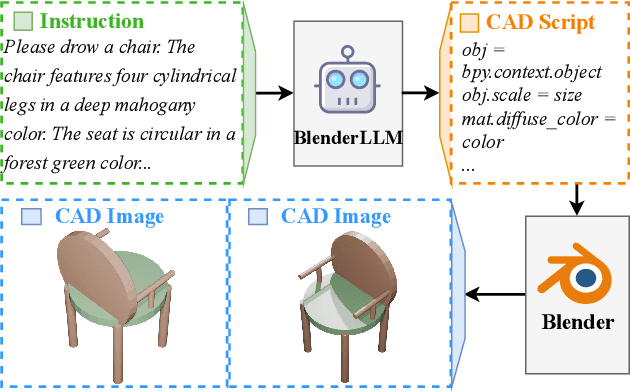
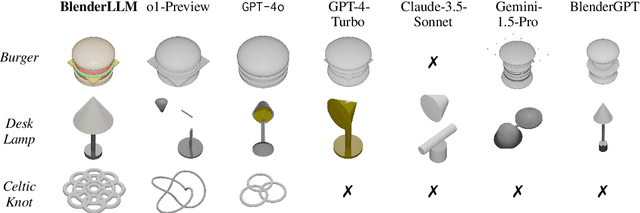
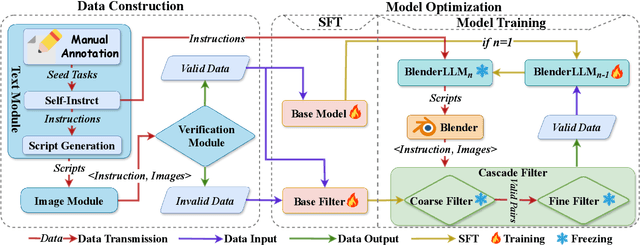
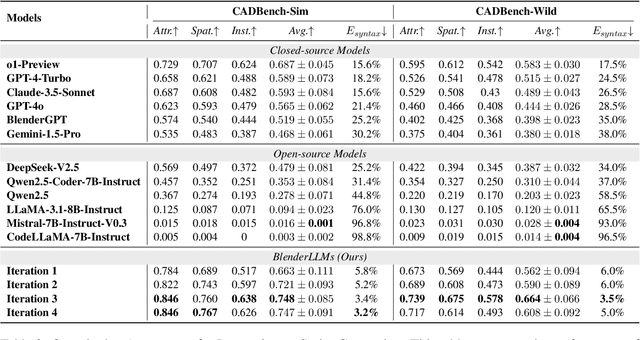
The application of Large Language Models (LLMs) in Computer-Aided Design (CAD) remains an underexplored area, despite their remarkable advancements in other domains. In this paper, we present BlenderLLM, a novel framework for training LLMs specifically for CAD tasks leveraging a self-improvement methodology. To support this, we developed a bespoke training dataset, BlendNet, and introduced a comprehensive evaluation suite, CADBench. Our results reveal that existing models demonstrate significant limitations in generating accurate CAD scripts. However, through minimal instruction-based fine-tuning and iterative self-improvement, BlenderLLM significantly surpasses these models in both functionality and accuracy of CAD script generation. This research establishes a strong foundation for the application of LLMs in CAD while demonstrating the transformative potential of self-improving models in advancing CAD automation. We encourage further exploration and adoption of these methodologies to drive innovation in the field. The dataset, model, benchmark, and source code are publicly available at https://github.com/FreedomIntelligence/BlenderLLM
Both Text and Images Leaked! A Systematic Analysis of Multimodal LLM Data Contamination
Nov 06, 2024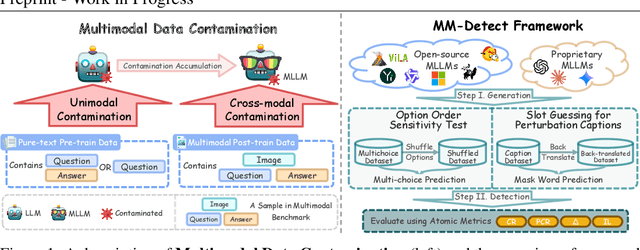
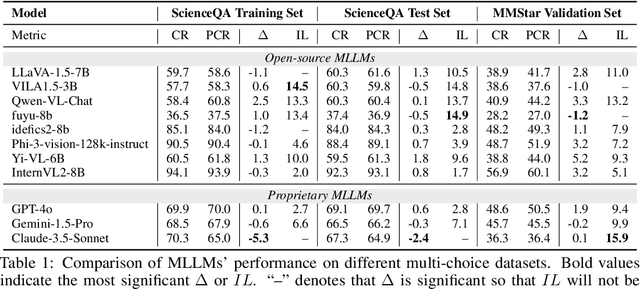
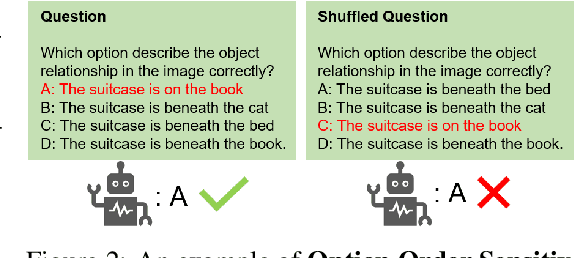

The rapid progression of multimodal large language models (MLLMs) has demonstrated superior performance on various multimodal benchmarks. However, the issue of data contamination during training creates challenges in performance evaluation and comparison. While numerous methods exist for detecting dataset contamination in large language models (LLMs), they are less effective for MLLMs due to their various modalities and multiple training phases. In this study, we introduce a multimodal data contamination detection framework, MM-Detect, designed for MLLMs. Our experimental results indicate that MM-Detect is sensitive to varying degrees of contamination and can highlight significant performance improvements due to leakage of the training set of multimodal benchmarks. Furthermore, We also explore the possibility of contamination originating from the pre-training phase of LLMs used by MLLMs and the fine-tuning phase of MLLMs, offering new insights into the stages at which contamination may be introduced.
VLFeedback: A Large-Scale AI Feedback Dataset for Large Vision-Language Models Alignment
Oct 12, 2024

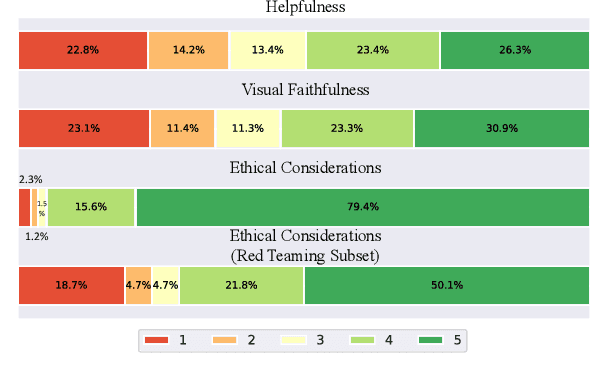

As large vision-language models (LVLMs) evolve rapidly, the demand for high-quality and diverse data to align these models becomes increasingly crucial. However, the creation of such data with human supervision proves costly and time-intensive. In this paper, we investigate the efficacy of AI feedback to scale supervision for aligning LVLMs. We introduce VLFeedback, the first large-scale vision-language feedback dataset, comprising over 82K multi-modal instructions and comprehensive rationales generated by off-the-shelf models without human annotations. To evaluate the effectiveness of AI feedback for vision-language alignment, we train Silkie, an LVLM fine-tuned via direct preference optimization on VLFeedback. Silkie showcases exceptional performance regarding helpfulness, visual faithfulness, and safety metrics. It outperforms its base model by 6.9\% and 9.5\% in perception and cognition tasks, reduces hallucination issues on MMHal-Bench, and exhibits enhanced resilience against red-teaming attacks. Furthermore, our analysis underscores the advantage of AI feedback, particularly in fostering preference diversity to deliver more comprehensive improvements. Our dataset, training code and models are available at https://vlf-silkie.github.io.
Less is More: A Simple yet Effective Token Reduction Method for Efficient Multi-modal LLMs
Sep 17, 2024The rapid advancement of Multimodal Large Language Models (MLLMs) has led to remarkable performances across various domains. However, this progress is accompanied by a substantial surge in the resource consumption of these models. We address this pressing issue by introducing a new approach, Token Reduction using CLIP Metric (TRIM), aimed at improving the efficiency of MLLMs without sacrificing their performance. Inspired by human attention patterns in Visual Question Answering (VQA) tasks, TRIM presents a fresh perspective on the selection and reduction of image tokens. The TRIM method has been extensively tested across 12 datasets, and the results demonstrate a significant reduction in computational overhead while maintaining a consistent level of performance. This research marks a critical stride in efficient MLLM development, promoting greater accessibility and sustainability of high-performing models.
LongLLaVA: Scaling Multi-modal LLMs to 1000 Images Efficiently via Hybrid Architecture
Sep 04, 2024
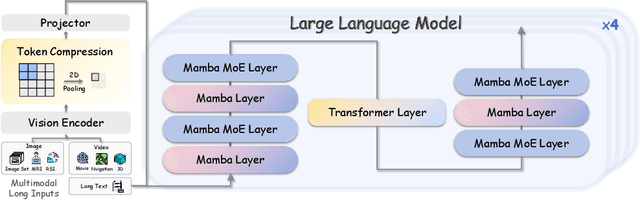
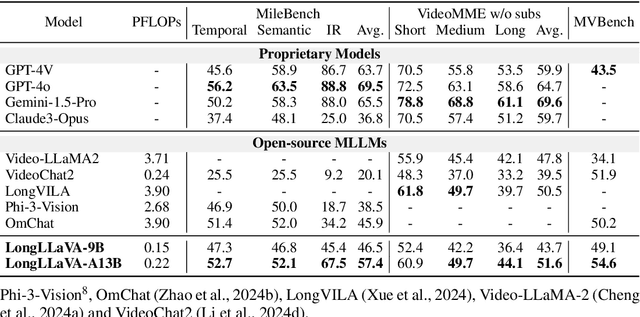

Expanding the long-context capabilities of Multi-modal Large Language Models~(MLLMs) is crucial for video understanding, high-resolution image understanding, and multi-modal agents. This involves a series of systematic optimizations, including model architecture, data construction and training strategy, particularly addressing challenges such as \textit{degraded performance with more images} and \textit{high computational costs}. In this paper, we adapt the model architecture to a hybrid of Mamba and Transformer blocks, approach data construction with both temporal and spatial dependencies among multiple images and employ a progressive training strategy. The released model \textbf{LongLLaVA}~(\textbf{Long}-Context \textbf{L}arge \textbf{L}anguage \textbf{a}nd \textbf{V}ision \textbf{A}ssistant) is the first hybrid MLLM, which achieved a better balance between efficiency and effectiveness. LongLLaVA not only achieves competitive results across various benchmarks, but also maintains high throughput and low memory consumption. Especially, it could process nearly a thousand images on a single A100 80GB GPU, showing promising application prospects for a wide range of tasks.
Open-FinLLMs: Open Multimodal Large Language Models for Financial Applications
Aug 20, 2024


Large language models (LLMs) have advanced financial applications, yet they often lack sufficient financial knowledge and struggle with tasks involving multi-modal inputs like tables and time series data. To address these limitations, we introduce \textit{Open-FinLLMs}, a series of Financial LLMs. We begin with FinLLaMA, pre-trained on a 52 billion token financial corpus, incorporating text, tables, and time-series data to embed comprehensive financial knowledge. FinLLaMA is then instruction fine-tuned with 573K financial instructions, resulting in FinLLaMA-instruct, which enhances task performance. Finally, we present FinLLaVA, a multimodal LLM trained with 1.43M image-text instructions to handle complex financial data types. Extensive evaluations demonstrate FinLLaMA's superior performance over LLaMA3-8B, LLaMA3.1-8B, and BloombergGPT in both zero-shot and few-shot settings across 19 and 4 datasets, respectively. FinLLaMA-instruct outperforms GPT-4 and other Financial LLMs on 15 datasets. FinLLaVA excels in understanding tables and charts across 4 multimodal tasks. Additionally, FinLLaMA achieves impressive Sharpe Ratios in trading simulations, highlighting its robust financial application capabilities. We will continually maintain and improve our models and benchmarks to support ongoing innovation in academia and industry.
HuatuoGPT-Vision, Towards Injecting Medical Visual Knowledge into Multimodal LLMs at Scale
Jun 27, 2024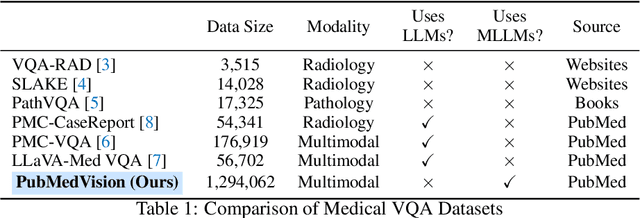
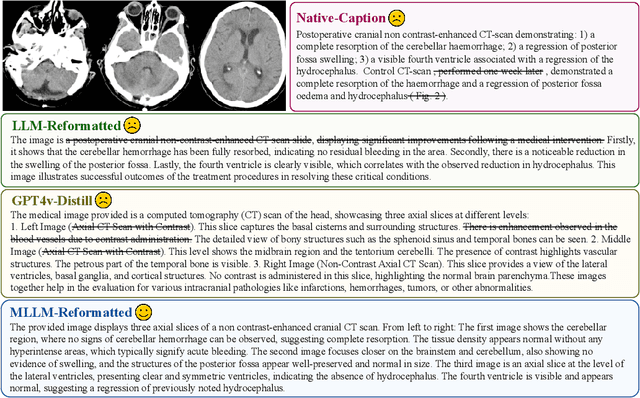

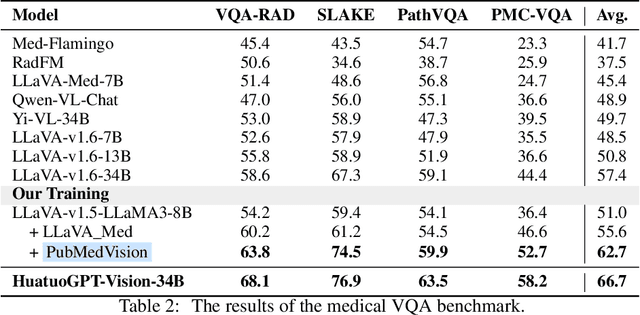
The rapid development of multimodal large language models (MLLMs), such as GPT-4V, has led to significant advancements. However, these models still face challenges in medical multimodal capabilities due to limitations in the quantity and quality of medical vision-text data, stemming from data privacy concerns and high annotation costs. While pioneering approaches utilize PubMed's large-scale, de-identified medical image-text pairs to address these limitations, they still fall short due to inherent data noise. To tackle this, we refined medical image-text pairs from PubMed and employed MLLMs (GPT-4V) in an 'unblinded' capacity to denoise and reformat the data, resulting in the creation of the PubMedVision dataset with 1.3 million medical VQA samples. Our validation demonstrates that: (1) PubMedVision can significantly enhance the medical multimodal capabilities of current MLLMs, showing significant improvement in benchmarks including the MMMU Health & Medicine track; (2) manual checks by medical experts and empirical results validate the superior data quality of our dataset compared to other data construction methods. Using PubMedVision, we train a 34B medical MLLM HuatuoGPT-Vision, which shows superior performance in medical multimodal scenarios among open-source MLLMs.