 Add to Chrome
 Add to Firefox
 Add to Edge
Herculean: An Agentic Benchmark for Financial Intelligence
May 14, 2026
As AI agents improve, the central question is no longer whether they can solve isolated well-defined financial tasks, but whether they can reliably carry out financial professional work. Existing financial benchmarks offer only a partial view of this ability, as they primarily evaluate static competencies such as question answering, retrieval, summarization, and classification. We introduce Herculean, the first skilled benchmark for agentic financial intelligence spanning four representative workflows, including Trading, Hedging, Market Insights, and Auditing. Each workflow is instantiated as a standardized MCP-based skill environment with its own tools, interaction dynamics, constraints, and success criteria, enabling consistent end-to-end assessment of heterogeneous agent systems. Across frontier agents, we find agents perform relatively well on Trading and Market Insights, but struggle substantially on Hedging and Auditing, where long-horizon coordination, state consistency, and structured verification are critical. Overall, our results point to a key gap in current agents in turning financial reasoning into dependable workflow execution in high-stakes financial workflows.

FinReporting: An Agentic Workflow for Localized Reporting of Cross-Jurisdiction Financial Disclosures
Apr 07, 2026Financial reporting systems increasingly use large language models (LLMs) to extract and summarize corporate disclosures. However, most assume a single-market setting and do not address structural differences across jurisdictions. Variations in accounting taxonomies, tagging infrastructures (e.g., XBRL vs. PDF), and aggregation conventions make cross-jurisdiction reporting a semantic alignment and verification challenge. We present FinReporting, an agentic workflow for localized cross-jurisdiction financial reporting. The system builds a unified canonical ontology over Income Statement, Balance Sheet, and Cash Flow, and decomposes reporting into auditable stages including filing acquisition, extraction, canonical mapping, and anomaly logging. Rather than using LLMs as free-form generators, FinReporting deploys them as constrained verifiers under explicit decision rules and evidence grounding. Evaluated on annual filings from the US, Japan, and China, the system improves consistency and reliability under heterogeneous reporting regimes. We release an interactive demo supporting cross-market inspection and structured export of localized financial statements. Our demo is available at https://huggingface.co/spaces/BoomQ/FinReporting-Demo . The video describing our system is available at https://www.youtube.com/watch?v=f65jdEL31Kk
Can LLM Agents Be CFOs? A Benchmark for Resource Allocation in Dynamic Enterprise Environments
Mar 24, 2026Large language models (LLMs) have enabled agentic systems that can reason, plan, and act across complex tasks, but it remains unclear whether they can allocate resources effectively under uncertainty. Unlike short-horizon reactive decisions, allocation requires committing scarce resources over time while balancing competing objectives and preserving flexibility for future needs. We introduce EnterpriseArena, the first benchmark for evaluating agents on long-horizon enterprise resource allocation. It instantiates CFO-style decision-making in a 132-month enterprise simulator combining firm-level financial data, anonymized business documents, macroeconomic and industry signals, and expert-validated operating rules. The environment is partially observable and reveals the state only through budgeted organizational tools, forcing agents to trade off information acquisition against conserving scarce resources. Experiments on eleven advanced LLMs show that this setting remains highly challenging: only 16% of runs survive the full horizon, and larger models do not reliably outperform smaller ones. These results identify long-horizon resource allocation under uncertainty as a distinct capability gap for current LLM agents.
Conv-FinRe: A Conversational and Longitudinal Benchmark for Utility-Grounded Financial Recommendation
Feb 19, 2026Most recommendation benchmarks evaluate how well a model imitates user behavior. In financial advisory, however, observed actions can be noisy or short-sighted under market volatility and may conflict with a user's long-term goals. Treating what users chose as the sole ground truth, therefore, conflates behavioral imitation with decision quality. We introduce Conv-FinRe, a conversational and longitudinal benchmark for stock recommendation that evaluates LLMs beyond behavior matching. Given an onboarding interview, step-wise market context, and advisory dialogues, models must generate rankings over a fixed investment horizon. Crucially, Conv-FinRe provides multi-view references that distinguish descriptive behavior from normative utility grounded in investor-specific risk preferences, enabling diagnosis of whether an LLM follows rational analysis, mimics user noise, or is driven by market momentum. We build the benchmark from real market data and human decision trajectories, instantiate controlled advisory conversations, and evaluate a suite of state-of-the-art LLMs. Results reveal a persistent tension between rational decision quality and behavioral alignment: models that perform well on utility-based ranking often fail to match user choices, whereas behaviorally aligned models can overfit short-term noise. The dataset is publicly released on Hugging Face, and the codebase is available on GitHub.
All That Glisters Is Not Gold: A Benchmark for Reference-Free Counterfactual Financial Misinformation Detection
Jan 08, 2026We introduce RFC Bench, a benchmark for evaluating large language models on financial misinformation under realistic news. RFC Bench operates at the paragraph level and captures the contextual complexity of financial news where meaning emerges from dispersed cues. The benchmark defines two complementary tasks: reference free misinformation detection and comparison based diagnosis using paired original perturbed inputs. Experiments reveal a consistent pattern: performance is substantially stronger when comparative context is available, while reference free settings expose significant weaknesses, including unstable predictions and elevated invalid outputs. These results indicate that current models struggle to maintain coherent belief states without external grounding. By highlighting this gap, RFC Bench provides a structured testbed for studying reference free reasoning and advancing more reliable financial misinformation detection in real world settings.
FinCriticalED: A Visual Benchmark for Financial Fact-Level OCR Evaluation
Nov 19, 2025We introduce FinCriticalED (Financial Critical Error Detection), a visual benchmark for evaluating OCR and vision language models on financial documents at the fact level. Financial documents contain visually dense and table heavy layouts where numerical and temporal information is tightly coupled with structure. In high stakes settings, small OCR mistakes such as sign inversion or shifted dates can lead to materially different interpretations, while traditional OCR metrics like ROUGE and edit distance capture only surface level text similarity. \ficriticaled provides 500 image-HTML pairs with expert annotated financial facts covering over seven hundred numerical and temporal facts. It introduces three key contributions. First, it establishes the first fact level evaluation benchmark for financial document understanding, shifting evaluation from lexical overlap to domain critical factual correctness. Second, all annotations are created and verified by financial experts with strict quality control over signs, magnitudes, and temporal expressions. Third, we develop an LLM-as-Judge evaluation pipeline that performs structured fact extraction and contextual verification for visually complex financial documents. We benchmark OCR systems, open source vision language models, and proprietary models on FinCriticalED. Results show that although the strongest proprietary models achieve the highest factual accuracy, substantial errors remain in visually intricate numerical and temporal contexts. Through quantitative evaluation and expert case studies, FinCriticalED provides a rigorous foundation for advancing visual factual precision in financial and other precision critical domains.
RKEFino1: A Regulation Knowledge-Enhanced Large Language Model
Jun 06, 2025Recent advances in large language models (LLMs) hold great promise for financial applications but introduce critical accuracy and compliance challenges in Digital Regulatory Reporting (DRR). To address these issues, we propose RKEFino1, a regulation knowledge-enhanced financial reasoning model built upon Fino1, fine-tuned with domain knowledge from XBRL, CDM, and MOF. We formulate two QA tasks-knowledge-based and mathematical reasoning-and introduce a novel Numerical NER task covering financial entities in both sentences and tables. Experimental results demonstrate the effectiveness and generalization capacity of RKEFino1 in compliance-critical financial tasks. We have released our model on Hugging Face.
FinAudio: A Benchmark for Audio Large Language Models in Financial Applications
Mar 26, 2025Audio Large Language Models (AudioLLMs) have received widespread attention and have significantly improved performance on audio tasks such as conversation, audio understanding, and automatic speech recognition (ASR). Despite these advancements, there is an absence of a benchmark for assessing AudioLLMs in financial scenarios, where audio data, such as earnings conference calls and CEO speeches, are crucial resources for financial analysis and investment decisions. In this paper, we introduce \textsc{FinAudio}, the first benchmark designed to evaluate the capacity of AudioLLMs in the financial domain. We first define three tasks based on the unique characteristics of the financial domain: 1) ASR for short financial audio, 2) ASR for long financial audio, and 3) summarization of long financial audio. Then, we curate two short and two long audio datasets, respectively, and develop a novel dataset for financial audio summarization, comprising the \textsc{FinAudio} benchmark. Then, we evaluate seven prevalent AudioLLMs on \textsc{FinAudio}. Our evaluation reveals the limitations of existing AudioLLMs in the financial domain and offers insights for improving AudioLLMs. All datasets and codes will be released.
Enhancing Financial Time-Series Forecasting with Retrieval-Augmented Large Language Models
Feb 11, 2025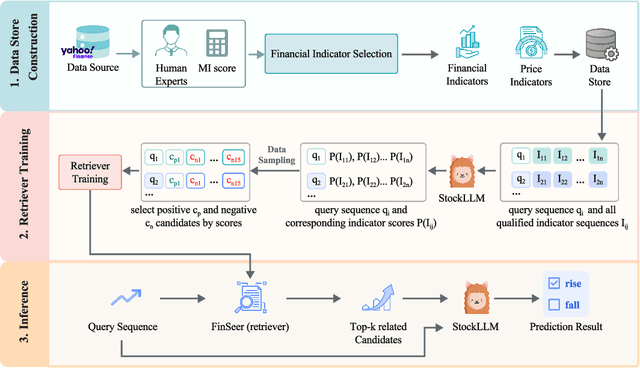
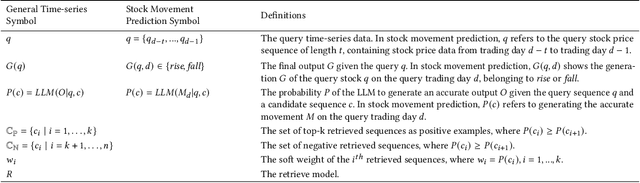
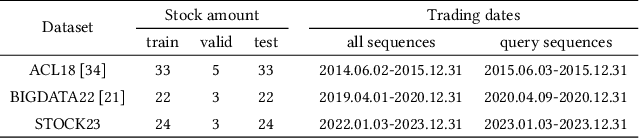
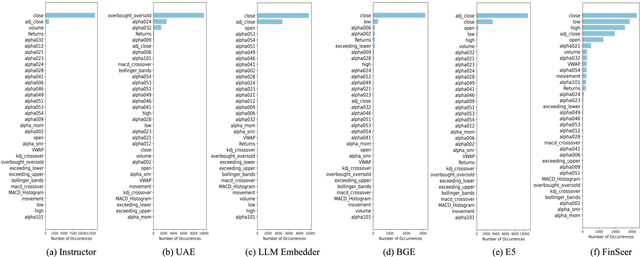
Stock movement prediction, a critical task in financial time-series forecasting, relies on identifying and retrieving key influencing factors from vast and complex datasets. However, traditional text-trained or numeric similarity-based retrieval methods often struggle to handle the intricacies of financial data. To address this, we propose the first retrieval-augmented generation (RAG) framework specifically designed for financial time-series forecasting. Our framework incorporates three key innovations: a fine-tuned 1B large language model (StockLLM) as its backbone, a novel candidate selection method enhanced by LLM feedback, and a training objective that maximizes the similarity between queries and historically significant sequences. These advancements enable our retriever, FinSeer, to uncover meaningful patterns while effectively minimizing noise in complex financial datasets. To support robust evaluation, we also construct new datasets that integrate financial indicators and historical stock prices. Experimental results demonstrate that our RAG framework outperforms both the baseline StockLLM and random retrieval methods, showcasing its effectiveness. FinSeer, as the retriever, achieves an 8% higher accuracy on the BIGDATA22 benchmark and retrieves more impactful sequences compared to existing retrieval methods. This work highlights the importance of tailored retrieval models in financial forecasting and provides a novel, scalable framework for future research in the field.
Retrieval-augmented Large Language Models for Financial Time Series Forecasting
Feb 09, 2025Stock movement prediction, a fundamental task in financial time-series forecasting, requires identifying and retrieving critical influencing factors from vast amounts of time-series data. However, existing text-trained or numeric similarity-based retrieval methods fall short in handling complex financial analysis. To address this, we propose the first retrieval-augmented generation (RAG) framework for financial time-series forecasting, featuring three key innovations: a fine-tuned 1B parameter large language model (StockLLM) as the backbone, a novel candidate selection method leveraging LLM feedback, and a training objective that maximizes similarity between queries and historically significant sequences. This enables our retriever, FinSeer, to uncover meaningful patterns while minimizing noise in complex financial data. We also construct new datasets integrating financial indicators and historical stock prices to train FinSeer and ensure robust evaluation. Experimental results demonstrate that our RAG framework outperforms bare StockLLM and random retrieval, highlighting its effectiveness, while FinSeer surpasses existing retrieval methods, achieving an 8\% higher accuracy on BIGDATA22 and retrieving more impactful sequences. This work underscores the importance of tailored retrieval models in financial forecasting and provides a novel framework for future research.