 Add to Chrome
 Add to Firefox
 Add to Edge
UniMax: Fairer and more Effective Language Sampling for Large-Scale Multilingual Pretraining
Apr 18, 2023


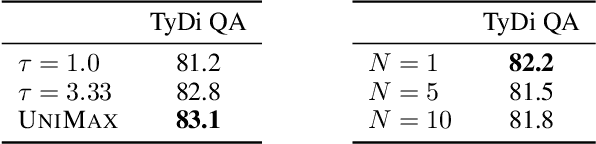
Pretrained multilingual large language models have typically used heuristic temperature-based sampling to balance between different languages. However previous work has not systematically evaluated the efficacy of different pretraining language distributions across model scales. In this paper, we propose a new sampling method, UniMax, that delivers more uniform coverage of head languages while mitigating overfitting on tail languages by explicitly capping the number of repeats over each language's corpus. We perform an extensive series of ablations testing a range of sampling strategies on a suite of multilingual benchmarks, while varying model scale. We find that UniMax outperforms standard temperature-based sampling, and the benefits persist as scale increases. As part of our contribution, we release: (i) an improved and refreshed mC4 multilingual corpus consisting of 29 trillion characters across 107 languages, and (ii) a suite of pretrained umT5 model checkpoints trained with UniMax sampling.

Character-Aware Models Improve Visual Text Rendering
Dec 20, 2022
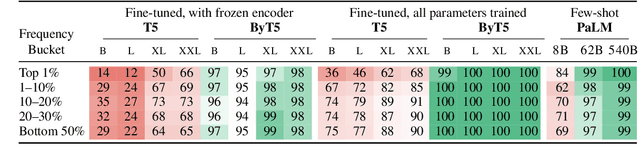
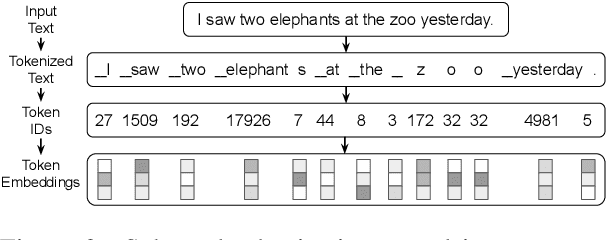
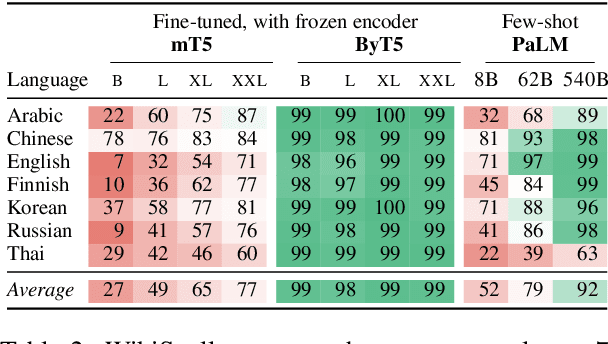
Current image generation models struggle to reliably produce well-formed visual text. In this paper, we investigate a key contributing factor: popular text-to-image models lack character-level input features, making it much harder to predict a word's visual makeup as a series of glyphs. To quantify the extent of this effect, we conduct a series of controlled experiments comparing character-aware vs. character-blind text encoders. In the text-only domain, we find that character-aware models provide large gains on a novel spelling task (WikiSpell). Transferring these learnings onto the visual domain, we train a suite of image generation models, and show that character-aware variants outperform their character-blind counterparts across a range of novel text rendering tasks (our DrawText benchmark). Our models set a much higher state-of-the-art on visual spelling, with 30+ point accuracy gains over competitors on rare words, despite training on far fewer examples.
FCM: Forgetful Causal Masking Makes Causal Language Models Better Zero-Shot Learners
Oct 24, 2022Large language models (LLM) trained using the next-token-prediction objective, such as GPT3 and PaLM, have revolutionized natural language processing in recent years by showing impressive zero-shot and few-shot capabilities across a wide range of tasks. In this work, we propose a simple technique that significantly boosts the performance of LLMs without adding computational cost. Our key observation is that, by performing the next token prediction task with randomly selected past tokens masked out, we can improve the quality of the learned representations for downstream language understanding tasks. We hypothesize that randomly masking past tokens prevents over-attending to recent tokens and encourages attention to tokens in the distant past. By randomly masking input tokens in the PaLM model, we show that we can significantly improve 1B and 8B PaLM's zero-shot performance on the SuperGLUE benchmark from 55.7 to 59.2 and from 61.6 to 64.0, respectively. Our largest 8B model matches the score of PaLM with an average score of 64, despite the fact that PaLM is trained on a much larger dataset (780B tokens) of high-quality conversation and webpage data, while ours is trained on the smaller C4 dataset (180B tokens). Experimental results show that our method also improves PaLM's zero and few-shot performance on a diverse suite of tasks, including commonsense reasoning, natural language inference and cloze completion. Moreover, we show that our technique also helps representation learning, significantly improving PaLM's finetuning results.
Scaling Instruction-Finetuned Language Models
Oct 20, 2022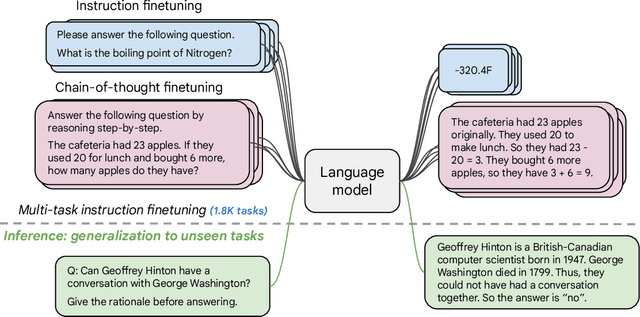
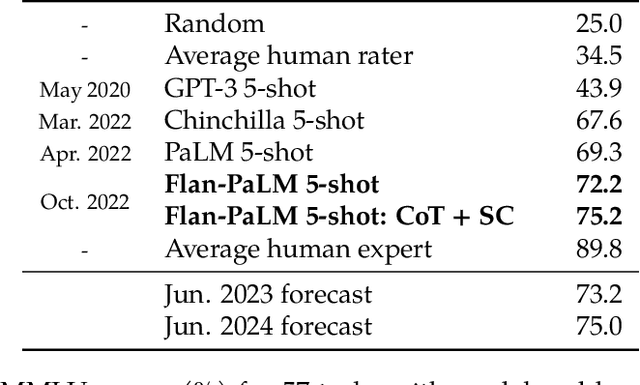
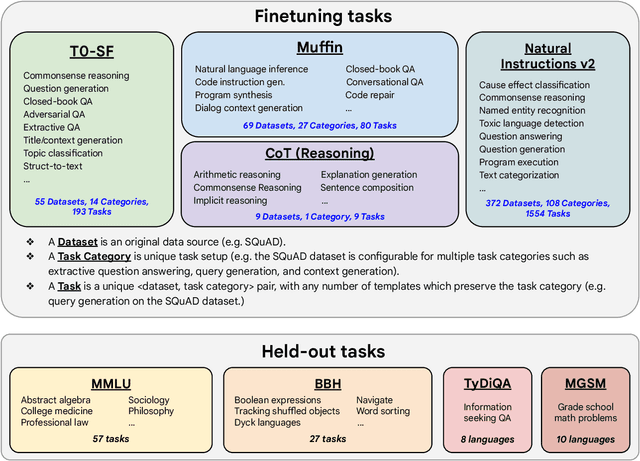
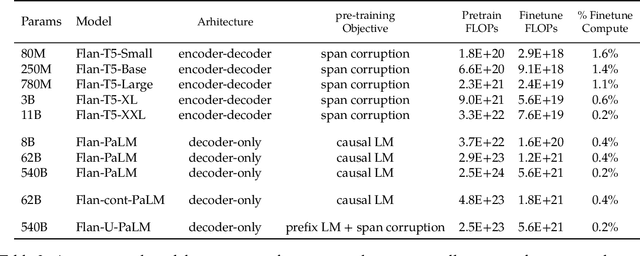
Finetuning language models on a collection of datasets phrased as instructions has been shown to improve model performance and generalization to unseen tasks. In this paper we explore instruction finetuning with a particular focus on (1) scaling the number of tasks, (2) scaling the model size, and (3) finetuning on chain-of-thought data. We find that instruction finetuning with the above aspects dramatically improves performance on a variety of model classes (PaLM, T5, U-PaLM), prompting setups (zero-shot, few-shot, CoT), and evaluation benchmarks (MMLU, BBH, TyDiQA, MGSM, open-ended generation). For instance, Flan-PaLM 540B instruction-finetuned on 1.8K tasks outperforms PALM 540B by a large margin (+9.4% on average). Flan-PaLM 540B achieves state-of-the-art performance on several benchmarks, such as 75.2% on five-shot MMLU. We also publicly release Flan-T5 checkpoints, which achieve strong few-shot performance even compared to much larger models, such as PaLM 62B. Overall, instruction finetuning is a general method for improving the performance and usability of pretrained language models.
Understanding HTML with Large Language Models
Oct 08, 2022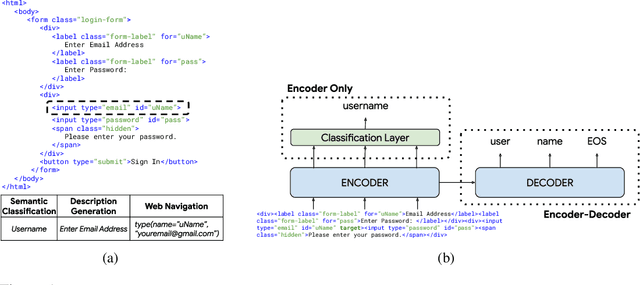

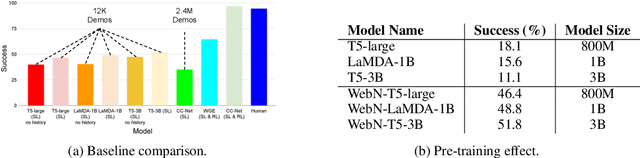
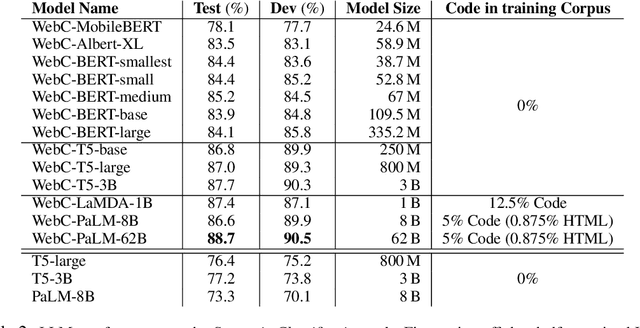
Large language models (LLMs) have shown exceptional performance on a variety of natural language tasks. Yet, their capabilities for HTML understanding -- i.e., parsing the raw HTML of a webpage, with applications to automation of web-based tasks, crawling, and browser-assisted retrieval -- have not been fully explored. We contribute HTML understanding models (fine-tuned LLMs) and an in-depth analysis of their capabilities under three tasks: (i) Semantic Classification of HTML elements, (ii) Description Generation for HTML inputs, and (iii) Autonomous Web Navigation of HTML pages. While previous work has developed dedicated architectures and training procedures for HTML understanding, we show that LLMs pretrained on standard natural language corpora transfer remarkably well to HTML understanding tasks. For instance, fine-tuned LLMs are 12% more accurate at semantic classification compared to models trained exclusively on the task dataset. Moreover, when fine-tuned on data from the MiniWoB benchmark, LLMs successfully complete 50% more tasks using 192x less data compared to the previous best supervised model. Out of the LLMs we evaluate, we show evidence that T5-based models are ideal due to their bidirectional encoder-decoder architecture. To promote further research on LLMs for HTML understanding, we create and open-source a large-scale HTML dataset distilled and auto-labeled from CommonCrawl.
Scaling Laws vs Model Architectures: How does Inductive Bias Influence Scaling?
Jul 21, 2022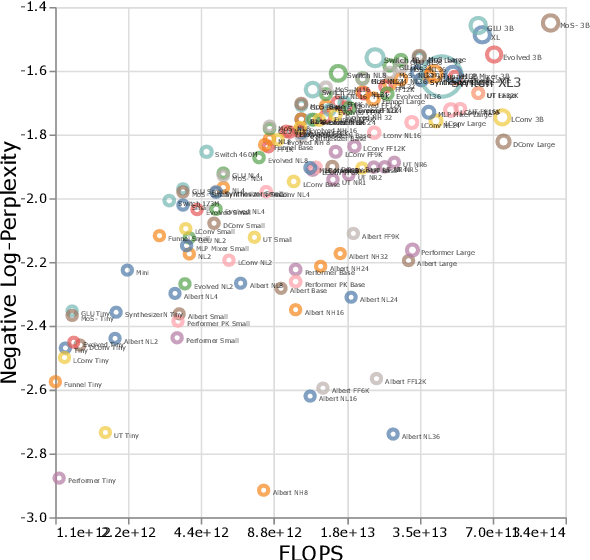
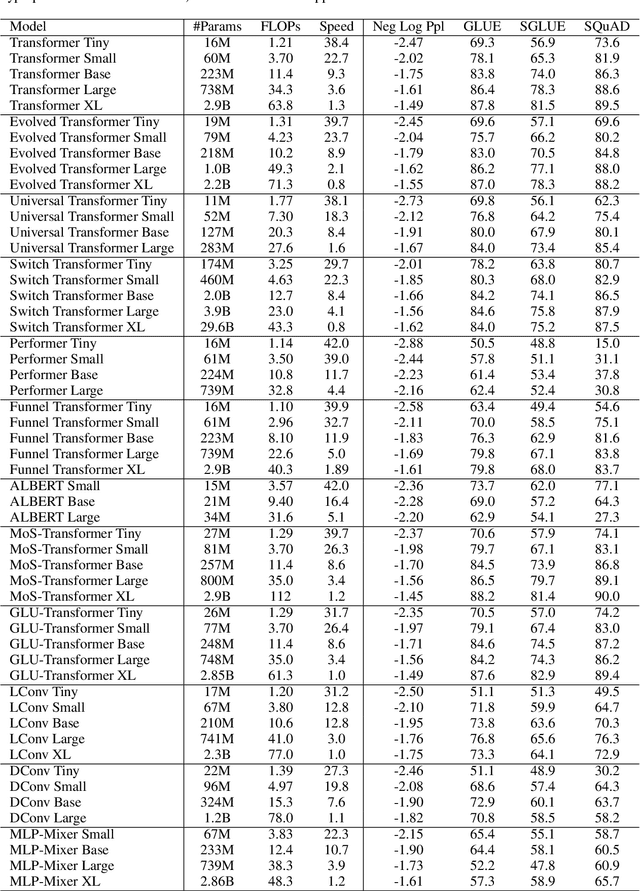
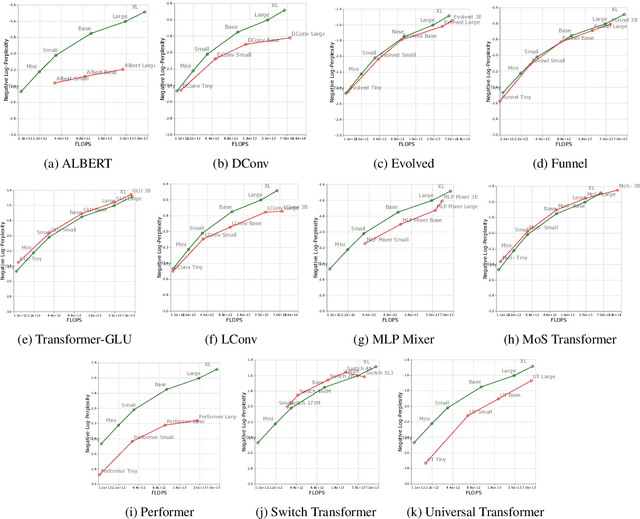
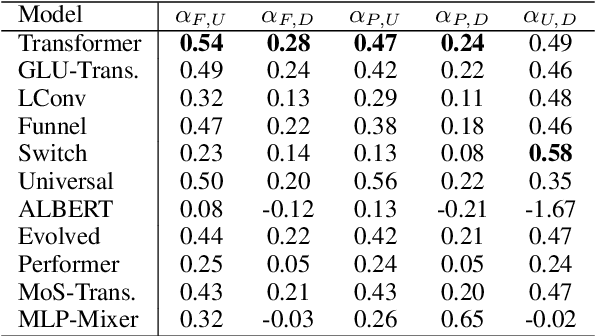
There have been a lot of interest in the scaling properties of Transformer models. However, not much has been done on the front of investigating the effect of scaling properties of different inductive biases and model architectures. Do model architectures scale differently? If so, how does inductive bias affect scaling behaviour? How does this influence upstream (pretraining) and downstream (transfer)? This paper conducts a systematic study of scaling behaviour of ten diverse model architectures such as Transformers, Switch Transformers, Universal Transformers, Dynamic convolutions, Performers, and recently proposed MLP-Mixers. Via extensive experiments, we show that (1) architecture is an indeed an important consideration when performing scaling and (2) the best performing model can fluctuate at different scales. We believe that the findings outlined in this work has significant implications to how model architectures are currently evaluated in the community.
PaLM: Scaling Language Modeling with Pathways
Apr 19, 2022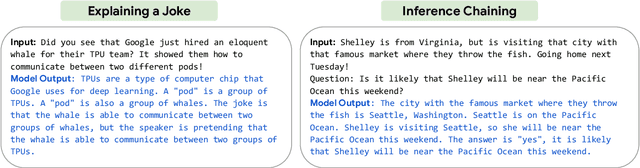

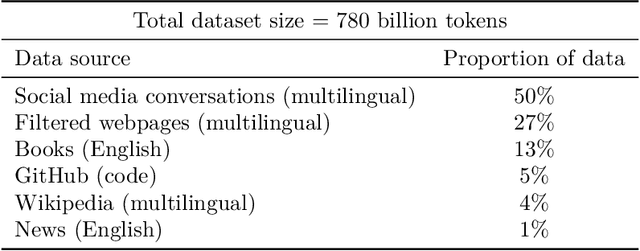
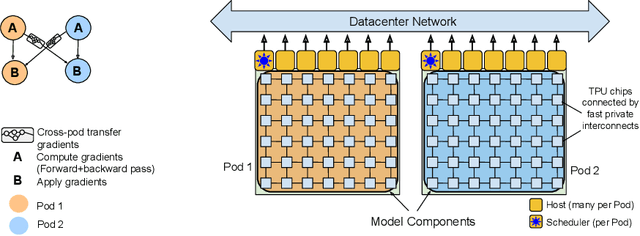
Large language models have been shown to achieve remarkable performance across a variety of natural language tasks using few-shot learning, which drastically reduces the number of task-specific training examples needed to adapt the model to a particular application. To further our understanding of the impact of scale on few-shot learning, we trained a 540-billion parameter, densely activated, Transformer language model, which we call Pathways Language Model PaLM. We trained PaLM on 6144 TPU v4 chips using Pathways, a new ML system which enables highly efficient training across multiple TPU Pods. We demonstrate continued benefits of scaling by achieving state-of-the-art few-shot learning results on hundreds of language understanding and generation benchmarks. On a number of these tasks, PaLM 540B achieves breakthrough performance, outperforming the finetuned state-of-the-art on a suite of multi-step reasoning tasks, and outperforming average human performance on the recently released BIG-bench benchmark. A significant number of BIG-bench tasks showed discontinuous improvements from model scale, meaning that performance steeply increased as we scaled to our largest model. PaLM also has strong capabilities in multilingual tasks and source code generation, which we demonstrate on a wide array of benchmarks. We additionally provide a comprehensive analysis on bias and toxicity, and study the extent of training data memorization with respect to model scale. Finally, we discuss the ethical considerations related to large language models and discuss potential mitigation strategies.
Self-Consistency Improves Chain of Thought Reasoning in Language Models
Apr 06, 2022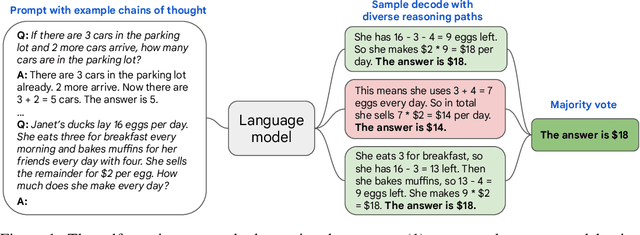
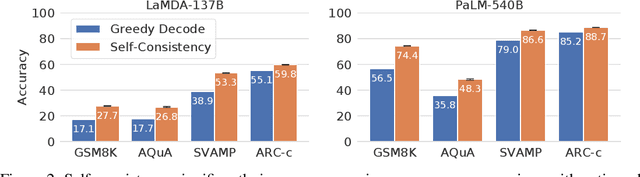
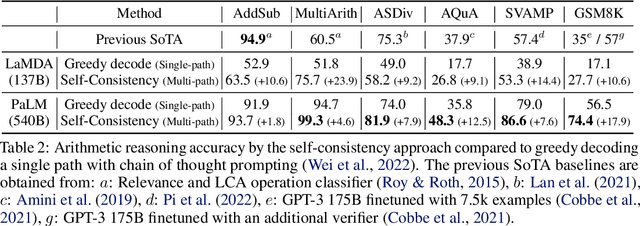
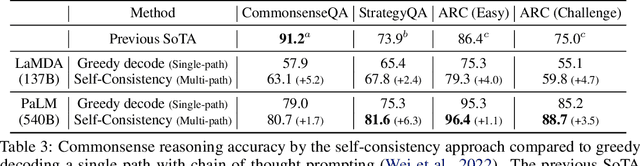
We explore a simple ensemble strategy, self-consistency, that significantly improves the reasoning accuracy of large language models. The idea is to sample a diverse set of reasoning paths from a language model via chain of thought prompting then return the most consistent final answer in the set. We evaluate self-consistency on a range of arithmetic and commonsense reasoning benchmarks, and find that it robustly improves accuracy across a variety of language models and model scales without the need for additional training or auxiliary models. When combined with a recent large language model, PaLM-540B, self-consistency increases performance to state-of-the-art levels across several benchmark reasoning tasks, including GSM8K (56.5% -> 74.4%), SVAMP (79.0% -> 86.6%), AQuA (35.8% -> 48.3%), StrategyQA (75.3% -> 81.6%) and ARC-challenge (85.2% -> 88.7%).
Scaling Up Models and Data with $\texttt{t5x}$ and $\texttt{seqio}$
Mar 31, 2022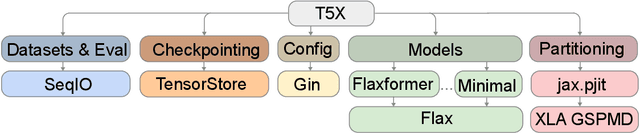
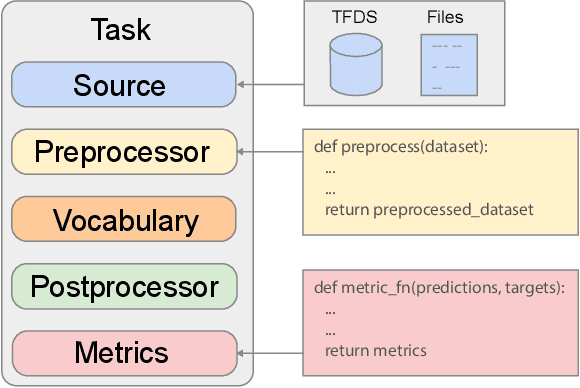
Recent neural network-based language models have benefited greatly from scaling up the size of training datasets and the number of parameters in the models themselves. Scaling can be complicated due to various factors including the need to distribute computation on supercomputer clusters (e.g., TPUs), prevent bottlenecks when infeeding data, and ensure reproducible results. In this work, we present two software libraries that ease these issues: $\texttt{t5x}$ simplifies the process of building and training large language models at scale while maintaining ease of use, and $\texttt{seqio}$ provides a task-based API for simple creation of fast and reproducible training data and evaluation pipelines. These open-source libraries have been used to train models with hundreds of billions of parameters on datasets with multiple terabytes of training data. Along with the libraries, we release configurations and instructions for T5-like encoder-decoder models as well as GPT-like decoder-only architectures. $\texttt{t5x}$ and $\texttt{seqio}$ are open source and available at https://github.com/google-research/t5x and https://github.com/google/seqio, respectively.
Scale Efficiently: Insights from Pre-training and Fine-tuning Transformers
Sep 22, 2021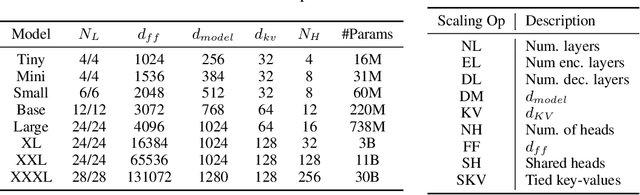
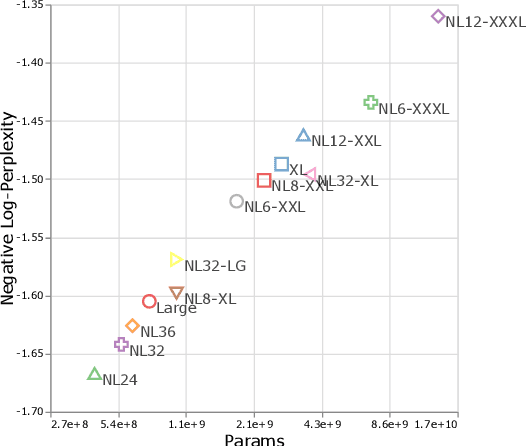
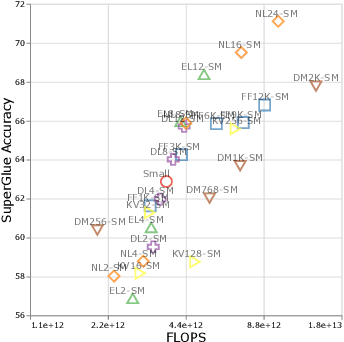
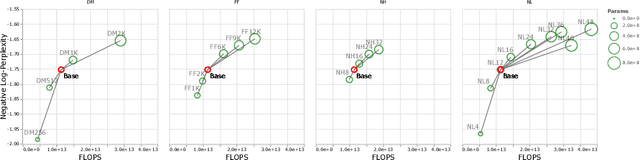
There remain many open questions pertaining to the scaling behaviour of Transformer architectures. These scaling decisions and findings can be critical, as training runs often come with an associated computational cost which have both financial and/or environmental impact. The goal of this paper is to present scaling insights from pretraining and finetuning Transformers. While Kaplan et al. presents a comprehensive study of the scaling behaviour of Transformer language models, the scope is only on the upstream (pretraining) loss. Therefore, it is still unclear if these set of findings transfer to downstream task within the context of the pretrain-finetune paradigm. The key findings of this paper are as follows: (1) we show that aside from only the model size, model shape matters for downstream fine-tuning, (2) scaling protocols operate differently at different compute regions, (3) widely adopted T5-base and T5-large sizes are Pareto-inefficient. To this end, we present improved scaling protocols whereby our redesigned models achieve similar downstream fine-tuning quality while having 50\% fewer parameters and training 40\% faster compared to the widely adopted T5-base model. We publicly release over 100 pretrained checkpoints of different T5 configurations to facilitate future research and analysis.