 Add to Chrome
 Add to Firefox
 Add to Edge
Integrated Decision Making and Trajectory Planning for Autonomous Driving Under Multimodal Uncertainties: A Bayesian Game Approach
Sep 21, 2024
Modeling the interaction between traffic agents is a key issue in designing safe and non-conservative maneuvers in autonomous driving. This problem can be challenging when multi-modality and behavioral uncertainties are engaged. Existing methods either fail to plan interactively or consider unimodal behaviors that could lead to catastrophic results. In this paper, we introduce an integrated decision-making and trajectory planning framework based on Bayesian game (i.e., game of incomplete information). Human decisions inherently exhibit discrete characteristics and therefore are modeled as types of players in the game. A general solver based on no-regret learning is introduced to obtain a corresponding Bayesian Coarse Correlated Equilibrium, which captures the interaction between traffic agents in the multimodal context. With the attained equilibrium, decision-making and trajectory planning are performed simultaneously, and the resulting interactive strategy is shown to be optimal over the expectation of rivals' driving intentions. Closed-loop simulations on different traffic scenarios are performed to illustrate the generalizability and the effectiveness of the proposed framework.

LMMCoDrive: Cooperative Driving with Large Multimodal Model
Sep 18, 2024To address the intricate challenges of decentralized cooperative scheduling and motion planning in Autonomous Mobility-on-Demand (AMoD) systems, this paper introduces LMMCoDrive, a novel cooperative driving framework that leverages a Large Multimodal Model (LMM) to enhance traffic efficiency in dynamic urban environments. This framework seamlessly integrates scheduling and motion planning processes to ensure the effective operation of Cooperative Autonomous Vehicles (CAVs). The spatial relationship between CAVs and passenger requests is abstracted into a Bird's-Eye View (BEV) to fully exploit the potential of the LMM. Besides, trajectories are cautiously refined for each CAV while ensuring collision avoidance through safety constraints. A decentralized optimization strategy, facilitated by the Alternating Direction Method of Multipliers (ADMM) within the LMM framework, is proposed to drive the graph evolution of CAVs. Simulation results demonstrate the pivotal role and significant impact of LMM in optimizing CAV scheduling and enhancing decentralized cooperative optimization process for each vehicle. This marks a substantial stride towards achieving practical, efficient, and safe AMoD systems that are poised to revolutionize urban transportation. The code is available at https://github.com/henryhcliu/LMMCoDrive.
SLIM: Scalable and Lightweight LiDAR Mapping in Urban Environments
Sep 13, 2024LiDAR point cloud maps are extensively utilized on roads for robot navigation due to their high consistency. However, dense point clouds face challenges of high memory consumption and reduced maintainability for long-term operations. In this study, we introduce SLIM, a scalable and lightweight mapping system for long-term LiDAR mapping in urban environments. The system begins by parameterizing structural point clouds into lines and planes. These lightweight and structural representations meet the requirements of map merging, pose graph optimization, and bundle adjustment, ensuring incremental management and local consistency. For long-term operations, a map-centric nonlinear factor recovery method is designed to sparsify poses while preserving mapping accuracy. We validate the SLIM system with multi-session real-world LiDAR data from classical LiDAR mapping datasets, including KITTI, NCLT, and HeLiPR. The experiments demonstrate its capabilities in mapping accuracy, lightweightness, and scalability. Map re-use is also verified through map-based robot localization. Ultimately, with multi-session LiDAR data, the SLIM system provides a globally consistent map with low memory consumption (130 KB/km). We have made our code open-source to benefit the community.
SOAR: Simultaneous Exploration and Photographing with Heterogeneous UAVs for Fast Autonomous Reconstruction
Sep 04, 2024Unmanned Aerial Vehicles (UAVs) have gained significant popularity in scene reconstruction. This paper presents SOAR, a LiDAR-Visual heterogeneous multi-UAV system specifically designed for fast autonomous reconstruction of complex environments. Our system comprises a LiDAR-equipped explorer with a large field-of-view (FoV), alongside photographers equipped with cameras. To ensure rapid acquisition of the scene's surface geometry, we employ a surface frontier-based exploration strategy for the explorer. As the surface is progressively explored, we identify the uncovered areas and generate viewpoints incrementally. These viewpoints are then assigned to photographers through solving a Consistent Multiple Depot Multiple Traveling Salesman Problem (Consistent-MDMTSP), which optimizes scanning efficiency while ensuring task consistency. Finally, photographers utilize the assigned viewpoints to determine optimal coverage paths for acquiring images. We present extensive benchmarks in the realistic simulator, which validates the performance of SOAR compared with classical and state-of-the-art methods. For more details, please see our project page at https://sysu-star.github.io/SOAR}{sysu-star.github.io/SOAR.
Multi-modal Integrated Prediction and Decision-making with Adaptive Interaction Modality Explorations
Aug 25, 2024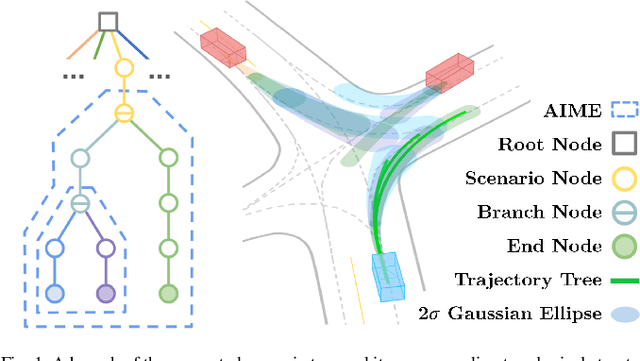
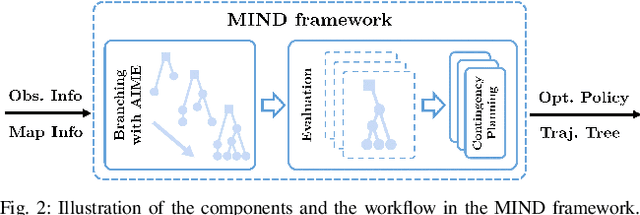
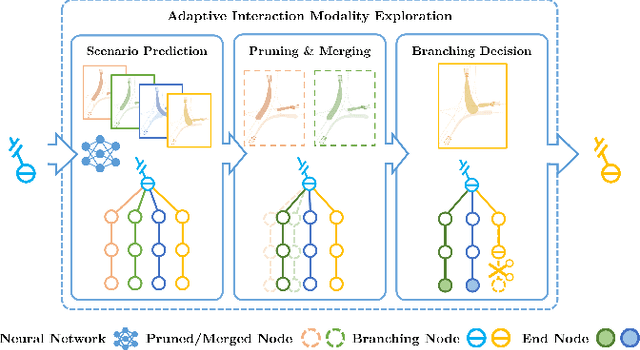
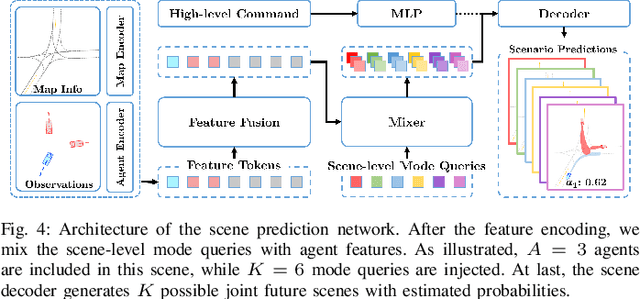
Navigating dense and dynamic environments poses a significant challenge for autonomous driving systems, owing to the intricate nature of multimodal interaction, wherein the actions of various traffic participants and the autonomous vehicle are complex and implicitly coupled. In this paper, we propose a novel framework, Multi-modal Integrated predictioN and Decision-making (MIND), which addresses the challenges by efficiently generating joint predictions and decisions covering multiple distinctive interaction modalities. Specifically, MIND leverages learning-based scenario predictions to obtain integrated predictions and decisions with social-consistent interaction modality and utilizes a modality-aware dynamic branching mechanism to generate scenario trees that efficiently capture the evolutions of distinctive interaction modalities with low variation of interaction uncertainty along the planning horizon. The scenario trees are seamlessly utilized by the contingency planning under interaction uncertainty to obtain clear and considerate maneuvers accounting for multi-modal evolutions. Comprehensive experimental results in the closed-loop simulation based on the real-world driving dataset showcase superior performance to other strong baselines under various driving contexts.
WING: Wheel-Inertial Neural Odometry with Ground Manifold Constraints
Jul 14, 2024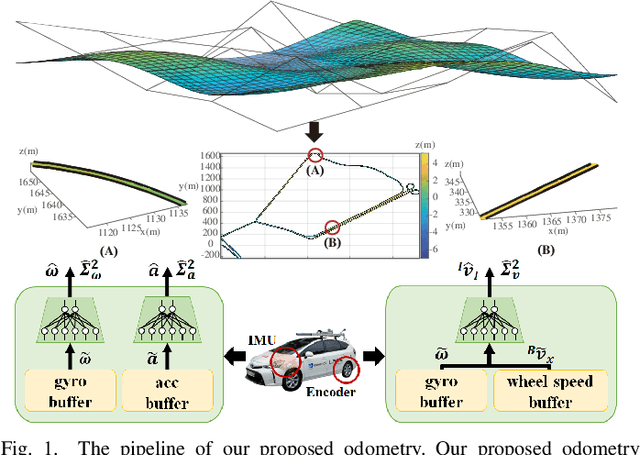
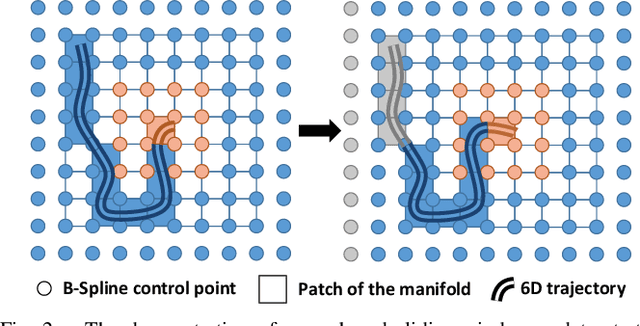
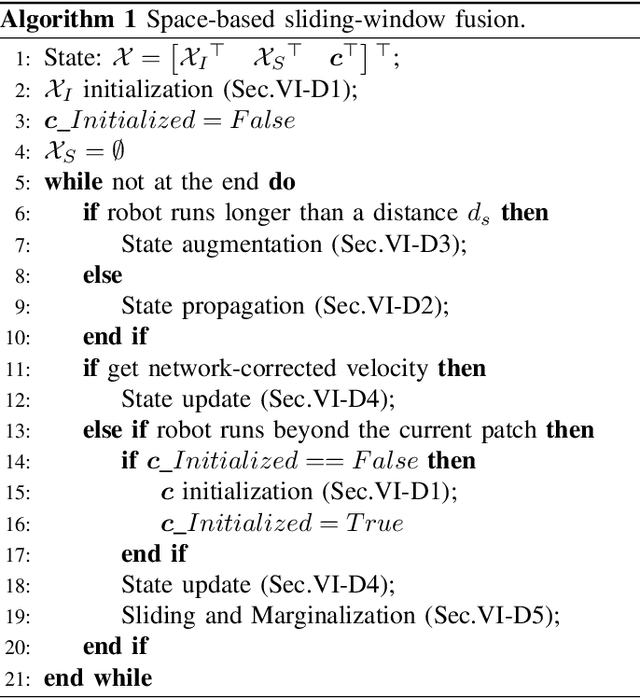
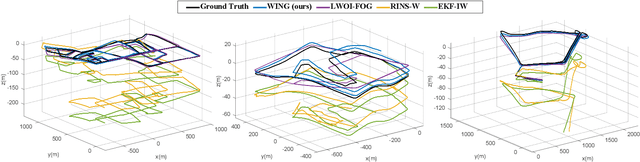
In this paper, we propose an interoceptive-only odometry system for ground robots with neural network processing and soft constraints based on the assumption of a globally continuous ground manifold. Exteroceptive sensors such as cameras, GPS and LiDAR may encounter difficulties in scenarios with poor illumination, indoor environments, dusty areas and straight tunnels. Therefore, improving the pose estimation accuracy only using interoceptive sensors is important to enhance the reliability of navigation system even in degrading scenarios mentioned above. However, interoceptive sensors like IMU and wheel encoders suffer from large drift due to noisy measurements. To overcome these challenges, the proposed system trains deep neural networks to correct the measurements from IMU and wheel encoders, while considering their uncertainty. Moreover, because ground robots can only travel on the ground, we model the ground surface as a globally continuous manifold using a dual cubic B-spline manifold to further improve the estimation accuracy by this soft constraint. A novel space-based sliding-window filtering framework is proposed to fully exploit the $C^2$ continuity of ground manifold soft constraints and fuse all the information from raw measurements and neural networks in a yaw-independent attitude convention. Extensive experiments demonstrate that our proposed approach can outperform state-of-the-art learning-based interoceptive-only odometry methods.
Event-Aided Time-to-Collision Estimation for Autonomous Driving
Jul 10, 2024Predicting a potential collision with leading vehicles is an essential functionality of any autonomous/assisted driving system. One bottleneck of existing vision-based solutions is that their updating rate is limited to the frame rate of standard cameras used. In this paper, we present a novel method that estimates the time to collision using a neuromorphic event-based camera, a biologically inspired visual sensor that can sense at exactly the same rate as scene dynamics. The core of the proposed algorithm consists of a two-step approach for efficient and accurate geometric model fitting on event data in a coarse-to-fine manner. The first step is a robust linear solver based on a novel geometric measurement that overcomes the partial observability of event-based normal flow. The second step further refines the resulting model via a spatio-temporal registration process formulated as a nonlinear optimization problem. Experiments on both synthetic and real data demonstrate the effectiveness of the proposed method, outperforming other alternative methods in terms of efficiency and accuracy.
UniQuad: A Unified and Versatile Quadrotor Platform Series for UAV Research and Application
Jun 30, 2024
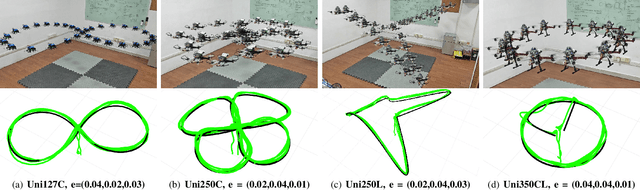

As quadrotors take on an increasingly diverse range of roles, researchers often need to develop new hardware platforms tailored for specific tasks, introducing significant engineering overhead. In this article, we introduce the UniQuad series, a unified and versatile quadrotor platform series that offers high flexibility to adapt to a wide range of common tasks, excellent customizability for advanced demands, and easy maintenance in case of crashes. This project is fully open-source at https://hkust-aerial-robotics.github.io/UniQuad.
FALCON: Fast Autonomous Aerial Exploration using Coverage Path Guidance
Jun 30, 2024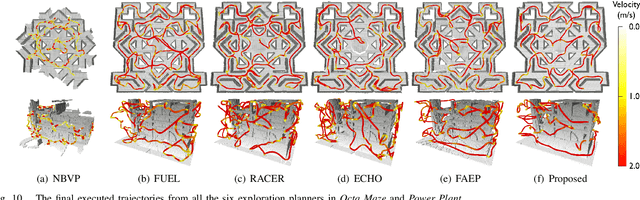
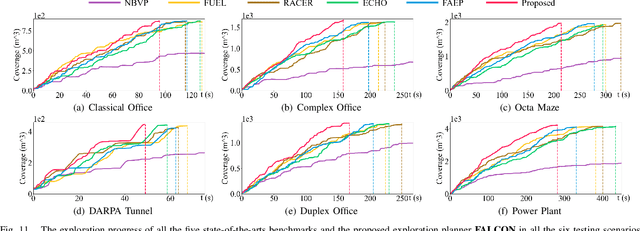
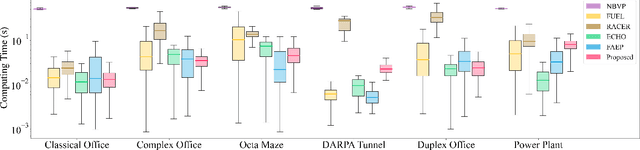
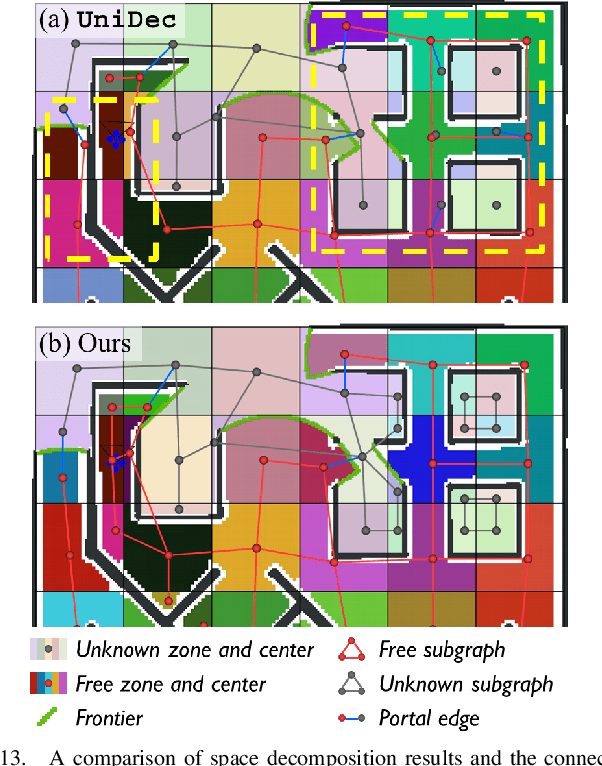
This paper introduces FALCON, a novel Fast Autonomous expLoration framework using COverage path guidaNce, which aims at setting a new performance benchmark in the field of autonomous aerial exploration. Despite recent advancements in the domain, existing exploration planners often suffer from inefficiencies such as frequent revisitations of previously explored regions. FALCON effectively harnesses the full potential of online generated coverage paths in enhancing exploration efficiency. The framework begins with an incremental connectivity-aware space decomposition and connectivity graph construction, which facilitate efficient coverage path planning. Subsequently, a hierarchical planner generates a coverage path spanning the entire unexplored space, serving as a global guidance. Then, a local planner optimizes the frontier visitation order, minimizing traversal time while consciously incorporating the intention of the global guidance. Finally, minimum-time smooth and safe trajectories are produced to visit the frontier viewpoints. For fair and comprehensive benchmark experiments, we introduce a lightweight exploration planner evaluation environment that allows for comparing exploration planners across a variety of testing scenarios using an identical quadrotor simulator. Additionally, a VECO criteria is proposed for an in-depth analysis of FALCON's significant performance in comparison with the state-of-the-art exploration planners. Extensive ablation studies demonstrate the effectiveness of each component in the proposed framework. Real-world experiments conducted fully onboard further validate FALCON's practical capability in complex and challenging environments. The source code of both the exploration planner FALCON and the exploration planner evaluation environment will be released to benefit the community.
MetaFollower: Adaptable Personalized Autonomous Car Following
Jun 23, 2024
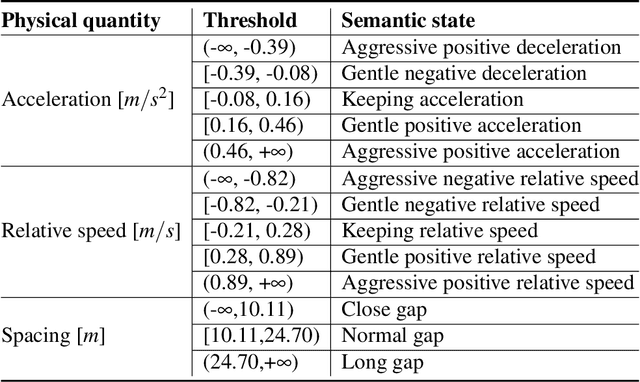
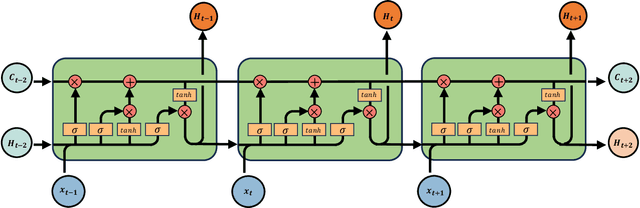
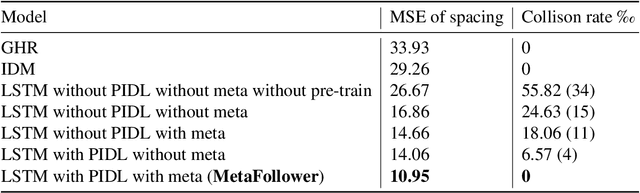
Car-following (CF) modeling, a fundamental component in microscopic traffic simulation, has attracted increasing interest of researchers in the past decades. In this study, we propose an adaptable personalized car-following framework -MetaFollower, by leveraging the power of meta-learning. Specifically, we first utilize Model-Agnostic Meta-Learning (MAML) to extract common driving knowledge from various CF events. Afterward, the pre-trained model can be fine-tuned on new drivers with only a few CF trajectories to achieve personalized CF adaptation. We additionally combine Long Short-Term Memory (LSTM) and Intelligent Driver Model (IDM) to reflect temporal heterogeneity with high interpretability. Unlike conventional adaptive cruise control (ACC) systems that rely on predefined settings and constant parameters without considering heterogeneous driving characteristics, MetaFollower can accurately capture and simulate the intricate dynamics of car-following behavior while considering the unique driving styles of individual drivers. We demonstrate the versatility and adaptability of MetaFollower by showcasing its ability to adapt to new drivers with limited training data quickly. To evaluate the performance of MetaFollower, we conduct rigorous experiments comparing it with both data-driven and physics-based models. The results reveal that our proposed framework outperforms baseline models in predicting car-following behavior with higher accuracy and safety. To the best of our knowledge, this is the first car-following model aiming to achieve fast adaptation by considering both driver and temporal heterogeneity based on meta-learning.