 Add to Chrome
 Add to Firefox
 Add to Edge
Path Integral Value Matching for Linear Quadratic Stochastic Optimal Control
Aug 11, 2026
Linear Quadratic Stochastic Optimal Control (LQ-SOC) establishes a fundamental framework for steering noisy dynamical systems and has recently gained renewed interest in the machine learning community. However, current state-of-the-art policy-based methods suffer from prohibitive computational costs and instability due to their heavy reliance on full-trajectory simulation. To overcome these limitations, we propose a paradigm shift toward a value-based approach by revisiting Path Integral Control (PIC). Although standard PIC suffers from the same high-variance bottleneck as policy-based methods, we discover that by truncating and marginalizing the original path integral formulation, we can derive a temporal recursive form of the value function. Building upon this theoretical foundation, we propose the Path Integral Value Matching (PI-VM) algorithm. Specifically, we employ temporal-difference learning to approximate the recursive value dynamics, and further integrate the Girsanov theorem with experience replay to enable off-policy training. We benchmark PI-VM against SOTA policy-based methods across various SOC benchmarks and sampling tasks. Empirical results demonstrate that PI-VM matches SOTA precision with an order-of-magnitude efficiency gain in low-dimensional settings, while effectively mitigating mode collapse in high-dimensional scenarios. Consequently, PI-VM offers a scalable solution for solving complex SOC problems.

Rolling Shutter Camera Self-Calibration
Aug 02, 2026Rolling shutter (RS) cameras are widely used in consumer devices, but their row-wise exposure causes distortions under motion, making geometric 3D vision problems dependent on both camera intrinsics and readout time ratio. Existing RS calibration methods rely on calibration targets or specialised hardware, limiting their use in unconstrained settings. We present the first self-calibration method for RS cameras that directly estimates camera intrinsics and the readout time ratio from image sequences, without requiring calibration targets. The method is implemented as a self-calibrating bundle adjustment (BA), which critically depends on the RS imaging model. We combine two known complementary models. The first formulates RS imaging as continuous-time trajectory estimation under a row-wise pose representation. The second interprets RS images as temporally distorted global shutter (GS) images and requires to estimate correction fields. The combination is non-trivial and results in a unified dual-projection model, in which each 3D point is simultaneously constrained at both row-dependent and reference timestamps along a shared continuous trajectory, enforcing stronger geometric and temporal consistency. Extensive simulations analyse the applicability of several implementations under varying conditions, and real data experiments demonstrate the accuracy, robustness, and practical effectiveness of the proposed approach.
PACE: Geometry-Aware Bridge Transport for Single-Cell Trajectory Inference
May 18, 2026Single-cell trajectory inference from destructive time-course snapshots is fundamentally ill-posed: neither cross-time cell correspondences nor continuous trajectories are observed, so the snapshot distributions alone do not uniquely determine the underlying dynamics. Existing optimal transport and flow-based methods typically couple cells by Euclidean proximity at observed clock times, which can misalign trajectories when development is asynchronous and cells sampled at the same experimental time occupy different latent pseudotime stages. We propose PACE, a trajectory inference framework that recovers geometry-consistent continuous transport dynamics from destructive time-course snapshots through three coupled components. First, PACE constructs a state- and time-dependent anisotropic Riemannian metric that assigns low transport cost along locally supported tangent directions while penalizing normal velocity components. Second, it alternates between refining cross-time couplings under the induced path-action cost and fitting endpoint-preserving neural bridges between adjacent snapshots. Third, it distills the learned bridge dynamics into a global continuous-time velocity field over cellular states. Across seven controlled and biological datasets covering nine held-out reconstruction experiments, PACE achieves the strongest overall reconstruction performance, reducing MMD, Wasserstein-1 distance, and Wasserstein-2 distance by 23.7% on average relative to the strongest competing baseline. PACE also improves RNA-velocity alignment by 15.4% on an embryoid body differentiation benchmark, without requiring explicit cell pairing, lineage tracing, or RNA-velocity supervision during training. Code is available at https://github.com/AI4Science-WestlakeU/PACE.
Advances in Global Solvers for 3D Vision
Feb 16, 2026Global solvers have emerged as a powerful paradigm for 3D vision, offering certifiable solutions to nonconvex geometric optimization problems traditionally addressed by local or heuristic methods. This survey presents the first systematic review of global solvers in geometric vision, unifying the field through a comprehensive taxonomy of three core paradigms: Branch-and-Bound (BnB), Convex Relaxation (CR), and Graduated Non-Convexity (GNC). We present their theoretical foundations, algorithmic designs, and practical enhancements for robustness and scalability, examining how each addresses the fundamental nonconvexity of geometric estimation problems. Our analysis spans ten core vision tasks, from Wahba problem to bundle adjustment, revealing the optimality-robustness-scalability trade-offs that govern solver selection. We identify critical future directions: scaling algorithms while maintaining guarantees, integrating data-driven priors with certifiable optimization, establishing standardized benchmarks, and addressing societal implications for safety-critical deployment. By consolidating theoretical foundations, practical advances, and broader impacts, this survey provides a unified perspective and roadmap toward certifiable, trustworthy perception for real-world applications. A continuously-updated literature summary and companion code tutorials are available at https://github.com/ericzzj1989/Awesome-Global-Solvers-for-3D-Vision.
scDFM: Distributional Flow Matching Model for Robust Single-Cell Perturbation Prediction
Feb 06, 2026A central goal in systems biology and drug discovery is to predict the transcriptional response of cells to perturbations. This task is challenging due to the noisy and sparse nature of single-cell measurements, as well as the fact that perturbations often induce population-level shifts rather than changes in individual cells. Existing deep learning methods typically assume cell-level correspondences, limiting their ability to capture such global effects. We present scDFM, a generative framework based on conditional flow matching that models the full distribution of perturbed cells conditioned on control states. By incorporating a maximum mean discrepancy (MMD) objective, our method aligns perturbed and control populations beyond cell-level correspondences. To further improve robustness to sparsity and noise, we introduce the Perturbation-Aware Differential Transformer (PAD-Transformer), a backbone architecture that leverages gene interaction graphs and differential attention to capture context-specific expression changes. Across multiple genetic and drug perturbation benchmarks, scDFM consistently outperforms prior methods, demonstrating strong generalization in both unseen and combinatorial settings. In the combinatorial setting, it reduces mean squared error by 19.6% relative to the strongest baseline. These results highlight the importance of distribution-level generative modeling for robust in silico perturbation prediction. The code is available at https://github.com/AI4Science-WestlakeU/scDFM
Neural Predictor-Corrector: Solving Homotopy Problems with Reinforcement Learning
Feb 03, 2026The Homotopy paradigm, a general principle for solving challenging problems, appears across diverse domains such as robust optimization, global optimization, polynomial root-finding, and sampling. Practical solvers for these problems typically follow a predictor-corrector (PC) structure, but rely on hand-crafted heuristics for step sizes and iteration termination, which are often suboptimal and task-specific. To address this, we unify these problems under a single framework, which enables the design of a general neural solver. Building on this unified view, we propose Neural Predictor-Corrector (NPC), which replaces hand-crafted heuristics with automatically learned policies. NPC formulates policy selection as a sequential decision-making problem and leverages reinforcement learning to automatically discover efficient strategies. To further enhance generalization, we introduce an amortized training mechanism, enabling one-time offline training for a class of problems and efficient online inference on new instances. Experiments on four representative homotopy problems demonstrate that our method generalizes effectively to unseen instances. It consistently outperforms classical and specialized baselines in efficiency while demonstrating superior stability across tasks, highlighting the value of unifying homotopy methods into a single neural framework.
E-MoFlow: Learning Egomotion and Optical Flow from Event Data via Implicit Regularization
Oct 14, 2025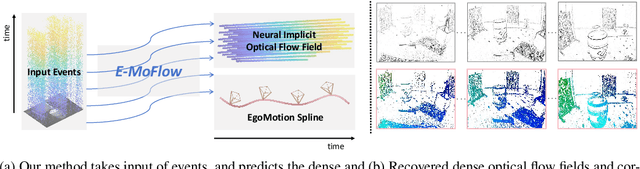
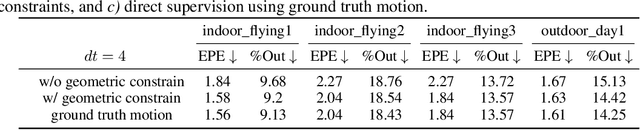
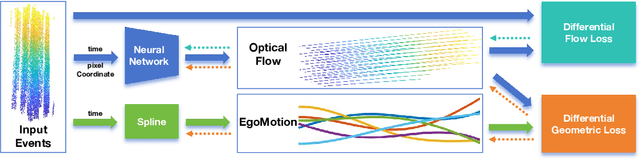
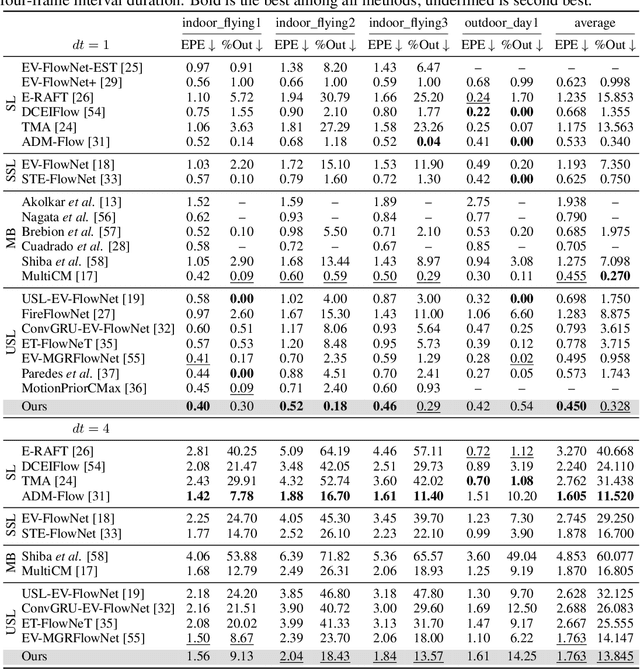
The estimation of optical flow and 6-DoF ego-motion, two fundamental tasks in 3D vision, has typically been addressed independently. For neuromorphic vision (e.g., event cameras), however, the lack of robust data association makes solving the two problems separately an ill-posed challenge, especially in the absence of supervision via ground truth. Existing works mitigate this ill-posedness by either enforcing the smoothness of the flow field via an explicit variational regularizer or leveraging explicit structure-and-motion priors in the parametrization to improve event alignment. The former notably introduces bias in results and computational overhead, while the latter, which parametrizes the optical flow in terms of the scene depth and the camera motion, often converges to suboptimal local minima. To address these issues, we propose an unsupervised framework that jointly optimizes egomotion and optical flow via implicit spatial-temporal and geometric regularization. First, by modeling camera's egomotion as a continuous spline and optical flow as an implicit neural representation, our method inherently embeds spatial-temporal coherence through inductive biases. Second, we incorporate structure-and-motion priors through differential geometric constraints, bypassing explicit depth estimation while maintaining rigorous geometric consistency. As a result, our framework (called E-MoFlow) unifies egomotion and optical flow estimation via implicit regularization under a fully unsupervised paradigm. Experiments demonstrate its versatility to general 6-DoF motion scenarios, achieving state-of-the-art performance among unsupervised methods and competitive even with supervised approaches.
VARD: Efficient and Dense Fine-Tuning for Diffusion Models with Value-based RL
May 21, 2025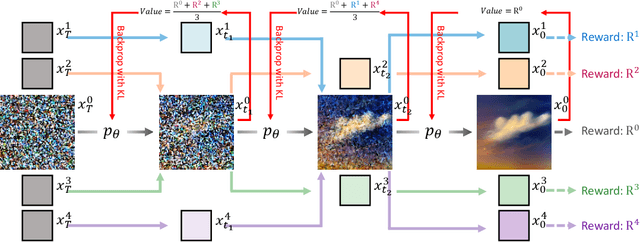
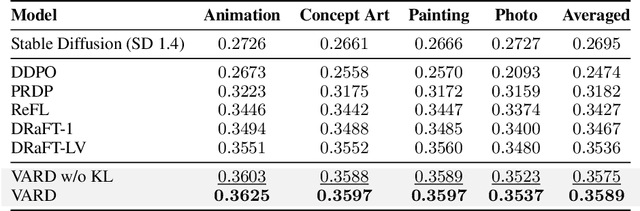
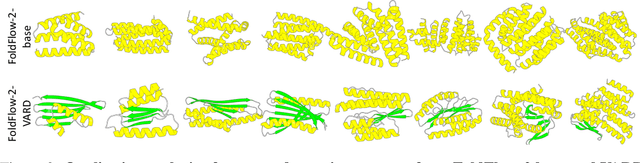
Diffusion models have emerged as powerful generative tools across various domains, yet tailoring pre-trained models to exhibit specific desirable properties remains challenging. While reinforcement learning (RL) offers a promising solution,current methods struggle to simultaneously achieve stable, efficient fine-tuning and support non-differentiable rewards. Furthermore, their reliance on sparse rewards provides inadequate supervision during intermediate steps, often resulting in suboptimal generation quality. To address these limitations, dense and differentiable signals are required throughout the diffusion process. Hence, we propose VAlue-based Reinforced Diffusion (VARD): a novel approach that first learns a value function predicting expection of rewards from intermediate states, and subsequently uses this value function with KL regularization to provide dense supervision throughout the generation process. Our method maintains proximity to the pretrained model while enabling effective and stable training via backpropagation. Experimental results demonstrate that our approach facilitates better trajectory guidance, improves training efficiency and extends the applicability of RL to diffusion models optimized for complex, non-differentiable reward functions.
Convex Relaxation for Robust Vanishing Point Estimation in Manhattan World
May 07, 2025


Determining the vanishing points (VPs) in a Manhattan world, as a fundamental task in many 3D vision applications, consists of jointly inferring the line-VP association and locating each VP. Existing methods are, however, either sub-optimal solvers or pursuing global optimality at a significant cost of computing time. In contrast to prior works, we introduce convex relaxation techniques to solve this task for the first time. Specifically, we employ a ``soft'' association scheme, realized via a truncated multi-selection error, that allows for joint estimation of VPs' locations and line-VP associations. This approach leads to a primal problem that can be reformulated into a quadratically constrained quadratic programming (QCQP) problem, which is then relaxed into a convex semidefinite programming (SDP) problem. To solve this SDP problem efficiently, we present a globally optimal outlier-robust iterative solver (called \textbf{GlobustVP}), which independently searches for one VP and its associated lines in each iteration, treating other lines as outliers. After each independent update of all VPs, the mutual orthogonality between the three VPs in a Manhattan world is reinforced via local refinement. Extensive experiments on both synthetic and real-world data demonstrate that \textbf{GlobustVP} achieves a favorable balance between efficiency, robustness, and global optimality compared to previous works. The code is publicly available at https://github.com/WU-CVGL/GlobustVP.
EvTTC: An Event Camera Dataset for Time-to-Collision Estimation
Dec 06, 2024Time-to-Collision (TTC) estimation lies in the core of the forward collision warning (FCW) functionality, which is key to all Automatic Emergency Braking (AEB) systems. Although the success of solutions using frame-based cameras (e.g., Mobileye's solutions) has been witnessed in normal situations, some extreme cases, such as the sudden variation in the relative speed of leading vehicles and the sudden appearance of pedestrians, still pose significant risks that cannot be handled. This is due to the inherent imaging principles of frame-based cameras, where the time interval between adjacent exposures introduces considerable system latency to AEB. Event cameras, as a novel bio-inspired sensor, offer ultra-high temporal resolution and can asynchronously report brightness changes at the microsecond level. To explore the potential of event cameras in the above-mentioned challenging cases, we propose EvTTC, which is, to the best of our knowledge, the first multi-sensor dataset focusing on TTC tasks under high-relative-speed scenarios. EvTTC consists of data collected using standard cameras and event cameras, covering various potential collision scenarios in daily driving and involving multiple collision objects. Additionally, LiDAR and GNSS/INS measurements are provided for the calculation of ground-truth TTC. Considering the high cost of testing TTC algorithms on full-scale mobile platforms, we also provide a small-scale TTC testbed for experimental validation and data augmentation. All the data and the design of the testbed are open sourced, and they can serve as a benchmark that will facilitate the development of vision-based TTC techniques.