 Add to Chrome
 Add to Firefox
 Add to Edge
Training a Generally Curious Agent
Feb 24, 2025
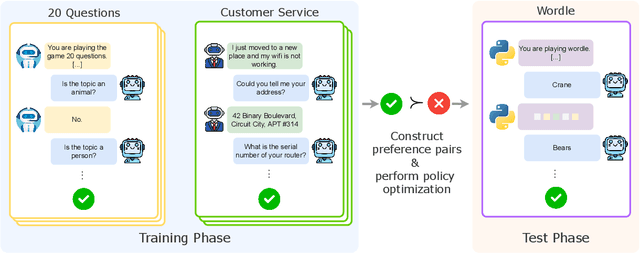
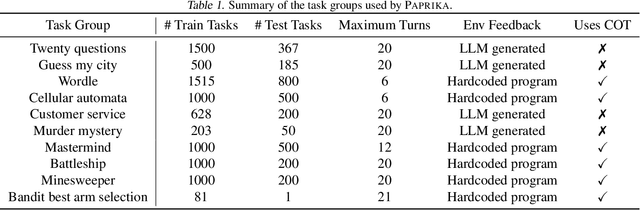
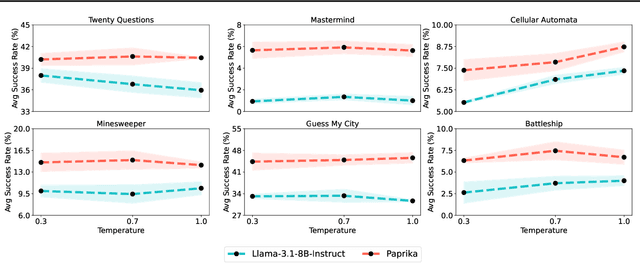

Efficient exploration is essential for intelligent systems interacting with their environment, but existing language models often fall short in scenarios that require strategic information gathering. In this paper, we present PAPRIKA, a fine-tuning approach that enables language models to develop general decision-making capabilities that are not confined to particular environments. By training on synthetic interaction data from different tasks that require diverse strategies, PAPRIKA teaches models to explore and adapt their behavior on a new task based on environment feedback in-context without more gradient updates. Experimental results show that models fine-tuned with PAPRIKA can effectively transfer their learned decision-making capabilities to entirely unseen tasks without additional training. Unlike traditional training, our approach's primary bottleneck lies in sampling useful interaction data instead of model updates. To improve sample efficiency, we propose a curriculum learning strategy that prioritizes sampling trajectories from tasks with high learning potential. These results suggest a promising path towards AI systems that can autonomously solve novel sequential decision-making problems that require interactions with the external world.

FACTR: Force-Attending Curriculum Training for Contact-Rich Policy Learning
Feb 24, 2025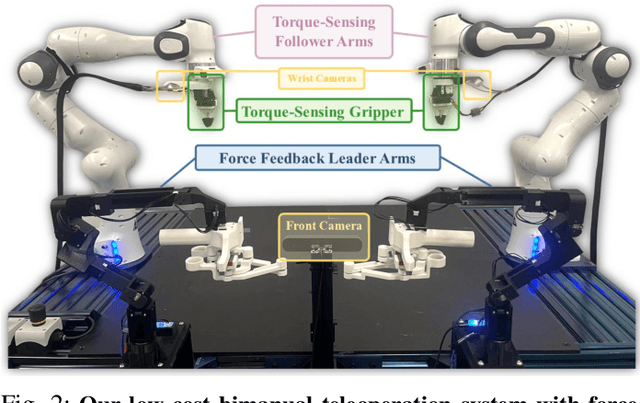
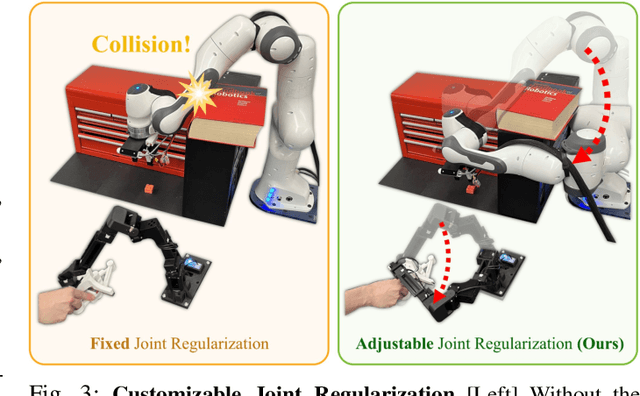
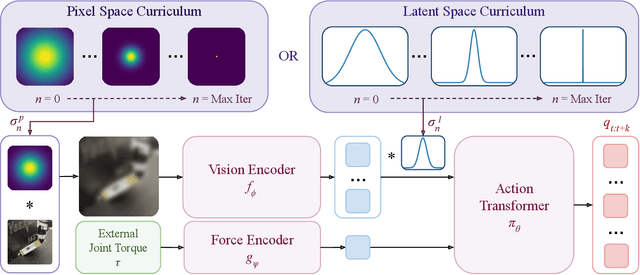
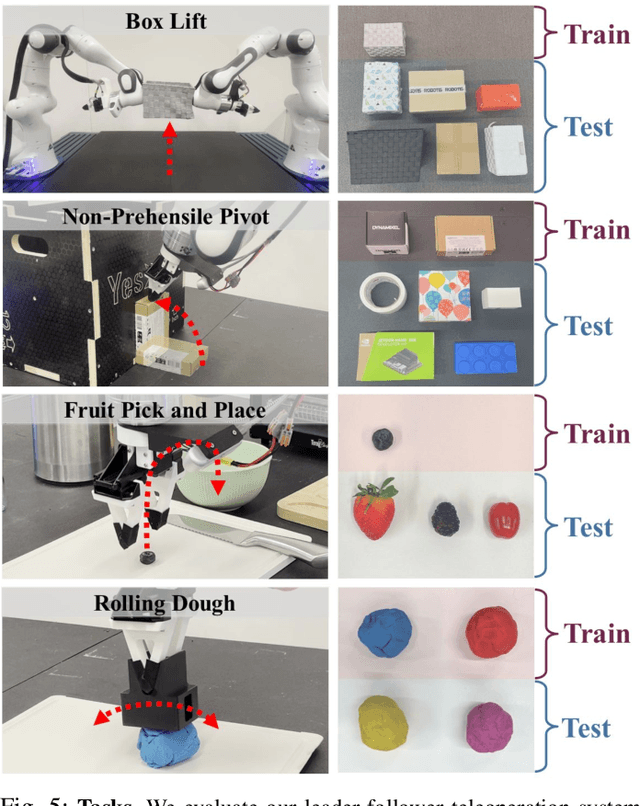
Many contact-rich tasks humans perform, such as box pickup or rolling dough, rely on force feedback for reliable execution. However, this force information, which is readily available in most robot arms, is not commonly used in teleoperation and policy learning. Consequently, robot behavior is often limited to quasi-static kinematic tasks that do not require intricate force-feedback. In this paper, we first present a low-cost, intuitive, bilateral teleoperation setup that relays external forces of the follower arm back to the teacher arm, facilitating data collection for complex, contact-rich tasks. We then introduce FACTR, a policy learning method that employs a curriculum which corrupts the visual input with decreasing intensity throughout training. The curriculum prevents our transformer-based policy from over-fitting to the visual input and guides the policy to properly attend to the force modality. We demonstrate that by fully utilizing the force information, our method significantly improves generalization to unseen objects by 43\% compared to baseline approaches without a curriculum. Video results and instructions at https://jasonjzliu.com/factr/
Towards Internet-Scale Training For Agents
Feb 10, 2025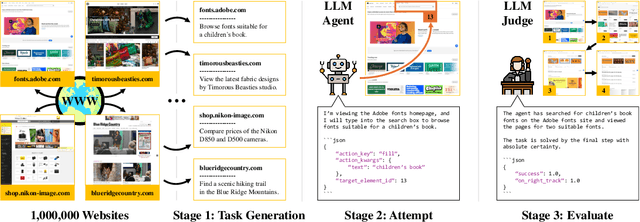
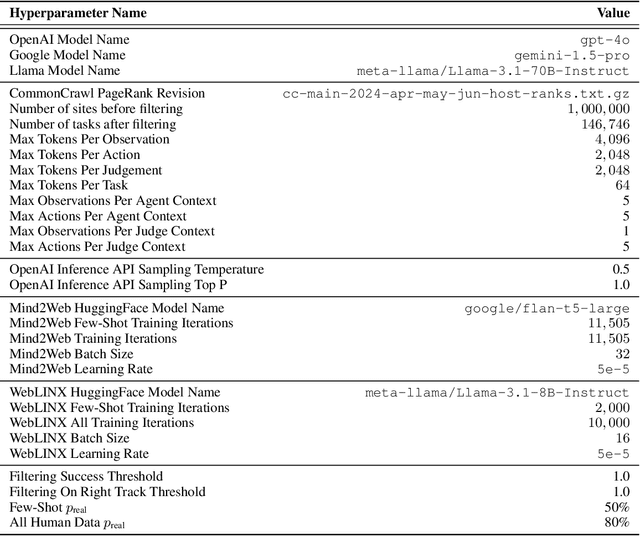
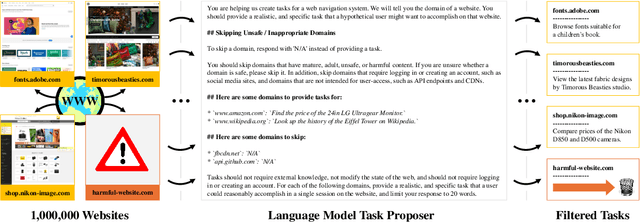

The predominant approach for training web navigation agents gathers human demonstrations for a set of popular websites and hand-written tasks, but it is becoming clear that human data are an inefficient resource. We develop a pipeline to facilitate Internet-scale training for agents without laborious human annotations. In the first stage, an LLM generates tasks for 150k diverse websites. In the next stage, LLM agents complete tasks and produce trajectories. In the final stage, an LLM reviews the trajectories and judges their success. Language models are competitive with human annotators, detecting and filtering out harmful content with an accuracy of 97%, generating feasible tasks with an 89% rate, and judging successful trajectories with an 82.6% accuracy. Scaling the pipeline, agents based on Llama 3.1 70B solve 16.7% of tasks for 150k sites. Training on the data generated by our pipeline is competitive with training on human demonstrations. In data-limited settings derived from Mind2Web and WebLINX, we improve Step Accuracy by up to +89.5% and +122.1% respectively for agents trained on mixtures of data from our pipeline, and human data. When training agents with all available human data from these benchmarks, agents fail to generalize to diverse real sites, and adding our data improves their generalization by +149.0% for WebLINX and +156.3% for Mind2Web. Code will be available at: data-for-agents.github.io.
Self-Regulation and Requesting Interventions
Feb 07, 2025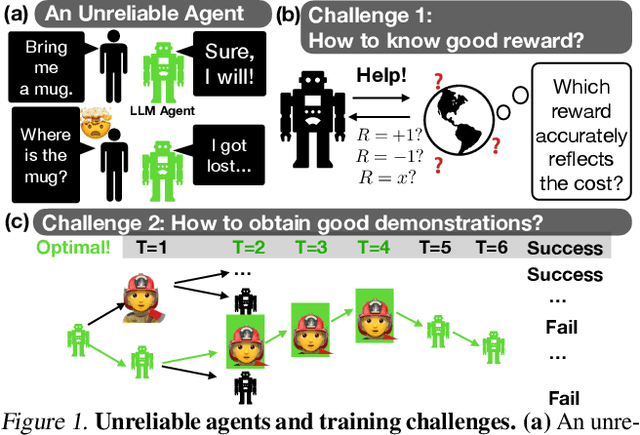
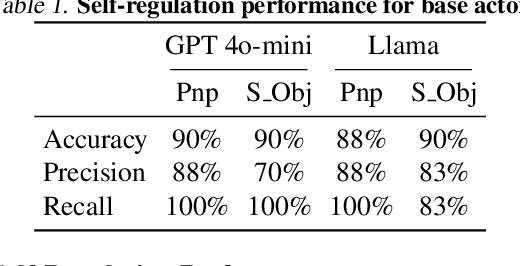
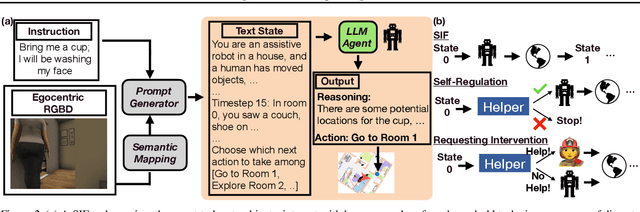

Human intelligence involves metacognitive abilities like self-regulation, recognizing limitations, and seeking assistance only when needed. While LLM Agents excel in many domains, they often lack this awareness. Overconfident agents risk catastrophic failures, while those that seek help excessively hinder efficiency. A key challenge is enabling agents with a limited intervention budget $C$ is to decide when to request assistance. In this paper, we propose an offline framework that trains a "helper" policy to request interventions, such as more powerful models or test-time compute, by combining LLM-based process reward models (PRMs) with tabular reinforcement learning. Using state transitions collected offline, we score optimal intervention timing with PRMs and train the helper model on these labeled trajectories. This offline approach significantly reduces costly intervention calls during training. Furthermore, the integration of PRMs with tabular RL enhances robustness to off-policy data while avoiding the inefficiencies of deep RL. We empirically find that our method delivers optimal helper behavior.
The BrowserGym Ecosystem for Web Agent Research
Dec 10, 2024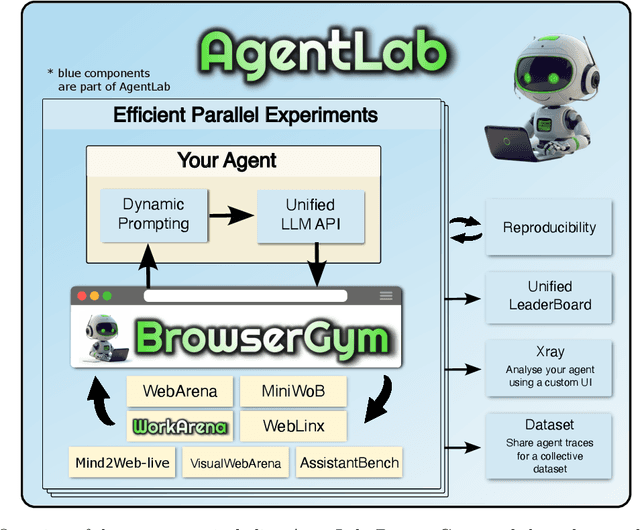
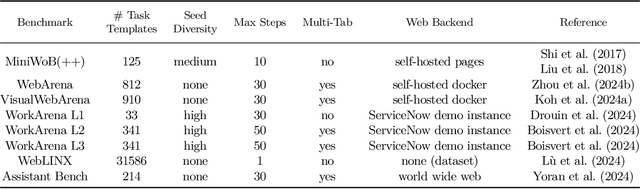

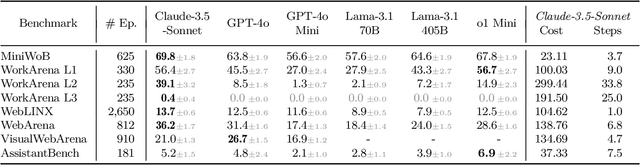
The BrowserGym ecosystem addresses the growing need for efficient evaluation and benchmarking of web agents, particularly those leveraging automation and Large Language Models (LLMs) for web interaction tasks. Many existing benchmarks suffer from fragmentation and inconsistent evaluation methodologies, making it challenging to achieve reliable comparisons and reproducible results. BrowserGym aims to solve this by providing a unified, gym-like environment with well-defined observation and action spaces, facilitating standardized evaluation across diverse benchmarks. Combined with AgentLab, a complementary framework that aids in agent creation, testing, and analysis, BrowserGym offers flexibility for integrating new benchmarks while ensuring consistent evaluation and comprehensive experiment management. This standardized approach seeks to reduce the time and complexity of developing web agents, supporting more reliable comparisons and facilitating in-depth analysis of agent behaviors, and could result in more adaptable, capable agents, ultimately accelerating innovation in LLM-driven automation. As a supporting evidence, we conduct the first large-scale, multi-benchmark web agent experiment and compare the performance of 6 state-of-the-art LLMs across all benchmarks currently available in BrowserGym. Among other findings, our results highlight a large discrepancy between OpenAI and Anthropic's latests models, with Claude-3.5-Sonnet leading the way on almost all benchmarks, except on vision-related tasks where GPT-4o is superior. Despite these advancements, our results emphasize that building robust and efficient web agents remains a significant challenge, due to the inherent complexity of real-world web environments and the limitations of current models.
Blind Inverse Problem Solving Made Easy by Text-to-Image Latent Diffusion
Nov 30, 2024
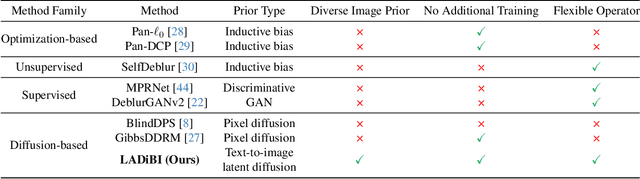
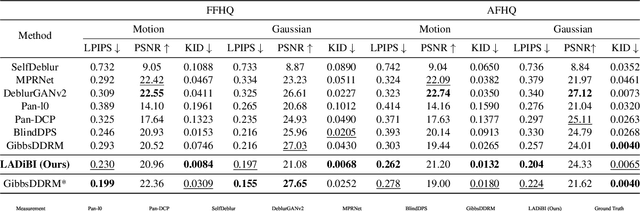

Blind inverse problems, where both the target data and forward operator are unknown, are crucial to many computer vision applications. Existing methods often depend on restrictive assumptions such as additional training, operator linearity, or narrow image distributions, thus limiting their generalizability. In this work, we present LADiBI, a training-free framework that uses large-scale text-to-image diffusion models to solve blind inverse problems with minimal assumptions. By leveraging natural language prompts, LADiBI jointly models priors for both the target image and operator, allowing for flexible adaptation across a variety of tasks. Additionally, we propose a novel posterior sampling approach that combines effective operator initialization with iterative refinement, enabling LADiBI to operate without predefined operator forms. Our experiments show that LADiBI is capable of solving a broad range of image restoration tasks, including both linear and nonlinear problems, on diverse target image distributions.
Local Policies Enable Zero-shot Long-horizon Manipulation
Oct 29, 2024Sim2real for robotic manipulation is difficult due to the challenges of simulating complex contacts and generating realistic task distributions. To tackle the latter problem, we introduce ManipGen, which leverages a new class of policies for sim2real transfer: local policies. Locality enables a variety of appealing properties including invariances to absolute robot and object pose, skill ordering, and global scene configuration. We combine these policies with foundation models for vision, language and motion planning and demonstrate SOTA zero-shot performance of our method to Robosuite benchmark tasks in simulation (97%). We transfer our local policies from simulation to reality and observe they can solve unseen long-horizon manipulation tasks with up to 8 stages with significant pose, object and scene configuration variation. ManipGen outperforms SOTA approaches such as SayCan, OpenVLA, LLMTrajGen and VoxPoser across 50 real-world manipulation tasks by 36%, 76%, 62% and 60% respectively. Video results at https://mihdalal.github.io/manipgen/
Embodied-RAG: General non-parametric Embodied Memory for Retrieval and Generation
Sep 26, 2024


There is no limit to how much a robot might explore and learn, but all of that knowledge needs to be searchable and actionable. Within language research, retrieval augmented generation (RAG) has become the workhouse of large-scale non-parametric knowledge, however existing techniques do not directly transfer to the embodied domain, which is multimodal, data is highly correlated, and perception requires abstraction. To address these challenges, we introduce Embodied-RAG, a framework that enhances the foundational model of an embodied agent with a non-parametric memory system capable of autonomously constructing hierarchical knowledge for both navigation and language generation. Embodied-RAG handles a full range of spatial and semantic resolutions across diverse environments and query types, whether for a specific object or a holistic description of ambiance. At its core, Embodied-RAG's memory is structured as a semantic forest, storing language descriptions at varying levels of detail. This hierarchical organization allows the system to efficiently generate context-sensitive outputs across different robotic platforms. We demonstrate that Embodied-RAG effectively bridges RAG to the robotics domain, successfully handling over 200 explanation and navigation queries across 19 environments, highlighting its promise for general-purpose non-parametric system for embodied agents.
Neural MP: A Generalist Neural Motion Planner
Sep 09, 2024The current paradigm for motion planning generates solutions from scratch for every new problem, which consumes significant amounts of time and computational resources. For complex, cluttered scenes, motion planning approaches can often take minutes to produce a solution, while humans are able to accurately and safely reach any goal in seconds by leveraging their prior experience. We seek to do the same by applying data-driven learning at scale to the problem of motion planning. Our approach builds a large number of complex scenes in simulation, collects expert data from a motion planner, then distills it into a reactive generalist policy. We then combine this with lightweight optimization to obtain a safe path for real world deployment. We perform a thorough evaluation of our method on 64 motion planning tasks across four diverse environments with randomized poses, scenes and obstacles, in the real world, demonstrating an improvement of 23%, 17% and 79% motion planning success rate over state of the art sampling, optimization and learning based planning methods. Video results available at mihdalal.github.io/neuralmotionplanner
Situated Instruction Following
Jul 15, 2024


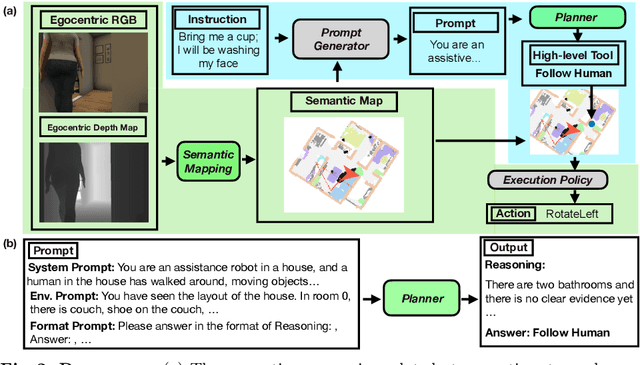
Language is never spoken in a vacuum. It is expressed, comprehended, and contextualized within the holistic backdrop of the speaker's history, actions, and environment. Since humans are used to communicating efficiently with situated language, the practicality of robotic assistants hinge on their ability to understand and act upon implicit and situated instructions. In traditional instruction following paradigms, the agent acts alone in an empty house, leading to language use that is both simplified and artificially "complete." In contrast, we propose situated instruction following, which embraces the inherent underspecification and ambiguity of real-world communication with the physical presence of a human speaker. The meaning of situated instructions naturally unfold through the past actions and the expected future behaviors of the human involved. Specifically, within our settings we have instructions that (1) are ambiguously specified, (2) have temporally evolving intent, (3) can be interpreted more precisely with the agent's dynamic actions. Our experiments indicate that state-of-the-art Embodied Instruction Following (EIF) models lack holistic understanding of situated human intention.