 Add to Chrome
 Add to Firefox
 Add to Edge
AgentBeats: Agentifying Agent Assessment for Openness, Standardization, and Reproducibility
Jun 11, 2026
Agent systems are advancing quickly across domains, but their evaluation remains fragmented. Most benchmarks rely on fixed, LLM-centric harnesses that require heavy integration, create test-production mismatch, and limit fair comparison across diverse agent designs. The root problem is the lack of an open, agent-agnostic assessment interface. We advocate Agentified Agent Assessment (AAA), where evaluation is performed by judge agents and all participants interact through standardized protocols: A2A for task management and MCP for tool access. Conventional benchmarking defines two separate interfaces, one for the benchmark and one for the agent, while AAA only needs one; this yields a generic, unified framework that separates assessment logic from agent implementation and enables reproducible, interoperable, and multi-agent evaluation. We further introduce AgentBeats as a concrete realization of AAA: we identify five practical operation modes that make standardized assessment compatible with real-world constraints on openness, privacy, and reproducibility. To evaluate our design at scale, we conduct two studies: a five-month open competition that drew 298 judge agents across 12 categories together with 467 subject agents from independent participants, showing that AAA applies across a heterogeneous range of benchmarks; and a case study on coding agents that confirms agentified evaluation preserves fidelity with the public record while surfacing previously missing head-to-head results, yielding research insights about agent design. Combining a community-scale field study and a controlled coding case study, we verify that AAA delivers coverage, practicality, and fidelity across heterogeneous scenarios at scale. Together, AAA and AgentBeats offer a clear path toward open, standardized, and reproducible agent assessment.

MosaicLeaks:Privacy Risks in Querying-in-the-Open for Deep Research Agents
May 29, 2026Deep research agents increasingly combine private local documents with external tools like web retrieval, creating a privacy risk: an agent's external queries may leak sensitive information from its local context. This risk is amplified by the mosaic effect, where individual queries may appear harmless but become revealing in aggregate. We introduce MosaicLeaks, a benchmark of 1,001 multi-hop deep research tasks that chain private enterprise documents and a public web corpus, forcing agents to make external queries that depend on local information. We evaluate leakage with an adversary LLM that observes only the agent's external queries and attempts to infer private information at three levels: the agent's research intent, answers to specific private questions and verifiable claims about the enterprise documents. We find that models across families and sizes frequently leak at all three levels, that zero-shot privacy prompting reduces but does not eliminate leakage and that reinforcement learning for task performance alone worsens leakage. To address this, we propose Privacy-Aware Deep Research (PA-DR), an RL framework that combines situational rewards for task success with a learned privacy classifier to provide dense credit assignment over both per-query and mosaic-level leakage. Training Qwen3-4B-Instruct with PA-DR improves accuracy from 48.7% to 58.7% and reduces answer and full-information leakage from 34.0% to 9.9%.
Dr-CiK: A Testbed for Foresight-Driven Agents
May 27, 2026Time series forecasting in real-world settings often depends not only on historical observations, but also on external context that must be actively discovered from noisy, heterogeneous information sources. Yet existing context-aided forecasting benchmarks typically assume that the supporting context is already provided, leaving open whether agents can identify it on their own. Therefore, we introduce Dr-CiK, a benchmark for evaluating whether agents can retrieve forecasting-relevant supporting context from a document corpus, filter out distractors, distill the retrieved context into forecast-useful evidence, and generate forecasts supported by that evidence. Through context ablations and evaluations of state-of-the-art deep research and forecasting methods paired together, we show that high-quality context substantially improves forecasting performance in Dr-CiK. However, most existing DR agents recover only a small fraction of the ground-truth supporting evidence (usually <5%), are frequently misled by distractors (>80% distractor citations), and can cause forecasters to perform worse with retrieved context than without context. Our results motivate research on foresight-driven agents that search for the right context to predict the future.
Apriel-1.5-OpenReasoner: RL Post-Training for General-Purpose and Efficient Reasoning
Apr 03, 2026Building general-purpose reasoning models using reinforcement learning with verifiable rewards (RLVR) across diverse domains has been widely adopted by frontier open-weight models. However, their training recipes and domain mixtures are often not disclosed. Joint optimization across domains poses significant challenges: domains vary widely in rollout length, problem difficulty and sample efficiency. Further, models with long chain-of-thought traces increase inference cost and latency, making efficiency critical for practical deployment. We present Apriel-1.5-OpenReasoner, trained with a fully reproducible multi-domain RL post-training recipe on Apriel-Base, a 15B-parameter open-weight LLM, across five domains using public datasets: mathematics, code generation, instruction following, logical puzzles and function calling. We introduce an adaptive domain sampling mechanism that preserves target domain ratios despite heterogeneous rollout dynamics, and a difficulty-aware extension of the standard length penalty that, with no additional training overhead, encourages longer reasoning for difficult problems and shorter traces for easy ones. Trained with a strict 16K-token output budget, Apriel-1.5-OpenReasoner generalizes to 32K tokens at inference and improves over Apriel-Base on AIME 2025, GPQA, MMLU-Pro, and LiveCodeBench while producing 30-50% shorter reasoning traces. It matches strong open-weight models of similar size at lower token cost, thereby pushing the Pareto frontier of accuracy versus token budget.
Apriel-Reasoner: RL Post-Training for General-Purpose and Efficient Reasoning
Apr 02, 2026Building general-purpose reasoning models using reinforcement learning with verifiable rewards (RLVR) across diverse domains has been widely adopted by frontier open-weight models. However, their training recipes and domain mixtures are often not disclosed. Joint optimization across domains poses significant challenges: domains vary widely in rollout length, problem difficulty and sample efficiency. Further, models with long chain-of-thought traces increase inference cost and latency, making efficiency critical for practical deployment. We present Apriel-Reasoner, trained with a fully reproducible multi-domain RL post-training recipe on Apriel-Base, a 15B-parameter open-weight LLM, across five domains using public datasets: mathematics, code generation, instruction following, logical puzzles and function calling. We introduce an adaptive domain sampling mechanism that preserves target domain ratios despite heterogeneous rollout dynamics, and a difficulty-aware extension of the standard length penalty that, with no additional training overhead, encourages longer reasoning for difficult problems and shorter traces for easy ones. Trained with a strict 16K-token output budget, Apriel-Reasoner generalizes to 32K tokens at inference and improves over Apriel-Base on AIME 2025, GPQA, MMLU-Pro, and LiveCodeBench while producing 30-50% shorter reasoning traces. It matches strong open-weight models of similar size at lower token cost, thereby pushing the Pareto frontier of accuracy versus token budget.
CUBE: A Standard for Unifying Agent Benchmarks
Mar 16, 2026The proliferation of agent benchmarks has created critical fragmentation that threatens research productivity. Each new benchmark requires substantial custom integration, creating an "integration tax" that limits comprehensive evaluation. We propose CUBE (Common Unified Benchmark Environments), a universal protocol standard built on MCP and Gym that allows benchmarks to be wrapped once and used everywhere. By separating task, benchmark, package, and registry concerns into distinct API layers, CUBE enables any compliant platform to access any compliant benchmark for evaluation, RL training, or data generation without custom integration. We call on the community to contribute to the development of this standard before platform-specific implementations deepen fragmentation as benchmark production accelerates through 2026.
Overcoming the Modality Gap in Context-Aided Forecasting
Mar 16, 2026Context-aided forecasting (CAF) holds promise for integrating domain knowledge and forward-looking information, enabling AI systems to surpass traditional statistical methods. However, recent empirical studies reveal a puzzling gap: multimodal models often fail to outperform their unimodal counterparts. We hypothesize that this underperformance stems from poor context quality in existing datasets, as verification is challenging. To address these limitations, we introduce a semi-synthetic data augmentation method that generates contexts both descriptive of temporal dynamics and verifiably complementary to numerical histories. This approach enables massive-scale dataset creation, resulting in CAF-7M, a corpus of 7 million context-augmented time series windows, including a rigorously verified test set. We demonstrate that semi-synthetic pre-training transfers effectively to real-world evaluation, and show clear evidence of context utilization. Our results suggest that dataset quality, rather than architectural limitations, has been the primary bottleneck in context-aided forecasting.
Just-in-time Episodic Feedback Hinter: Leveraging Offline Knowledge to Improve LLM Agents Adaptation
Oct 05, 2025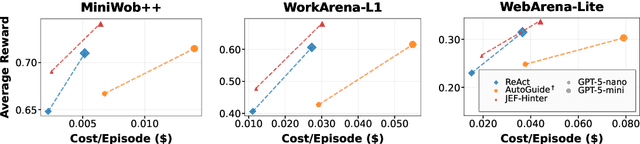
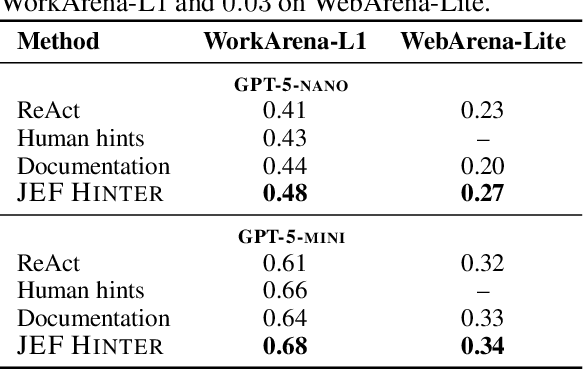
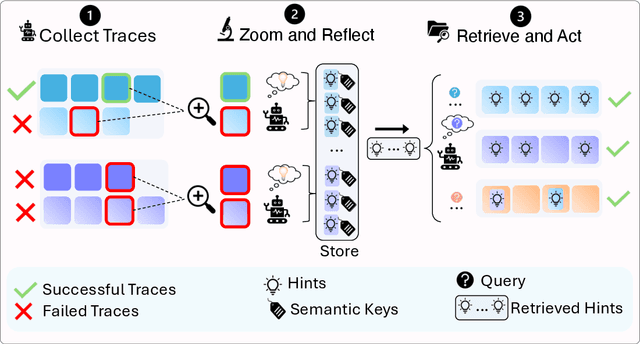
Large language model (LLM) agents perform well in sequential decision-making tasks, but improving them on unfamiliar domains often requires costly online interactions or fine-tuning on large expert datasets. These strategies are impractical for closed-source models and expensive for open-source ones, with risks of catastrophic forgetting. Offline trajectories offer reusable knowledge, yet demonstration-based methods struggle because raw traces are long, noisy, and tied to specific tasks. We present Just-in-time Episodic Feedback Hinter (JEF Hinter), an agentic system that distills offline traces into compact, context-aware hints. A zooming mechanism highlights decisive steps in long trajectories, capturing both strategies and pitfalls. Unlike prior methods, JEF Hinter leverages both successful and failed trajectories, extracting guidance even when only failure data is available, while supporting parallelized hint generation and benchmark-independent prompting. At inference, a retriever selects relevant hints for the current state, providing targeted guidance with transparency and traceability. Experiments on MiniWoB++, WorkArena-L1, and WebArena-Lite show that JEF Hinter consistently outperforms strong baselines, including human- and document-based hints.
Beyond Naïve Prompting: Strategies for Improved Zero-shot Context-aided Forecasting with LLMs
Aug 13, 2025Forecasting in real-world settings requires models to integrate not only historical data but also relevant contextual information, often available in textual form. While recent work has shown that large language models (LLMs) can be effective context-aided forecasters via na\"ive direct prompting, their full potential remains underexplored. We address this gap with 4 strategies, providing new insights into the zero-shot capabilities of LLMs in this setting. ReDP improves interpretability by eliciting explicit reasoning traces, allowing us to assess the model's reasoning over the context independently from its forecast accuracy. CorDP leverages LLMs solely to refine existing forecasts with context, enhancing their applicability in real-world forecasting pipelines. IC-DP proposes embedding historical examples of context-aided forecasting tasks in the prompt, substantially improving accuracy even for the largest models. Finally, RouteDP optimizes resource efficiency by using LLMs to estimate task difficulty, and routing the most challenging tasks to larger models. Evaluated on different kinds of context-aided forecasting tasks from the CiK benchmark, our strategies demonstrate distinct benefits over na\"ive prompting across LLMs of different sizes and families. These results open the door to further simple yet effective improvements in LLM-based context-aided forecasting.
Learning to Defer for Causal Discovery with Imperfect Experts
Feb 18, 2025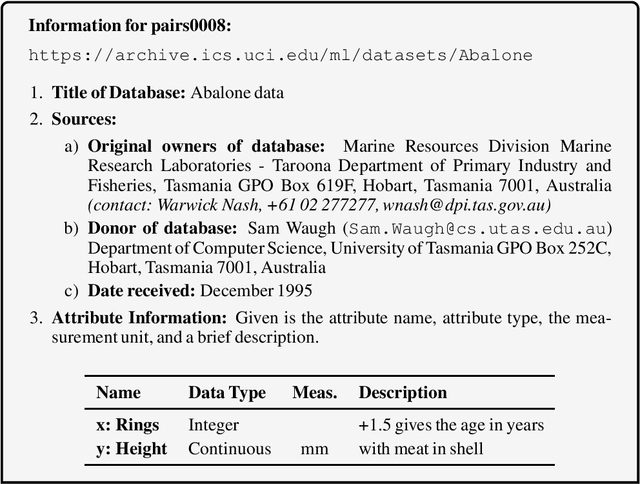
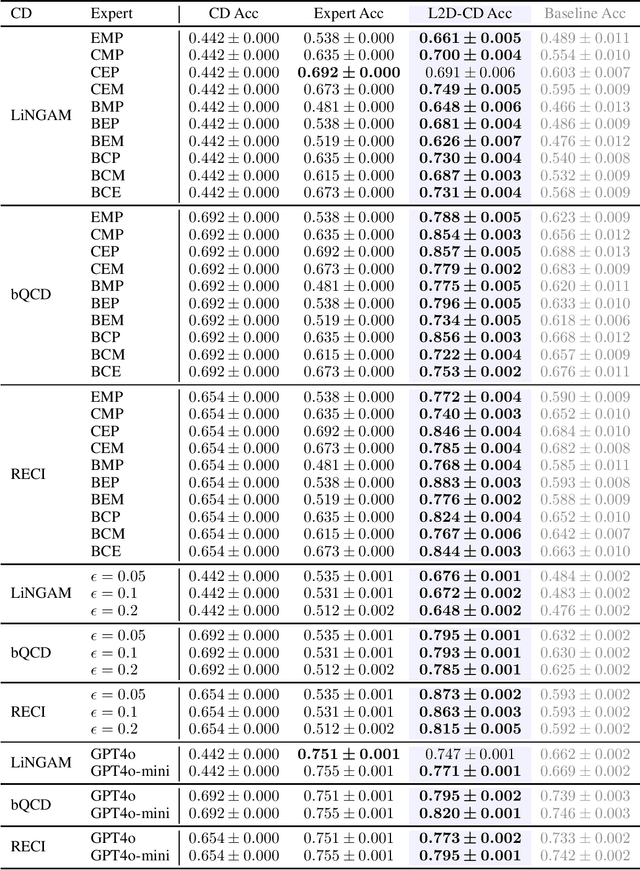
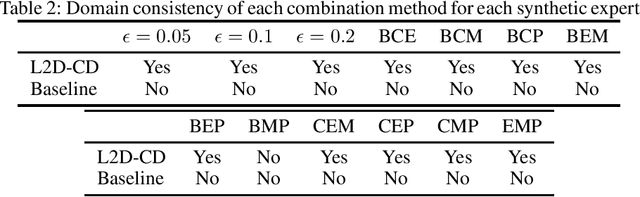
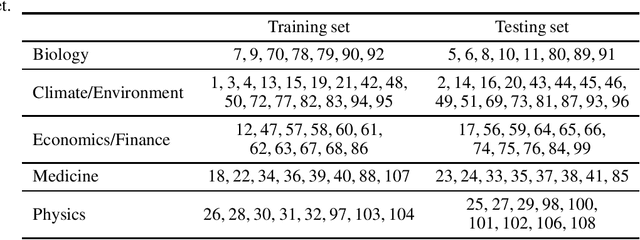
Integrating expert knowledge, e.g. from large language models, into causal discovery algorithms can be challenging when the knowledge is not guaranteed to be correct. Expert recommendations may contradict data-driven results, and their reliability can vary significantly depending on the domain or specific query. Existing methods based on soft constraints or inconsistencies in predicted causal relationships fail to account for these variations in expertise. To remedy this, we propose L2D-CD, a method for gauging the correctness of expert recommendations and optimally combining them with data-driven causal discovery results. By adapting learning-to-defer (L2D) algorithms for pairwise causal discovery (CD), we learn a deferral function that selects whether to rely on classical causal discovery methods using numerical data or expert recommendations based on textual meta-data. We evaluate L2D-CD on the canonical T\"ubingen pairs dataset and demonstrate its superior performance compared to both the causal discovery method and the expert used in isolation. Moreover, our approach identifies domains where the expert's performance is strong or weak. Finally, we outline a strategy for generalizing this approach to causal discovery on graphs with more than two variables, paving the way for further research in this area.