 Add to Chrome
 Add to Firefox
 Add to Edge
MyPCBench: A Benchmark for Personally Intelligent Computer-Use Agents
Jun 15, 2026
Current benchmarks for computer-use agents evaluate models in impersonal environments. This leaves a gap between evaluation and deployment where personal assistants are expected to work across a user's whole digital life, including their context, historical data, and logged-in accounts. This gap is widest on web tasks, where live web evaluations cannot exercise sites that require logging in or personal information, the kind of site a real personal assistant has to drive. We introduce MyPCBench, which tests computer-use agents as personal assistants on a Linux desktop populated with 17 simulated real-world web applications and a full desktop stack, all seeded for one canonical persona, Michael Scott from The Office. We define 184 tasks in this environment, each inspired by a real request drawn from the OpenClaw community, and benchmark six closed and open-weight models with a uniform computer+bash tool surface. We find that the best model, Claude Opus 4.6, fully solves 55.4\% of the tasks, the only model above 50\%. Model failures cluster on tasks that span many applications and on long trajectories, where personalization stresses an assistant the most. We release the environment, task set, and agent harness at https://mypcbench.com.

iOSWorld: A Benchmark for Personally Intelligent Phone Agents
Jun 08, 2026A useful phone agent needs to be personally intelligent. It should reason over a user's identity, history, and preferences as they exist on the device, not just follow isolated instructions in an impersonal sandbox. Existing mobile agent benchmarks lack this kind of personalization. We introduce iOSWorld, the first interactive native iOS simulator benchmark built around a persistent user identity spanning 26 newly built iOS apps. These apps contain connected data such as transactions, messages, travel records, social relationships, and financial activity. iOSWorld includes 133 tasks across three increasingly difficult categories. Single-app tasks (27) test one app, multi-app tasks (60) span 2 to 8 apps, and memory and personalization tasks (46) require agents to infer patterns from personal data. We evaluate frontier and open-source computer-use models in both vision-only and privileged vision+XML settings. The best configuration reaches 52\% overall but only 37\% on multi-app tasks. Privileged vision+XML access improves frontier models by up to 26 percentage points, while smaller models do not benefit from added accessibility-tree input. We release iOSWorld as an open-source benchmark with all apps, seeded data, tasks, rubrics, and evaluation code.
Odysseys: Benchmarking Web Agents on Realistic Long Horizon Tasks
Apr 27, 2026Existing web agent benchmarks have largely converged on short, single-site tasks that frontier models are approaching saturation on. However, real world web use consists of long-horizon, multi-site workflows. Common web navigation tasks, such as comparing products across different domains, planning trips across multiple services, or summarizing information from multiple search queries, require sustained context and cross-site reasoning over potentially hours of browsing. To capture and evaluate such behaviors, we introduce Odysseys: a benchmark of 200 long-horizon web tasks derived from real world browsing sessions evaluated on the live Internet. We find that binary pass/fail evaluation is inadequate for long-horizon settings and introduce a rubric-based evaluation, annotating each Odysseys task with an average of 6.1 graded rubrics. We demonstrate that this yields higher agreement with humans and provides a more fine-grained signal than commonly used trajectory-level LLM-as-a-judge evaluation metrics. We tested several leading frontier models and find that the strongest models achieve a success rate of 44.5%, which leaves substantial room for future improvements. Beyond task success, we argue that efficiency is a first-class concern for long-horizon agents. We introduce a Trajectory Efficiency metric (rubric score per step) and find that even frontier agents achieve only 1.15%, marking an evident need for agents that can succeed efficiently and not simply eventually. Odysseys isolates the critical evaluation of long-horizon proficiency in open-web environments, providing a realistic benchmark to measure progress towards computer-use agents that can potentially productively operate for hours. We release our tasks, evaluation scripts, and other results at https://odysseys-website.pages.dev
The BrowserGym Ecosystem for Web Agent Research
Dec 10, 2024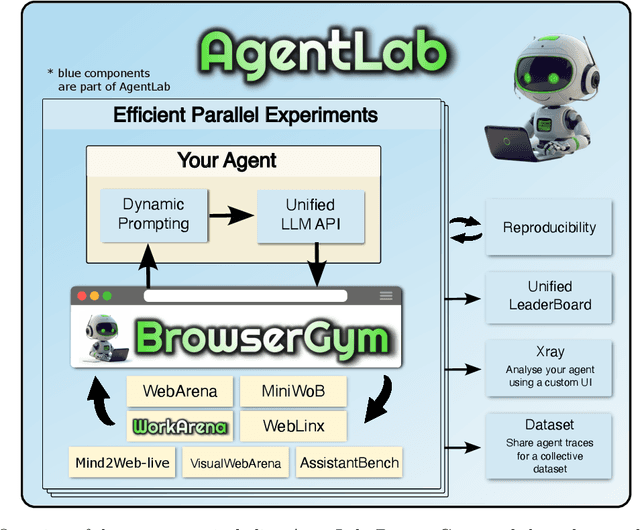
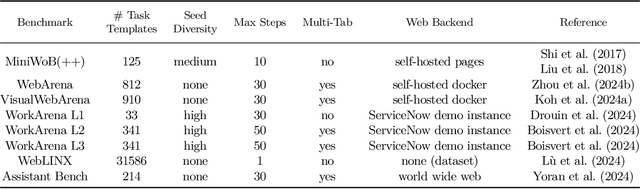

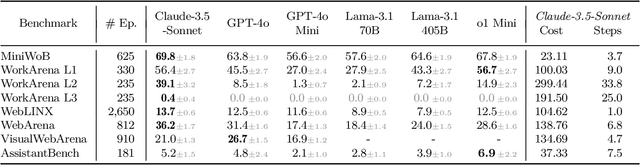
The BrowserGym ecosystem addresses the growing need for efficient evaluation and benchmarking of web agents, particularly those leveraging automation and Large Language Models (LLMs) for web interaction tasks. Many existing benchmarks suffer from fragmentation and inconsistent evaluation methodologies, making it challenging to achieve reliable comparisons and reproducible results. BrowserGym aims to solve this by providing a unified, gym-like environment with well-defined observation and action spaces, facilitating standardized evaluation across diverse benchmarks. Combined with AgentLab, a complementary framework that aids in agent creation, testing, and analysis, BrowserGym offers flexibility for integrating new benchmarks while ensuring consistent evaluation and comprehensive experiment management. This standardized approach seeks to reduce the time and complexity of developing web agents, supporting more reliable comparisons and facilitating in-depth analysis of agent behaviors, and could result in more adaptable, capable agents, ultimately accelerating innovation in LLM-driven automation. As a supporting evidence, we conduct the first large-scale, multi-benchmark web agent experiment and compare the performance of 6 state-of-the-art LLMs across all benchmarks currently available in BrowserGym. Among other findings, our results highlight a large discrepancy between OpenAI and Anthropic's latests models, with Claude-3.5-Sonnet leading the way on almost all benchmarks, except on vision-related tasks where GPT-4o is superior. Despite these advancements, our results emphasize that building robust and efficient web agents remains a significant challenge, due to the inherent complexity of real-world web environments and the limitations of current models.