 Add to Chrome
 Add to Firefox
 Add to Edge
Aligning and Prompting Everything All at Once for Universal Visual Perception
Dec 04, 2023
Vision foundation models have been explored recently to build general-purpose vision systems. However, predominant paradigms, driven by casting instance-level tasks as an object-word alignment, bring heavy cross-modality interaction, which is not effective in prompting object detection and visual grounding. Another line of work that focuses on pixel-level tasks often encounters a large annotation gap of things and stuff, and suffers from mutual interference between foreground-object and background-class segmentation. In stark contrast to the prevailing methods, we present APE, a universal visual perception model for aligning and prompting everything all at once in an image to perform diverse tasks, i.e., detection, segmentation, and grounding, as an instance-level sentence-object matching paradigm. Specifically, APE advances the convergence of detection and grounding by reformulating language-guided grounding as open-vocabulary detection, which efficiently scales up model prompting to thousands of category vocabularies and region descriptions while maintaining the effectiveness of cross-modality fusion. To bridge the granularity gap of different pixel-level tasks, APE equalizes semantic and panoptic segmentation to proxy instance learning by considering any isolated regions as individual instances. APE aligns vision and language representation on broad data with natural and challenging characteristics all at once without task-specific fine-tuning. The extensive experiments on over 160 datasets demonstrate that, with only one-suit of weights, APE outperforms (or is on par with) the state-of-the-art models, proving that an effective yet universal perception for anything aligning and prompting is indeed feasible. Codes and trained models are released at https://github.com/shenyunhang/APE.

Less is More: Learning Reference Knowledge Using No-Reference Image Quality Assessment
Dec 01, 2023Image Quality Assessment (IQA) with reference images have achieved great success by imitating the human vision system, in which the image quality is effectively assessed by comparing the query image with its pristine reference image. However, for the images in the wild, it is quite difficult to access accurate reference images. We argue that it is possible to learn reference knowledge under the No-Reference Image Quality Assessment (NR-IQA) setting, which is effective and efficient empirically. Concretely, by innovatively introducing a novel feature distillation method in IQA, we propose a new framework to learn comparative knowledge from non-aligned reference images. And then, to achieve fast convergence and avoid overfitting, we further propose an inductive bias regularization. Such a framework not only solves the congenital defects of NR-IQA but also improves the feature extraction framework, enabling it to express more abundant quality information. Surprisingly, our method utilizes less input while obtaining a more significant improvement compared to the teacher models. Extensive experiments on eight standard NR-IQA datasets demonstrate the superior performance to the state-of-the-art NR-IQA methods, i.e., achieving the PLCC values of 0.917 (vs. 0.884 in LIVEC) and 0.686 (vs. 0.661 in LIVEFB).
X-Dreamer: Creating High-quality 3D Content by Bridging the Domain Gap Between Text-to-2D and Text-to-3D Generation
Nov 30, 2023
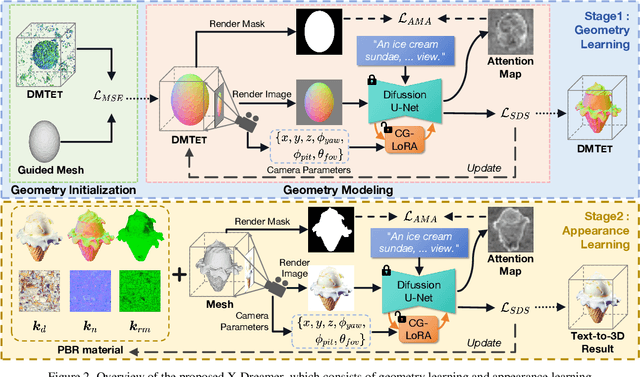

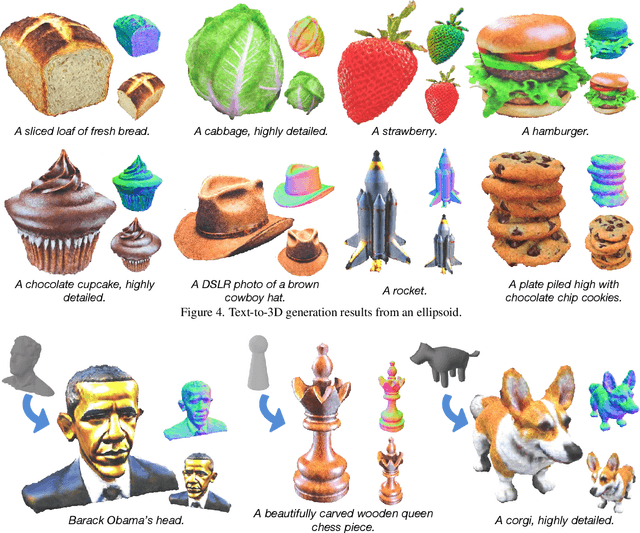
In recent times, automatic text-to-3D content creation has made significant progress, driven by the development of pretrained 2D diffusion models. Existing text-to-3D methods typically optimize the 3D representation to ensure that the rendered image aligns well with the given text, as evaluated by the pretrained 2D diffusion model. Nevertheless, a substantial domain gap exists between 2D images and 3D assets, primarily attributed to variations in camera-related attributes and the exclusive presence of foreground objects. Consequently, employing 2D diffusion models directly for optimizing 3D representations may lead to suboptimal outcomes. To address this issue, we present X-Dreamer, a novel approach for high-quality text-to-3D content creation that effectively bridges the gap between text-to-2D and text-to-3D synthesis. The key components of X-Dreamer are two innovative designs: Camera-Guided Low-Rank Adaptation (CG-LoRA) and Attention-Mask Alignment (AMA) Loss. CG-LoRA dynamically incorporates camera information into the pretrained diffusion models by employing camera-dependent generation for trainable parameters. This integration enhances the alignment between the generated 3D assets and the camera's perspective. AMA loss guides the attention map of the pretrained diffusion model using the binary mask of the 3D object, prioritizing the creation of the foreground object. This module ensures that the model focuses on generating accurate and detailed foreground objects. Extensive evaluations demonstrate the effectiveness of our proposed method compared to existing text-to-3D approaches. Our project webpage: https://xmuxiaoma666.github.io/Projects/X-Dreamer .
I&S-ViT: An Inclusive & Stable Method for Pushing the Limit of Post-Training ViTs Quantization
Nov 16, 2023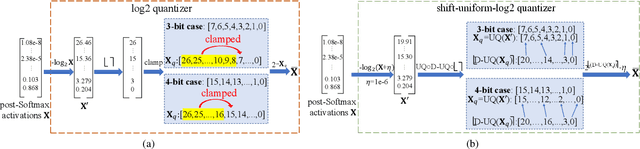
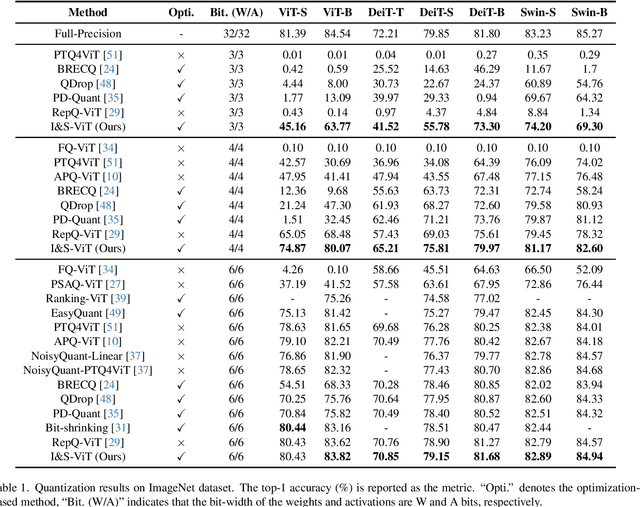
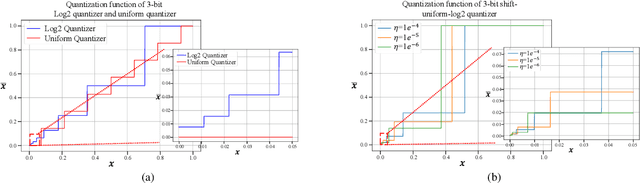
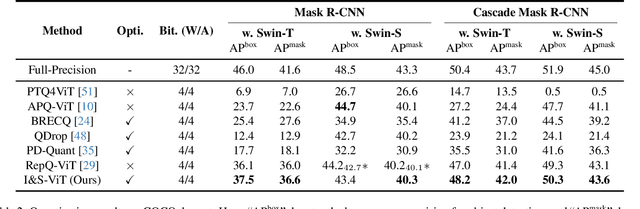
Albeit the scalable performance of vision transformers (ViTs), the dense computational costs (training & inference) undermine their position in industrial applications. Post-training quantization (PTQ), tuning ViTs with a tiny dataset and running in a low-bit format, well addresses the cost issue but unluckily bears more performance drops in lower-bit cases. In this paper, we introduce I&S-ViT, a novel method that regulates the PTQ of ViTs in an inclusive and stable fashion. I&S-ViT first identifies two issues in the PTQ of ViTs: (1) Quantization inefficiency in the prevalent log2 quantizer for post-Softmax activations; (2) Rugged and magnified loss landscape in coarse-grained quantization granularity for post-LayerNorm activations. Then, I&S-ViT addresses these issues by introducing: (1) A novel shift-uniform-log2 quantizer (SULQ) that incorporates a shift mechanism followed by uniform quantization to achieve both an inclusive domain representation and accurate distribution approximation; (2) A three-stage smooth optimization strategy (SOS) that amalgamates the strengths of channel-wise and layer-wise quantization to enable stable learning. Comprehensive evaluations across diverse vision tasks validate I&S-ViT' superiority over existing PTQ of ViTs methods, particularly in low-bit scenarios. For instance, I&S-ViT elevates the performance of 3-bit ViT-B by an impressive 50.68%.
Semi-Supervised Panoptic Narrative Grounding
Oct 27, 2023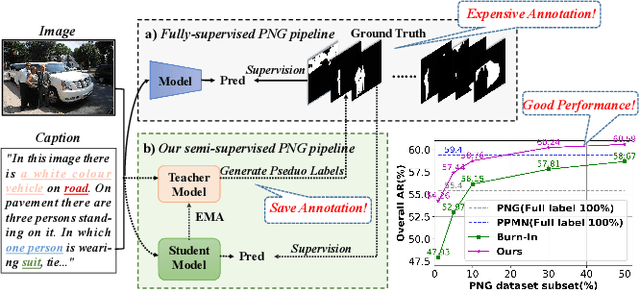
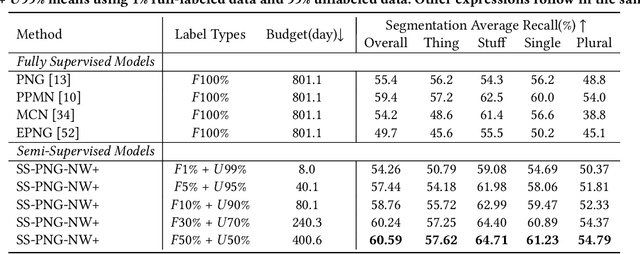
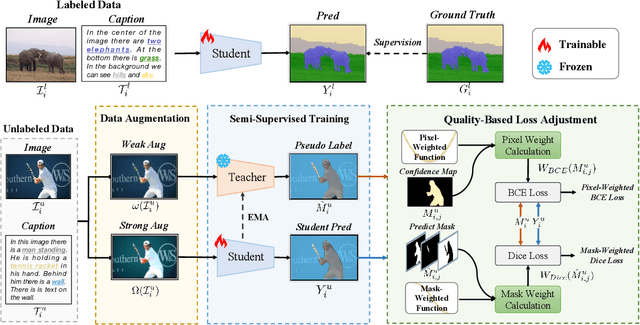
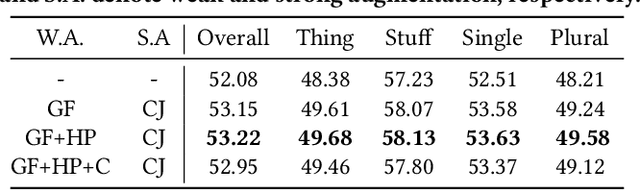
Despite considerable progress, the advancement of Panoptic Narrative Grounding (PNG) remains hindered by costly annotations. In this paper, we introduce a novel Semi-Supervised Panoptic Narrative Grounding (SS-PNG) learning scheme, capitalizing on a smaller set of labeled image-text pairs and a larger set of unlabeled pairs to achieve competitive performance. Unlike visual segmentation tasks, PNG involves one pixel belonging to multiple open-ended nouns. As a result, existing multi-class based semi-supervised segmentation frameworks cannot be directly applied to this task. To address this challenge, we first develop a novel SS-PNG Network (SS-PNG-NW) tailored to the SS-PNG setting. We thoroughly investigate strategies such as Burn-In and data augmentation to determine the optimal generic configuration for the SS-PNG-NW. Additionally, to tackle the issue of imbalanced pseudo-label quality, we propose a Quality-Based Loss Adjustment (QLA) approach to adjust the semi-supervised objective, resulting in an enhanced SS-PNG-NW+. Employing our proposed QLA, we improve BCE Loss and Dice loss at pixel and mask levels, respectively. We conduct extensive experiments on PNG datasets, with our SS-PNG-NW+ demonstrating promising results comparable to fully-supervised models across all data ratios. Remarkably, our SS-PNG-NW+ outperforms fully-supervised models with only 30% and 50% supervision data, exceeding their performance by 0.8% and 1.1% respectively. This highlights the effectiveness of our proposed SS-PNG-NW+ in overcoming the challenges posed by limited annotations and enhancing the applicability of PNG tasks. The source code is available at https://github.com/nini0919/SSPNG.
NICE: Improving Panoptic Narrative Detection and Segmentation with Cascading Collaborative Learning
Oct 23, 2023Panoptic Narrative Detection (PND) and Segmentation (PNS) are two challenging tasks that involve identifying and locating multiple targets in an image according to a long narrative description. In this paper, we propose a unified and effective framework called NICE that can jointly learn these two panoptic narrative recognition tasks. Existing visual grounding tasks use a two-branch paradigm, but applying this directly to PND and PNS can result in prediction conflict due to their intrinsic many-to-many alignment property. To address this, we introduce two cascading modules based on the barycenter of the mask, which are Coordinate Guided Aggregation (CGA) and Barycenter Driven Localization (BDL), responsible for segmentation and detection, respectively. By linking PNS and PND in series with the barycenter of segmentation as the anchor, our approach naturally aligns the two tasks and allows them to complement each other for improved performance. Specifically, CGA provides the barycenter as a reference for detection, reducing BDL's reliance on a large number of candidate boxes. BDL leverages its excellent properties to distinguish different instances, which improves the performance of CGA for segmentation. Extensive experiments demonstrate that NICE surpasses all existing methods by a large margin, achieving 4.1% for PND and 2.9% for PNS over the state-of-the-art. These results validate the effectiveness of our proposed collaborative learning strategy. The project of this work is made publicly available at https://github.com/Mr-Neko/NICE.
JM3D & JM3D-LLM: Elevating 3D Representation with Joint Multi-modal Cues
Oct 20, 2023The rising importance of 3D representation learning, pivotal in computer vision, autonomous driving, and robotics, is evident. However, a prevailing trend, which straightforwardly resorted to transferring 2D alignment strategies to the 3D domain, encounters three distinct challenges: (1) Information Degradation: This arises from the alignment of 3D data with mere single-view 2D images and generic texts, neglecting the need for multi-view images and detailed subcategory texts. (2) Insufficient Synergy: These strategies align 3D representations to image and text features individually, hampering the overall optimization for 3D models. (3) Underutilization: The fine-grained information inherent in the learned representations is often not fully exploited, indicating a potential loss in detail. To address these issues, we introduce JM3D, a comprehensive approach integrating point cloud, text, and image. Key contributions include the Structured Multimodal Organizer (SMO), enriching vision-language representation with multiple views and hierarchical text, and the Joint Multi-modal Alignment (JMA), combining language understanding with visual representation. Our advanced model, JM3D-LLM, marries 3D representation with large language models via efficient fine-tuning. Evaluations on ModelNet40 and ScanObjectNN establish JM3D's superiority. The superior performance of JM3D-LLM further underscores the effectiveness of our representation transfer approach. Our code and models are available at https://github.com/Mr-Neko/JM3D.
Dynamic Sparse No Training: Training-Free Fine-tuning for Sparse LLMs
Oct 17, 2023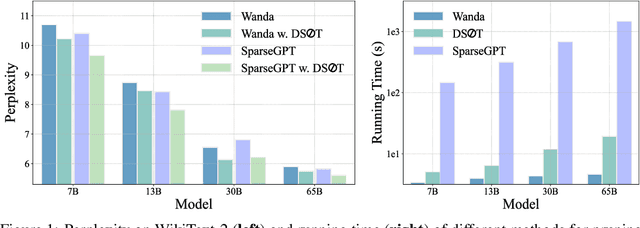
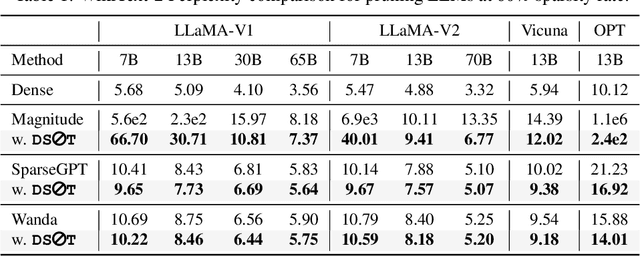
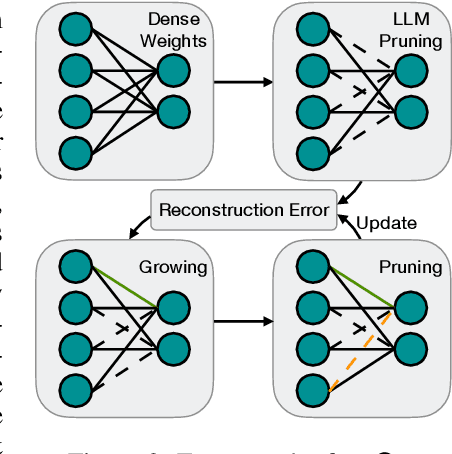
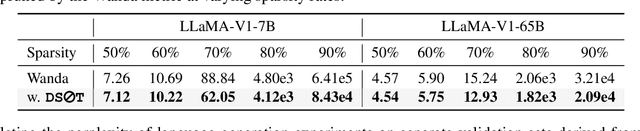
The ever-increasing large language models (LLMs), though opening a potential path for the upcoming artificial general intelligence, sadly drops a daunting obstacle on the way towards their on-device deployment. As one of the most well-established pre-LLMs approaches in reducing model complexity, network pruning appears to lag behind in the era of LLMs, due mostly to its costly fine-tuning (or re-training) necessity under the massive volumes of model parameter and training data. To close this industry-academia gap, we introduce Dynamic Sparse No Training (DSnoT), a training-free fine-tuning approach that slightly updates sparse LLMs without the expensive backpropagation and any weight updates. Inspired by the Dynamic Sparse Training, DSnoT minimizes the reconstruction error between the dense and sparse LLMs, in the fashion of performing iterative weight pruning-and-growing on top of sparse LLMs. To accomplish this purpose, DSnoT particularly takes into account the anticipated reduction in reconstruction error for pruning and growing, as well as the variance w.r.t. different input data for growing each weight. This practice can be executed efficiently in linear time since its obviates the need of backpropagation for fine-tuning LLMs. Extensive experiments on LLaMA-V1/V2, Vicuna, and OPT across various benchmarks demonstrate the effectiveness of DSnoT in enhancing the performance of sparse LLMs, especially at high sparsity levels. For instance, DSnoT is able to outperform the state-of-the-art Wanda by 26.79 perplexity at 70% sparsity with LLaMA-7B. Our paper offers fresh insights into how to fine-tune sparse LLMs in an efficient training-free manner and open new venues to scale the great potential of sparsity to LLMs. Codes are available at https://github.com/zyxxmu/DSnoT.
CAPro: Webly Supervised Learning with Cross-Modality Aligned Prototypes
Oct 15, 2023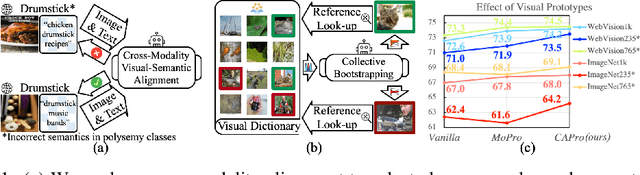
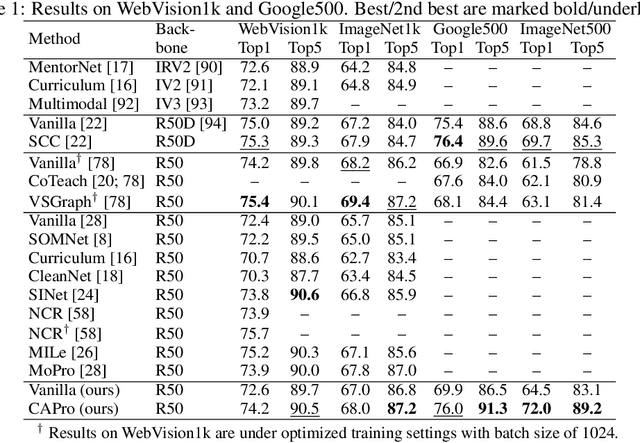
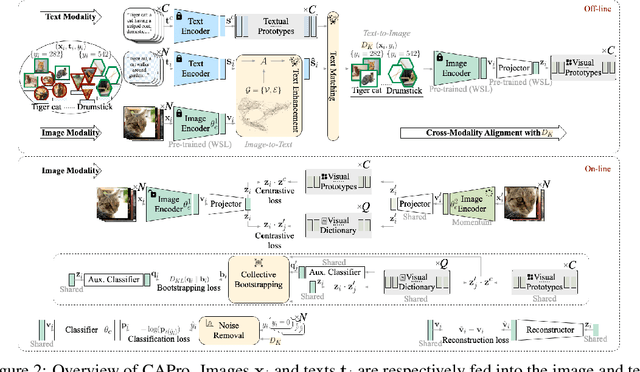
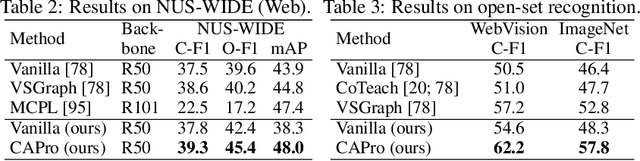
Webly supervised learning has attracted increasing attention for its effectiveness in exploring publicly accessible data at scale without manual annotation. However, most existing methods of learning with web datasets are faced with challenges from label noise, and they have limited assumptions on clean samples under various noise. For instance, web images retrieved with queries of tiger cat (a cat species) and drumstick (a musical instrument) are almost dominated by images of tigers and chickens, which exacerbates the challenge of fine-grained visual concept learning. In this case, exploiting both web images and their associated texts is a requisite solution to combat real-world noise. In this paper, we propose Cross-modality Aligned Prototypes (CAPro), a unified prototypical contrastive learning framework to learn visual representations with correct semantics. For one thing, we leverage textual prototypes, which stem from the distinct concept definition of classes, to select clean images by text matching and thus disambiguate the formation of visual prototypes. For another, to handle missing and mismatched noisy texts, we resort to the visual feature space to complete and enhance individual texts and thereafter improve text matching. Such semantically aligned visual prototypes are further polished up with high-quality samples, and engaged in both cluster regularization and noise removal. Besides, we propose collective bootstrapping to encourage smoother and wiser label reference from appearance-similar instances in a manner of dictionary look-up. Extensive experiments on WebVision1k and NUS-WIDE (Web) demonstrate that CAPro well handles realistic noise under both single-label and multi-label scenarios. CAPro achieves new state-of-the-art performance and exhibits robustness to open-set recognition. Codes are available at https://github.com/yuleiqin/capro.
AutoDiffusion: Training-Free Optimization of Time Steps and Architectures for Automated Diffusion Model Acceleration
Sep 23, 2023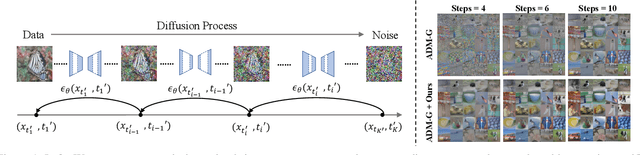
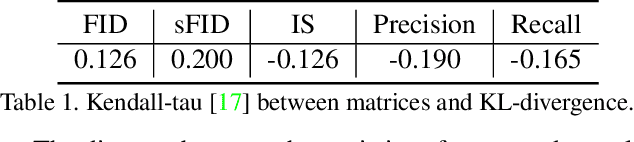
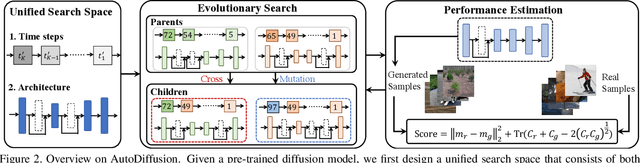
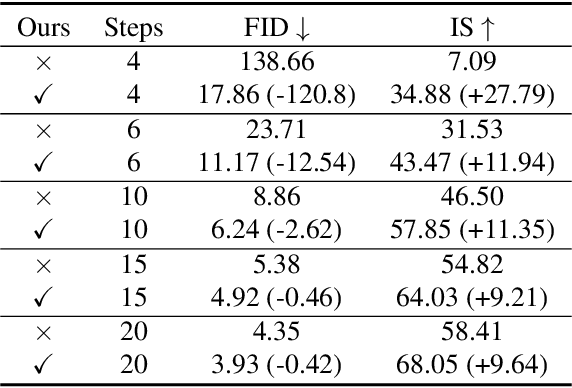
Diffusion models are emerging expressive generative models, in which a large number of time steps (inference steps) are required for a single image generation. To accelerate such tedious process, reducing steps uniformly is considered as an undisputed principle of diffusion models. We consider that such a uniform assumption is not the optimal solution in practice; i.e., we can find different optimal time steps for different models. Therefore, we propose to search the optimal time steps sequence and compressed model architecture in a unified framework to achieve effective image generation for diffusion models without any further training. Specifically, we first design a unified search space that consists of all possible time steps and various architectures. Then, a two stage evolutionary algorithm is introduced to find the optimal solution in the designed search space. To further accelerate the search process, we employ FID score between generated and real samples to estimate the performance of the sampled examples. As a result, the proposed method is (i).training-free, obtaining the optimal time steps and model architecture without any training process; (ii). orthogonal to most advanced diffusion samplers and can be integrated to gain better sample quality. (iii). generalized, where the searched time steps and architectures can be directly applied on different diffusion models with the same guidance scale. Experimental results show that our method achieves excellent performance by using only a few time steps, e.g. 17.86 FID score on ImageNet 64 $\times$ 64 with only four steps, compared to 138.66 with DDIM. The code is available at https://github.com/lilijiangg/AutoDiffusion.