 Add to Chrome
 Add to Firefox
 Add to Edge
SpecF2M: A Spectral-Aware Multi-task Network Estimating Axial Length and Refractive Error from Pediatric Fundus Photographs
Aug 07, 2026
Spherical Equivalent Refraction (SER) and Axial Length (AL) are core indicators for pediatric myopia screening, yet their measurements require dedicated biometry and cycloplegic refraction. Fundus photography offers an accessible imaging modality, as myopia-related posterior-pole changes are visible in 45$^\circ$ fundus images. However, these cues are often low-contrast, spatially diffuse, and multi-scale. Moreover, AL, Sphere (SPH), and Cylinder (CYL) share partially overlapping but non-identical anatomical correlates. We propose SpecF2M, a spectral-aware multi-task network for estimating AL and SER components from pediatric fundus photographs. SpecF2M integrates a deterministic anatomy-guided enhancement module, a hybrid spatial--spectral backbone combining MixCNN and Hybrid Spectral Learning (HSL) blocks, and an expert-routing head for component-level estimation of AL, SPH, and CYL. On a pediatric cohort of 4,359 eligible child visits and 6,966 fundus images, SpecF2M outperforms controlled CNN/ViT baselines for AL and SPH estimation, achieving MAEs of 0.5347 mm and 0.7062 D, respectively. Component-level analysis further reveals asymmetric task coupling, where CYL exhibits weaker association with fundus-derived myopic patterns than AL/SPH. These results support fundus-based, screening-oriented estimation of pediatric myopia indicators, while external validation remains necessary before deployment.

TC-Padé: Trajectory-Consistent Padé Approximation for Diffusion Acceleration
Mar 03, 2026Despite achieving state-of-the-art generation quality, diffusion models are hindered by the substantial computational burden of their iterative sampling process. While feature caching techniques achieve effective acceleration at higher step counts (e.g., 50 steps), they exhibit critical limitations in the practical low-step regime of 20-30 steps. As the interval between steps increases, polynomial-based extrapolators like TaylorSeer suffer from error accumulation and trajectory drift. Meanwhile, conventional caching strategies often overlook the distinct dynamical properties of different denoising phases. To address these challenges, we propose Trajectory-Consistent Padé approximation, a feature prediction framework grounded in Padé approximation. By modeling feature evolution through rational functions, our approach captures asymptotic and transitional behaviors more accurately than Taylor-based methods. To enable stable and trajectory-consistent sampling under reduced step counts, TC-Padé incorporates (1) adaptive coefficient modulation that leverages historical cached residuals to detect subtle trajectory transitions, and (2) step-aware prediction strategies tailored to the distinct dynamics of early, mid, and late sampling stages. Extensive experiments on DiT-XL/2, FLUX.1-dev, and Wan2.1 across both image and video generation demonstrate the effectiveness of TC-Padé. For instance, TC-Padé achieves 2.88x acceleration on FLUX.1-dev and 1.72x on Wan2.1 while maintaining high quality across FID, CLIP, Aesthetic, and VBench-2.0 metrics, substantially outperforming existing feature caching methods.
Dynamic Sparse No Training: Training-Free Fine-tuning for Sparse LLMs
Oct 17, 2023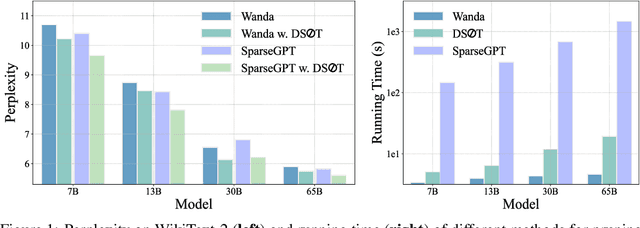
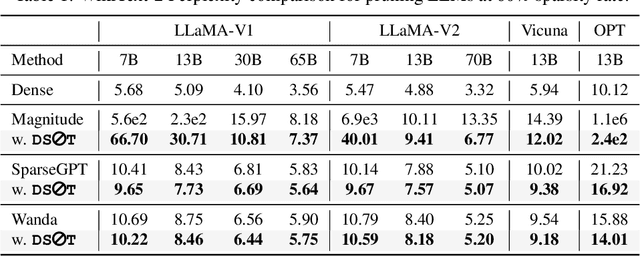
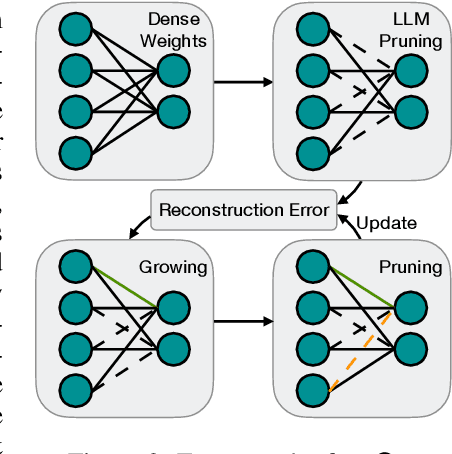
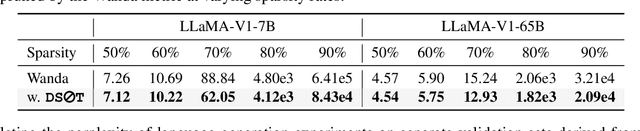
The ever-increasing large language models (LLMs), though opening a potential path for the upcoming artificial general intelligence, sadly drops a daunting obstacle on the way towards their on-device deployment. As one of the most well-established pre-LLMs approaches in reducing model complexity, network pruning appears to lag behind in the era of LLMs, due mostly to its costly fine-tuning (or re-training) necessity under the massive volumes of model parameter and training data. To close this industry-academia gap, we introduce Dynamic Sparse No Training (DSnoT), a training-free fine-tuning approach that slightly updates sparse LLMs without the expensive backpropagation and any weight updates. Inspired by the Dynamic Sparse Training, DSnoT minimizes the reconstruction error between the dense and sparse LLMs, in the fashion of performing iterative weight pruning-and-growing on top of sparse LLMs. To accomplish this purpose, DSnoT particularly takes into account the anticipated reduction in reconstruction error for pruning and growing, as well as the variance w.r.t. different input data for growing each weight. This practice can be executed efficiently in linear time since its obviates the need of backpropagation for fine-tuning LLMs. Extensive experiments on LLaMA-V1/V2, Vicuna, and OPT across various benchmarks demonstrate the effectiveness of DSnoT in enhancing the performance of sparse LLMs, especially at high sparsity levels. For instance, DSnoT is able to outperform the state-of-the-art Wanda by 26.79 perplexity at 70% sparsity with LLaMA-7B. Our paper offers fresh insights into how to fine-tune sparse LLMs in an efficient training-free manner and open new venues to scale the great potential of sparsity to LLMs. Codes are available at https://github.com/zyxxmu/DSnoT.
VisionFM: a Multi-Modal Multi-Task Vision Foundation Model for Generalist Ophthalmic Artificial Intelligence
Oct 08, 2023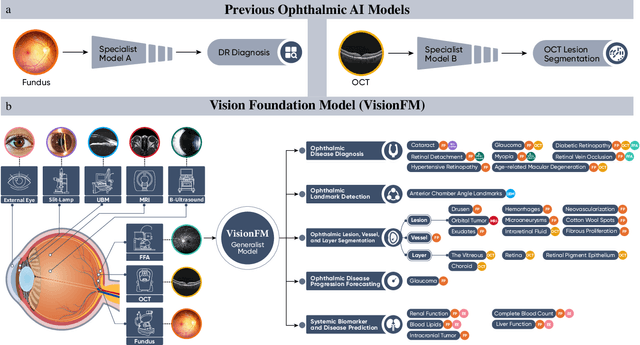
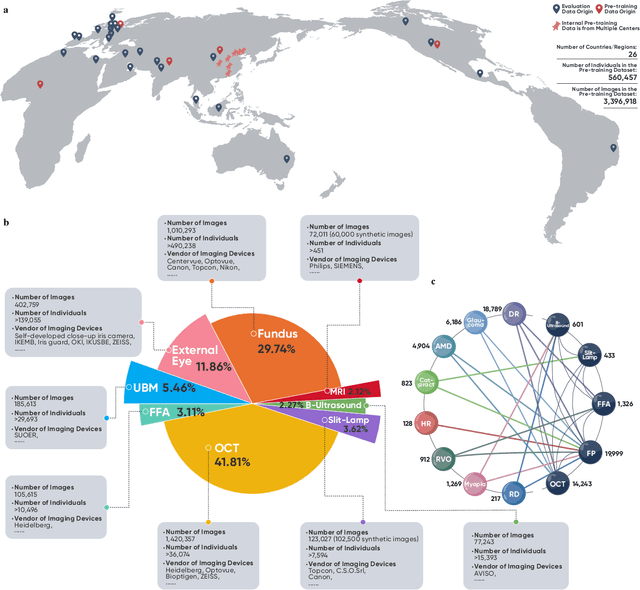
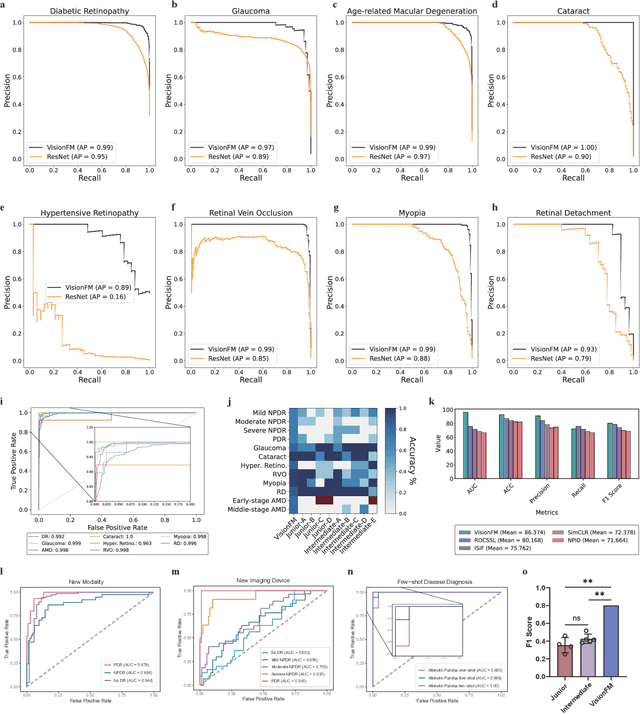
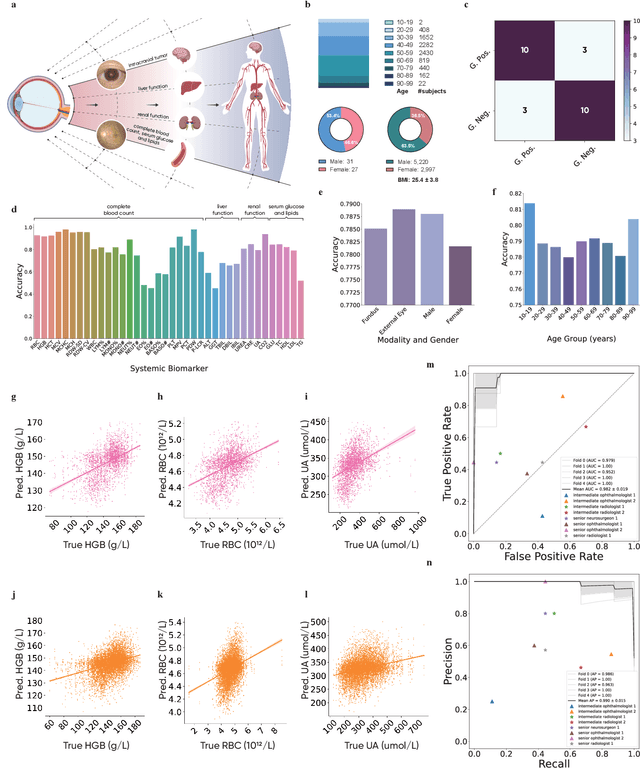
We present VisionFM, a foundation model pre-trained with 3.4 million ophthalmic images from 560,457 individuals, covering a broad range of ophthalmic diseases, modalities, imaging devices, and demography. After pre-training, VisionFM provides a foundation to foster multiple ophthalmic artificial intelligence (AI) applications, such as disease screening and diagnosis, disease prognosis, subclassification of disease phenotype, and systemic biomarker and disease prediction, with each application enhanced with expert-level intelligence and accuracy. The generalist intelligence of VisionFM outperformed ophthalmologists with basic and intermediate levels in jointly diagnosing 12 common ophthalmic diseases. Evaluated on a new large-scale ophthalmic disease diagnosis benchmark database, as well as a new large-scale segmentation and detection benchmark database, VisionFM outperformed strong baseline deep neural networks. The ophthalmic image representations learned by VisionFM exhibited noteworthy explainability, and demonstrated strong generalizability to new ophthalmic modalities, disease spectrum, and imaging devices. As a foundation model, VisionFM has a large capacity to learn from diverse ophthalmic imaging data and disparate datasets. To be commensurate with this capacity, in addition to the real data used for pre-training, we also generated and leveraged synthetic ophthalmic imaging data. Experimental results revealed that synthetic data that passed visual Turing tests, can also enhance the representation learning capability of VisionFM, leading to substantial performance gains on downstream ophthalmic AI tasks. Beyond the ophthalmic AI applications developed, validated, and demonstrated in this work, substantial further applications can be achieved in an efficient and cost-effective manner using VisionFM as the foundation.