 Add to Chrome
 Add to Firefox
 Add to Edge
Single Image Depth Prediction Made Better: A Multivariate Gaussian Take
Apr 18, 2023
Neural-network-based single image depth prediction (SIDP) is a challenging task where the goal is to predict the scene's per-pixel depth at test time. Since the problem, by definition, is ill-posed, the fundamental goal is to come up with an approach that can reliably model the scene depth from a set of training examples. In the pursuit of perfect depth estimation, most existing state-of-the-art learning techniques predict a single scalar depth value per-pixel. Yet, it is well-known that the trained model has accuracy limits and can predict imprecise depth. Therefore, an SIDP approach must be mindful of the expected depth variations in the model's prediction at test time. Accordingly, we introduce an approach that performs continuous modeling of per-pixel depth, where we can predict and reason about the per-pixel depth and its distribution. To this end, we model per-pixel scene depth using a multivariate Gaussian distribution. Moreover, contrary to the existing uncertainty modeling methods -- in the same spirit, where per-pixel depth is assumed to be independent, we introduce per-pixel covariance modeling that encodes its depth dependency w.r.t all the scene points. Unfortunately, per-pixel depth covariance modeling leads to a computationally expensive continuous loss function, which we solve efficiently using the learned low-rank approximation of the overall covariance matrix. Notably, when tested on benchmark datasets such as KITTI, NYU, and SUN-RGB-D, the SIDP model obtained by optimizing our loss function shows state-of-the-art results. Our method's accuracy (named MG) is among the top on the KITTI depth-prediction benchmark leaderboard.

Spherical Space Feature Decomposition for Guided Depth Map Super-Resolution
Mar 15, 2023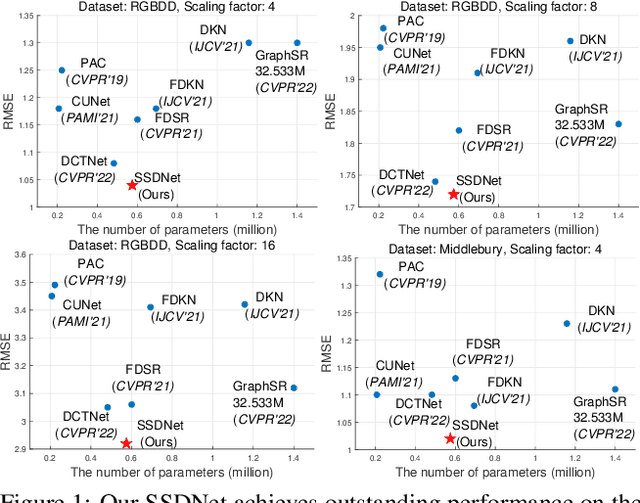

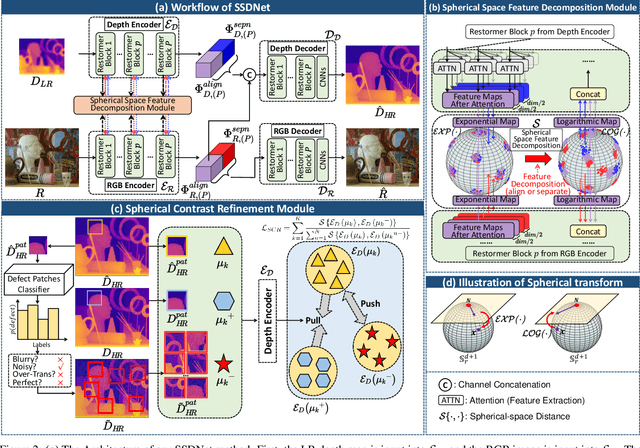

Guided depth map super-resolution (GDSR), as a hot topic in multi-modal image processing, aims to upsample low-resolution (LR) depth maps with additional information involved in high-resolution (HR) RGB images from the same scene. The critical step of this task is to effectively extract domain-shared and domain-private RGB/depth features. In addition, three detailed issues, namely blurry edges, noisy surfaces, and over-transferred RGB texture, need to be addressed. In this paper, we propose the Spherical Space feature Decomposition Network (SSDNet) to solve the above issues. To better model cross-modality features, Restormer block-based RGB/depth encoders are employed for extracting local-global features. Then, the extracted features are mapped to the spherical space to complete the separation of private features and the alignment of shared features. Shared features of RGB are fused with the depth features to complete the GDSR task. Subsequently, a spherical contrast refinement (SCR) module is proposed to further address the detail issues. Patches that are classified according to imperfect categories are input to the SCR module, where the patch features are pulled closer to the ground truth and pushed away from the corresponding imperfect samples in the spherical feature space via contrastive learning. Extensive experiments demonstrate that our method can achieve state-of-the-art results on four test datasets and can successfully generalize to real-world scenes. Code will be released.
Graph Transformer GANs for Graph-Constrained House Generation
Mar 14, 2023We present a novel graph Transformer generative adversarial network (GTGAN) to learn effective graph node relations in an end-to-end fashion for the challenging graph-constrained house generation task. The proposed graph-Transformer-based generator includes a novel graph Transformer encoder that combines graph convolutions and self-attentions in a Transformer to model both local and global interactions across connected and non-connected graph nodes. Specifically, the proposed connected node attention (CNA) and non-connected node attention (NNA) aim to capture the global relations across connected nodes and non-connected nodes in the input graph, respectively. The proposed graph modeling block (GMB) aims to exploit local vertex interactions based on a house layout topology. Moreover, we propose a new node classification-based discriminator to preserve the high-level semantic and discriminative node features for different house components. Finally, we propose a novel graph-based cycle-consistency loss that aims at maintaining the relative spatial relationships between ground truth and predicted graphs. Experiments on two challenging graph-constrained house generation tasks (i.e., house layout and roof generation) with two public datasets demonstrate the effectiveness of GTGAN in terms of objective quantitative scores and subjective visual realism. New state-of-the-art results are established by large margins on both tasks.
DDFM: Denoising Diffusion Model for Multi-Modality Image Fusion
Mar 13, 2023Multi-modality image fusion aims to combine different modalities to produce fused images that retain the complementary features of each modality, such as functional highlights and texture details. To leverage strong generative priors and address challenges such as unstable training and lack of interpretability for GAN-based generative methods, we propose a novel fusion algorithm based on the denoising diffusion probabilistic model (DDPM). The fusion task is formulated as a conditional generation problem under the DDPM sampling framework, which is further divided into an unconditional generation subproblem and a maximum likelihood subproblem. The latter is modeled in a hierarchical Bayesian manner with latent variables and inferred by the expectation-maximization algorithm. By integrating the inference solution into the diffusion sampling iteration, our method can generate high-quality fused images with natural image generative priors and cross-modality information from source images. Note that all we required is an unconditional pre-trained generative model, and no fine-tuning is needed. Our extensive experiments indicate that our approach yields promising fusion results in infrared-visible image fusion and medical image fusion. The code will be released.
Retinexformer: One-stage Retinex-based Transformer for Low-light Image Enhancement
Mar 12, 2023When enhancing low-light images, many deep learning algorithms are based on the Retinex theory. However, the Retinex model does not consider the corruptions hidden in the dark or introduced by the light-up process. Besides, these methods usually require a tedious multi-stage training pipeline and rely on convolutional neural networks, showing limitations in capturing long-range dependencies. In this paper, we formulate a simple yet principled One-stage Retinex-based Framework (ORF). ORF first estimates the illumination information to light up the low-light image and then restores the corruption to produce the enhanced image. We design an Illumination-Guided Transformer (IGT) that utilizes illumination representations to direct the modeling of non-local interactions of regions with different lighting conditions. By plugging IGT into ORF, we obtain our algorithm, Retinexformer. Comprehensive quantitative and qualitative experiments demonstrate that our Retinexformer significantly outperforms state-of-the-art methods on seven benchmarks. The user study and application on low-light object detection also reveal the latent practical values of our method. Codes and pre-trained models will be released.
Efficient and Explicit Modelling of Image Hierarchies for Image Restoration
Mar 01, 2023The aim of this paper is to propose a mechanism to efficiently and explicitly model image hierarchies in the global, regional, and local range for image restoration. To achieve that, we start by analyzing two important properties of natural images including cross-scale similarity and anisotropic image features. Inspired by that, we propose the anchored stripe self-attention which achieves a good balance between the space and time complexity of self-attention and the modelling capacity beyond the regional range. Then we propose a new network architecture dubbed GRL to explicitly model image hierarchies in the Global, Regional, and Local range via anchored stripe self-attention, window self-attention, and channel attention enhanced convolution. Finally, the proposed network is applied to 7 image restoration types, covering both real and synthetic settings. The proposed method sets the new state-of-the-art for several of those. Code will be available at https://github.com/ofsoundof/GRL-Image-Restoration.git.
VA-DepthNet: A Variational Approach to Single Image Depth Prediction
Feb 15, 2023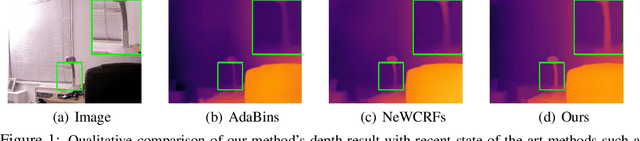
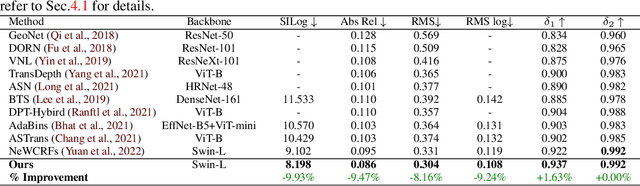
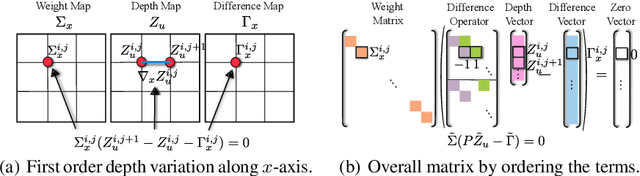
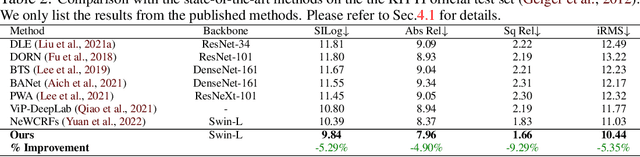
We introduce VA-DepthNet, a simple, effective, and accurate deep neural network approach for the single-image depth prediction (SIDP) problem. The proposed approach advocates using classical first-order variational constraints for this problem. While state-of-the-art deep neural network methods for SIDP learn the scene depth from images in a supervised setting, they often overlook the invaluable invariances and priors in the rigid scene space, such as the regularity of the scene. The paper's main contribution is to reveal the benefit of classical and well-founded variational constraints in the neural network design for the SIDP task. It is shown that imposing first-order variational constraints in the scene space together with popular encoder-decoder-based network architecture design provides excellent results for the supervised SIDP task. The imposed first-order variational constraint makes the network aware of the depth gradient in the scene space, i.e., regularity. The paper demonstrates the usefulness of the proposed approach via extensive evaluation and ablation analysis over several benchmark datasets, such as KITTI, NYU Depth V2, and SUN RGB-D. The VA-DepthNet at test time shows considerable improvements in depth prediction accuracy compared to the prior art and is accurate also at high-frequency regions in the scene space. At the time of writing this paper, our method -- labeled as VA-DepthNet, when tested on the KITTI depth-prediction evaluation set benchmarks, shows state-of-the-art results, and is the top-performing published approach.
Audio-Visual Efficient Conformer for Robust Speech Recognition
Jan 04, 2023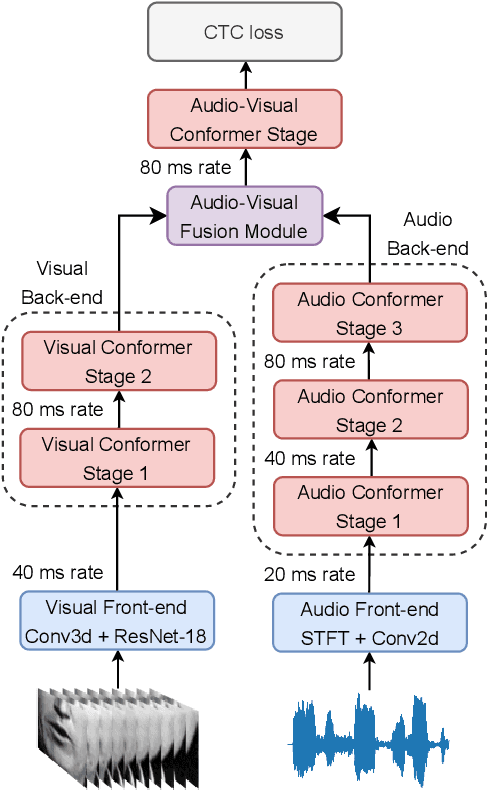
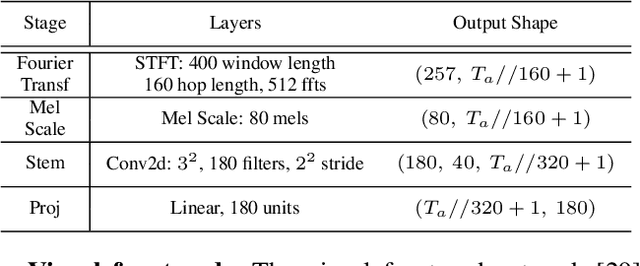
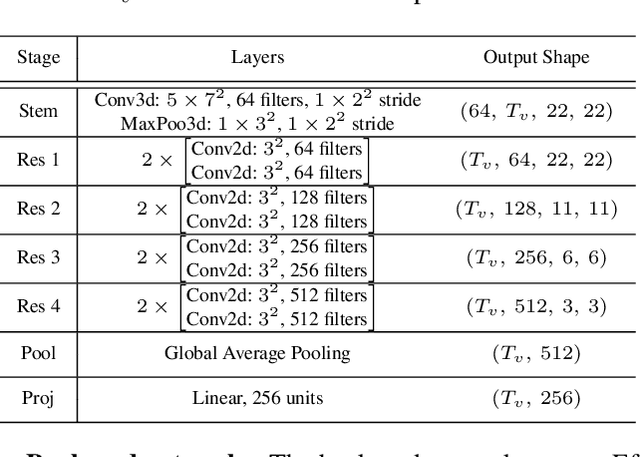

End-to-end Automatic Speech Recognition (ASR) systems based on neural networks have seen large improvements in recent years. The availability of large scale hand-labeled datasets and sufficient computing resources made it possible to train powerful deep neural networks, reaching very low Word Error Rate (WER) on academic benchmarks. However, despite impressive performance on clean audio samples, a drop of performance is often observed on noisy speech. In this work, we propose to improve the noise robustness of the recently proposed Efficient Conformer Connectionist Temporal Classification (CTC)-based architecture by processing both audio and visual modalities. We improve previous lip reading methods using an Efficient Conformer back-end on top of a ResNet-18 visual front-end and by adding intermediate CTC losses between blocks. We condition intermediate block features on early predictions using Inter CTC residual modules to relax the conditional independence assumption of CTC-based models. We also replace the Efficient Conformer grouped attention by a more efficient and simpler attention mechanism that we call patch attention. We experiment with publicly available Lip Reading Sentences 2 (LRS2) and Lip Reading Sentences 3 (LRS3) datasets. Our experiments show that using audio and visual modalities allows to better recognize speech in the presence of environmental noise and significantly accelerate training, reaching lower WER with 4 times less training steps. Our Audio-Visual Efficient Conformer (AVEC) model achieves state-of-the-art performance, reaching WER of 2.3% and 1.8% on LRS2 and LRS3 test sets. Code and pretrained models are available at https://github.com/burchim/AVEC.
Source-free Depth for Object Pop-out
Dec 10, 2022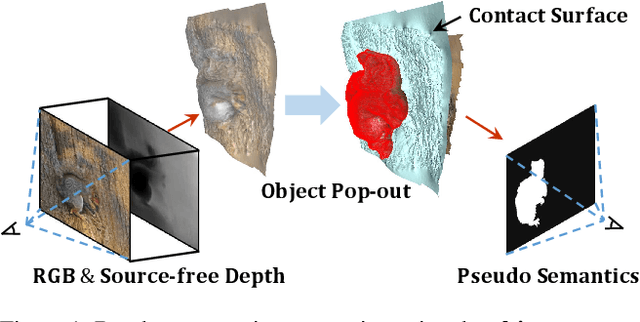
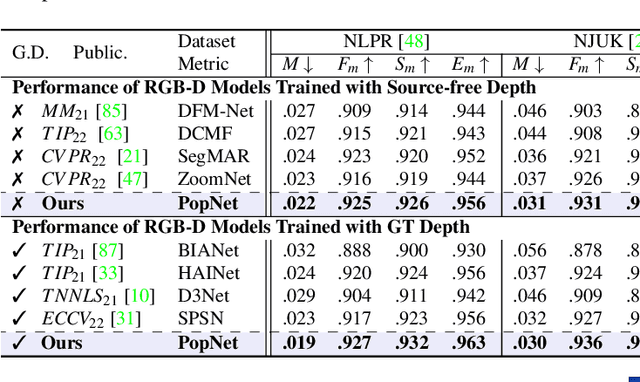
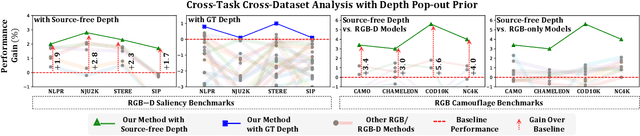
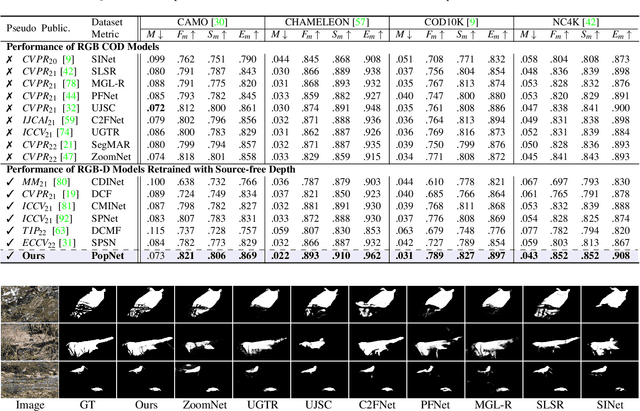
Depth cues are known to be useful for visual perception. However, direct measurement of depth is often impracticable. Fortunately, though, modern learning-based methods offer promising depth maps by inference in the wild. In this work, we adapt such depth inference models for object segmentation using the objects' ``pop-out'' prior in 3D. The ``pop-out'' is a simple composition prior that assumes objects reside on the background surface. Such compositional prior allows us to reason about objects in the 3D space. More specifically, we adapt the inferred depth maps such that objects can be localized using only 3D information. Such separation, however, requires knowledge about contact surface which we learn using the weak supervision of the segmentation mask. Our intermediate representation of contact surface, and thereby reasoning about objects purely in 3D, allows us to better transfer the depth knowledge into semantics. The proposed adaptation method uses only the depth model without needing the source data used for training, making the learning process efficient and practical. Our experiments on eight datasets of two challenging tasks, namely camouflaged object detection and salient object detection, consistently demonstrate the benefit of our method in terms of both performance and generalizability.
CiaoSR: Continuous Implicit Attention-in-Attention Network for Arbitrary-Scale Image Super-Resolution
Dec 08, 2022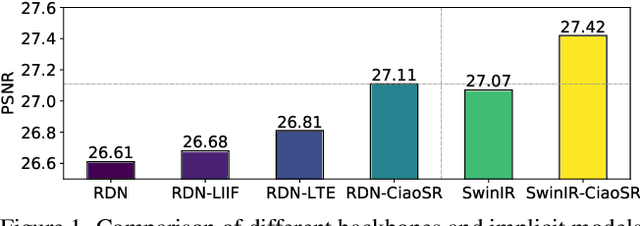
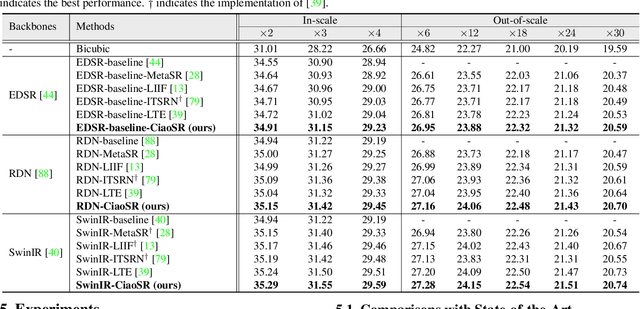
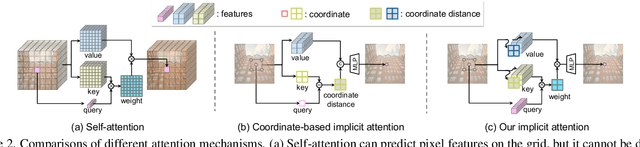
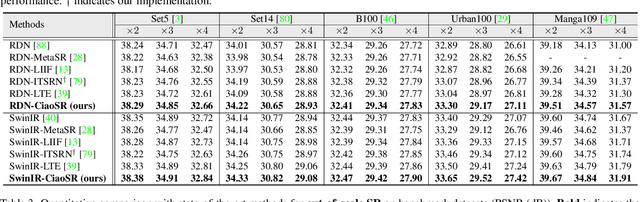
Learning continuous image representations is recently gaining popularity for image super-resolution (SR) because of its ability to reconstruct high-resolution images with arbitrary scales from low-resolution inputs. Existing methods mostly ensemble nearby features to predict the new pixel at any queried coordinate in the SR image. Such a local ensemble suffers from some limitations: i) it has no learnable parameters and it neglects the similarity of the visual features; ii) it has a limited receptive field and cannot ensemble relevant features in a large field which are important in an image; iii) it inherently has a gap with real camera imaging since it only depends on the coordinate. To address these issues, this paper proposes a continuous implicit attention-in-attention network, called CiaoSR. We explicitly design an implicit attention network to learn the ensemble weights for the nearby local features. Furthermore, we embed a scale-aware attention in this implicit attention network to exploit additional non-local information. Extensive experiments on benchmark datasets demonstrate CiaoSR significantly outperforms the existing single image super resolution (SISR) methods with the same backbone. In addition, the proposed method also achieves the state-of-the-art performance on the arbitrary-scale SR task. The effectiveness of the method is also demonstrated on the real-world SR setting. More importantly, CiaoSR can be flexibly integrated into any backbone to improve the SR performance.