 Add to Chrome
 Add to Firefox
 Add to Edge
LAVE: Latent Visual Evidence-Enhanced Planning for Video Tool-use Agents
Aug 05, 2026
Long-video understanding requires models to efficiently acquire and reuse sparse visual evidence from long and redundant video streams. Recent video tool-use agents address this challenge by iteratively invoking visual Tools at different temporal scales, but their Tool-Planner communication typically relies on textual observations. Such text-only interfaces provide lossy summaries of Tool computations, causing previously computed visual evidence not verbalized to be discarded and unavailable for subsequent planning. We identify this limitation as the Tool observation bottleneck and propose Latent Visual Evidence-Enhanced Planning (LAVE), a training-free framework for reusing latent visual evidence from completed Tool calls. LAVE introduces a dual-channel observation interface: the visible channel preserves the original textual trajectory, while the latent channel stores pre-verbal visual updates with their Tool roles, source-frame timestamps, and visual locations. During planning, LAVE retrieves evidence relevant to the current Planner state but not covered by textual observations, and integrates it through bounded timestamp-aligned latent updates with entropy-constrained frame-time routing. This enables video agents to reuse existing visual computation without additional training, frame replay, or modifications to the original orchestration. Extensive experiments on Video-MME, LongVideoBench, and CG-Bench show that LAVE consistently improves video tool-use agents across backbones. Under a comparable frame budget, LAVE improves the Video-MME overall score by 3.76 points over the strongest baseline, demonstrating the effectiveness of latent visual evidence reuse for multi-step video-agent planning.

ProtoAct: Turning Wet-Lab Protocols into Embodied Robotic Actions
Aug 03, 2026Biological wet-lab protocols are written for trained researchers and often leave routine operations, state-dependent conditions, and contextual parameters implicit, making them difficult to translate into robot-executable actions. We present ProtoAct, a structured protocol-grounding framework that converts free-form biological procedures into state-aware, embodiment-ready action sequences. ProtoAct uses ProtoRAG to retrieve manually annotated examples for context-sensitive parsing, employs RefineChecker to detect and revise missing or inconsistent steps, and applies ActSchema to map the refined procedure into constrained JSON function sequences. We further introduce BioP2E, for which we manually annotate 22 cell-culture protocols into 258 monitoring conditions, 910 executable subtasks, and 962 grounded action calls. Evaluation across seven large language models demonstrates that ProtoAct can be effectively instantiated with different backbones. Ablations confirm that retrieval, posterior checking, and schema constraints make complementary contributions. The parsed subtasks further support demonstration collection and VLA model training, enabling successful execution in both simulation and real-robot settings. ProtoAct thus provides a practical interface between biological protocol understanding and embodied robotic execution.
BioVLN: A Simulation Platform for Visual Language Navigation in Biomedical Laboratories
Jul 29, 2026Biomedical laboratory robots must navigate to instruments before performing experimental procedures. Existing embodied navigation platforms are designed for household environments and treat a target as an object center or an arbitrary nearby position. This representation is inadequate for laboratory instruments, which must be approached from their operating side while maintaining safe clearance from surrounding equipment. We introduce BioVLN, a simulation platform for developing and evaluating visual-language navigation agents in biomedical laboratories. BioVLN represents each instrument with three regions: its physical body, a surrounding clearance region, and an operation area in front of the usable side. This model is applied consistently to scene generation, target placement, navigation evaluation, and safety analysis, so success depends on reaching a position from which the instrument can be accessed. BioVLN supports procedural scene generation and manually designed environments, producing 47 scenes and 1667 episodes. Standardized navigation and reinforcement-learning interfaces enable trajectory collection and policy training. Experiments show that geometric exploration reaches 74.4--87.5% success, while sampling multiple valid positions in the operation area improves success to 83.3--92.5% and reduces unsafe proximity.
An Embodied Simulation Platform, Benchmark, and Data-Efficient Augmentation Framework for Wet-Lab Robotics
Jun 11, 2026Wet-lab robots can improve the reproducibility, throughput, and safety of biomedical experiments, but scaling their learning requires customizable simulators for safe and reproducible task generation, open editable laboratory assets, and efficient pipelines that turn limited demonstrations into usable training data. We present Pipette, an embodied simulation platform, benchmark, and data-efficient augmentation framework for wet-lab robot learning. Pipette releases over 43 open-source and re-editable wet-lab assets, together with an extensible asset-building pipeline. A key component of Pipette is its simulation-based data augmentation pipeline, replaying human demonstrations in simulation, applies lighting, camera, speed, and action perturbations, and filters generated episodes with automatic task success checks, rapidly expanding usable training data from limited manual demonstrations. We further introduce an 11-task wet-lab embodied benchmark covering sample handling, culture-ware manipulation, device operation, and precision placement. With only 30 demonstrations per task, ACT achieves 65.5% average success rate, while simulation augmentation improves SmolVLA from 44.1% to 74.7% and π0 from 40.4% to 46.5%, validating the effectiveness of Pipette for data-efficient VLA training and evaluation. Pipette also supports natural-language-driven scene construction and task registration, lowering the barrier for non-expert users to define new wet-lab robotic tasks.
Lung-R1: A Knowledge Graph-Guided LLM for Pulmonary Diagnostic Reasoning
Jun 10, 2026Diagnosing pulmonary diseases requires integrating heterogeneous evidence amid phenotypic variability and cross-disease overlap. Although large language models (LLMs) have shown progress on pulmonary knowledge question answering (QA) and information-processing tasks, reliable pulmonary diagnosis requires patient-specific, relation-aware reasoning over electronic medical record (EMR) evidence rather than isolated knowledge recall. We define this gap between pulmonary knowledge and case-level diagnostic reasoning as the Pulmonary Knowledge-to-Diagnosis Gap. To address it, we introduce LungKG, the first structured pulmonary knowledge graph for diagnostic knowledge organization and record-grounded reasoning. LungKG contains 59,038 nodes and 164,308 edges across 15 entity types and 112 relation types, serving as both a reusable pulmonary knowledge resource and the foundation for LungKG-guided model adaptation. Built on LungKG, we propose Lung-R1, a LungKG-guided pulmonary LLM trained through KG-constrained reasoning-chain construction and KG-guided reinforcement learning. In a 20-system evaluation, Lung-R1-14B achieves state-of-the-art performance across Choice, Pulmonary-QA, and EMR Diagnosis, reaching an EMR Diagnosis score of 4.3583 and surpassing the strongest non-Lung-R1 baseline by 0.1476 points. These results demonstrate the value of LungKG-guided training for EMR-based pulmonary diagnosis.
Towards Human-Like Grading: A Unified LLM-Enhanced Framework for Subjective Question Evaluation
Oct 09, 2025Automatic grading of subjective questions remains a significant challenge in examination assessment due to the diversity in question formats and the open-ended nature of student responses. Existing works primarily focus on a specific type of subjective question and lack the generality to support comprehensive exams that contain diverse question types. In this paper, we propose a unified Large Language Model (LLM)-enhanced auto-grading framework that provides human-like evaluation for all types of subjective questions across various domains. Our framework integrates four complementary modules to holistically evaluate student answers. In addition to a basic text matching module that provides a foundational assessment of content similarity, we leverage the powerful reasoning and generative capabilities of LLMs to: (1) compare key knowledge points extracted from both student and reference answers, (2) generate a pseudo-question from the student answer to assess its relevance to the original question, and (3) simulate human evaluation by identifying content-related and non-content strengths and weaknesses. Extensive experiments on both general-purpose and domain-specific datasets show that our framework consistently outperforms traditional and LLM-based baselines across multiple grading metrics. Moreover, the proposed system has been successfully deployed in real-world training and certification exams at a major e-commerce enterprise.
MERIT: A Merchant Incentive Ranking Model for Hotel Search & Ranking
Jun 10, 2025Online Travel Platforms (OTPs) have been working on improving their hotel Search & Ranking (S&R) systems that facilitate efficient matching between consumers and hotels. Existing OTPs focus almost exclusively on improving platform revenue. In this work, we take a first step in incorporating hotel merchants' objectives into the design of hotel S&R systems to achieve an incentive loop: the OTP tilts impressions and better-ranked positions to merchants with high quality, and in return, the merchants provide better service to consumers. Three critical design challenges need to be resolved to achieve this incentive loop: Matthew Effect in the consumer feedback-loop, unclear relation between hotel quality and performance, and conflicts between short-term and long-term revenue. To address these challenges, we propose MERIT, a MERchant IncenTive ranking model, which can simultaneously take the interests of merchants and consumers into account. We define a new Merchant Competitiveness Index (MCI) to represent hotel merchant quality and propose a new Merchant Tower to model the relation between MCI and ranking scores. Also, we design a monotonic structure for Merchant Tower to provide a clear relation between hotel quality and performance. Finally, we propose a Multi-objective Stratified Pairwise Loss, which can mitigate the conflicts between OTP's short-term and long-term revenue. The offline experiment results indicate that MERIT outperforms these methods in optimizing the demands of consumers and merchants. Furthermore, we conduct an online A/B test and obtain an improvement of 3.02% for the MCI score.
Whisper-SV: Adapting Whisper for Low-data-resource Speaker Verification
Jul 14, 2024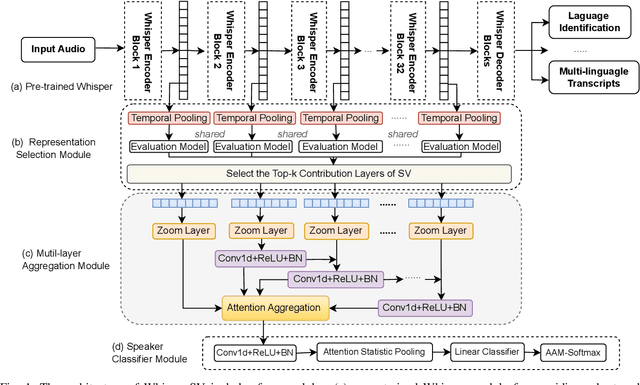
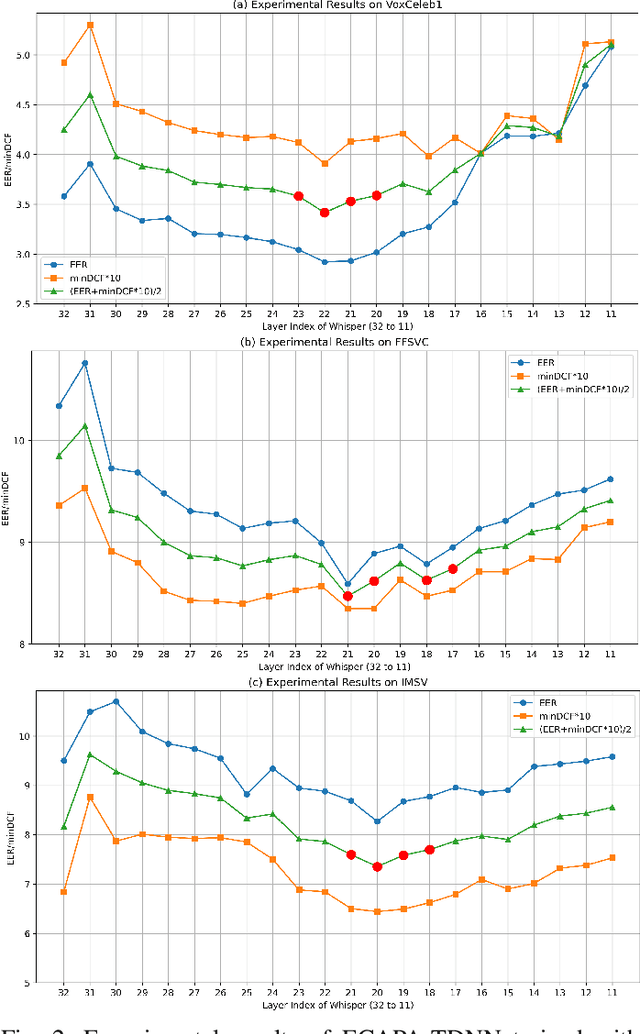
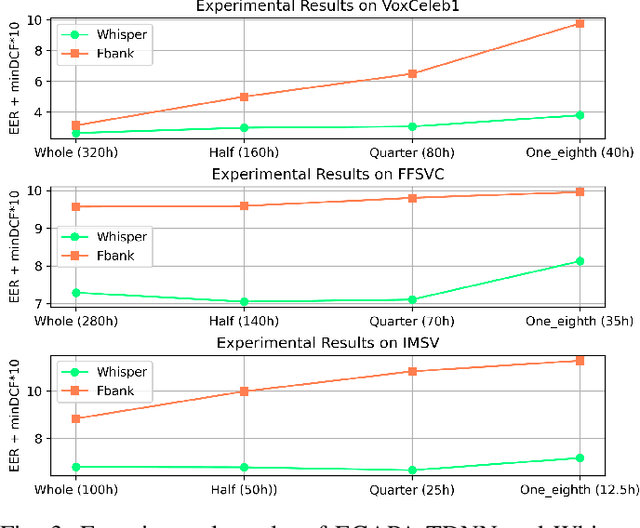
Trained on 680,000 hours of massive speech data, Whisper is a multitasking, multilingual speech foundation model demonstrating superior performance in automatic speech recognition, translation, and language identification. However, its applicability in speaker verification (SV) tasks remains unexplored, particularly in low-data-resource scenarios where labeled speaker data in specific domains are limited. To fill this gap, we propose a lightweight adaptor framework to boost SV with Whisper, namely Whisper-SV. Given that Whisper is not specifically optimized for SV tasks, we introduce a representation selection module to quantify the speaker-specific characteristics contained in each layer of Whisper and select the top-k layers with prominent discriminative speaker features. To aggregate pivotal speaker-related features while diminishing non-speaker redundancies across the selected top-k distinct layers of Whisper, we design a multi-layer aggregation module in Whisper-SV to integrate multi-layer representations into a singular, compacted representation for SV. In the multi-layer aggregation module, we employ convolutional layers with shortcut connections among different layers to refine speaker characteristics derived from multi-layer representations from Whisper. In addition, an attention aggregation layer is used to reduce non-speaker interference and amplify speaker-specific cues for SV tasks. Finally, a simple classification module is used for speaker classification. Experiments on VoxCeleb1, FFSVC, and IMSV datasets demonstrate that Whisper-SV achieves EER/minDCF of 2.22%/0.307, 6.14%/0.488, and 7.50%/0.582, respectively, showing superior performance in low-data-resource SV scenarios.
Factorized Learning Assisted with Large Language Model for Gloss-free Sign Language Translation
Mar 19, 2024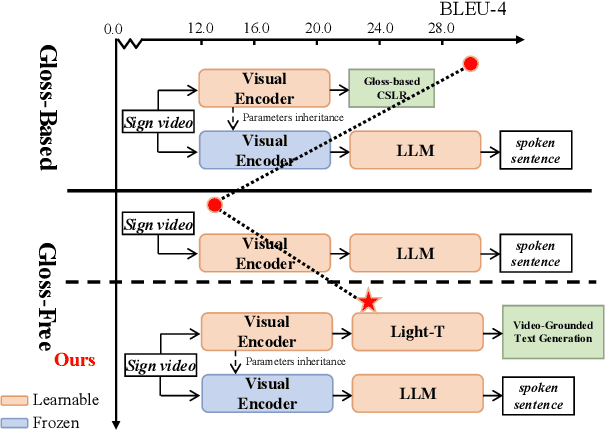
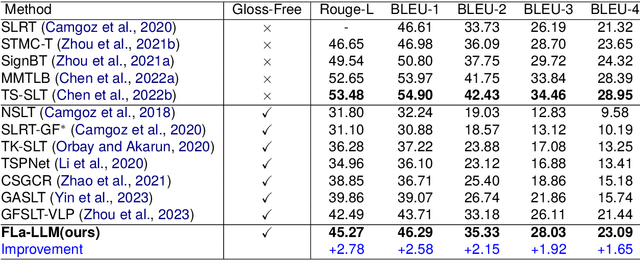

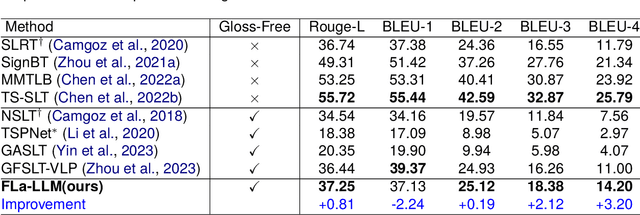
Previous Sign Language Translation (SLT) methods achieve superior performance by relying on gloss annotations. However, labeling high-quality glosses is a labor-intensive task, which limits the further development of SLT. Although some approaches work towards gloss-free SLT through jointly training the visual encoder and translation network, these efforts still suffer from poor performance and inefficient use of the powerful Large Language Model (LLM). Most seriously, we find that directly introducing LLM into SLT will lead to insufficient learning of visual representations as LLM dominates the learning curve. To address these problems, we propose Factorized Learning assisted with Large Language Model (FLa-LLM) for gloss-free SLT. Concretely, we factorize the training process into two stages. In the visual initialing stage, we employ a lightweight translation model after the visual encoder to pre-train the visual encoder. In the LLM fine-tuning stage, we freeze the acquired knowledge in the visual encoder and integrate it with a pre-trained LLM to inspire the LLM's translation potential. This factorized training strategy proves to be highly effective as evidenced by significant improvements achieved across three SLT datasets which are all conducted under the gloss-free setting.
An audio-quality-based multi-strategy approach for target speaker extraction in the MISP 2023 Challenge
Jan 08, 2024This paper describes our audio-quality-based multi-strategy approach for the audio-visual target speaker extraction (AVTSE) task in the Multi-modal Information based Speech Processing (MISP) 2023 Challenge. Specifically, our approach adopts different extraction strategies based on the audio quality, striking a balance between interference removal and speech preservation, which benifits the back-end automatic speech recognition (ASR) systems. Experiments show that our approach achieves a character error rate (CER) of 24.2% and 33.2% on the Dev and Eval set, respectively, obtaining the second place in the challenge.