 Add to Chrome
 Add to Firefox
 Add to Edge
NodeImport: Imbalanced Node Classification with Node Importance Assessment
Jul 15, 2026
In real-world applications, node classification on graphs often faces the challenge of class imbalance, where majority classes dominate training, resulting in biased model performance. Traditional GNNs often struggle in such scenarios, as they tend to overfit to majority classes while underrepresenting minority classes. Existing solutions, which either prioritize nodes based on class size or synthesize new nodes for minority classes, often fall short of effectively addressing this imbalance issue. This paper introduces an approach to class-imbalanced node classification by utilizing a balanced meta-set for importance measurement, where a training node is considered significant if it enhances model performance under an unbiased setting. Our method identifies important nodes that can counteract class imbalance and utilizes them for model training, allowing for fine-grained and dynamic node selection throughout the training process. We theoretically derive a formula to directly assess node importance, reducing computational overhead and providing an intuitive threshold for node selection. Guided by this metric, we develop a novel framework that filters valuable labeled, unlabeled, and synthetic nodes that enhance model performance in an unbiased context. A key advantage of this framework is its separation of the synthetic node generation process from the filtering process, ensuring compatibility with various node generation methods. Furthermore, we introduce a strategy to construct a high-quality meta-set that closely approximates the overall feature distribution, ensuring robust representation of each class. We evaluate our framework, NodeImport, across multiple datasets using popular GNN architectures, demonstrating its superiority over existing baselines. Our results highlight the flexibility and effectiveness of the framework in mitigating class imbalance, leading to improved outcomes.

Multi-Label Node Classification with Label Influence Propagation
Jul 01, 2026Graphs are a complex and versatile data structure used across various domains, with possibly multi-label nodes playing a particularly crucial role. Examples include proteins in PPI networks with multiple functions and users in social or e-commerce networks exhibiting diverse interests. Tackling multi-label node classification (MLNC) on graphs has led to the development of various approaches. Some methods leverage graph neural networks (GNNs) to exploit label co-occurrence correlations, while others incorporate label embeddings to capture label proximity. However, these approaches fail to account for the intricate influences between labels in non-Euclidean graph data. To address this issue, we decompose the message passing process in GNNs into two operations: propagation and transformation. We then conduct a comprehensive analysis and quantification of the influence correlations between labels in each operation. Building on these insights, we propose a novel model, Label Influence Propagation (LIP). Specifically, we construct a label influence graph based on the integrated label correlations. Then, we propagate high-order influences through this graph, dynamically adjusting the learning process by amplifying labels with positive contributions and mitigating those with negative influence. Finally, our framework is evaluated on comprehensive benchmark datasets, consistently outperforming SOTA methods across various settings, demonstrating its effectiveness on MLNC tasks.
ReCal: Reward Calibration for RL-based LLM Routing
Jun 10, 2026Large language model (LLM) routing has emerged as an effective paradigm for leveraging the complementary strengths of multiple LLMs through dynamic model and reasoning-strategy selection. Recent reinforcement learning (RL)-based routing methods further improve routing quality by optimizing routing policies from interaction feedback. However, they still struggle to provide informative and comparable learning signals under heterogeneous tasks with varying difficulty. In practice, multiple objectives (e.g., correctness, format behavior) are aggregated into a single scalar reward, leading to ambiguous credit assignment and conflicting optimization signals. Moreover, reward signals exhibit significant variability across instances, where some instances produce higher or more variable rewards, introducing optimization bias that favors trivial samples over informative ones. To address these issues, we propose \textbf{ReCal}, a \textbf{\underline{Re}}ward \textbf{\underline{Cal}}ibration framework for RL-based LLM routing. We first introduce a hierarchical reward decomposition mechanism with component-wise advantage estimation. We further propose a distribution-aware optimization strategy that calibrates optimization variability through variance-aware reweighting and per-dataset normalization. Experiments on seven datasets demonstrate that ReCal consistently improves routing performance, and training stability over baselines. Code is available at https://anonymous.4open.science/r/ReCal.
Speech Token Prediction via Compressed-to-fine Language Modeling for Speech Generation
May 30, 2025Neural audio codecs, used as speech tokenizers, have demonstrated remarkable potential in the field of speech generation. However, to ensure high-fidelity audio reconstruction, neural audio codecs typically encode audio into long sequences of speech tokens, posing a significant challenge for downstream language models in long-context modeling. We observe that speech token sequences exhibit short-range dependency: due to the monotonic alignment between text and speech in text-to-speech (TTS) tasks, the prediction of the current token primarily relies on its local context, while long-range tokens contribute less to the current token prediction and often contain redundant information. Inspired by this observation, we propose a \textbf{compressed-to-fine language modeling} approach to address the challenge of long sequence speech tokens within neural codec language models: (1) \textbf{Fine-grained Initial and Short-range Information}: Our approach retains the prompt and local tokens during prediction to ensure text alignment and the integrity of paralinguistic information; (2) \textbf{Compressed Long-range Context}: Our approach compresses long-range token spans into compact representations to reduce redundant information while preserving essential semantics. Extensive experiments on various neural audio codecs and downstream language models validate the effectiveness and generalizability of the proposed approach, highlighting the importance of token compression in improving speech generation within neural codec language models. The demo of audio samples will be available at https://anonymous.4open.science/r/SpeechTokenPredictionViaCompressedToFinedLM.
RGL: A Graph-Centric, Modular Framework for Efficient Retrieval-Augmented Generation on Graphs
Mar 25, 2025Recent advances in graph learning have paved the way for innovative retrieval-augmented generation (RAG) systems that leverage the inherent relational structures in graph data. However, many existing approaches suffer from rigid, fixed settings and significant engineering overhead, limiting their adaptability and scalability. Additionally, the RAG community has largely overlooked the decades of research in the graph database community regarding the efficient retrieval of interesting substructures on large-scale graphs. In this work, we introduce the RAG-on-Graphs Library (RGL), a modular framework that seamlessly integrates the complete RAG pipeline-from efficient graph indexing and dynamic node retrieval to subgraph construction, tokenization, and final generation-into a unified system. RGL addresses key challenges by supporting a variety of graph formats and integrating optimized implementations for essential components, achieving speedups of up to 143x compared to conventional methods. Moreover, its flexible utilities, such as dynamic node filtering, allow for rapid extraction of pertinent subgraphs while reducing token consumption. Our extensive evaluations demonstrate that RGL not only accelerates the prototyping process but also enhances the performance and applicability of graph-based RAG systems across a range of tasks.
One-shot Federated Learning Methods: A Practical Guide
Feb 13, 2025One-shot Federated Learning (OFL) is a distributed machine learning paradigm that constrains client-server communication to a single round, addressing privacy and communication overhead issues associated with multiple rounds of data exchange in traditional Federated Learning (FL). OFL demonstrates the practical potential for integration with future approaches that require collaborative training models, such as large language models (LLMs). However, current OFL methods face two major challenges: data heterogeneity and model heterogeneity, which result in subpar performance compared to conventional FL methods. Worse still, despite numerous studies addressing these limitations, a comprehensive summary is still lacking. To address these gaps, this paper presents a systematic analysis of the challenges faced by OFL and thoroughly reviews the current methods. We also offer an innovative categorization method and analyze the trade-offs of various techniques. Additionally, we discuss the most promising future directions and the technologies that should be integrated into the OFL field. This work aims to provide guidance and insights for future research.
Automatic Pruning via Structured Lasso with Class-wise Information
Feb 13, 2025Most pruning methods concentrate on unimportant filters of neural networks. However, they face the loss of statistical information due to a lack of consideration for class-wise data. In this paper, from the perspective of leveraging precise class-wise information for model pruning, we utilize structured lasso with guidance from Information Bottleneck theory. Our approach ensures that statistical information is retained during the pruning process. With these techniques, we introduce two innovative adaptive network pruning schemes: sparse graph-structured lasso pruning with Information Bottleneck (\textbf{sGLP-IB}) and sparse tree-guided lasso pruning with Information Bottleneck (\textbf{sTLP-IB}). The key aspect is pruning model filters using sGLP-IB and sTLP-IB to better capture class-wise relatedness. Compared to multiple state-of-the-art methods, our approaches demonstrate superior performance across three datasets and six model architectures in extensive experiments. For instance, using the VGG16 model on the CIFAR-10 dataset, we achieve a parameter reduction of 85%, a decrease in FLOPs by 61%, and maintain an accuracy of 94.10% (0.14% higher than the original model); we reduce the parameters by 55% with the accuracy at 76.12% using the ResNet architecture on ImageNet (only drops 0.03%). In summary, we successfully reduce model size and computational resource usage while maintaining accuracy. Our codes are at https://anonymous.4open.science/r/IJCAI-8104.
Partitioning Message Passing for Graph Fraud Detection
Nov 16, 2024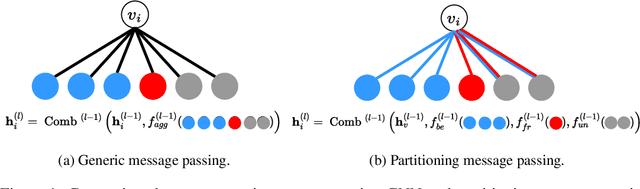
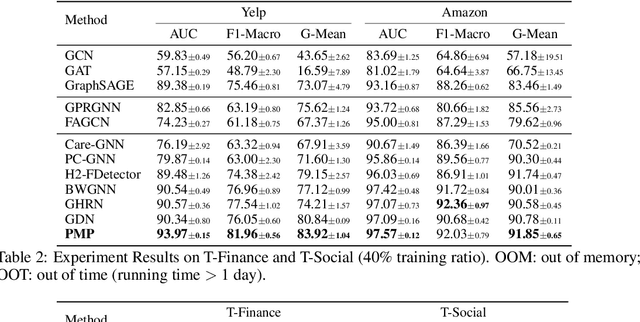
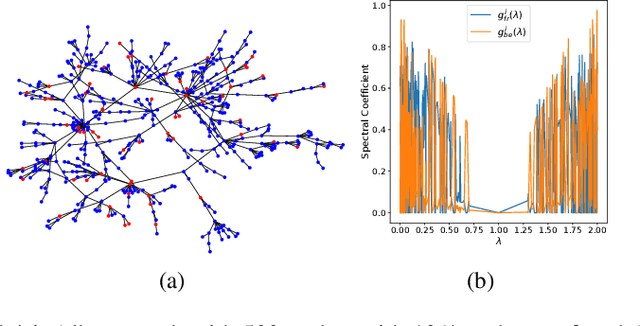
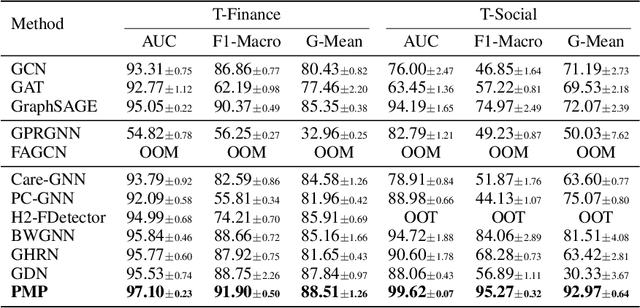
Label imbalance and homophily-heterophily mixture are the fundamental problems encountered when applying Graph Neural Networks (GNNs) to Graph Fraud Detection (GFD) tasks. Existing GNN-based GFD models are designed to augment graph structure to accommodate the inductive bias of GNNs towards homophily, by excluding heterophilic neighbors during message passing. In our work, we argue that the key to applying GNNs for GFD is not to exclude but to {\em distinguish} neighbors with different labels. Grounded in this perspective, we introduce Partitioning Message Passing (PMP), an intuitive yet effective message passing paradigm expressly crafted for GFD. Specifically, in the neighbor aggregation stage of PMP, neighbors with different classes are aggregated with distinct node-specific aggregation functions. By this means, the center node can adaptively adjust the information aggregated from its heterophilic and homophilic neighbors, thus avoiding the model gradient being dominated by benign nodes which occupy the majority of the population. We theoretically establish a connection between the spatial formulation of PMP and spectral analysis to characterize that PMP operates an adaptive node-specific spectral graph filter, which demonstrates the capability of PMP to handle heterophily-homophily mixed graphs. Extensive experimental results show that PMP can significantly boost the performance on GFD tasks.
ED-ViT: Splitting Vision Transformer for Distributed Inference on Edge Devices
Oct 15, 2024

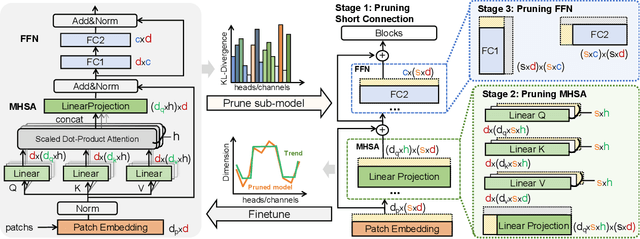
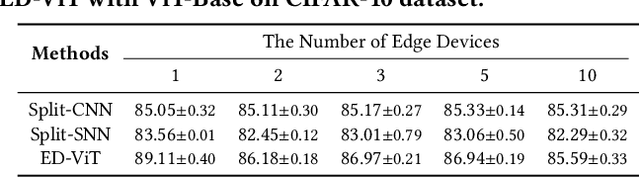
Deep learning models are increasingly deployed on resource-constrained edge devices for real-time data analytics. In recent years, Vision Transformer models and their variants have demonstrated outstanding performance across various computer vision tasks. However, their high computational demands and inference latency pose significant challenges for model deployment on resource-constraint edge devices. To address this issue, we propose a novel Vision Transformer splitting framework, ED-ViT, designed to execute complex models across multiple edge devices efficiently. Specifically, we partition Vision Transformer models into several sub-models, where each sub-model is tailored to handle a specific subset of data classes. To further minimize computation overhead and inference latency, we introduce a class-wise pruning technique that reduces the size of each sub-model. We conduct extensive experiments on five datasets with three model structures, demonstrating that our approach significantly reduces inference latency on edge devices and achieves a model size reduction of up to 28.9 times and 34.1 times, respectively, while maintaining test accuracy comparable to the original Vision Transformer. Additionally, we compare ED-ViT with two state-of-the-art methods that deploy CNN and SNN models on edge devices, evaluating accuracy, inference time, and overall model size. Our comprehensive evaluation underscores the effectiveness of the proposed ED-ViT framework.
BuffGraph: Enhancing Class-Imbalanced Node Classification via Buffer Nodes
Feb 20, 2024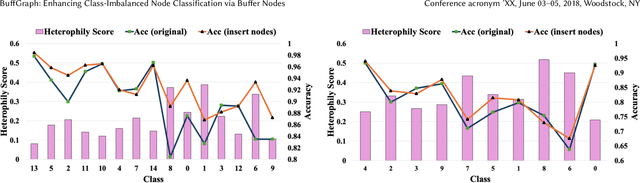
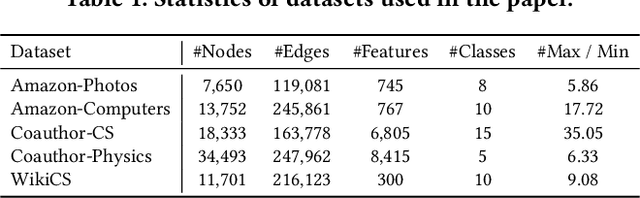
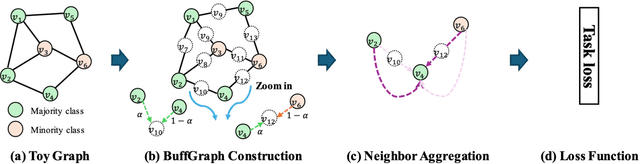

Class imbalance in graph-structured data, where minor classes are significantly underrepresented, poses a critical challenge for Graph Neural Networks (GNNs). To address this challenge, existing studies generally generate new minority nodes and edges connecting new nodes to the original graph to make classes balanced. However, they do not solve the problem that majority classes still propagate information to minority nodes by edges in the original graph which introduces bias towards majority classes. To address this, we introduce BuffGraph, which inserts buffer nodes into the graph, modulating the impact of majority classes to improve minor class representation. Our extensive experiments across diverse real-world datasets empirically demonstrate that BuffGraph outperforms existing baseline methods in class-imbalanced node classification in both natural settings and imbalanced settings. Code is available at https://anonymous.4open.science/r/BuffGraph-730A.