 Add to Chrome
 Add to Firefox
 Add to Edge
Stop When Further Reasoning Won't Help: Attention-State Adaptive Generation in Reasoning Models
Jun 13, 2026
By incorporating test-time compute scaling, large reasoning models (LRMs) can solve complex problems through explicit chain-of-thought (CoT) reasoning processes. However, they often suffer from overthinking, resulting in redundant token outputs and degraded accuracy. Current methods to mitigate this issue remain limited: training-based approaches require substantial computational resources, while training-free methods rely on well-crafted prompts or unreliable confidence signals. In this work, we investigate early stopping from the perspective of attention distributions and propose a simple method, ASAG, which infers the model's reasoning state and adaptively adjusts the generation strategy. The proposed framework is training-free and plug-and-play, enabling seamless integration into existing LRMs. Extensive experiments on nine benchmarks demonstrate consistent improvements across mainstream LRMs with varying parameter scales, including the DeepSeek-R1-Distill and Qwen3 series. Specifically, ASAG improves average accuracy by 3.2% while reducing the number of generated tokens by nearly 40% across all reasoning tasks on Qwen3-8B.

Cosmos 3: Omnimodal World Models for Physical AI
Jun 01, 2026We introduce Cosmos 3, a family of omnimodal world models designed to jointly process and generate language, image, video, audio, and action sequences within a unified mixture-of-transformers architecture. By supporting highly flexible input-output configurations, Cosmos 3 seamlessly unifies critical modalities for Physical AI -- effectively subsuming vision-language models, video generators, world simulators, and world-action models into a single framework. Our evaluation demonstrates that Cosmos 3 establishes a new state-of-the-art across a diverse suite of understanding and generation tasks, demonstrating omnimodal world models as scalable, general-purpose backbones for embodied agents. Our post-trained Cosmos 3 models were ranked as the best open-source Text-to-Image and Image-to-Video models by Artificial Analysis, and the best policy model by RoboArena at the time the technical report was written. To accelerate open research and deployment in Physical AI, we make our code, model checkpoints, curated synthetic datasets, and evaluation benchmark available under the Linux Foundation's OpenMDW-1.1 https://openmdw.ai/license/1-1/ License at https://github.com/nvidia/cosmos}{github.com/nvidia/cosmos and https://huggingface.co/collections/nvidia/cosmos3 . The project website is available at https://research.nvidia.com/labs/cosmos-lab/cosmos3 .
Q-GeoMem: Question-Guided Geometric Memory for Video Spatial Reasoning
May 26, 2026Video spatial reasoning requires accumulating viewpoint-dependent evidence over time while retaining information useful to the question being asked. Existing spatial video-language models improve geometric perception and long-range context modeling, but often treat memory as a generic temporal cache, which can introduce redundant or irrelevant geometry and weaken long-horizon reasoning. We propose \textbf{\ours}, a question-guided geometric memory framework for video spatial reasoning. \ours injects camera-conditioned geometry into visual tokens and maintains two complementary memories: a Fine-Grained Context Bank for recent dense features and camera states, and a Semantic-Geometric Evidence Bank for compact long-range evidence. Each candidate frame is scored by the product of Q-Former-based question relevance and novelty with respect to the retained bank; this score is stored and reused during reading, while a capacity-based replacement rule keeps the bank compact. During reasoning, both memories are read before update and adaptively fused with the current frame representation. Experiments on VSI-Bench and VSTI-Bench show that \ours achieves state-of-the-art performance among evaluated spatial reasoning models, validating the effectiveness of question-guided geometric memory. Ablations further verify the contribution of the proposed evidence scoring mechanism.
VGGT-Edit: Feed-forward Native 3D Scene Editing with Residual Field Prediction
May 14, 2026High-quality 3D scene reconstruction has recently advanced toward generalizable feed-forward architectures, enabling the generation of complex environments in a single forward pass. However, despite their strong performance in static scene perception, these models remain limited in responding to dynamic human instructions, which restricts their use in interactive applications. Existing editing methods typically rely on a 2D-lifting strategy, where individual views are edited independently and then lifted back into 3D space. This indirect pipeline often leads to blurry textures and inconsistent geometry, as 2D editors lack the spatial awareness required to preserve structure across viewpoints. To address these limitations, we propose VGGT-Edit, a feed-forward framework for text-conditioned native 3D scene editing. VGGT-Edit introduces depth-synchronized text injection to align semantic guidance with the backbone's spatial poses, ensuring stable instruction grounding. This semantic signal is then processed by a residual transformation head, which directly predicts 3D geometric displacements to deform the scene while preserving background stability. To ensure high-fidelity results, we supervise the framework with a multi-term objective function that enforces geometric accuracy and cross-view consistency. We also construct the DeltaScene Dataset, a large-scale dataset generated through an automated pipeline with 3D agreement filtering to ensure ground-truth quality. Experiments show that VGGT-Edit substantially outperforms 2D-lifting baselines, producing sharper object details, stronger multi-view consistency, and near-instant inference speed.
Mitigating KG Quality Issues: A Robust Multi-Hop GraphRAG Retrieval Framework
Mar 16, 2026Graph Retrieval-Augmented Generation enhances multi-hop reasoning but relies on imperfect knowledge graphs that frequently suffer from inherent quality issues. Current approaches often overlook these issues, consequently struggling with retrieval drift driven by spurious noise and retrieval hallucinations stemming from incomplete information. To address these challenges, we propose C2RAG (Constraint-Checked Retrieval-Augmented Generation), a framework aimed at robust multi-hop retrieval over the imperfect KG. First, C2RAG performs constraint-based retrieval by decomposing each query into atomic constraint triples, with using fine-grained constraint anchoring to filter candidates for suppressing retrieval drift. Second, C2RAG introduces a sufficiency check to explicitly prevent retrieval hallucinations by deciding whether the current evidence is sufficient to justify structural propagation, and activating textual recovery otherwise. Extensive experiments on multi-hop benchmarks demonstrate that C2RAG consistently outperforms the latest baselines by 3.4\% EM and 3.9\% F1 on average, while exhibiting improved robustness under KG issues.
KEPo: Knowledge Evolution Poison on Graph-based Retrieval-Augmented Generation
Mar 12, 2026Graph-based Retrieval-Augmented Generation (GraphRAG) constructs the Knowledge Graph (KG) from external databases to enhance the timeliness and accuracy of Large Language Model (LLM) generations.However,this reliance on external data introduces new attack surfaces.Attackers can inject poisoned texts into databases to manipulate LLMs into producing harmful target responses for attacker-chosen queries.Existing research primarily focuses on attacking conventional RAG systems.However,such methods are ineffective against GraphRAG.This robustness derives from the KG abstraction of GraphRAG,which reorganizes injected text into a graph before retrieval,thereby enabling the LLM to reason based on the restructured context instead of raw poisoned passages.To expose latent security vulnerabilities in GraphRAG,we propose Knowledge Evolution Poison (KEPo),a novel poisoning attack method specifically designed for GraphRAG.For each target query,KEPo first generates a toxic event containing poisoned knowledge based on the target answer.By fabricating event backgrounds and forging knowledge evolution paths from original facts to the toxic event,it then poisons the KG and misleads the LLM into treating the poisoned knowledge as the final result.In multi-target attack scenarios,KEPo further connects multiple attack corpora,enabling their poisoned knowledge to mutually reinforce while expanding the scale of poisoned communities,thereby amplifying attack effectiveness.Experimental results across multiple datasets demonstrate that KEPo achieves state-of-the-art attack success rates for both single-target and multi-target attacks,significantly outperforming previous methods.
NL2Repo-Bench: Towards Long-Horizon Repository Generation Evaluation of Coding Agents
Dec 14, 2025Recent advances in coding agents suggest rapid progress toward autonomous software development, yet existing benchmarks fail to rigorously evaluate the long-horizon capabilities required to build complete software systems. Most prior evaluations focus on localized code generation, scaffolded completion, or short-term repair tasks, leaving open the question of whether agents can sustain coherent reasoning, planning, and execution over the extended horizons demanded by real-world repository construction. To address this gap, we present NL2Repo Bench, a benchmark explicitly designed to evaluate the long-horizon repository generation ability of coding agents. Given only a single natural-language requirements document and an empty workspace, agents must autonomously design the architecture, manage dependencies, implement multi-module logic, and produce a fully installable Python library. Our experiments across state-of-the-art open- and closed-source models reveal that long-horizon repository generation remains largely unsolved: even the strongest agents achieve below 40% average test pass rates and rarely complete an entire repository correctly. Detailed analysis uncovers fundamental long-horizon failure modes, including premature termination, loss of global coherence, fragile cross-file dependencies, and inadequate planning over hundreds of interaction steps. NL2Repo Bench establishes a rigorous, verifiable testbed for measuring sustained agentic competence and highlights long-horizon reasoning as a central bottleneck for the next generation of autonomous coding agents.
Openpi Comet: Competition Solution For 2025 BEHAVIOR Challenge
Dec 12, 2025The 2025 BEHAVIOR Challenge is designed to rigorously track progress toward solving long-horizon tasks by physical agents in simulated environments. BEHAVIOR-1K focuses on everyday household tasks that people most want robots to assist with and these tasks introduce long-horizon mobile manipulation challenges in realistic settings, bridging the gap between current research and real-world, human-centric applications. This report presents our solution to the 2025 BEHAVIOR Challenge in a very close 2nd place and substantially outperforms the rest of the submissions. Building on $π_{0.5}$, we focus on systematically building our solution by studying the effects of training techniques and data. Through careful ablations, we show the scaling power in pre-training and post-training phases for competitive performance. We summarize our practical lessons and design recommendations that we hope will provide actionable insights for the broader embodied AI community when adapting powerful foundation models to complex embodied scenarios.
Are We Ready for RL in Text-to-3D Generation? A Progressive Investigation
Dec 11, 2025Reinforcement learning (RL), earlier proven to be effective in large language and multi-modal models, has been successfully extended to enhance 2D image generation recently. However, applying RL to 3D generation remains largely unexplored due to the higher spatial complexity of 3D objects, which require globally consistent geometry and fine-grained local textures. This makes 3D generation significantly sensitive to reward designs and RL algorithms. To address these challenges, we conduct the first systematic study of RL for text-to-3D autoregressive generation across several dimensions. (1) Reward designs: We evaluate reward dimensions and model choices, showing that alignment with human preference is crucial, and that general multi-modal models provide robust signal for 3D attributes. (2) RL algorithms: We study GRPO variants, highlighting the effectiveness of token-level optimization, and further investigate the scaling of training data and iterations. (3) Text-to-3D Benchmarks: Since existing benchmarks fail to measure implicit reasoning abilities in 3D generation models, we introduce MME-3DR. (4) Advanced RL paradigms: Motivated by the natural hierarchy of 3D generation, we propose Hi-GRPO, which optimizes the global-to-local hierarchical 3D generation through dedicated reward ensembles. Based on these insights, we develop AR3D-R1, the first RL-enhanced text-to-3D model, expert from coarse shape to texture refinement. We hope this study provides insights into RL-driven reasoning for 3D generation. Code is released at https://github.com/Ivan-Tang-3D/3DGen-R1.
NeuroPath: Neurobiology-Inspired Path Tracking and Reflection for Semantically Coherent Retrieval
Nov 18, 2025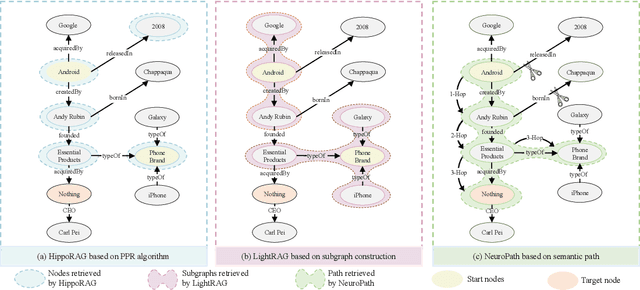
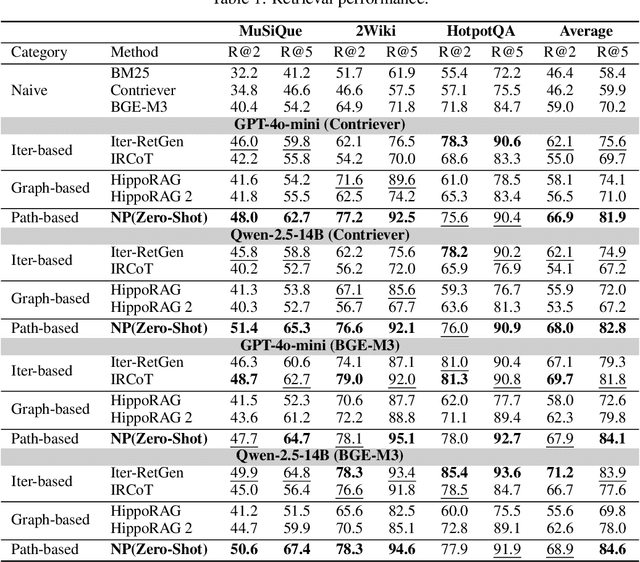
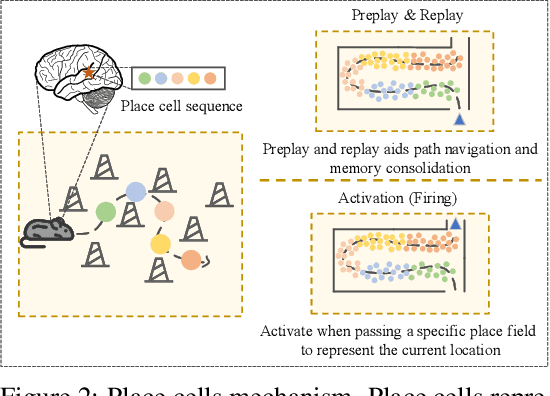
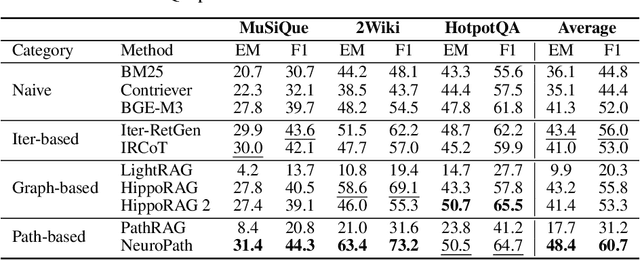
Retrieval-augmented generation (RAG) greatly enhances large language models (LLMs) performance in knowledge-intensive tasks. However, naive RAG methods struggle with multi-hop question answering due to their limited capacity to capture complex dependencies across documents. Recent studies employ graph-based RAG to capture document connections. However, these approaches often result in a loss of semantic coherence and introduce irrelevant noise during node matching and subgraph construction. To address these limitations, we propose NeuroPath, an LLM-driven semantic path tracking RAG framework inspired by the path navigational planning of place cells in neurobiology. It consists of two steps: Dynamic Path Tracking and Post-retrieval Completion. Dynamic Path Tracking performs goal-directed semantic path tracking and pruning over the constructed knowledge graph (KG), improving noise reduction and semantic coherence. Post-retrieval Completion further reinforces these benefits by conducting second-stage retrieval using intermediate reasoning and the original query to refine the query goal and complete missing information in the reasoning path. NeuroPath surpasses current state-of-the-art baselines on three multi-hop QA datasets, achieving average improvements of 16.3% on recall@2 and 13.5% on recall@5 over advanced graph-based RAG methods. Moreover, compared to existing iter-based RAG methods, NeuroPath achieves higher accuracy and reduces token consumption by 22.8%. Finally, we demonstrate the robustness of NeuroPath across four smaller LLMs (Llama3.1, GLM4, Mistral0.3, and Gemma3), and further validate its scalability across tasks of varying complexity. Code is available at https://github.com/KennyCaty/NeuroPath.