 Add to Chrome
 Add to Firefox
 Add to Edge
Stop When Further Reasoning Won't Help: Attention-State Adaptive Generation in Reasoning Models
Jun 13, 2026
By incorporating test-time compute scaling, large reasoning models (LRMs) can solve complex problems through explicit chain-of-thought (CoT) reasoning processes. However, they often suffer from overthinking, resulting in redundant token outputs and degraded accuracy. Current methods to mitigate this issue remain limited: training-based approaches require substantial computational resources, while training-free methods rely on well-crafted prompts or unreliable confidence signals. In this work, we investigate early stopping from the perspective of attention distributions and propose a simple method, ASAG, which infers the model's reasoning state and adaptively adjusts the generation strategy. The proposed framework is training-free and plug-and-play, enabling seamless integration into existing LRMs. Extensive experiments on nine benchmarks demonstrate consistent improvements across mainstream LRMs with varying parameter scales, including the DeepSeek-R1-Distill and Qwen3 series. Specifically, ASAG improves average accuracy by 3.2% while reducing the number of generated tokens by nearly 40% across all reasoning tasks on Qwen3-8B.

GraphCogent: Overcoming LLMs' Working Memory Constraints via Multi-Agent Collaboration in Complex Graph Understanding
Aug 17, 2025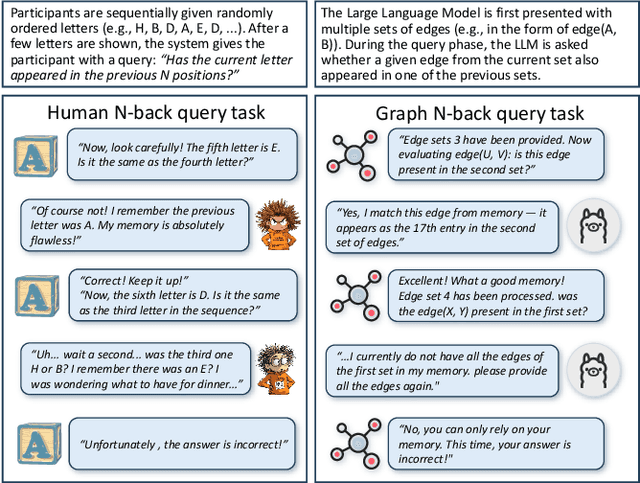
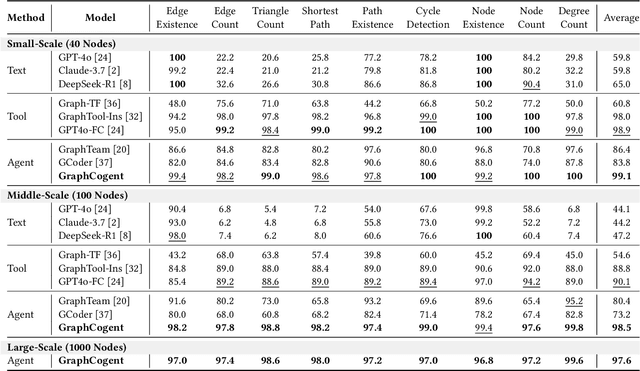

Large language models (LLMs) show promising performance on small-scale graph reasoning tasks but fail when handling real-world graphs with complex queries. This phenomenon stems from LLMs' inability to effectively process complex graph topology and perform multi-step reasoning simultaneously. To address these limitations, we propose GraphCogent, a collaborative agent framework inspired by human Working Memory Model that decomposes graph reasoning into specialized cognitive processes: sense, buffer, and execute. The framework consists of three modules: Sensory Module standardizes diverse graph text representations via subgraph sampling, Buffer Module integrates and indexes graph data across multiple formats, and Execution Module combines tool calling and model generation for efficient reasoning. We also introduce Graph4real, a comprehensive benchmark contains with four domains of real-world graphs (Web, Social, Transportation, and Citation) to evaluate LLMs' graph reasoning capabilities. Our Graph4real covers 21 different graph reasoning tasks, categorized into three types (Structural Querying, Algorithmic Reasoning, and Predictive Modeling tasks), with graph scales that are 10 times larger than existing benchmarks. Experiments show that Llama3.1-8B based GraphCogent achieves a 50% improvement over massive-scale LLMs like DeepSeek-R1 (671B). Compared to state-of-the-art agent-based baseline, our framework outperforms by 20% in accuracy while reducing token usage by 80% for in-toolset tasks and 30% for out-toolset tasks. Code will be available after review.