 Add to Chrome
 Add to Firefox
 Add to Edge
Stop When Further Reasoning Won't Help: Attention-State Adaptive Generation in Reasoning Models
Jun 13, 2026
By incorporating test-time compute scaling, large reasoning models (LRMs) can solve complex problems through explicit chain-of-thought (CoT) reasoning processes. However, they often suffer from overthinking, resulting in redundant token outputs and degraded accuracy. Current methods to mitigate this issue remain limited: training-based approaches require substantial computational resources, while training-free methods rely on well-crafted prompts or unreliable confidence signals. In this work, we investigate early stopping from the perspective of attention distributions and propose a simple method, ASAG, which infers the model's reasoning state and adaptively adjusts the generation strategy. The proposed framework is training-free and plug-and-play, enabling seamless integration into existing LRMs. Extensive experiments on nine benchmarks demonstrate consistent improvements across mainstream LRMs with varying parameter scales, including the DeepSeek-R1-Distill and Qwen3 series. Specifically, ASAG improves average accuracy by 3.2% while reducing the number of generated tokens by nearly 40% across all reasoning tasks on Qwen3-8B.

Mind Your Margin and Boundary: Are Your Distilled Datasets Truly Robust?
May 20, 2026Dataset distillation (DD) compresses a large training set into a small synthetic set for efficient training, but most DD methods optimize only clean accuracy and leave robustness uncontrolled. Recent robust DD methods improve robustness, yet they often suffer from a poor accuracy-robustness trade-off because they (i) treat all adversarially perturbed examples uniformly, despite robust risk being dominated by near-zero robust margins, and (ii) do not explicitly increase inter-class separation in the decision boundary where attacks concentrate. We present Contrastive Curriculum for Robust Dataset Distillation (C$^2$R), a framework that couples an attack-aware curriculum with a contrastive robustness objective. From a robust-margin perspective, we derive a perturbation score that approximates each sample's robust hinge, enabling a curriculum that prioritizes the smallest-margin adversaries that most directly drive robust error. In parallel, a class-balanced contrastive robustness loss enforces adversarial invariance while explicitly widening boundary separation across classes. Experiments on CIFAR-10/100, Tiny-ImageNet, and multiple ImageNet-1K subsets under six attacks show that C$^2$R achieves the best robust accuracy, outperforming prior robust DD by $2.8$% on average.
Mitigating KG Quality Issues: A Robust Multi-Hop GraphRAG Retrieval Framework
Mar 16, 2026Graph Retrieval-Augmented Generation enhances multi-hop reasoning but relies on imperfect knowledge graphs that frequently suffer from inherent quality issues. Current approaches often overlook these issues, consequently struggling with retrieval drift driven by spurious noise and retrieval hallucinations stemming from incomplete information. To address these challenges, we propose C2RAG (Constraint-Checked Retrieval-Augmented Generation), a framework aimed at robust multi-hop retrieval over the imperfect KG. First, C2RAG performs constraint-based retrieval by decomposing each query into atomic constraint triples, with using fine-grained constraint anchoring to filter candidates for suppressing retrieval drift. Second, C2RAG introduces a sufficiency check to explicitly prevent retrieval hallucinations by deciding whether the current evidence is sufficient to justify structural propagation, and activating textual recovery otherwise. Extensive experiments on multi-hop benchmarks demonstrate that C2RAG consistently outperforms the latest baselines by 3.4\% EM and 3.9\% F1 on average, while exhibiting improved robustness under KG issues.
KEPo: Knowledge Evolution Poison on Graph-based Retrieval-Augmented Generation
Mar 12, 2026Graph-based Retrieval-Augmented Generation (GraphRAG) constructs the Knowledge Graph (KG) from external databases to enhance the timeliness and accuracy of Large Language Model (LLM) generations.However,this reliance on external data introduces new attack surfaces.Attackers can inject poisoned texts into databases to manipulate LLMs into producing harmful target responses for attacker-chosen queries.Existing research primarily focuses on attacking conventional RAG systems.However,such methods are ineffective against GraphRAG.This robustness derives from the KG abstraction of GraphRAG,which reorganizes injected text into a graph before retrieval,thereby enabling the LLM to reason based on the restructured context instead of raw poisoned passages.To expose latent security vulnerabilities in GraphRAG,we propose Knowledge Evolution Poison (KEPo),a novel poisoning attack method specifically designed for GraphRAG.For each target query,KEPo first generates a toxic event containing poisoned knowledge based on the target answer.By fabricating event backgrounds and forging knowledge evolution paths from original facts to the toxic event,it then poisons the KG and misleads the LLM into treating the poisoned knowledge as the final result.In multi-target attack scenarios,KEPo further connects multiple attack corpora,enabling their poisoned knowledge to mutually reinforce while expanding the scale of poisoned communities,thereby amplifying attack effectiveness.Experimental results across multiple datasets demonstrate that KEPo achieves state-of-the-art attack success rates for both single-target and multi-target attacks,significantly outperforming previous methods.
Fixed Anchors Are Not Enough: Dynamic Retrieval and Persistent Homology for Dataset Distillation
Feb 27, 2026Decoupled dataset distillation (DD) compresses large corpora into a few synthetic images by matching a frozen teacher's statistics. However, current residual-matching pipelines rely on static real patches, creating a fit-complexity gap and a pull-to-anchor effect that reduce intra-class diversity and hurt generalization. To address these issues, we introduce RETA -- a Retrieval and Topology Alignment framework for decoupled DD. First, Dynamic Retrieval Connection (DRC) selects a real patch from a prebuilt pool by minimizing a fit-complexity score in teacher feature space; the chosen patch is injected via a residual connection to tighten feature fit while controlling injected complexity. Second, Persistent Topology Alignment (PTA) regularizes synthesis with persistent homology: we build a mutual k-NN feature graph, compute persistence images of components and loops, and penalize topology discrepancies between real and synthetic sets, mitigating pull-to-anchor effect. Across CIFAR-100, Tiny-ImageNet, ImageNet-1K, and multiple ImageNet subsets, RETA consistently outperforms various baselines under comparable time and memory, especially reaching 64.3% top-1 accuracy on ImageNet-1K with ResNet-18 at 50 images per class, +3.1% over the best prior.
Beyond Random: Automatic Inner-loop Optimization in Dataset Distillation
Oct 06, 2025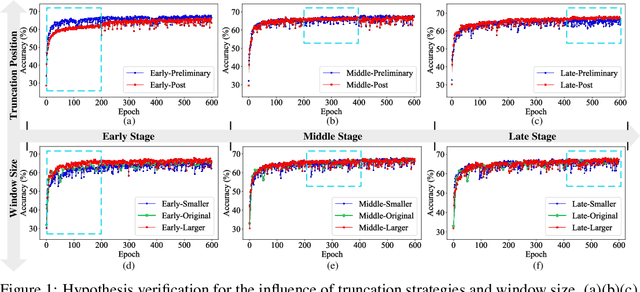
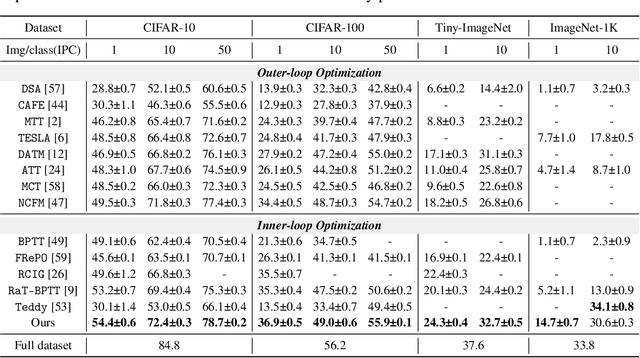
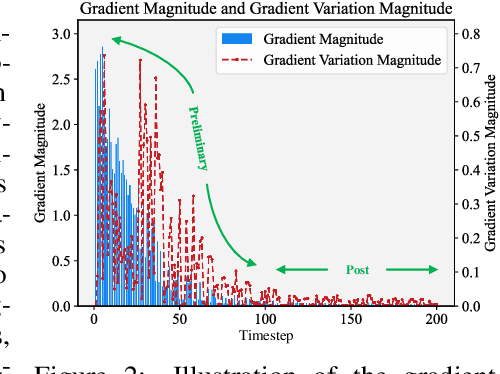
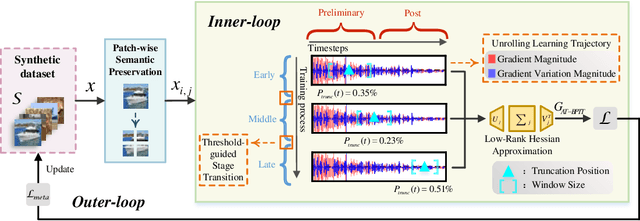
The growing demand for efficient deep learning has positioned dataset distillation as a pivotal technique for compressing training dataset while preserving model performance. However, existing inner-loop optimization methods for dataset distillation typically rely on random truncation strategies, which lack flexibility and often yield suboptimal results. In this work, we observe that neural networks exhibit distinct learning dynamics across different training stages-early, middle, and late-making random truncation ineffective. To address this limitation, we propose Automatic Truncated Backpropagation Through Time (AT-BPTT), a novel framework that dynamically adapts both truncation positions and window sizes according to intrinsic gradient behavior. AT-BPTT introduces three key components: (1) a probabilistic mechanism for stage-aware timestep selection, (2) an adaptive window sizing strategy based on gradient variation, and (3) a low-rank Hessian approximation to reduce computational overhead. Extensive experiments on CIFAR-10, CIFAR-100, Tiny-ImageNet, and ImageNet-1K show that AT-BPTT achieves state-of-the-art performance, improving accuracy by an average of 6.16% over baseline methods. Moreover, our approach accelerates inner-loop optimization by 3.9x while saving 63% memory cost.
GraphCogent: Overcoming LLMs' Working Memory Constraints via Multi-Agent Collaboration in Complex Graph Understanding
Aug 17, 2025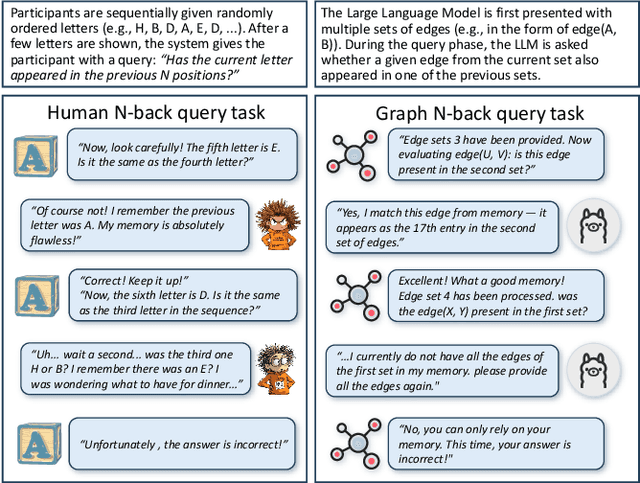
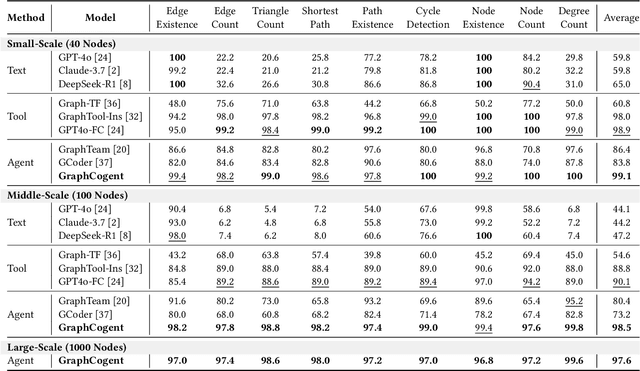
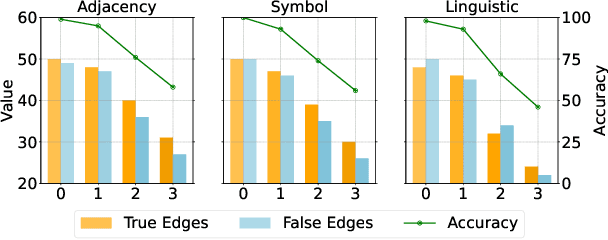

Large language models (LLMs) show promising performance on small-scale graph reasoning tasks but fail when handling real-world graphs with complex queries. This phenomenon stems from LLMs' inability to effectively process complex graph topology and perform multi-step reasoning simultaneously. To address these limitations, we propose GraphCogent, a collaborative agent framework inspired by human Working Memory Model that decomposes graph reasoning into specialized cognitive processes: sense, buffer, and execute. The framework consists of three modules: Sensory Module standardizes diverse graph text representations via subgraph sampling, Buffer Module integrates and indexes graph data across multiple formats, and Execution Module combines tool calling and model generation for efficient reasoning. We also introduce Graph4real, a comprehensive benchmark contains with four domains of real-world graphs (Web, Social, Transportation, and Citation) to evaluate LLMs' graph reasoning capabilities. Our Graph4real covers 21 different graph reasoning tasks, categorized into three types (Structural Querying, Algorithmic Reasoning, and Predictive Modeling tasks), with graph scales that are 10 times larger than existing benchmarks. Experiments show that Llama3.1-8B based GraphCogent achieves a 50% improvement over massive-scale LLMs like DeepSeek-R1 (671B). Compared to state-of-the-art agent-based baseline, our framework outperforms by 20% in accuracy while reducing token usage by 80% for in-toolset tasks and 30% for out-toolset tasks. Code will be available after review.
Adaptive Dataset Quantization
Dec 22, 2024Contemporary deep learning, characterized by the training of cumbersome neural networks on massive datasets, confronts substantial computational hurdles. To alleviate heavy data storage burdens on limited hardware resources, numerous dataset compression methods such as dataset distillation (DD) and coreset selection have emerged to obtain a compact but informative dataset through synthesis or selection for efficient training. However, DD involves an expensive optimization procedure and exhibits limited generalization across unseen architectures, while coreset selection is limited by its low data keep ratio and reliance on heuristics, hindering its practicality and feasibility. To address these limitations, we introduce a newly versatile framework for dataset compression, namely Adaptive Dataset Quantization (ADQ). Specifically, we first identify the sub-optimal performance of naive Dataset Quantization (DQ), which relies on uniform sampling and overlooks the varying importance of each generated bin. Subsequently, we propose a novel adaptive sampling strategy through the evaluation of generated bins' representativeness score, diversity score and importance score, where the former two scores are quantified by the texture level and contrastive learning-based techniques, respectively. Extensive experiments demonstrate that our method not only exhibits superior generalization capability across different architectures, but also attains state-of-the-art results, surpassing DQ by average 3\% on various datasets.
Towards Effective Data-Free Knowledge Distillation via Diverse Diffusion Augmentation
Oct 23, 2024Data-free knowledge distillation (DFKD) has emerged as a pivotal technique in the domain of model compression, substantially reducing the dependency on the original training data. Nonetheless, conventional DFKD methods that employ synthesized training data are prone to the limitations of inadequate diversity and discrepancies in distribution between the synthesized and original datasets. To address these challenges, this paper introduces an innovative approach to DFKD through diverse diffusion augmentation (DDA). Specifically, we revise the paradigm of common data synthesis in DFKD to a composite process through leveraging diffusion models subsequent to data synthesis for self-supervised augmentation, which generates a spectrum of data samples with similar distributions while retaining controlled variations. Furthermore, to mitigate excessive deviation in the embedding space, we introduce an image filtering technique grounded in cosine similarity to maintain fidelity during the knowledge distillation process. Comprehensive experiments conducted on CIFAR-10, CIFAR-100, and Tiny-ImageNet datasets showcase the superior performance of our method across various teacher-student network configurations, outperforming the contemporary state-of-the-art DFKD methods. Code will be available at:https://github.com/SLGSP/DDA.