 Add to Chrome
 Add to Firefox
 Add to Edge
LeAP: Learnable Adaptive Permutation for Feature Selection in Heterogeneous and Sparse Recommender Systems
May 31, 2026
Modern industrial recommender systems rely on thousands of heterogeneous features -- ranging from low-dimensional scalars (e.g., statistical value) to high-dimensional embeddings (e.g., user-id embeddings, MLP representations) -- to achieve high-precision predictions. Given the immense computational costs associated with training, efficient feature selection is critical. However, existing methods encounter three primary bottlenecks: (1) they typically assume uniform feature dimensions or require costly mapping to a fixed size; (2) they struggle with extreme sparsity, where the majority of features (e.g., 99%+) remain at default values; and (3) traditional permutation-based approaches are computationally prohibitive in large-scale settings. To address these challenges, we propose LeAP (Learnable Adaptive Permutation), a novel, model-agnostic plug-in module for feature selection. LeAP transforms the inefficient random permutation process into a learnable mechanism, significantly accelerating the evaluation of feature importance. In addition, we introduce an adaptive regularization strategy tailored for heterogeneous dimensions and extreme sparsity, enabling superior feature importance ranking results across asymmetric input spaces. Experiments on four public recommendation datasets demonstrate that LeAP achieves state-of-the-art performance. Furthermore, LeAP has been deployed in a large-scale industrial search ranking model with over a billion daily requests and a 2TB model parameter scale. In this real-world scenario involving 12,000+ total feature dimensions, LeAP successfully identified and removed over 3,600 redundant dimensions without performance degradation, which is 2 to 10 times the ability of compared baseline methods.

Mind Your Margin and Boundary: Are Your Distilled Datasets Truly Robust?
May 20, 2026Dataset distillation (DD) compresses a large training set into a small synthetic set for efficient training, but most DD methods optimize only clean accuracy and leave robustness uncontrolled. Recent robust DD methods improve robustness, yet they often suffer from a poor accuracy-robustness trade-off because they (i) treat all adversarially perturbed examples uniformly, despite robust risk being dominated by near-zero robust margins, and (ii) do not explicitly increase inter-class separation in the decision boundary where attacks concentrate. We present Contrastive Curriculum for Robust Dataset Distillation (C$^2$R), a framework that couples an attack-aware curriculum with a contrastive robustness objective. From a robust-margin perspective, we derive a perturbation score that approximates each sample's robust hinge, enabling a curriculum that prioritizes the smallest-margin adversaries that most directly drive robust error. In parallel, a class-balanced contrastive robustness loss enforces adversarial invariance while explicitly widening boundary separation across classes. Experiments on CIFAR-10/100, Tiny-ImageNet, and multiple ImageNet-1K subsets under six attacks show that C$^2$R achieves the best robust accuracy, outperforming prior robust DD by $2.8$% on average.
KEPo: Knowledge Evolution Poison on Graph-based Retrieval-Augmented Generation
Mar 12, 2026Graph-based Retrieval-Augmented Generation (GraphRAG) constructs the Knowledge Graph (KG) from external databases to enhance the timeliness and accuracy of Large Language Model (LLM) generations.However,this reliance on external data introduces new attack surfaces.Attackers can inject poisoned texts into databases to manipulate LLMs into producing harmful target responses for attacker-chosen queries.Existing research primarily focuses on attacking conventional RAG systems.However,such methods are ineffective against GraphRAG.This robustness derives from the KG abstraction of GraphRAG,which reorganizes injected text into a graph before retrieval,thereby enabling the LLM to reason based on the restructured context instead of raw poisoned passages.To expose latent security vulnerabilities in GraphRAG,we propose Knowledge Evolution Poison (KEPo),a novel poisoning attack method specifically designed for GraphRAG.For each target query,KEPo first generates a toxic event containing poisoned knowledge based on the target answer.By fabricating event backgrounds and forging knowledge evolution paths from original facts to the toxic event,it then poisons the KG and misleads the LLM into treating the poisoned knowledge as the final result.In multi-target attack scenarios,KEPo further connects multiple attack corpora,enabling their poisoned knowledge to mutually reinforce while expanding the scale of poisoned communities,thereby amplifying attack effectiveness.Experimental results across multiple datasets demonstrate that KEPo achieves state-of-the-art attack success rates for both single-target and multi-target attacks,significantly outperforming previous methods.
Nüwa: Mending the Spatial Integrity Torn by VLM Token Pruning
Feb 03, 2026Vision token pruning has proven to be an effective acceleration technique for the efficient Vision Language Model (VLM). However, existing pruning methods demonstrate excellent performance preservation in visual question answering (VQA) and suffer substantial degradation on visual grounding (VG) tasks. Our analysis of the VLM's processing pipeline reveals that strategies utilizing global semantic similarity and attention scores lose the global spatial reference frame, which is derived from the interactions of tokens' positional information. Motivated by these findings, we propose $\text{Nüwa}$, a two-stage token pruning framework that enables efficient feature aggregation while maintaining spatial integrity. In the first stage, after the vision encoder, we apply three operations, namely separation, alignment, and aggregation, which are inspired by swarm intelligence algorithms to retain information-rich global spatial anchors. In the second stage, within the LLM, we perform text-guided pruning to retain task-relevant visual tokens. Extensive experiments demonstrate that $\text{Nüwa}$ achieves SOTA performance on multiple VQA benchmarks (from 94% to 95%) and yields substantial improvements on visual grounding tasks (from 7% to 47%).
NeuroPath: Neurobiology-Inspired Path Tracking and Reflection for Semantically Coherent Retrieval
Nov 18, 2025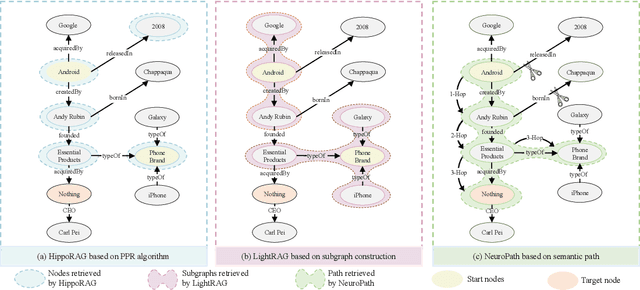
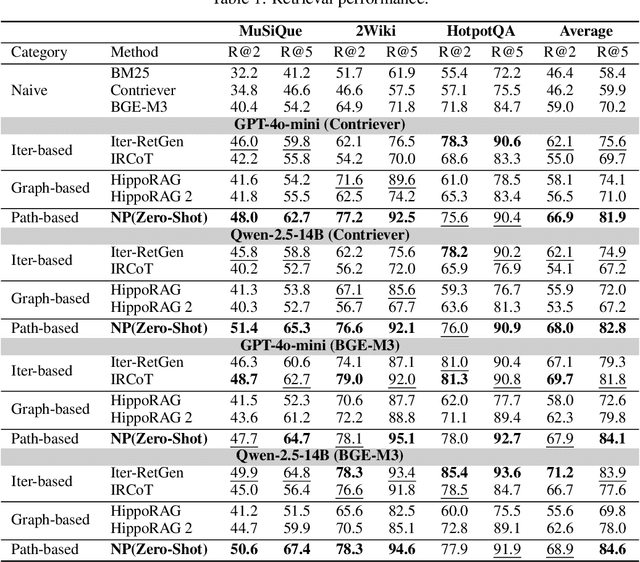
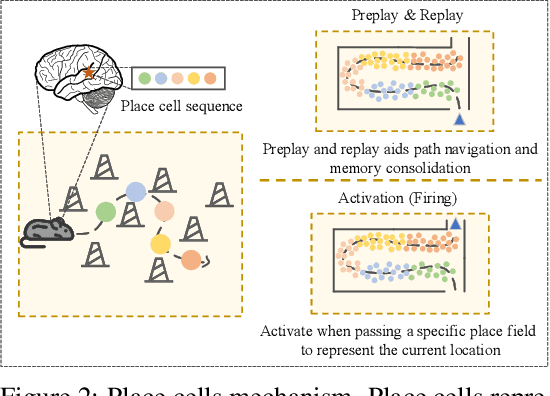
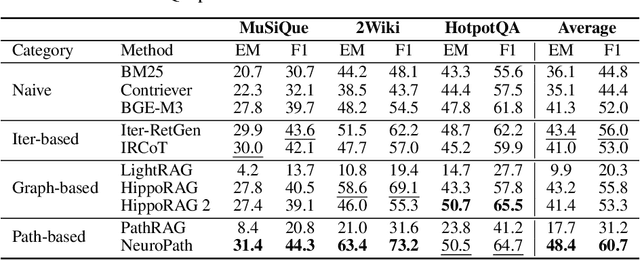
Retrieval-augmented generation (RAG) greatly enhances large language models (LLMs) performance in knowledge-intensive tasks. However, naive RAG methods struggle with multi-hop question answering due to their limited capacity to capture complex dependencies across documents. Recent studies employ graph-based RAG to capture document connections. However, these approaches often result in a loss of semantic coherence and introduce irrelevant noise during node matching and subgraph construction. To address these limitations, we propose NeuroPath, an LLM-driven semantic path tracking RAG framework inspired by the path navigational planning of place cells in neurobiology. It consists of two steps: Dynamic Path Tracking and Post-retrieval Completion. Dynamic Path Tracking performs goal-directed semantic path tracking and pruning over the constructed knowledge graph (KG), improving noise reduction and semantic coherence. Post-retrieval Completion further reinforces these benefits by conducting second-stage retrieval using intermediate reasoning and the original query to refine the query goal and complete missing information in the reasoning path. NeuroPath surpasses current state-of-the-art baselines on three multi-hop QA datasets, achieving average improvements of 16.3% on recall@2 and 13.5% on recall@5 over advanced graph-based RAG methods. Moreover, compared to existing iter-based RAG methods, NeuroPath achieves higher accuracy and reduces token consumption by 22.8%. Finally, we demonstrate the robustness of NeuroPath across four smaller LLMs (Llama3.1, GLM4, Mistral0.3, and Gemma3), and further validate its scalability across tasks of varying complexity. Code is available at https://github.com/KennyCaty/NeuroPath.
GraphCogent: Overcoming LLMs' Working Memory Constraints via Multi-Agent Collaboration in Complex Graph Understanding
Aug 17, 2025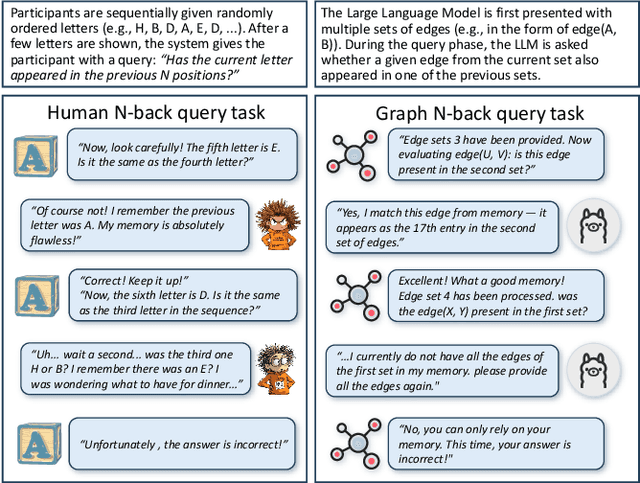
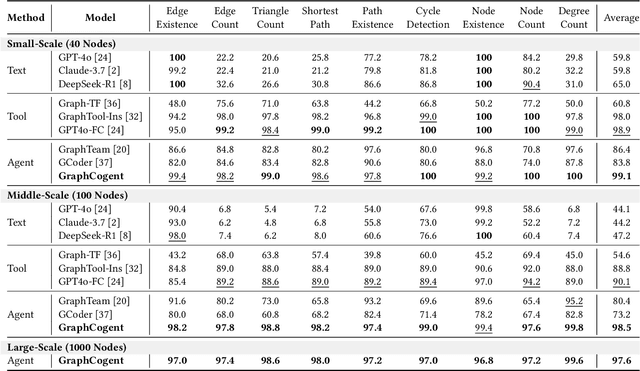
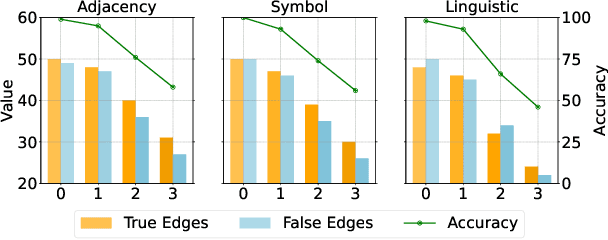

Large language models (LLMs) show promising performance on small-scale graph reasoning tasks but fail when handling real-world graphs with complex queries. This phenomenon stems from LLMs' inability to effectively process complex graph topology and perform multi-step reasoning simultaneously. To address these limitations, we propose GraphCogent, a collaborative agent framework inspired by human Working Memory Model that decomposes graph reasoning into specialized cognitive processes: sense, buffer, and execute. The framework consists of three modules: Sensory Module standardizes diverse graph text representations via subgraph sampling, Buffer Module integrates and indexes graph data across multiple formats, and Execution Module combines tool calling and model generation for efficient reasoning. We also introduce Graph4real, a comprehensive benchmark contains with four domains of real-world graphs (Web, Social, Transportation, and Citation) to evaluate LLMs' graph reasoning capabilities. Our Graph4real covers 21 different graph reasoning tasks, categorized into three types (Structural Querying, Algorithmic Reasoning, and Predictive Modeling tasks), with graph scales that are 10 times larger than existing benchmarks. Experiments show that Llama3.1-8B based GraphCogent achieves a 50% improvement over massive-scale LLMs like DeepSeek-R1 (671B). Compared to state-of-the-art agent-based baseline, our framework outperforms by 20% in accuracy while reducing token usage by 80% for in-toolset tasks and 30% for out-toolset tasks. Code will be available after review.
DimGrow: Memory-Efficient Field-level Embedding Dimension Search
May 19, 2025Key feature fields need bigger embedding dimensionality, others need smaller. This demands automated dimension allocation. Existing approaches, such as pruning or Neural Architecture Search (NAS), require training a memory-intensive SuperNet that enumerates all possible dimension combinations, which is infeasible for large feature spaces. We propose DimGrow, a lightweight approach that eliminates the SuperNet requirement. Starting training model from one dimension per feature field, DimGrow can progressively expand/shrink dimensions via importance scoring. Dimensions grow only when their importance consistently exceed a threshold, ensuring memory efficiency. Experiments on three recommendation datasets verify the effectiveness of DimGrow while it reduces training memory compared to SuperNet-based methods.
ShuffleGate: An Efficient and Self-Polarizing Feature Selection Method for Large-Scale Deep Models in Industry
Mar 12, 2025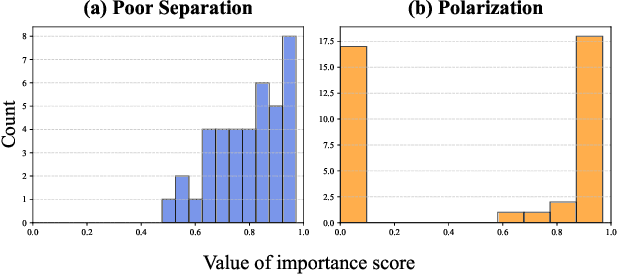
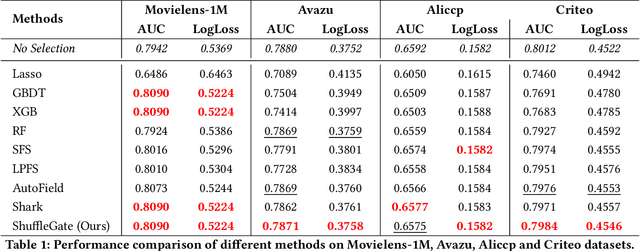
Deep models in industrial applications rely on thousands of features for accurate predictions, such as deep recommendation systems. While new features are introduced to capture evolving user behavior, outdated or redundant features often remain, significantly increasing storage and computational costs. To address this issue, feature selection methods are widely adopted to identify and remove less important features. However, existing approaches face two major challenges: (1) they often require complex Hyperparameter (Hp) tuning, making them difficult to employ in practice, and (2) they fail to produce well-separated feature importance scores, which complicates straightforward feature removal. Moreover, the impact of removing unimportant features can only be evaluated through retraining the model, a time-consuming and resource-intensive process that severely hinders efficient feature selection. To solve these challenges, we propose a novel feature selection approach, Shuffle-Gate. In particular, it shuffles all feature values across instances simultaneously and uses a gating mechanism that allows the model to dynamically learn the weights for combining the original and shuffled inputs. Notably, it can generate well-separated feature importance scores and estimate the performance without retraining the model, while introducing only a single Hp. Experiments on four public datasets show that our approach outperforms state-of-the-art methods in selecting the top half of the feature set for model retraining. Moreover, it has been successfully integrated into the daily iteration of Bilibili's search models across various scenarios, where it significantly reduces feature set size and computational resource usage, while maintaining comparable performance.
GradStop: Exploring Training Dynamics in Unsupervised Outlier Detection through Gradient Cohesion
Dec 11, 2024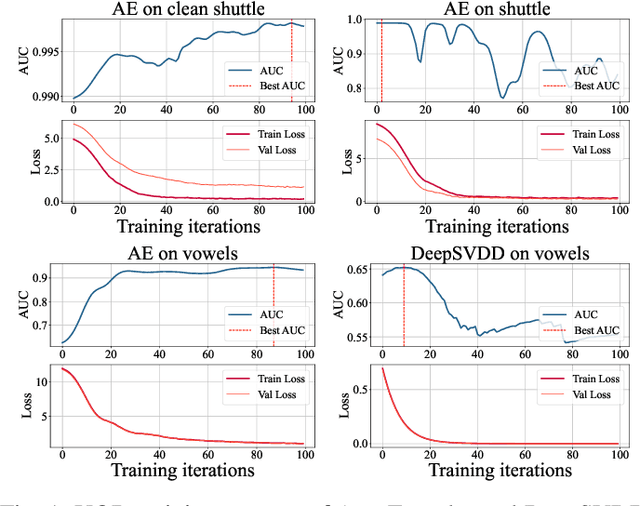
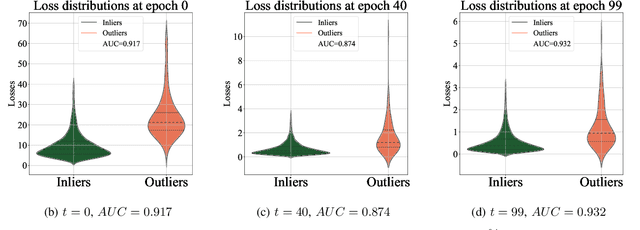

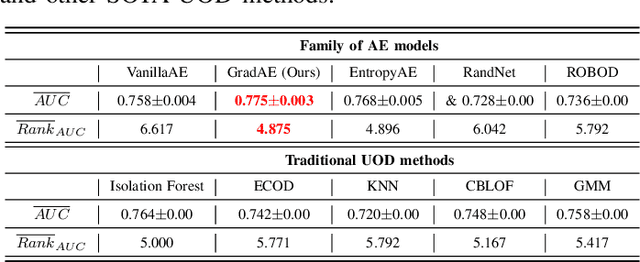
Unsupervised Outlier Detection (UOD) is a critical task in data mining and machine learning, aiming to identify instances that significantly deviate from the majority. Without any label, deep UOD methods struggle with the misalignment between the model's direct optimization goal and the final performance goal of Outlier Detection (OD) task. Through the perspective of training dynamics, this paper proposes an early stopping algorithm to optimize the training of deep UOD models, ensuring they perform optimally in OD rather than overfitting the entire contaminated dataset. Inspired by UOD mechanism and inlier priority phenomenon, where intuitively models fit inliers more quickly than outliers, we propose GradStop, a sampling-based label-free algorithm to estimate model's real-time performance during training. First, a sampling method generates two sets: one likely containing more outliers and the other more inliers, then a metric based on gradient cohesion is applied to probe into current training dynamics, which reflects model's performance on OD task. Experimental results on 4 deep UOD algorithms and 47 real-world datasets and theoretical proofs demonstrate the effectiveness of our proposed early stopping algorithm in enhancing the performance of deep UOD models. Auto Encoder (AE) enhanced by GradStop achieves better performance than itself, other SOTA UOD methods, and even ensemble AEs. Our method provides a robust and effective solution to the problem of performance degradation during training, enabling deep UOD models to achieve better potential in anomaly detection tasks.
EntropyStop: Unsupervised Deep Outlier Detection with Loss Entropy
May 21, 2024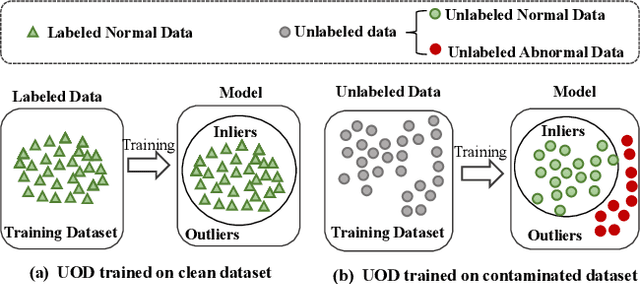
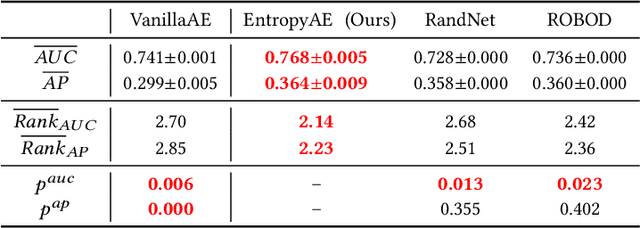
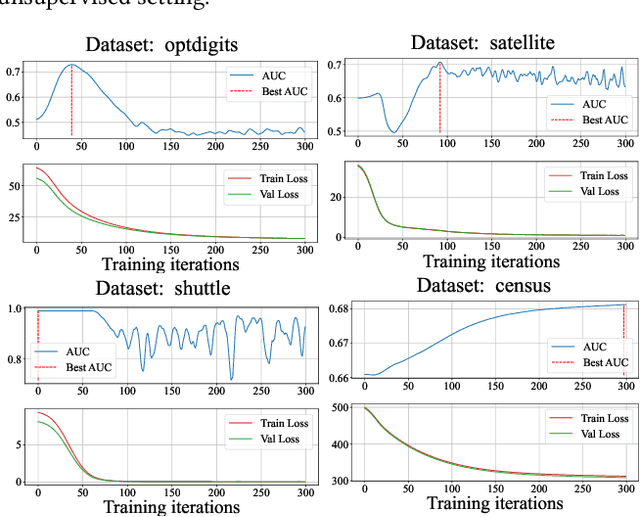

Unsupervised Outlier Detection (UOD) is an important data mining task. With the advance of deep learning, deep Outlier Detection (OD) has received broad interest. Most deep UOD models are trained exclusively on clean datasets to learn the distribution of the normal data, which requires huge manual efforts to clean the real-world data if possible. Instead of relying on clean datasets, some approaches directly train and detect on unlabeled contaminated datasets, leading to the need for methods that are robust to such conditions. Ensemble methods emerged as a superior solution to enhance model robustness against contaminated training sets. However, the training time is greatly increased by the ensemble. In this study, we investigate the impact of outliers on the training phase, aiming to halt training on unlabeled contaminated datasets before performance degradation. Initially, we noted that blending normal and anomalous data causes AUC fluctuations, a label-dependent measure of detection accuracy. To circumvent the need for labels, we propose a zero-label entropy metric named Loss Entropy for loss distribution, enabling us to infer optimal stopping points for training without labels. Meanwhile, we theoretically demonstrate negative correlation between entropy metric and the label-based AUC. Based on this, we develop an automated early-stopping algorithm, EntropyStop, which halts training when loss entropy suggests the maximum model detection capability. We conduct extensive experiments on ADBench (including 47 real datasets), and the overall results indicate that AutoEncoder (AE) enhanced by our approach not only achieves better performance than ensemble AEs but also requires under 1\% of training time. Lastly, our proposed metric and early-stopping approach are evaluated on other deep OD models, exhibiting their broad potential applicability.