 Add to Chrome
 Add to Firefox
 Add to Edge
AeroAct: Action-Centered World-Action Models for Language-Conditioned Quadrotor Flight
Jul 16, 2026
Language-conditioned quadrotor flight requires a policy to ground semantic goals, anticipate the visual consequences of ego-motion, and output control references that remain smooth and dynamically executable under rapidly changing first-person views. Existing aerial vision-language navigation and vision-language-action methods commonly use discrete actions, high-level waypoints, or instantaneous velocity commands, which provide limited supervision about how flight actions change future observations. We present AeroAct, an action-centered world-action model (WAM) for quadrotor navigation. To the best of our knowledge, AeroAct is the first WAM instantiated and demonstrated for real-world aerial flight. The model adapts a pretrained video diffusion Transformer to predict local trajectory-action chunks from egocentric visual history, proprioception, and language. Future first-person frames are used during training as dense consequence supervision, while deployment directly decodes actions without generating future video. To obtain aligned visual, state, language, and dynamically feasible action data, we build a DiffAero-based pipeline with complementary Isaac Lab and 3D Gaussian splatting renderers. We further introduce a low-cost handheld collection device that couples camera observations with motion estimates to recreate flight-like egocentric trajectories, and a self-guidance procedure that improves temporal consistency across overlapping trajectory chunks. Closed-loop simulation and real-world experiments show that temporal visual context improves target tracking and object-search performance, and that WAM-based policies can be executed on a physical quadrotor.

IndexMem: Learned KV-Cache Eviction with Latent Memory for Long-Context LLM Inference
May 25, 2026Large Language Models (LLMs) are increasingly expected to operate over long contexts, yet standard softmax attention incurs a KV cache that grows linearly with sequence length, quickly becoming the bottleneck for long context inference. A practical remedy is to evict less important KV entries; however, existing eviction policies are largely heuristic and struggle to capture the rich, input-dependent distribution of token importance. In this work, we introduce a learnable indexer that predicts KV importance, enabling more accurate retention of critical tokens. Meanwhile, naively evicting tokens permanently discards their information, leading to irreversible forgetting and degraded retrieval over long ranges. To address this, we propose a lightweight latent memory module that compresses evicted tokens into a compact, online-updated state and provides residual readouts to compensate for the attention contributions lost through KV eviction. Collectively, our method enables accurate long-context inference under a bounded KV budget, delivering consistent improvements on RULER (4K/16K) across Qwen, Mistral, and Llama models (up to 25 points under aggressive eviction), markedly more stable Needle-in-a-Haystack retrieval, and superior LongBench scores and compression curves compared to existing eviction policies.
NanoResearch: Co-Evolving Skills, Memory, and Policy for Personalized Research Automation
May 11, 2026LLM-powered multi-agent systems can now automate the full research pipeline from ideation to paper writing, but a fundamental question remains: automation for whom? Researchers operate under different resource configurations, hold different methodological preferences, and target different output formats. A system that produces uniform outputs regardless of these differences will systematically under-serve every individual user, making personalization a precondition for research automation to be genuinely usable. However, achieving it requires three capabilities that current systems lack: accumulating reusable procedural knowledge across projects, retaining user-specific experience across sessions, and internalizing implicit preferences that resist explicit formalization. We propose NanoResearch, a multi-agent framework that addresses these gaps through tri-level co-evolution. A skill bank distills recurring operations into compact procedural rules reusable across projects. A memory module maintains user- and project-specific experience that grounds planning decisions in each user's research history. A label-free policy learning converts free-form feedback into persistent parameter updates of the planner, reshaping subsequent coordination. These three layers co-evolve: reliable skills produce richer memory, richer memory informs better planning, and preference internalization continuously realigns the loop to each user. Extensive experiments demonstrate that NanoResearch delivers substantial gains over state-of-the-art AI research systems, and progressively refines itself to produce better research at lower cost over successive cycles.
Bit-by-Bit: Progressive QAT Strategy with Outlier Channel Splitting for Stable Low-Bit LLMs
Apr 09, 2026Training LLMs at ultra-low precision remains a formidable challenge. Direct low-bit QAT often suffers from convergence instability and substantial training costs, exacerbated by quantization noise from heavy-tailed outlier channels and error accumulation across layers. To address these issues, we present Bit-by-Bit, a progressive QAT framework with outlier channel splitting. Our approach integrates three key components: (1) block-wise progressive training that reduces precision stage by stage, ensuring stable initialization for low-bit optimization; (2) nested structure of integer quantization grids to enable a "train once, deploy any precision" paradigm, allowing a single model to support multiple bit-widths without retraining; (3) rounding-aware outlier channel splitting, which mitigates quantization error while acting as an identity transform that preserves the quantized outputs. Furthermore, we follow microscaling groups with E4M3 scales, capturing dynamic activation ranges in alignment with OCP/NVIDIA standards. To address the lack of efficient 2-bit kernels, we developed custom operators for both W2A2 and W2A16 configurations, achieving up to 11$\times$ speedup over BF16. Under W2A2 settings, Bit-by-Bit significantly outperforms baselines like BitDistiller and EfficientQAT on both Llama2/3, achieving a loss of only 2.25 WikiText2 PPL compared to full-precision models.
QaRL: Rollout-Aligned Quantization-Aware RL for Fast and Stable Training under Training--Inference Mismatch
Apr 09, 2026Large language model (LLM) reinforcement learning (RL) pipelines are often bottlenecked by rollout generation, making end-to-end training slow. Recent work mitigates this by running rollouts with quantization to accelerate decoding, which is the most expensive stage of the RL loop. However, these setups destabilize optimization by amplifying the training-inference gap: rollouts are operated at low precision, while learning updates are computed at full precision. To address this challenge, we propose QaRL (Rollout Alignment Quantization-Aware RL), which aligns training-side forward with the quantized rollout to minimize mismatch. We further identify a failure mode in quantized rollouts: long-form responses tend to produce repetitive, garbled tokens (error tokens). To mitigate these problems, we introduce TBPO (Trust-Band Policy Optimization), a sequence-level objective with dual clipping for negative samples, aimed at keeping updates within the trust region. On Qwen3-30B-A3B MoE for math problems, QaRL outperforms quantized-rollout training by +5.5 while improving stability and preserving low-bit throughput benefits.
Follow-Your-Motion: Video Motion Transfer via Efficient Spatial-Temporal Decoupled Finetuning
Jun 05, 2025Recently, breakthroughs in the video diffusion transformer have shown remarkable capabilities in diverse motion generations. As for the motion-transfer task, current methods mainly use two-stage Low-Rank Adaptations (LoRAs) finetuning to obtain better performance. However, existing adaptation-based motion transfer still suffers from motion inconsistency and tuning inefficiency when applied to large video diffusion transformers. Naive two-stage LoRA tuning struggles to maintain motion consistency between generated and input videos due to the inherent spatial-temporal coupling in the 3D attention operator. Additionally, they require time-consuming fine-tuning processes in both stages. To tackle these issues, we propose Follow-Your-Motion, an efficient two-stage video motion transfer framework that finetunes a powerful video diffusion transformer to synthesize complex motion.Specifically, we propose a spatial-temporal decoupled LoRA to decouple the attention architecture for spatial appearance and temporal motion processing. During the second training stage, we design the sparse motion sampling and adaptive RoPE to accelerate the tuning speed. To address the lack of a benchmark for this field, we introduce MotionBench, a comprehensive benchmark comprising diverse motion, including creative camera motion, single object motion, multiple object motion, and complex human motion. We show extensive evaluations on MotionBench to verify the superiority of Follow-Your-Motion.
Delta Decompression for MoE-based LLMs Compression
Feb 24, 2025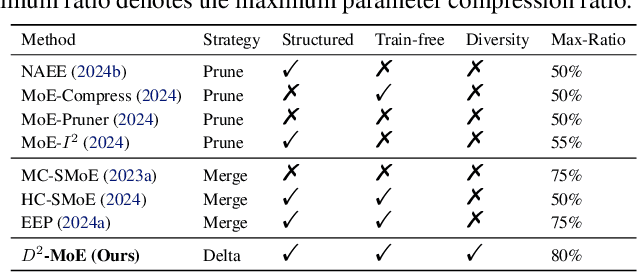
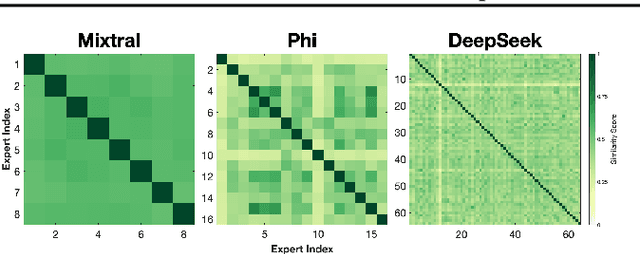
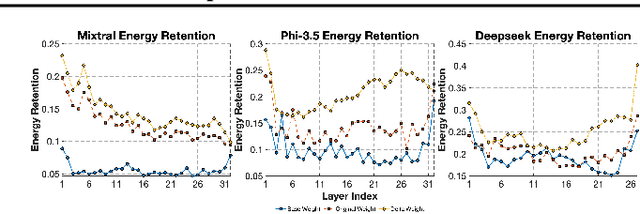
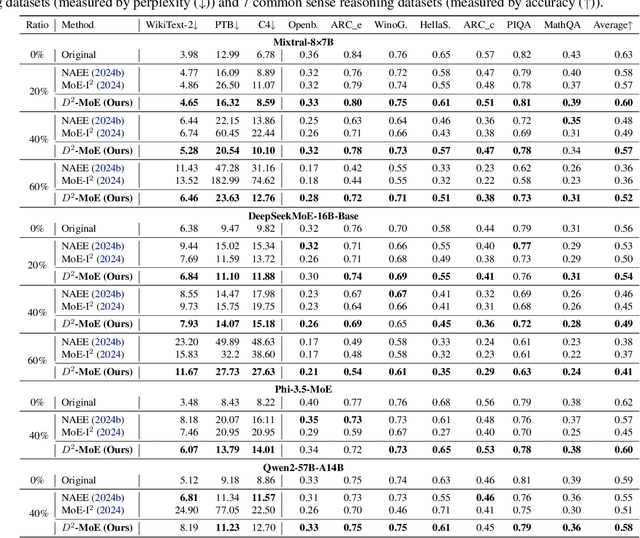
Mixture-of-Experts (MoE) architectures in large language models (LLMs) achieve exceptional performance, but face prohibitive storage and memory requirements. To address these challenges, we present $D^2$-MoE, a new delta decompression compressor for reducing the parameters of MoE LLMs. Based on observations of expert diversity, we decompose their weights into a shared base weight and unique delta weights. Specifically, our method first merges each expert's weight into the base weight using the Fisher information matrix to capture shared components. Then, we compress delta weights through Singular Value Decomposition (SVD) by exploiting their low-rank properties. Finally, we introduce a semi-dynamical structured pruning strategy for the base weights, combining static and dynamic redundancy analysis to achieve further parameter reduction while maintaining input adaptivity. In this way, our $D^2$-MoE successfully compact MoE LLMs to high compression ratios without additional training. Extensive experiments highlight the superiority of our approach, with over 13% performance gains than other compressors on Mixtral|Phi-3.5|DeepSeek|Qwen2 MoE LLMs at 40$\sim$60% compression rates. Codes are available in https://github.com/lliai/D2MoE.
An Experimental Study on Decomposition-Based Deep Ensemble Learning for Traffic Flow Forecasting
Nov 06, 2024Traffic flow forecasting is a crucial task in intelligent transport systems. Deep learning offers an effective solution, capturing complex patterns in time-series traffic flow data to enable the accurate prediction. However, deep learning models are prone to overfitting the intricate details of flow data, leading to poor generalisation. Recent studies suggest that decomposition-based deep ensemble learning methods may address this issue by breaking down a time series into multiple simpler signals, upon which deep learning models are built and ensembled to generate the final prediction. However, few studies have compared the performance of decomposition-based ensemble methods with non-decomposition-based ones which directly utilise raw time-series data. This work compares several decomposition-based and non-decomposition-based deep ensemble learning methods. Experimental results on three traffic datasets demonstrate the superiority of decomposition-based ensemble methods, while also revealing their sensitivity to aggregation strategies and forecasting horizons.
Decentralised Traffic Incident Detection via Network Lasso
Feb 28, 2024Traffic incident detection plays a key role in intelligent transportation systems, which has gained great attention in transport engineering. In the past, traditional machine learning (ML) based detection methods achieved good performance under a centralised computing paradigm, where all data are transmitted to a central server for building ML models therein. Nowadays, deep neural networks based federated learning (FL) has become a mainstream detection approach to enable the model training in a decentralised manner while warranting local data governance. Such neural networks-centred techniques, however, have overshadowed the utility of well-established ML-based detection methods. In this work, we aim to explore the potential of potent conventional ML-based detection models in modern traffic scenarios featured by distributed data. We leverage an elegant but less explored distributed optimisation framework named Network Lasso, with guaranteed global convergence for convex problem formulations, integrate the potent convex ML model with it, and compare it with centralised learning, local learning, and federated learning methods atop a well-known traffic incident detection dataset. Experimental results show that the proposed network lasso-based approach provides a promising alternative to the FL-based approach in data-decentralised traffic scenarios, with a strong convergence guarantee while rekindling the significance of conventional ML-based detection methods.
M$^{6}$Doc: A Large-Scale Multi-Format, Multi-Type, Multi-Layout, Multi-Language, Multi-Annotation Category Dataset for Modern Document Layout Analysis
May 21, 2023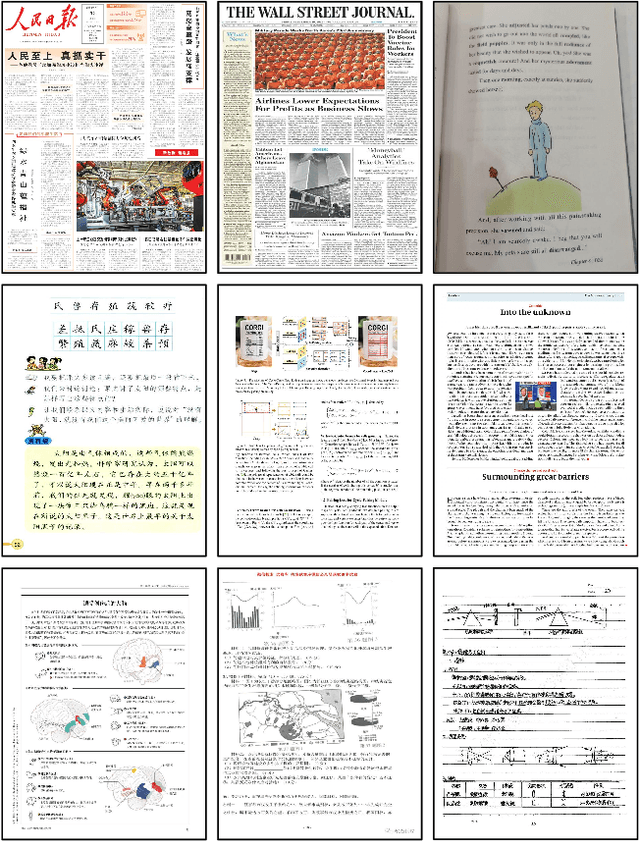
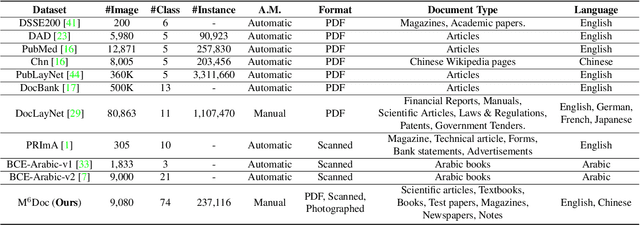
Document layout analysis is a crucial prerequisite for document understanding, including document retrieval and conversion. Most public datasets currently contain only PDF documents and lack realistic documents. Models trained on these datasets may not generalize well to real-world scenarios. Therefore, this paper introduces a large and diverse document layout analysis dataset called $M^{6}Doc$. The $M^6$ designation represents six properties: (1) Multi-Format (including scanned, photographed, and PDF documents); (2) Multi-Type (such as scientific articles, textbooks, books, test papers, magazines, newspapers, and notes); (3) Multi-Layout (rectangular, Manhattan, non-Manhattan, and multi-column Manhattan); (4) Multi-Language (Chinese and English); (5) Multi-Annotation Category (74 types of annotation labels with 237,116 annotation instances in 9,080 manually annotated pages); and (6) Modern documents. Additionally, we propose a transformer-based document layout analysis method called TransDLANet, which leverages an adaptive element matching mechanism that enables query embedding to better match ground truth to improve recall, and constructs a segmentation branch for more precise document image instance segmentation. We conduct a comprehensive evaluation of $M^{6}Doc$ with various layout analysis methods and demonstrate its effectiveness. TransDLANet achieves state-of-the-art performance on $M^{6}Doc$ with 64.5% mAP. The $M^{6}Doc$ dataset will be available at https://github.com/HCIILAB/M6Doc.