 Add to Chrome
 Add to Firefox
 Add to Edge
On the Push-Based Asynchronous Federated Learning: A Bias-Correction Aggregation Approach
May 24, 2026
Asynchronous decentralized federated learning (ADFL) eliminates central coordination and global synchronization, making it attractive for large-scale and heterogeneous systems. However, frequent peer-to-peer communication, asynchronous updates on directed topologies, and non-IID data jointly lead to excessive communication overhead, biased aggregation and severe model drift. We propose PushCen-ADFL, a communication-efficient ADFL framework that enables stable training under asymmetric communication and delayed client participation. PushCen-ADFL couples communication, aggregation, and local stabilization in a shared centroid representation space, forming a closed loop between compression and optimization. Clients exchange centroid-form messages, apply average-preserving push-sum mixing to correct aggregation bias, and use a lightweight centroid regularization anchored in the same centroid space to mitigate drift under heterogeneity and staleness. A bounded, sender-deduplicated buffer further improves robustness under irregular asynchronous arrivals. Experiments on vision datasets demonstrate that PushCen-ADFL improves accuracy under data heterogeneity by up to 6\% while reducing per-push communication cost by more than 80\%, achieving a favorable accuracy-communication trade-off.

Taming the Instability: A Robust Second-Order Optimizer for Federated Learning over Non-IID Data
Mar 30, 2026In this paper, we present Federated Robust Curvature Optimization (FedRCO), a novel second-order optimization framework designed to improve convergence speed and reduce communication cost in Federated Learning systems under statistical heterogeneity. Existing second-order optimization methods are often computationally expensive and numerically unstable in distributed settings. In contrast, FedRCO addresses these challenges by integrating an efficient approximate curvature optimizer with a provable stability mechanism. Specifically, FedRCO incorporates three key components: (1) a Gradient Anomaly Monitor that detects and mitigates exploding gradients in real-time, (2) a Fail-Safe Resilience protocol that resets optimization states upon numerical instability, and (3) a Curvature-Preserving Adaptive Aggregation strategy that safely integrates global knowledge without erasing the local curvature geometry. Theoretical analysis shows that FedRCO can effectively mitigate instability and prevent unbounded updates while preserving optimization efficiency. Extensive experiments show that FedRCO achieves superior robustness against diverse non-IID scenarios while achieving higher accuracy and faster convergence than both state-of-the-art first-order and second-order methods.
A self-evolving multi-role collaborative framework with fine-grained difficulty guidance for innovative mathematical problem generation
Jan 16, 2026Mathematical problem generation (MPG) is a significant research direction in the field of intelligent education. In recent years, the rapid development of large language models (LLMs) has enabled new technological approaches to problem-generation tasks. Although existing LLMs can achieve high correctness rates, they generally lack innovation and exhibit poor discrimination. In this paper, we propose the task of innovative math problem generation (IMPG). To solve the IMPG task, this paper proposes a self-evolving, multi-role collaborative framework with fine-grained difficulty guidance. First, a multi-role collaborative mechanism comprising a sampler, generator, evaluator, state machine, and memory is constructed, ensuring the correctness of generated problems through iterative optimization informed by self-assessment and external feedback. Second, we introduce an improved difficulty model to quantify difficulty and provide fine-grained guidance. We adopt the data-driven association-guided path sampling (DAPS) algorithm to enhance the semantic rationality of sampled encodings. Third, we construct the HSM3K-CN dataset, which comprises high-quality high school math problems. A multi-stage training pipeline is adopted, incorporating continual pre-training (CPT), supervised fine-tuning (SFT), and group relative policy optimization (GRPO), to enhance the generation and evaluation capabilities of the base model. Finally, system self-evolution is achieved by transferring evaluation capabilities from the expert model to the apprentice model via distillation. Experiments show that, compared to baseline models, our proposed method significantly improves the innovation of the generated problems while maintaining a high correctness rate.
Energy and Memory-Efficient Federated Learning With Ordered Layer Freezing
Dec 29, 2025Federated Learning (FL) has emerged as a privacy-preserving paradigm for training machine learning models across distributed edge devices in the Internet of Things (IoT). By keeping data local and coordinating model training through a central server, FL effectively addresses privacy concerns and reduces communication overhead. However, the limited computational power, memory, and bandwidth of IoT edge devices pose significant challenges to the efficiency and scalability of FL, especially when training deep neural networks. Various FL frameworks have been proposed to reduce computation and communication overheads through dropout or layer freezing. However, these approaches often sacrifice accuracy or neglect memory constraints. To this end, in this work, we introduce Federated Learning with Ordered Layer Freezing (FedOLF). FedOLF consistently freezes layers in a predefined order before training, significantly mitigating computation and memory requirements. To further reduce communication and energy costs, we incorporate Tensor Operation Approximation (TOA), a lightweight alternative to conventional quantization that better preserves model accuracy. Experimental results demonstrate that over non-iid data, FedOLF achieves at least 0.3%, 6.4%, 5.81%, 4.4%, 6.27% and 1.29% higher accuracy than existing works respectively on EMNIST (with CNN), CIFAR-10 (with AlexNet), CIFAR-100 (with ResNet20 and ResNet44), and CINIC-10 (with ResNet20 and ResNet44), along with higher energy efficiency and lower memory footprint.
An Experimental Study on Decomposition-Based Deep Ensemble Learning for Traffic Flow Forecasting
Nov 06, 2024Traffic flow forecasting is a crucial task in intelligent transport systems. Deep learning offers an effective solution, capturing complex patterns in time-series traffic flow data to enable the accurate prediction. However, deep learning models are prone to overfitting the intricate details of flow data, leading to poor generalisation. Recent studies suggest that decomposition-based deep ensemble learning methods may address this issue by breaking down a time series into multiple simpler signals, upon which deep learning models are built and ensembled to generate the final prediction. However, few studies have compared the performance of decomposition-based ensemble methods with non-decomposition-based ones which directly utilise raw time-series data. This work compares several decomposition-based and non-decomposition-based deep ensemble learning methods. Experimental results on three traffic datasets demonstrate the superiority of decomposition-based ensemble methods, while also revealing their sensitivity to aggregation strategies and forecasting horizons.
FedSPU: Personalized Federated Learning for Resource-constrained Devices with Stochastic Parameter Update
Mar 18, 2024Personalized Federated Learning (PFL) is widely employed in IoT applications to handle high-volume, non-iid client data while ensuring data privacy. However, heterogeneous edge devices owned by clients may impose varying degrees of resource constraints, causing computation and communication bottlenecks for PFL. Federated Dropout has emerged as a popular strategy to address this challenge, wherein only a subset of the global model, i.e. a \textit{sub-model}, is trained on a client's device, thereby reducing computation and communication overheads. Nevertheless, the dropout-based model-pruning strategy may introduce bias, particularly towards non-iid local data. When biased sub-models absorb highly divergent parameters from other clients, performance degradation becomes inevitable. In response, we propose federated learning with stochastic parameter update (FedSPU). Unlike dropout that tailors the global model to small-size local sub-models, FedSPU maintains the full model architecture on each device but randomly freezes a certain percentage of neurons in the local model during training while updating the remaining neurons. This approach ensures that a portion of the local model remains personalized, thereby enhancing the model's robustness against biased parameters from other clients. Experimental results demonstrate that FedSPU outperforms federated dropout by 7.57\% on average in terms of accuracy. Furthermore, an introduced early stopping scheme leads to a significant reduction of the training time by \(24.8\%\sim70.4\%\) while maintaining high accuracy.
FAGH: Accelerating Federated Learning with Approximated Global Hessian
Mar 16, 2024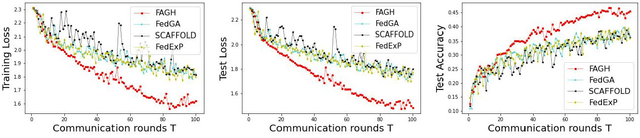
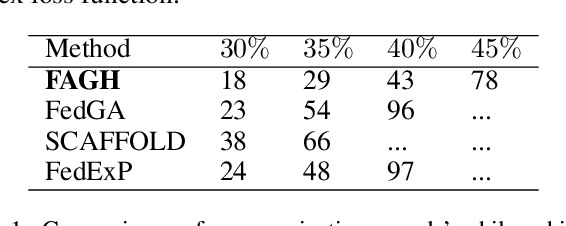
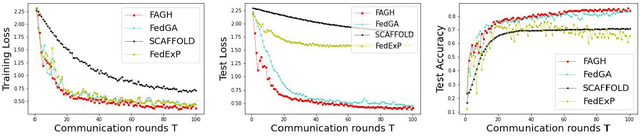
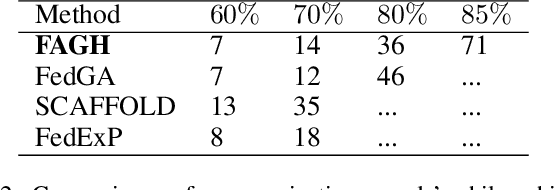
In federated learning (FL), the significant communication overhead due to the slow convergence speed of training the global model poses a great challenge. Specifically, a large number of communication rounds are required to achieve the convergence in FL. One potential solution is to employ the Newton-based optimization method for training, known for its quadratic convergence rate. However, the existing Newton-based FL training methods suffer from either memory inefficiency or high computational costs for local clients or the server. To address this issue, we propose an FL with approximated global Hessian (FAGH) method to accelerate FL training. FAGH leverages the first moment of the approximated global Hessian and the first moment of the global gradient to train the global model. By harnessing the approximated global Hessian curvature, FAGH accelerates the convergence of global model training, leading to the reduced number of communication rounds and thus the shortened training time. Experimental results verify FAGH's effectiveness in decreasing the number of communication rounds and the time required to achieve the pre-specified objectives of the global model performance in terms of training and test losses as well as test accuracy. Notably, FAGH outperforms several state-of-the-art FL training methods.
SOFIM: Stochastic Optimization Using Regularized Fisher Information Matrix
Mar 05, 2024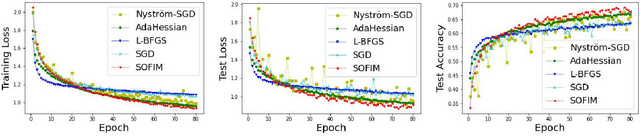
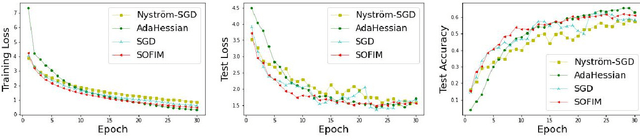
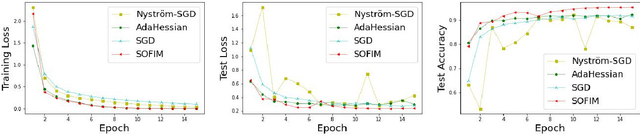
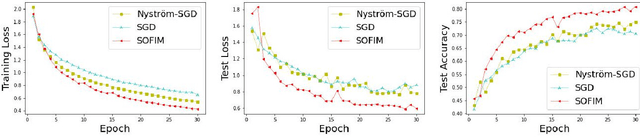
This paper introduces a new stochastic optimization method based on the regularized Fisher information matrix (FIM), named SOFIM, which can efficiently utilize the FIM to approximate the Hessian matrix for finding Newton's gradient update in large-scale stochastic optimization of machine learning models. It can be viewed as a variant of natural gradient descent (NGD), where the challenge of storing and calculating the full FIM is addressed through making use of the regularized FIM and directly finding the gradient update direction via Sherman-Morrison matrix inversion. Additionally, like the popular Adam method, SOFIM uses the first moment of the gradient to address the issue of non-stationary objectives across mini-batches due to heterogeneous data. The utilization of the regularized FIM and Sherman-Morrison matrix inversion leads to the improved convergence rate with the same space and time complexities as stochastic gradient descent (SGD) with momentum. The extensive experiments on training deep learning models on several benchmark image classification datasets demonstrate that the proposed SOFIM outperforms SGD with momentum and several state-of-the-art Newton optimization methods, such as Nystrom-SGD, L-BFGS, and AdaHessian, in term of the convergence speed for achieving the pre-specified objectives of training and test losses as well as test accuracy.
Decentralised Traffic Incident Detection via Network Lasso
Feb 28, 2024Traffic incident detection plays a key role in intelligent transportation systems, which has gained great attention in transport engineering. In the past, traditional machine learning (ML) based detection methods achieved good performance under a centralised computing paradigm, where all data are transmitted to a central server for building ML models therein. Nowadays, deep neural networks based federated learning (FL) has become a mainstream detection approach to enable the model training in a decentralised manner while warranting local data governance. Such neural networks-centred techniques, however, have overshadowed the utility of well-established ML-based detection methods. In this work, we aim to explore the potential of potent conventional ML-based detection models in modern traffic scenarios featured by distributed data. We leverage an elegant but less explored distributed optimisation framework named Network Lasso, with guaranteed global convergence for convex problem formulations, integrate the potent convex ML model with it, and compare it with centralised learning, local learning, and federated learning methods atop a well-known traffic incident detection dataset. Experimental results show that the proposed network lasso-based approach provides a promising alternative to the FL-based approach in data-decentralised traffic scenarios, with a strong convergence guarantee while rekindling the significance of conventional ML-based detection methods.
Two-Stage Multi-task Self-Supervised Learning for Medical Image Segmentation
Feb 11, 2024Medical image segmentation has been significantly advanced by deep learning (DL) techniques, though the data scarcity inherent in medical applications poses a great challenge to DL-based segmentation methods. Self-supervised learning offers a solution by creating auxiliary learning tasks from the available dataset and then leveraging the knowledge acquired from solving auxiliary tasks to help better solve the target segmentation task. Different auxiliary tasks may have different properties and thus can help the target task to different extents. It is desired to leverage their complementary advantages to enhance the overall assistance to the target task. To achieve this, existing methods often adopt a joint training paradigm, which co-solves segmentation and auxiliary tasks by integrating their losses or intermediate gradients. However, direct coupling of losses or intermediate gradients risks undesirable interference because the knowledge acquired from solving each auxiliary task at every training step may not always benefit the target task. To address this issue, we propose a two-stage training approach. In the first stage, the target segmentation task will be independently co-solved with each auxiliary task in both joint training and pre-training modes, with the better model selected via validation performance. In the second stage, the models obtained with respect to each auxiliary task are converted into a single model using an ensemble knowledge distillation method. Our approach allows for making best use of each auxiliary task to create multiple elite segmentation models and then combine them into an even more powerful model. We employed five auxiliary tasks of different proprieties in our approach and applied it to train the U-Net model on an X-ray pneumothorax segmentation dataset. Experimental results demonstrate the superiority of our approach over several existing methods.