 Add to Chrome
 Add to Firefox
 Add to Edge
LiPS: Large-Scale Humanoid Robot Reinforcement Learning with Parallel-Series Structures
Mar 11, 2025
In recent years, research on humanoid robots has garnered significant attention, particularly in reinforcement learning based control algorithms, which have achieved major breakthroughs. Compared to traditional model-based control algorithms, reinforcement learning based algorithms demonstrate substantial advantages in handling complex tasks. Leveraging the large-scale parallel computing capabilities of GPUs, contemporary humanoid robots can undergo extensive parallel training in simulated environments. A physical simulation platform capable of large-scale parallel training is crucial for the development of humanoid robots. As one of the most complex robot forms, humanoid robots typically possess intricate mechanical structures, encompassing numerous series and parallel mechanisms. However, many reinforcement learning based humanoid robot control algorithms currently employ open-loop topologies during training, deferring the conversion to series-parallel structures until the sim2real phase. This approach is primarily due to the limitations of physics engines, as current GPU-based physics engines often only support open-loop topologies or have limited capabilities in simulating multi-rigid-body closed-loop topologies. For enabling reinforcement learning-based humanoid robot control algorithms to train in large-scale parallel environments, we propose a novel training method LiPS. By incorporating multi-rigid-body dynamics modeling in the simulation environment, we significantly reduce the sim2real gap and the difficulty of converting to parallel structures during model deployment, thereby robustly supporting large-scale reinforcement learning for humanoid robots.

Generative method for aerodynamic optimization based on classifier-free guided denoising diffusion probabilistic model
Mar 10, 2025Inverse design approach, which directly generates optimal aerodynamic shape with neural network models to meet designated performance targets, has drawn enormous attention. However, the current state-of-the-art inverse design approach for airfoils, which is based on generative adversarial network, demonstrates insufficient precision in its generating and training processes and struggles to reveal the coupling relationship among specified performance indicators. To address these issues, the airfoil inverse design framework based on the classifier-free guided denoising diffusion probabilistic model (CDDPM) is proposed innovatively in this paper. First, the CDDPM can effectively capture the correlations among specific performance indicators and, by adjusting the classifier-free guide coefficient, generate corresponding upper and lower surface pressure coefficient distributions based on designated pressure features. These distributions are then accurately translated into airfoil geometries through a mapping model. Experimental results using classical transonic airfoils as examples show that the inverse design based on CDDPM can generate a variety of pressure coefficient distributions, which enriches the diversity of design results. Compared with current state-of-the-art Wasserstein generative adversarial network methods, CDDPM achieves a 33.6% precision improvement in airfoil generating tasks. Moreover, a practical method to readjust each performance indicator value is proposed based on global optimization algorithm in conjunction with active learning strategy, aiming to provide rational value combination of performance indicators for the inverse design framework. This work is not only suitable for the airfoils design, but also has the capability to apply to optimization process of general product parts targeting selected performance indicators.
Spiking Meets Attention: Efficient Remote Sensing Image Super-Resolution with Attention Spiking Neural Networks
Mar 06, 2025Spiking neural networks (SNNs) are emerging as a promising alternative to traditional artificial neural networks (ANNs), offering biological plausibility and energy efficiency. Despite these merits, SNNs are frequently hampered by limited capacity and insufficient representation power, yet remain underexplored in remote sensing super-resolution (SR) tasks. In this paper, we first observe that spiking signals exhibit drastic intensity variations across diverse textures, highlighting an active learning state of the neurons. This observation motivates us to apply SNNs for efficient SR of RSIs. Inspired by the success of attention mechanisms in representing salient information, we devise the spiking attention block (SAB), a concise yet effective component that optimizes membrane potentials through inferred attention weights, which, in turn, regulates spiking activity for superior feature representation. Our key contributions include: 1) we bridge the independent modulation between temporal and channel dimensions, facilitating joint feature correlation learning, and 2) we access the global self-similar patterns in large-scale remote sensing imagery to infer spatial attention weights, incorporating effective priors for realistic and faithful reconstruction. Building upon SAB, we proposed SpikeSR, which achieves state-of-the-art performance across various remote sensing benchmarks such as AID, DOTA, and DIOR, while maintaining high computational efficiency. The code of SpikeSR will be available upon paper acceptance.
STAA-SNN: Spatial-Temporal Attention Aggregator for Spiking Neural Networks
Mar 05, 2025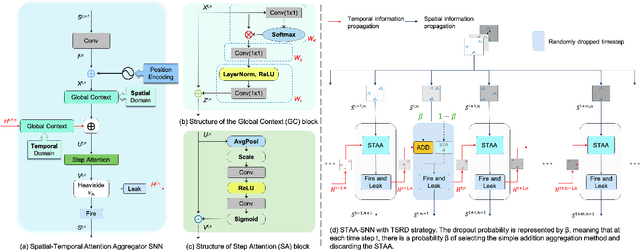
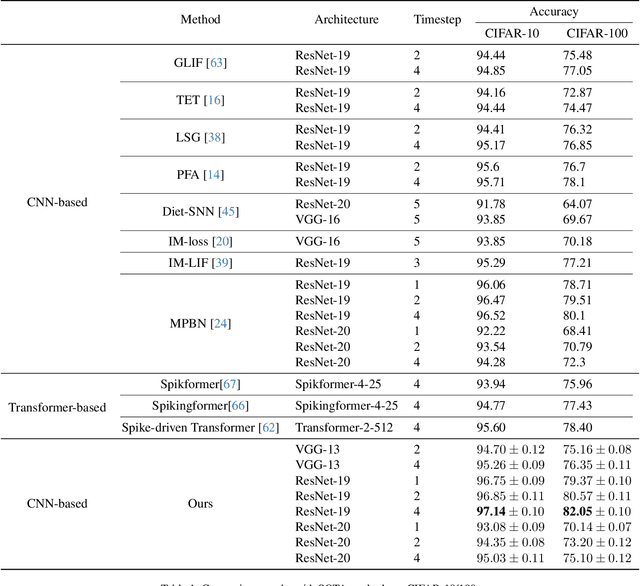
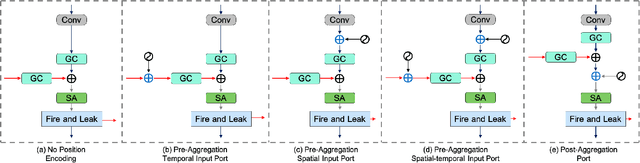
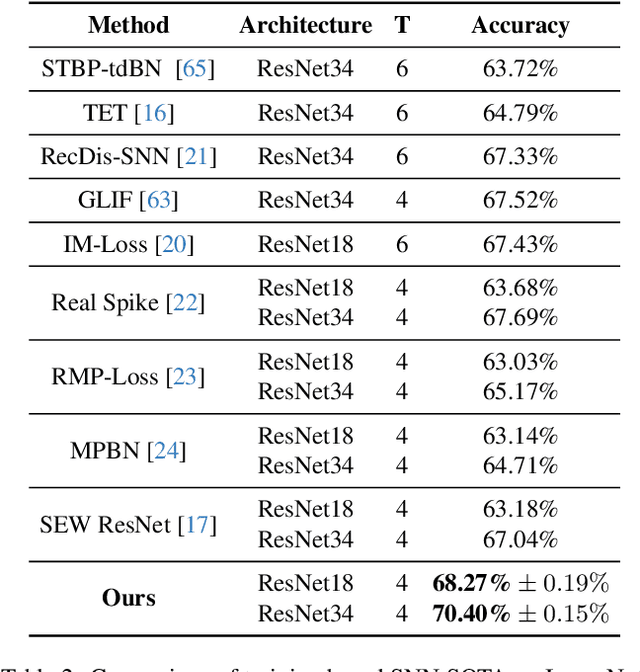
Spiking Neural Networks (SNNs) have gained significant attention due to their biological plausibility and energy efficiency, making them promising alternatives to Artificial Neural Networks (ANNs). However, the performance gap between SNNs and ANNs remains a substantial challenge hindering the widespread adoption of SNNs. In this paper, we propose a Spatial-Temporal Attention Aggregator SNN (STAA-SNN) framework, which dynamically focuses on and captures both spatial and temporal dependencies. First, we introduce a spike-driven self-attention mechanism specifically designed for SNNs. Additionally, we pioneeringly incorporate position encoding to integrate latent temporal relationships into the incoming features. For spatial-temporal information aggregation, we employ step attention to selectively amplify relevant features at different steps. Finally, we implement a time-step random dropout strategy to avoid local optima. As a result, STAA-SNN effectively captures both spatial and temporal dependencies, enabling the model to analyze complex patterns and make accurate predictions. The framework demonstrates exceptional performance across diverse datasets and exhibits strong generalization capabilities. Notably, STAA-SNN achieves state-of-the-art results on neuromorphic datasets CIFAR10-DVS, with remarkable performances of 97.14%, 82.05% and 70.40% on the static datasets CIFAR-10, CIFAR-100 and ImageNet, respectively. Furthermore, our model exhibits improved performance ranging from 0.33\% to 2.80\% with fewer time steps. The code for the model is available on GitHub.
Temporal Separation with Entropy Regularization for Knowledge Distillation in Spiking Neural Networks
Mar 05, 2025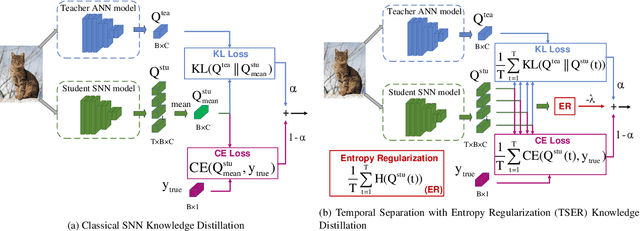
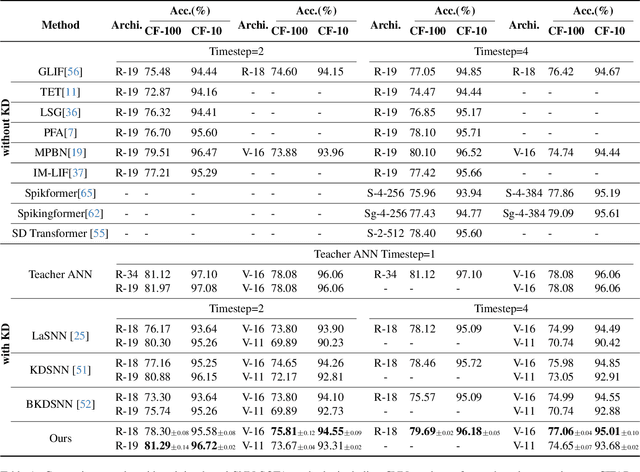
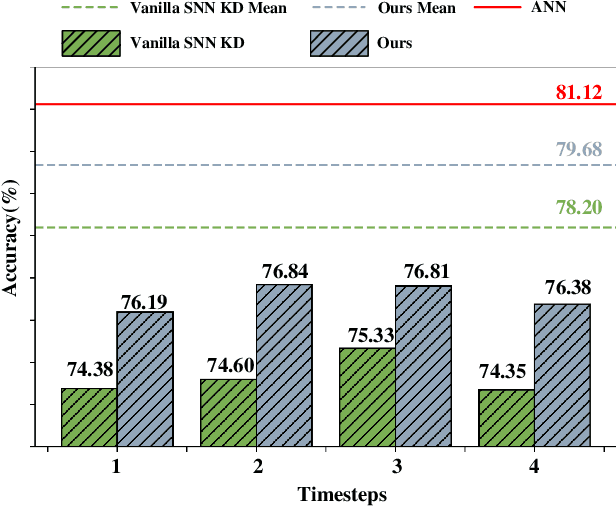
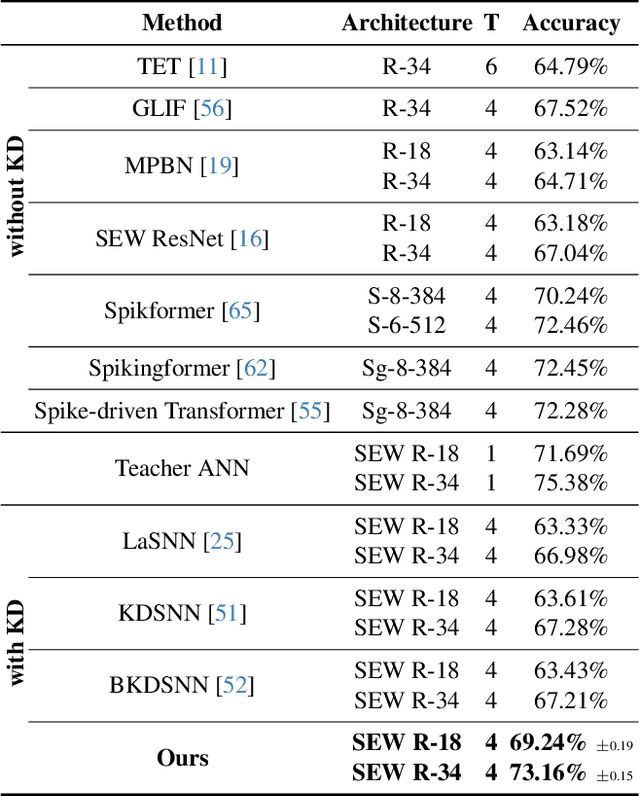
Spiking Neural Networks (SNNs), inspired by the human brain, offer significant computational efficiency through discrete spike-based information transfer. Despite their potential to reduce inference energy consumption, a performance gap persists between SNNs and Artificial Neural Networks (ANNs), primarily due to current training methods and inherent model limitations. While recent research has aimed to enhance SNN learning by employing knowledge distillation (KD) from ANN teacher networks, traditional distillation techniques often overlook the distinctive spatiotemporal properties of SNNs, thus failing to fully leverage their advantages. To overcome these challenge, we propose a novel logit distillation method characterized by temporal separation and entropy regularization. This approach improves existing SNN distillation techniques by performing distillation learning on logits across different time steps, rather than merely on aggregated output features. Furthermore, the integration of entropy regularization stabilizes model optimization and further boosts the performance. Extensive experimental results indicate that our method surpasses prior SNN distillation strategies, whether based on logit distillation, feature distillation, or a combination of both. The code will be available on GitHub.
Factor Graph-based Interpretable Neural Networks
Feb 20, 2025Comprehensible neural network explanations are foundations for a better understanding of decisions, especially when the input data are infused with malicious perturbations. Existing solutions generally mitigate the impact of perturbations through adversarial training, yet they fail to generate comprehensible explanations under unknown perturbations. To address this challenge, we propose AGAIN, a fActor GrAph-based Interpretable neural Network, which is capable of generating comprehensible explanations under unknown perturbations. Instead of retraining like previous solutions, the proposed AGAIN directly integrates logical rules by which logical errors in explanations are identified and rectified during inference. Specifically, we construct the factor graph to express logical rules between explanations and categories. By treating logical rules as exogenous knowledge, AGAIN can identify incomprehensible explanations that violate real-world logic. Furthermore, we propose an interactive intervention switch strategy rectifying explanations based on the logical guidance from the factor graph without learning perturbations, which overcomes the inherent limitation of adversarial training-based methods in defending only against known perturbations. Additionally, we theoretically demonstrate the effectiveness of employing factor graph by proving that the comprehensibility of explanations is strongly correlated with factor graph. Extensive experiments are conducted on three datasets and experimental results illustrate the superior performance of AGAIN compared to state-of-the-art baselines.
MapNav: A Novel Memory Representation via Annotated Semantic Maps for VLM-based Vision-and-Language Navigation
Feb 19, 2025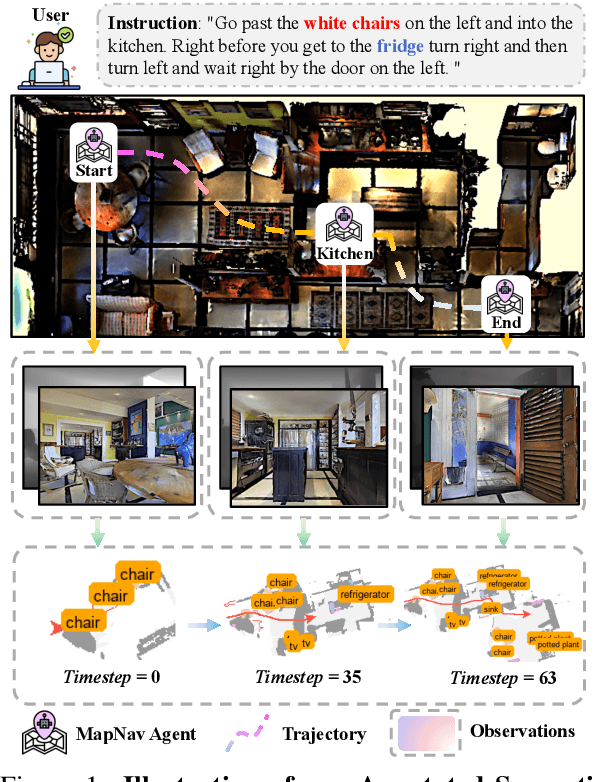
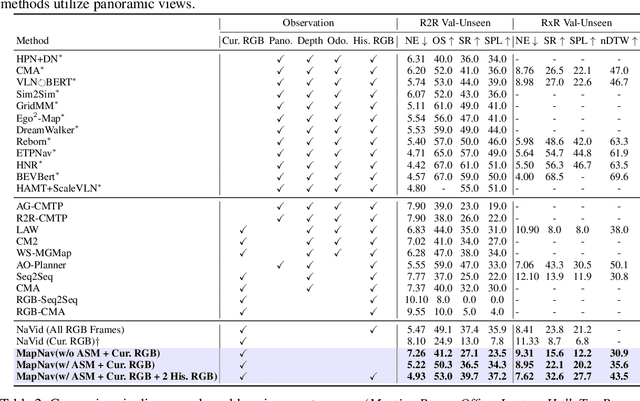
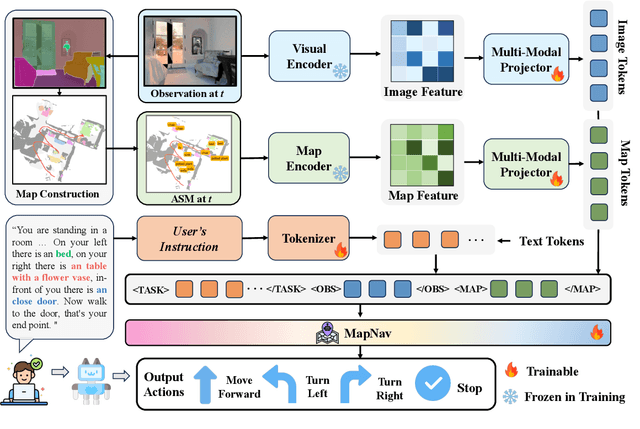

Vision-and-language navigation (VLN) is a key task in Embodied AI, requiring agents to navigate diverse and unseen environments while following natural language instructions. Traditional approaches rely heavily on historical observations as spatio-temporal contexts for decision making, leading to significant storage and computational overhead. In this paper, we introduce MapNav, a novel end-to-end VLN model that leverages Annotated Semantic Map (ASM) to replace historical frames. Specifically, our approach constructs a top-down semantic map at the start of each episode and update it at each timestep, allowing for precise object mapping and structured navigation information. Then, we enhance this map with explicit textual labels for key regions, transforming abstract semantics into clear navigation cues and generate our ASM. MapNav agent using the constructed ASM as input, and use the powerful end-to-end capabilities of VLM to empower VLN. Extensive experiments demonstrate that MapNav achieves state-of-the-art (SOTA) performance in both simulated and real-world environments, validating the effectiveness of our method. Moreover, we will release our ASM generation source code and dataset to ensure reproducibility, contributing valuable resources to the field. We believe that our proposed MapNav can be used as a new memory representation method in VLN, paving the way for future research in this field.
UniMatch: Universal Matching from Atom to Task for Few-Shot Drug Discovery
Feb 18, 2025Drug discovery is crucial for identifying candidate drugs for various diseases.However, its low success rate often results in a scarcity of annotations, posing a few-shot learning problem. Existing methods primarily focus on single-scale features, overlooking the hierarchical molecular structures that determine different molecular properties. To address these issues, we introduce Universal Matching Networks (UniMatch), a dual matching framework that integrates explicit hierarchical molecular matching with implicit task-level matching via meta-learning, bridging multi-level molecular representations and task-level generalization. Specifically, our approach explicitly captures structural features across multiple levels, such as atoms, substructures, and molecules, via hierarchical pooling and matching, facilitating precise molecular representation and comparison. Additionally, we employ a meta-learning strategy for implicit task-level matching, allowing the model to capture shared patterns across tasks and quickly adapt to new ones. This unified matching framework ensures effective molecular alignment while leveraging shared meta-knowledge for fast adaptation. Our experimental results demonstrate that UniMatch outperforms state-of-the-art methods on the MoleculeNet and FS-Mol benchmarks, achieving improvements of 2.87% in AUROC and 6.52% in delta AUPRC. UniMatch also shows excellent generalization ability on the Meta-MolNet benchmark.
Playmate: Flexible Control of Portrait Animation via 3D-Implicit Space Guided Diffusion
Feb 11, 2025Recent diffusion-based talking face generation models have demonstrated impressive potential in synthesizing videos that accurately match a speech audio clip with a given reference identity. However, existing approaches still encounter significant challenges due to uncontrollable factors, such as inaccurate lip-sync, inappropriate head posture and the lack of fine-grained control over facial expressions. In order to introduce more face-guided conditions beyond speech audio clips, a novel two-stage training framework Playmate is proposed to generate more lifelike facial expressions and talking faces. In the first stage, we introduce a decoupled implicit 3D representation along with a meticulously designed motion-decoupled module to facilitate more accurate attribute disentanglement and generate expressive talking videos directly from audio cues. Then, in the second stage, we introduce an emotion-control module to encode emotion control information into the latent space, enabling fine-grained control over emotions and thereby achieving the ability to generate talking videos with desired emotion. Extensive experiments demonstrate that Playmate outperforms existing state-of-the-art methods in terms of video quality and lip-synchronization, and improves flexibility in controlling emotion and head pose. The code will be available at https://playmate111.github.io.
BRIDLE: Generalized Self-supervised Learning with Quantization
Feb 04, 2025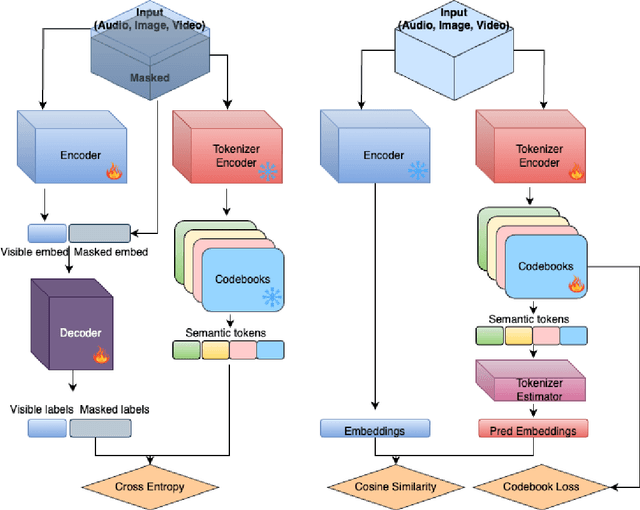


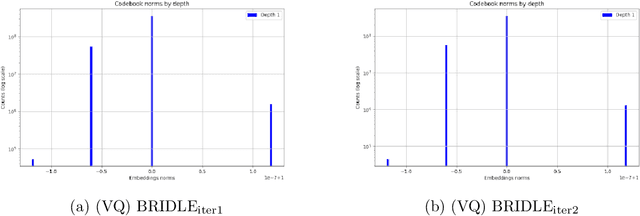
Self-supervised learning has been a powerful approach for learning meaningful representations from unlabeled data across various domains, reducing the reliance on large labeled datasets. Inspired by BERT's success in capturing deep bidirectional contexts in natural language processing, similar frameworks have been adapted to other modalities such as audio, with models like BEATs extending the bidirectional training paradigm to audio signals using vector quantization (VQ). However, these frameworks face challenges, notably their dependence on a single codebook for quantization, which may not capture the complex, multifaceted nature of signals. In addition, inefficiencies in codebook utilization lead to underutilized code vectors. To address these limitations, we introduce BRIDLE (Bidirectional Residual Quantization Interleaved Discrete Learning Encoder), a self-supervised encoder pretraining framework that incorporates residual quantization (RQ) into the bidirectional training process, and is generalized for pretraining with audio, image, and video. Using multiple hierarchical codebooks, RQ enables fine-grained discretization in the latent space, enhancing representation quality. BRIDLE involves an interleaved training procedure between the encoder and tokenizer. We evaluate BRIDLE on audio understanding tasks using classification benchmarks, achieving state-of-the-art results, and demonstrate competitive performance on image classification and video classification tasks, showing consistent improvements over traditional VQ methods in downstream performance.