 Add to Chrome
 Add to Firefox
 Add to Edge
High-Fidelity and Long-Duration Human Image Animation with Diffusion Transformer
Dec 26, 2025
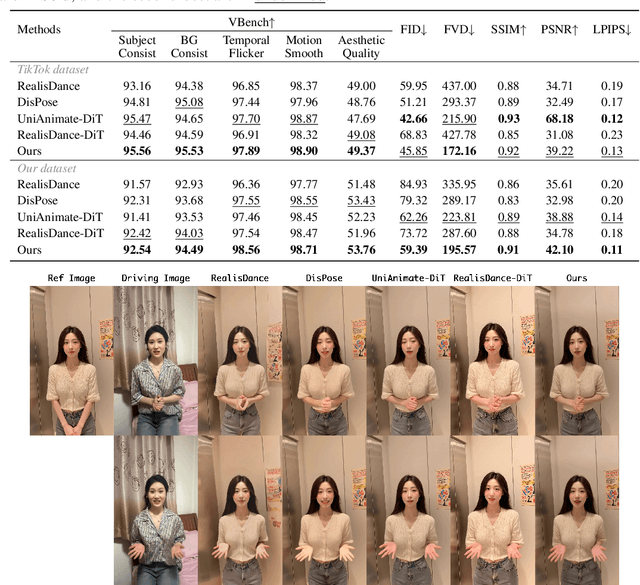
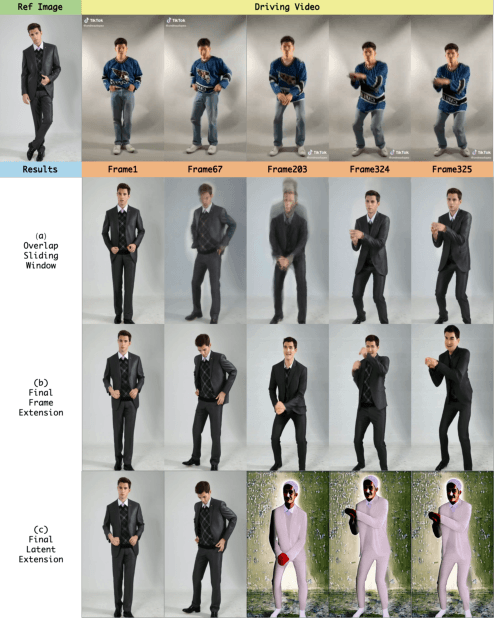
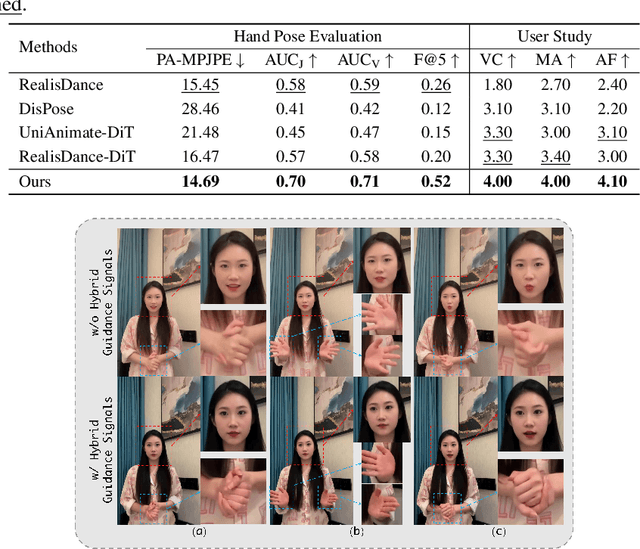
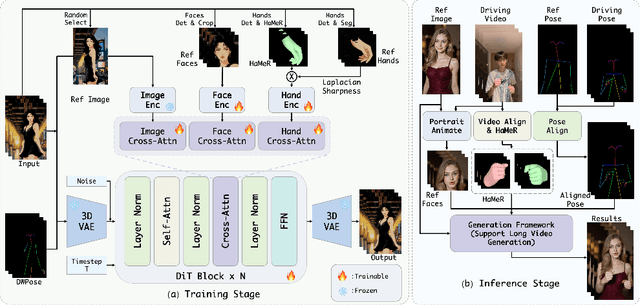
Recent progress in diffusion models has significantly advanced the field of human image animation. While existing methods can generate temporally consistent results for short or regular motions, significant challenges remain, particularly in generating long-duration videos. Furthermore, the synthesis of fine-grained facial and hand details remains under-explored, limiting the applicability of current approaches in real-world, high-quality applications. To address these limitations, we propose a diffusion transformer (DiT)-based framework which focuses on generating high-fidelity and long-duration human animation videos. First, we design a set of hybrid implicit guidance signals and a sharpness guidance factor, enabling our framework to additionally incorporate detailed facial and hand features as guidance. Next, we incorporate the time-aware position shift fusion module, modify the input format within the DiT backbone, and refer to this mechanism as the Position Shift Adaptive Module, which enables video generation of arbitrary length. Finally, we introduce a novel data augmentation strategy and a skeleton alignment model to reduce the impact of human shape variations across different identities. Experimental results demonstrate that our method outperforms existing state-of-the-art approaches, achieving superior performance in both high-fidelity and long-duration human image animation.

Playmate: Flexible Control of Portrait Animation via 3D-Implicit Space Guided Diffusion
Feb 11, 2025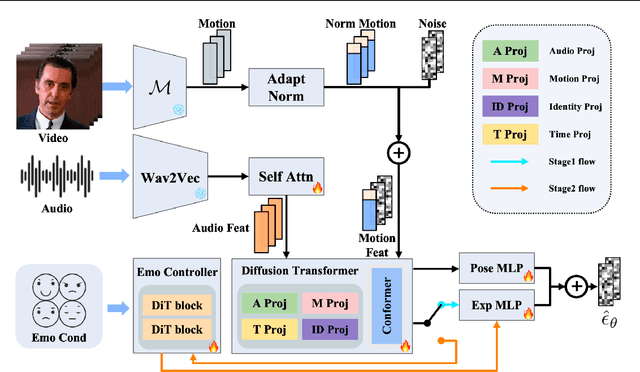
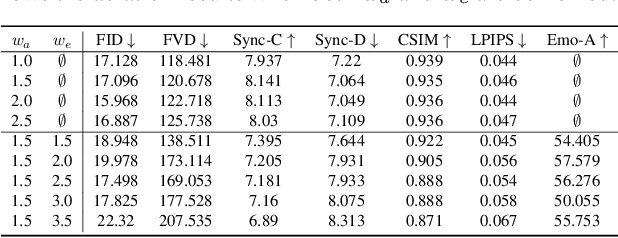
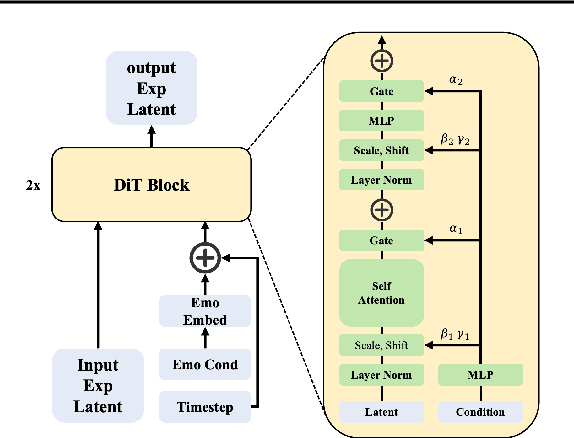
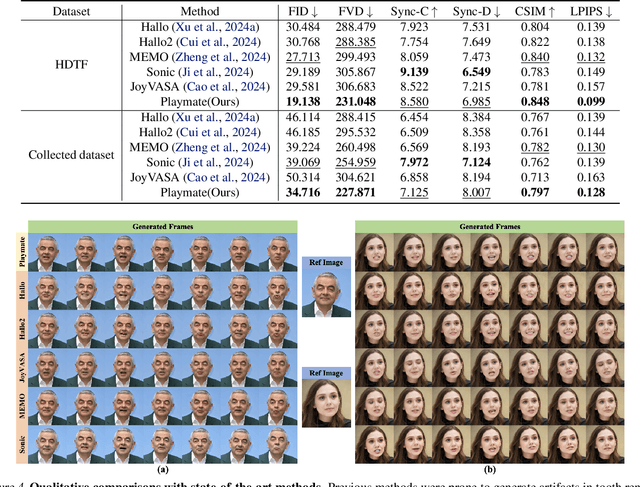
Recent diffusion-based talking face generation models have demonstrated impressive potential in synthesizing videos that accurately match a speech audio clip with a given reference identity. However, existing approaches still encounter significant challenges due to uncontrollable factors, such as inaccurate lip-sync, inappropriate head posture and the lack of fine-grained control over facial expressions. In order to introduce more face-guided conditions beyond speech audio clips, a novel two-stage training framework Playmate is proposed to generate more lifelike facial expressions and talking faces. In the first stage, we introduce a decoupled implicit 3D representation along with a meticulously designed motion-decoupled module to facilitate more accurate attribute disentanglement and generate expressive talking videos directly from audio cues. Then, in the second stage, we introduce an emotion-control module to encode emotion control information into the latent space, enabling fine-grained control over emotions and thereby achieving the ability to generate talking videos with desired emotion. Extensive experiments demonstrate that Playmate outperforms existing state-of-the-art methods in terms of video quality and lip-synchronization, and improves flexibility in controlling emotion and head pose. The code will be available at https://playmate111.github.io.
Learning Visual Planning Models from Partially Observed Images
Nov 25, 2022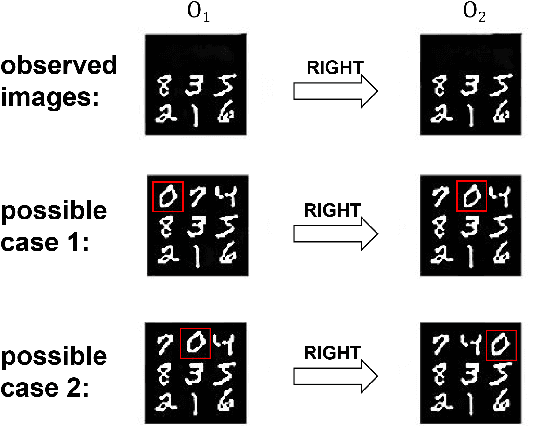
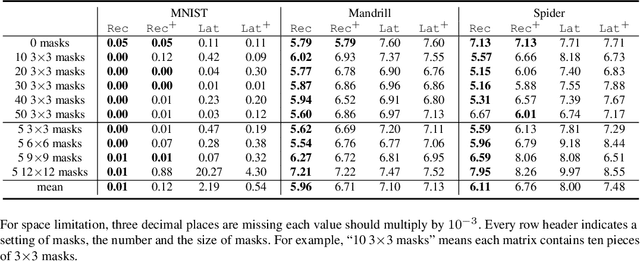
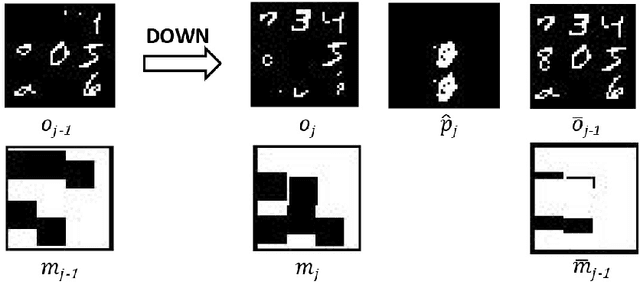
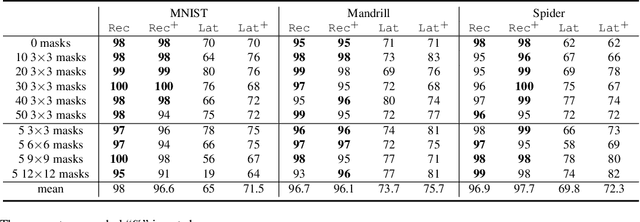
There has been increasing attention on planning model learning in classical planning. Most existing approaches, however, focus on learning planning models from structured data in symbolic representations. It is often difficult to obtain such structured data in real-world scenarios. Although a number of approaches have been developed for learning planning models from fully observed unstructured data (e.g., images), in many scenarios raw observations are often incomplete. In this paper, we provide a novel framework, \aType{Recplan}, for learning a transition model from partially observed raw image traces. More specifically, by considering the preceding and subsequent images in a trace, we learn the latent state representations of raw observations and then build a transition model based on such representations. Additionally, we propose a neural-network-based approach to learn a heuristic model that estimates the distance toward a given goal observation. Based on the learned transition model and heuristic model, we implement a classical planner for images. We exhibit empirically that our approach is more effective than a state-of-the-art approach of learning visual planning models in the environment with incomplete observations.