 Add to Chrome
 Add to Firefox
 Add to Edge
READ More than What You See: Reinforcement Learning for Accurate and Coherent Audio Description Generations
Jun 22, 2026
Audio Description aims to generate concise narrations of essential visual content in audio-visual media for blind and low-vision audiences. Existing methods either rely on prompting off-the-shelf multimodal models, which often mismatch AD style, or partially optimize training-based systems with next-token prediction, which under-explores model capacity and biases generation toward generic expressions. We present READ, the first reinforcement-learning (RL) framework for training-based AD generation. READ formulates AD as sequence-level optimization with reference-matching, length, and format rewards, and further introduces a dedicated coherence reward under context-aware supervision to promote narratively coherent descriptions. Experiments on MAD-Eval, CMD-AD, and TV-AD show that READ substantially outperforms prior methods across diverse evaluation metrics. Our results highlight RL as a promising paradigm for accurate and coherent AD generation. Our codes, models, and benchmark results will be publicly available.

Machine Learning Modeling for Real-Time Melt Pool Monitoring in Laser Powder Bed Fusion Additive Manufacturing: A Hybrid Approach
Jun 22, 2026This work investigates the implementation of artificial intelligence and machine learning (AI/ML) for real-time monitoring in laser powder bed fusion (LPBF) additive manufacturing. We developed a binary image classification framework for distinguishing normal and abnormal melt pool images using a balanced dataset of 1,200 images collected from Nickel superalloy 625 on the NIST AMMT platform. The study evaluates accuracy and inference time based on control requirements and hardware limitations of open-architecture LPBF machines. We benchmark three transfer learning architectures (ResNet50, EfficientNetB0, and MobileNetV2) against two Random Forest approaches: one trained on EfficientNetB0 feature embeddings (hybrid) and one trained on raw pixel features (baseline). Images are stratified into 80/20 train-test splits, with a further 90/10 validation split on the training set, and undergo standardized resizing, normalization, and label-preserving data augmentation to emulate realistic process variability. Each model is evaluated using accuracy, precision, recall, F1 score, and area under the receiver operating characteristic curve (AUC), along with training time, inference latency, and CPU & GPU usage to capture deployability constraints relevant to factory-floor monitoring. The hybrid EfficientNetB0-plus-Random Forest approach achieves the best performance on the held-out test set, with an F1 score of 0.9451, accuracy of 0.9458, and AUC of 0.9904, while maintaining sub-millisecond per-image inference (1.15 ms). In contrast, purely deep learning models exhibit significantly higher inference times with lower accuracy. These results demonstrate that combining pre-trained convolutional features with classical ensemble methods provides a robust, computationally efficient route to real-time melt pool anomaly detection in data-limited additive manufacturing environments.
Predictive Repair Management Using a Multi-Head Attention Transformer and Online Learning
Jun 19, 2026Accurate prediction of repair duration is an important challenge in product maintenance due to its implications for resource allocation, customer satisfaction, and operational performance. This study aims to develop a deep learning framework to help fleet repair shops accurately categorize repair time given product historical data. The study uses an automobile repair and maintenance dataset and creates an end-to-end predictive framework by employing a multi-head attention network designed for tabular data. The developed framework combines categorical information, transformed through embeddings and attention mechanisms, with numerical historical data to facilitate integration and learning from diverse data features. A weighted loss function is introduced to overcome class imbalance issues in large datasets. Moreover, an online learning strategy is used for continuous incremental model updates to maintain predictive accuracy in evolving operational environments. Our empirical findings demonstrate that the multi-head attention mechanism extracts meaningful interactions between vehicle identifiers and repair types compared to a feed-forward neural network and a random forest model. Also, combining historical maintenance data with an online learning strategy facilitates real-time adjustments to changing patterns and increases the model's predictive performance on new data. The model is tested on real-world repair data spanning 2013 to 2020 and achieves an accuracy of 78%, with attention weight analyses illustrating feature interactions.
Employing General-Purpose and Biomedical Large Language Models with Advanced Prompt Engineering for Pharmacoepidemiologic Study Design
Apr 20, 2026Background: The potential of large language models (LLMs) to automate and support pharmacoepidemiologic study design is an emerging area of interest, yet their reliability remains insufficiently characterized. General-purpose LLMs often display inaccuracies, while the comparative performance of specialized biomedical LLMs in this domain remains unknown. Methods: This study evaluated general-purpose LLMs (GPT-4o and DeepSeek-R1) versus biomedically fine-tuned LLMs (QuantFactory/Bio-Medical-Llama-3-8B-GGUF and Irathernotsay/qwen2-1.5B-medical_qa-Finetune) using 46 protocols (2018-2024) from the HMA-EMA Catalogue and Sentinel System. Performance was assessed across relevance, logic of justification, and ontology-code agreement across multiple coding systems using Least-to-Most (LTM) and Active Prompting strategies. Results: GPT-4o and DeepSeek-R1 paired with LTM prompting achieved the highest relevance and logic of justification scores, with GPT-4o-LTM reaching a median relevance score of 4 in 8 of 9 questions for HMA-EMA protocols. Biomedical LLMs showed lower relevance overall and frequently generated insufficient justification. All LLMs demonstrated limited proficiency in ontology-code mapping, although LTM provided the most consistent improvements in reasoning stability. Conclusion: Off-the-shelf general-purpose LLMs currently offer superior support for pharmacoepidemiologic design compared to biomedical LLMs. Prompt strategy strongly influenced LLM performance.
Precise Robot Command Understanding Using Grammar-Constrained Large Language Models
Apr 05, 2026Human-robot collaboration in industrial settings requires precise and reliable communication to enhance operational efficiency. While Large Language Models (LLMs) understand general language, they often lack the domain-specific rigidity needed for safe and executable industrial commands. To address this gap, this paper introduces a novel grammar-constrained LLM that integrates a grammar-driven Natural Language Understanding (NLU) system with a fine-tuned LLM, which enables both conversational flexibility and the deterministic precision required in robotics. Our method employs a two-stage process. First, a fine-tuned LLM performs high-level contextual reasoning and parameter inference on natural language inputs. Second, a Structured Language Model (SLM) and a grammar-based canonicalizer constrain the LLM's output, forcing it into a standardized symbolic format composed of valid action frames and command elements. This process guarantees that generated commands are valid and structured in a robot-readable JSON format. A key feature of the proposed model is a validation and feedback loop. A grammar parser validates the output against a predefined list of executable robotic actions. If a command is invalid, the system automatically generates corrective prompts and re-engages the LLM. This iterative self-correction mechanism allows the model to recover from initial interpretation errors to improve system robustness. We evaluate our grammar-constrained hybrid model against two baselines: a fine-tuned API-based LLM and a standalone grammar-driven NLU model. Using the Human Robot Interaction Corpus (HuRIC) dataset, we demonstrate that the hybrid approach achieves superior command validity, which promotes safer and more effective industrial human-robot collaboration.
Evaluating Large and Lightweight Vision Models for Irregular Component Segmentation in E-Waste Disassembly
Mar 28, 2026Precise segmentation of irregular and densely arranged components is essential for robotic disassembly and material recovery in electronic waste (e-waste) recycling. This study evaluates the impact of model architecture and scale on segmentation performance by comparing SAM2, a transformer-based vision model, with the lightweight YOLOv8 network. Both models were trained and tested on a newly collected dataset of 1,456 annotated RGB images of laptop components including logic boards, heat sinks, and fans, captured under varying illumination and orientation conditions. Data augmentation techniques, such as random rotation, flipping, and cropping, were applied to improve model robustness. YOLOv8 achieved higher segmentation accuracy (mAP50 = 98.8%, mAP50-95 = 85%) and stronger boundary precision than SAM2 (mAP50 = 8.4%). SAM2 demonstrated flexibility in representing diverse object structures but often produced overlapping masks and inconsistent contours. These findings show that large pre-trained models require task-specific optimization for industrial applications. The resulting dataset and benchmarking framework provide a foundation for developing scalable vision algorithms for robotic e-waste disassembly and circular manufacturing systems.
SAMA: Factorized Semantic Anchoring and Motion Alignment for Instruction-Guided Video Editing
Mar 19, 2026Current instruction-guided video editing models struggle to simultaneously balance precise semantic modifications with faithful motion preservation. While existing approaches rely on injecting explicit external priors (e.g., VLM features or structural conditions) to mitigate these issues, this reliance severely bottlenecks model robustness and generalization. To overcome this limitation, we present SAMA (factorized Semantic Anchoring and Motion Alignment), a framework that factorizes video editing into semantic anchoring and motion modeling. First, we introduce Semantic Anchoring, which establishes a reliable visual anchor by jointly predicting semantic tokens and video latents at sparse anchor frames, enabling purely instruction-aware structural planning. Second, Motion Alignment pre-trains the same backbone on motion-centric video restoration pretext tasks (cube inpainting, speed perturbation, and tube shuffle), enabling the model to internalize temporal dynamics directly from raw videos. SAMA is optimized with a two-stage pipeline: a factorized pre-training stage that learns inherent semantic-motion representations without paired video-instruction editing data, followed by supervised fine-tuning on paired editing data. Remarkably, the factorized pre-training alone already yields strong zero-shot video editing ability, validating the proposed factorization. SAMA achieves state-of-the-art performance among open-source models and is competitive with leading commercial systems (e.g., Kling-Omni). Code, models, and datasets will be released.
MapNav: A Novel Memory Representation via Annotated Semantic Maps for VLM-based Vision-and-Language Navigation
Feb 19, 2025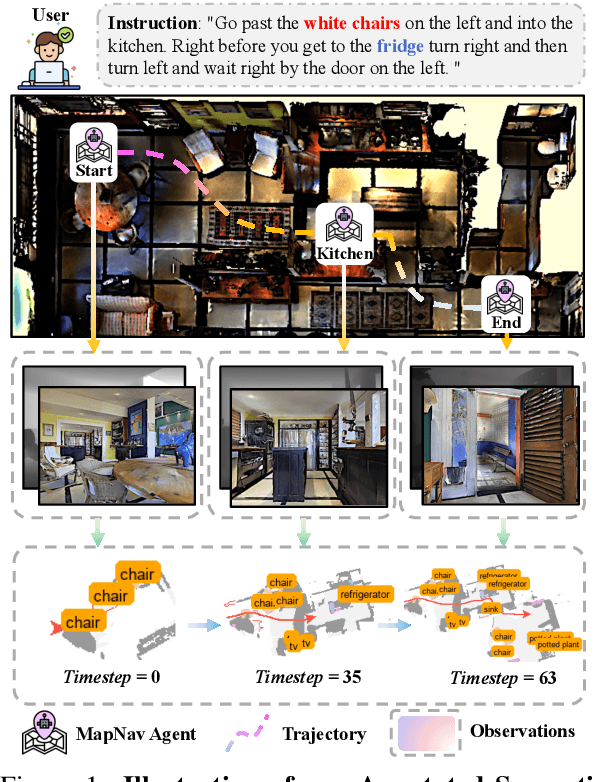
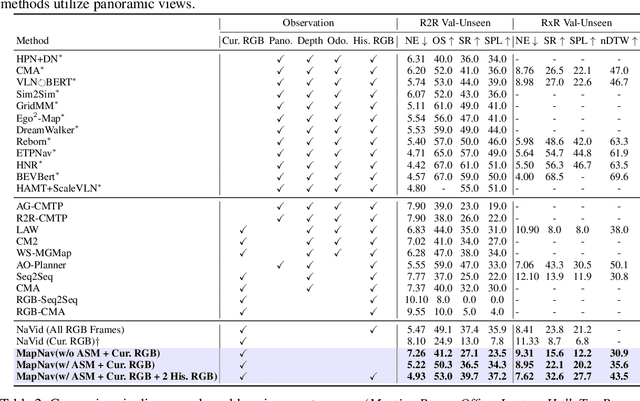
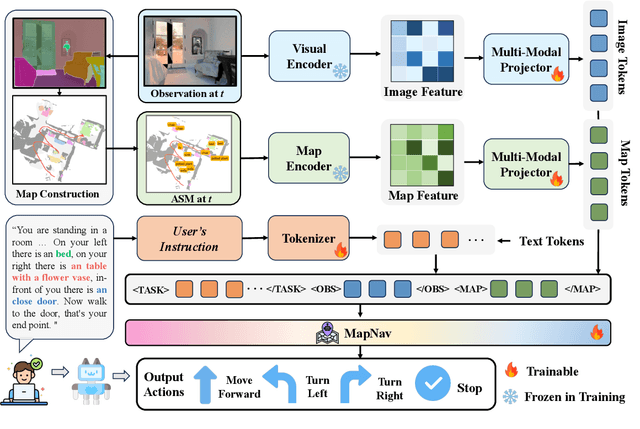

Vision-and-language navigation (VLN) is a key task in Embodied AI, requiring agents to navigate diverse and unseen environments while following natural language instructions. Traditional approaches rely heavily on historical observations as spatio-temporal contexts for decision making, leading to significant storage and computational overhead. In this paper, we introduce MapNav, a novel end-to-end VLN model that leverages Annotated Semantic Map (ASM) to replace historical frames. Specifically, our approach constructs a top-down semantic map at the start of each episode and update it at each timestep, allowing for precise object mapping and structured navigation information. Then, we enhance this map with explicit textual labels for key regions, transforming abstract semantics into clear navigation cues and generate our ASM. MapNav agent using the constructed ASM as input, and use the powerful end-to-end capabilities of VLM to empower VLN. Extensive experiments demonstrate that MapNav achieves state-of-the-art (SOTA) performance in both simulated and real-world environments, validating the effectiveness of our method. Moreover, we will release our ASM generation source code and dataset to ensure reproducibility, contributing valuable resources to the field. We believe that our proposed MapNav can be used as a new memory representation method in VLN, paving the way for future research in this field.
Multi-Floor Zero-Shot Object Navigation Policy
Sep 17, 2024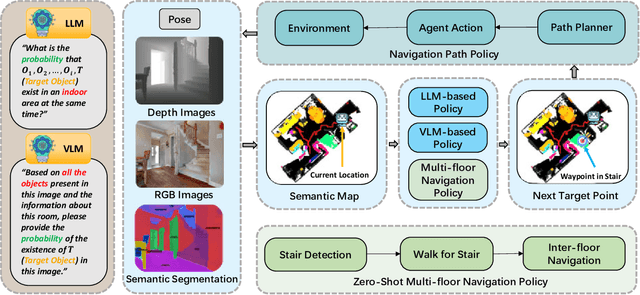



Object navigation in multi-floor environments presents a formidable challenge in robotics, requiring sophisticated spatial reasoning and adaptive exploration strategies. Traditional approaches have primarily focused on single-floor scenarios, overlooking the complexities introduced by multi-floor structures. To address these challenges, we first propose a Multi-floor Navigation Policy (MFNP) and implement it in Zero-Shot object navigation tasks. Our framework comprises three key components: (i) Multi-floor Navigation Policy, which enables an agent to explore across multiple floors; (ii) Multi-modal Large Language Models (MLLMs) for reasoning in the navigation process; and (iii) Inter-Floor Navigation, ensuring efficient floor transitions. We evaluate MFNP on the Habitat-Matterport 3D (HM3D) and Matterport 3D (MP3D) datasets, both include multi-floor scenes. Our experiment results demonstrate that MFNP significantly outperforms all the existing methods in Zero-Shot object navigation, achieving higher success rates and improved exploration efficiency. Ablation studies further highlight the effectiveness of each component in addressing the unique challenges of multi-floor navigation. Meanwhile, we conducted real-world experiments to evaluate the feasibility of our policy. Upon deployment of MFNP, the Unitree quadruped robot demonstrated successful multi-floor navigation and found the target object in a completely unseen environment. By introducing MFNP, we offer a new paradigm for tackling complex, multi-floor environments in object navigation tasks, opening avenues for future research in visual-based navigation in realistic, multi-floor settings.
RoboGPT: an intelligent agent of making embodied long-term decisions for daily instruction tasks
Nov 27, 2023Robotic agents must master common sense and long-term sequential decisions to solve daily tasks through natural language instruction. The developments in Large Language Models (LLMs) in natural language processing have inspired efforts to use LLMs in complex robot planning. Despite LLMs' great generalization and comprehension of instruction tasks, LLMs-generated task plans sometimes lack feasibility and correctness. To address the problem, we propose a RoboGPT agent\footnote{our code and dataset will be released soon} for making embodied long-term decisions for daily tasks, with two modules: 1) LLMs-based planning with re-plan to break the task into multiple sub-goals; 2) RoboSkill individually designed for sub-goals to learn better navigation and manipulation skills. The LLMs-based planning is enhanced with a new robotic dataset and re-plan, called RoboGPT. The new robotic dataset of 67k daily instruction tasks is gathered for fine-tuning the Llama model and obtaining RoboGPT. RoboGPT planner with strong generalization can plan hundreds of daily instruction tasks. Additionally, a low-computational Re-Plan module is designed to allow plans to flexibly adapt to the environment, thereby addressing the nomenclature diversity challenge. The proposed RoboGPT agent outperforms SOTA methods on the ALFRED daily tasks. Moreover, RoboGPT planner exceeds SOTA LLM-based planners like ChatGPT in task-planning rationality for hundreds of unseen daily tasks, and even other domain tasks, while keeping the large model's original broad application and generality.