 Add to Chrome
 Add to Firefox
 Add to Edge
ALIEN: Analytic Latent Watermarking for Controllable Generation
Feb 05, 2026
Watermarking is a technical alternative to safeguarding intellectual property and reducing misuse. Existing methods focus on optimizing watermarked latent variables to balance watermark robustness and fidelity, as Latent diffusion models (LDMs) are considered a powerful tool for generative tasks. However, reliance on computationally intensive heuristic optimization for iterative signal refinement results in high training overhead and local optima entrapment.To address these issues, we propose an \underline{A}na\underline{l}ytical Watermark\underline{i}ng Framework for Controllabl\underline{e} Generatio\underline{n} (ALIEN). We develop the first analytical derivation of the time-dependent modulation coefficient that guides the diffusion of watermark residuals to achieve controllable watermark embedding pattern.Experimental results show that ALIEN-Q outperforms the state-of-the-art by 33.1\% across 5 quality metrics, and ALIEN-R demonstrates 14.0\% improved robustness against generative variant and stability threats compared to the state-of-the-art across 15 distinct conditions. Code can be available at https://anonymous.4open.science/r/ALIEN/.

ProxyWar: Dynamic Assessment of LLM Code Generation in Game Arenas
Feb 04, 2026Large language models (LLMs) have revolutionized automated code generation, yet the evaluation of their real-world effectiveness remains limited by static benchmarks and simplistic metrics. We present ProxyWar, a novel framework that systematically assesses code generation quality by embedding LLM-generated agents within diverse, competitive game environments. Unlike existing approaches, ProxyWar evaluates not only functional correctness but also the operational characteristics of generated programs, combining automated testing, iterative code repair, and multi-agent tournaments to provide a holistic view of program behavior. Applied to a range of state-of-the-art coders and games, our approach uncovers notable discrepancies between benchmark scores and actual performance in dynamic settings, revealing overlooked limitations and opportunities for improvement. These findings highlight the need for richer, competition-based evaluation of code generation. Looking forward, ProxyWar lays a foundation for research into LLM-driven algorithm discovery, adaptive problem solving, and the study of practical efficiency and robustness, including the potential for models to outperform hand-crafted agents. The project is available at https://github.com/xinke-wang/ProxyWar.
SpatialNav: Leveraging Spatial Scene Graphs for Zero-Shot Vision-and-Language Navigation
Jan 11, 2026Although learning-based vision-and-language navigation (VLN) agents can learn spatial knowledge implicitly from large-scale training data, zero-shot VLN agents lack this process, relying primarily on local observations for navigation, which leads to inefficient exploration and a significant performance gap. To deal with the problem, we consider a zero-shot VLN setting that agents are allowed to fully explore the environment before task execution. Then, we construct the Spatial Scene Graph (SSG) to explicitly capture global spatial structure and semantics in the explored environment. Based on the SSG, we introduce SpatialNav, a zero-shot VLN agent that integrates an agent-centric spatial map, a compass-aligned visual representation, and a remote object localization strategy for efficient navigation. Comprehensive experiments in both discrete and continuous environments demonstrate that SpatialNav significantly outperforms existing zero-shot agents and clearly narrows the gap with state-of-the-art learning-based methods. Such results highlight the importance of global spatial representations for generalizable navigation.
A Scheduling Framework for Efficient MoE Inference on Edge GPU-NDP Systems
Jan 07, 2026Mixture-of-Experts (MoE) models facilitate edge deployment by decoupling model capacity from active computation, yet their large memory footprint drives the need for GPU systems with near-data processing (NDP) capabilities that offload experts to dedicated processing units. However, deploying MoE models on such edge-based GPU-NDP systems faces three critical challenges: 1) severe load imbalance across NDP units due to non-uniform expert selection and expert parallelism, 2) insufficient GPU utilization during expert computation within NDP units, and 3) extensive data pre-profiling necessitated by unpredictable expert activation patterns for pre-fetching. To address these challenges, this paper proposes an efficient inference framework featuring three key optimizations. First, the underexplored tensor parallelism in MoE inference is exploited to partition and compute large expert parameters across multiple NDP units simultaneously towards edge low-batch scenarios. Second, a load-balancing-aware scheduling algorithm distributes expert computations across NDP units and GPU to maximize resource utilization. Third, a dataset-free pre-fetching strategy proactively loads frequently accessed experts to minimize activation delays. Experimental results show that our framework enables GPU-NDP systems to achieve 2.41x on average and up to 2.56x speedup in end-to-end latency compared to state-of-the-art approaches, significantly enhancing MoE inference efficiency in resource-constrained environments.
VLN-MME: Diagnosing MLLMs as Language-guided Visual Navigation agents
Dec 31, 2025Multimodal Large Language Models (MLLMs) have demonstrated remarkable capabilities across a wide range of vision-language tasks. However, their performance as embodied agents, which requires multi-round dialogue spatial reasoning and sequential action prediction, needs further exploration. Our work investigates this potential in the context of Vision-and-Language Navigation (VLN) by introducing a unified and extensible evaluation framework to probe MLLMs as zero-shot agents by bridging traditional navigation datasets into a standardized benchmark, named VLN-MME. We simplify the evaluation with a highly modular and accessible design. This flexibility streamlines experiments, enabling structured comparisons and component-level ablations across diverse MLLM architectures, agent designs, and navigation tasks. Crucially, enabled by our framework, we observe that enhancing our baseline agent with Chain-of-Thought (CoT) reasoning and self-reflection leads to an unexpected performance decrease. This suggests MLLMs exhibit poor context awareness in embodied navigation tasks; although they can follow instructions and structure their output, their 3D spatial reasoning fidelity is low. VLN-MME lays the groundwork for systematic evaluation of general-purpose MLLMs in embodied navigation settings and reveals limitations in their sequential decision-making capabilities. We believe these findings offer crucial guidance for MLLM post-training as embodied agents.
Human Motion Estimation with Everyday Wearables
Dec 24, 2025While on-body device-based human motion estimation is crucial for applications such as XR interaction, existing methods often suffer from poor wearability, expensive hardware, and cumbersome calibration, which hinder their adoption in daily life. To address these challenges, we present EveryWear, a lightweight and practical human motion capture approach based entirely on everyday wearables: a smartphone, smartwatch, earbuds, and smart glasses equipped with one forward-facing and two downward-facing cameras, requiring no explicit calibration before use. We introduce Ego-Elec, a 9-hour real-world dataset covering 56 daily activities across 17 diverse indoor and outdoor environments, with ground-truth 3D annotations provided by the motion capture (MoCap), to facilitate robust research and benchmarking in this direction. Our approach employs a multimodal teacher-student framework that integrates visual cues from egocentric cameras with inertial signals from consumer devices. By training directly on real-world data rather than synthetic data, our model effectively eliminates the sim-to-real gap that constrains prior work. Experiments demonstrate that our method outperforms baseline models, validating its effectiveness for practical full-body motion estimation.
XGrid-Mapping: Explicit Implicit Hybrid Grid Submaps for Efficient Incremental Neural LiDAR Mapping
Dec 24, 2025


Large-scale incremental mapping is fundamental to the development of robust and reliable autonomous systems, as it underpins incremental environmental understanding with sequential inputs for navigation and decision-making. LiDAR is widely used for this purpose due to its accuracy and robustness. Recently, neural LiDAR mapping has shown impressive performance; however, most approaches rely on dense implicit representations and underutilize geometric structure, while existing voxel-guided methods struggle to achieve real-time performance. To address these challenges, we propose XGrid-Mapping, a hybrid grid framework that jointly exploits explicit and implicit representations for efficient neural LiDAR mapping. Specifically, the strategy combines a sparse grid, providing geometric priors and structural guidance, with an implicit dense grid that enriches scene representation. By coupling the VDB structure with a submap-based organization, the framework reduces computational load and enables efficient incremental mapping on a large scale. To mitigate discontinuities across submaps, we introduce a distillation-based overlap alignment strategy, in which preceding submaps supervise subsequent ones to ensure consistency in overlapping regions. To further enhance robustness and sampling efficiency, we incorporate a dynamic removal module. Extensive experiments show that our approach delivers superior mapping quality while overcoming the efficiency limitations of voxel-guided methods, thereby outperforming existing state-of-the-art mapping methods.
VLNVerse: A Benchmark for Vision-Language Navigation with Versatile, Embodied, Realistic Simulation and Evaluation
Dec 22, 2025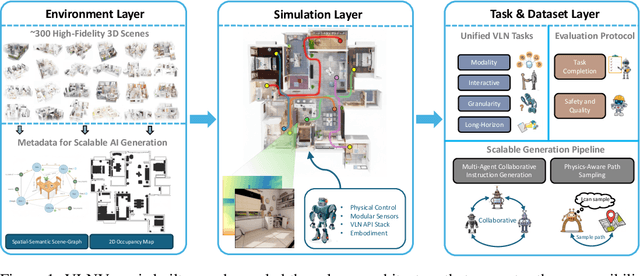
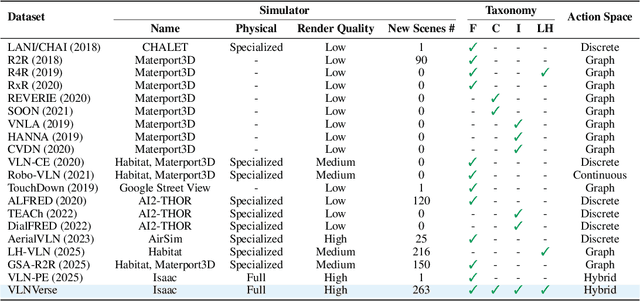
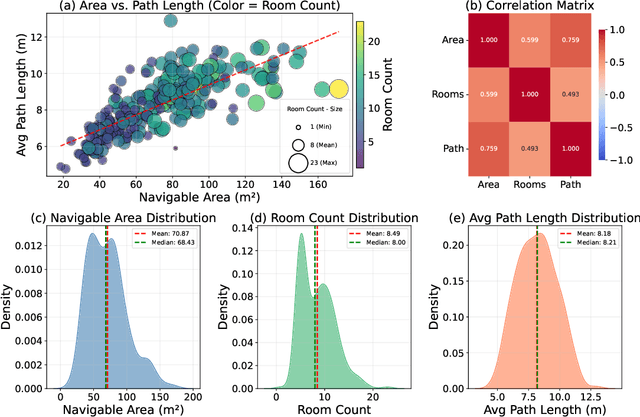
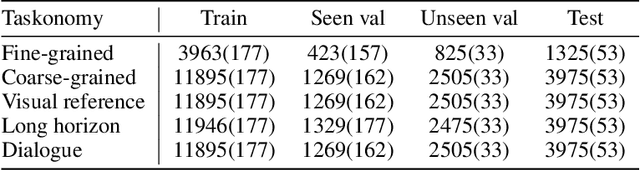
Despite remarkable progress in Vision-Language Navigation (VLN), existing benchmarks remain confined to fixed, small-scale datasets with naive physical simulation. These shortcomings limit the insight that the benchmarks provide into sim-to-real generalization, and create a significant research gap. Furthermore, task fragmentation prevents unified/shared progress in the area, while limited data scales fail to meet the demands of modern LLM-based pretraining. To overcome these limitations, we introduce VLNVerse: a new large-scale, extensible benchmark designed for Versatile, Embodied, Realistic Simulation, and Evaluation. VLNVerse redefines VLN as a scalable, full-stack embodied AI problem. Its Versatile nature unifies previously fragmented tasks into a single framework and provides an extensible toolkit for researchers. Its Embodied design moves beyond intangible and teleporting "ghost" agents that support full-kinematics in a Realistic Simulation powered by a robust physics engine. We leverage the scale and diversity of VLNVerse to conduct a comprehensive Evaluation of existing methods, from classic models to MLLM-based agents. We also propose a novel unified multi-task model capable of addressing all tasks within the benchmark. VLNVerse aims to narrow the gap between simulated navigation and real-world generalization, providing the community with a vital tool to boost research towards scalable, general-purpose embodied locomotion agents.
User-Feedback-Driven Continual Adaptation for Vision-and-Language Navigation
Dec 11, 2025Vision-and-Language Navigation (VLN) requires agents to navigate complex environments by following natural-language instructions. General Scene Adaptation for VLN (GSA-VLN) shifts the focus from zero-shot generalization to continual, environment-specific adaptation, narrowing the gap between static benchmarks and real-world deployment. However, current GSA-VLN frameworks exclude user feedback, relying solely on unsupervised adaptation from repeated environmental exposure. In practice, user feedback offers natural and valuable supervision that can significantly enhance adaptation quality. We introduce a user-feedback-driven adaptation framework that extends GSA-VLN by systematically integrating human interactions into continual learning. Our approach converts user feedback-navigation instructions and corrective signals-into high-quality, environment-aligned training data, enabling efficient and realistic adaptation. A memory-bank warm-start mechanism further reuses previously acquired environmental knowledge, mitigating cold-start degradation and ensuring stable redeployment. Experiments on the GSA-R2R benchmark show that our method consistently surpasses strong baselines such as GR-DUET, improving navigation success and path efficiency. The memory-bank warm start stabilizes early navigation and reduces performance drops after updates. Results under both continual and hybrid adaptation settings confirm the robustness and generality of our framework, demonstrating sustained improvement across diverse deployment conditions.
OmniSparse: Training-Aware Fine-Grained Sparse Attention for Long-Video MLLMs
Nov 18, 2025Existing sparse attention methods primarily target inference-time acceleration by selecting critical tokens under predefined sparsity patterns. However, they often fail to bridge the training-inference gap and lack the capacity for fine-grained token selection across multiple dimensions such as queries, key-values (KV), and heads, leading to suboptimal performance and limited acceleration gains. In this paper, we introduce OmniSparse, a training-aware fine-grained sparse attention framework for long-video MLLMs, which operates in both training and inference with dynamic token budget allocation. Specifically, OmniSparse contains three adaptive and complementary mechanisms: (1) query selection via lazy-active classification, retaining active queries that capture broad semantic similarity while discarding most lazy ones that focus on limited local context and exhibit high functional redundancy; (2) KV selection with head-level dynamic budget allocation, where a shared budget is determined based on the flattest head and applied uniformly across all heads to ensure attention recall; and (3) KV cache slimming to reduce head-level redundancy by selectively fetching visual KV cache according to the head-level decoding query pattern. Experimental results show that OmniSparse matches the performance of full attention while achieving up to 2.7x speedup during prefill and 2.4x memory reduction during decoding.