 Add to Chrome
 Add to Firefox
 Add to Edge
AE-UAV: An Air-to-Air Event-Based UAV Tracking Benchmark and a Real-Time Frequency-Domain Tracker
Jul 16, 2026
Air-to-air (A2A) unmanned aerial vehicle (UAV) tracking is fundamental to airborne remote sensing of low-altitude aerial targets. However, the deployment of continuous, real-time tracking systems on UAVs presents significant challenges. In A2A scenarios, traditional frame-based cameras suffer from severe performance degradation under low illumination, overexposure, and high-speed motion owing to their limited dynamic range and fixed temporal sampling. Although event cameras offer a promising alternative with microsecond temporal resolution and a high dynamic range, current research is bottlenecked by two primary issues: 1) the absence of dedicated A2A event-based datasets, and 2) the heavy reliance of existing trackers on GPU acceleration and extensive training data, rendering them impractical for resource-constrained UAVs. To bridge these gaps, we introduce AE-UAV, an air-to-air event-based UAV tracking benchmark. To the best of our knowledge, this is the first airborne-captured event camera dataset for A2A tracking, comprising 178 flight sequences with continuous-time cubic B-spline annotations. Furthermore, we propose the Fast-Slow Frequency-domain Tracking (FSFT) method. This lightweight, training-free framework seamlessly integrates frequency-domain template matching with search region prediction and detection-based drift correction. Extensive experiments demonstrate that FSFT operates at an ultra-fast 420 frames per second (FPS) on CPU-only hardware. It retains 93.97% of the accuracy of state-of-the-art GPU-dependent methods while delivering a 5.32-fold effective speedup and exhibiting superior temporal resolution generalization, thereby providing a highly efficient and robust solution for airborne remote sensing of aerial targets. The dataset and source code are available at https://github.com/MSP-xEN/AE-UAV.

IMU-HOI: A Symbiotic Framework for Coherent Human-Object Interaction and Motion Capture via Contact-Conscious Inertial Fusion
Jun 26, 2026Capturing full-body human motion with object interactions is crucial for AR/VR and robotics applications, yet it remains challenging for conventional vision-based methods due to occlusions and constrained capture volumes. Inertial measurement units (IMUs) offer a compelling alternative without line-of-sight requirements, but existing IMU-based motion capture assumes an isolated human and ignores object contacts and dynamics. To bridge this gap, we present IMU-HOI, a novel framework that jointly recovers full-body human pose and 6-DoF object trajectory from sparse IMUs on the body and object, explicitly modeling human-object interaction. Our approach first infers probabilistic hand-object contacts directly from IMU streams and uses them as a high-level signal to route between kinematic and inertial reasoning. These contact cues drive a three-stage fusion pipeline that refines human pose and root translation, and fuses hand-based forward kinematics with object-IMU integration for object motion, yielding coherent, drift-resilient trajectories for both human and object. Experiments on challenging human-object interaction scenarios demonstrate substantial accuracy gains over prior inertial motion capture methods. Moreover, IMU-HOI can be plugged into existing sparse-IMU mocap backbones with minimal changes, effectively extending the scope of purely inertial motion capture from isolated humans to full human-object interaction and joint motion estimation.
* 10 pages, 5 figures. Accepted by CVPR 2026
Exploring Bottlenecks in VLM-LLM Navigation: How 3D Scene Understanding Capability Impacts Zero-Shot VLN
May 14, 2026Zero-shot vision-and-language navigation (VLN) has gained significant attention due to its minimal data collection costs and inherent generalization. This paradigm is typically driven by the integration of pre-trained Vision-Language Models (VLMs) and Large Language Models (LLMs), where VLMs construct 3D scene graphs while LLMs handle high-level reasoning and decision-making. However, a critical bottleneck exists in this system: current 3D perception models prioritize pixel-level accuracy, directly conflicting with the strict computational limits and real-time efficiency demanded by embodied navigation. To address this gap, this paper quantifies the actual impact of 3D scene understanding capability on VLN performance. Based on typical VLM-LLM frameworks, we propose statistical success rate (SR) upper bounds for two core subsystems: 1) the slow LLM planner, which relies on topological mapping semantics, and 2) the fast reactive navigator, which utilizes spatial coordinates and bounding boxes to execute LLM decisions. Evaluations using state-of-the-art 3D scene understanding models validate our proposed bounds and reveal a perception saturation phenomenon, indicating that improvements in perception accuracy beyond a certain threshold yield diminishing returns in navigation success. Our findings suggest that 3D scene understanding for VLN should pivot away from strict pixel-level precision, prioritizing instead navigation-relevant core vocabularies and accurate bounding box proportions.
SFCo-Nav: Efficient Zero-Shot Visual Language Navigation via Collaboration of Slow LLM and Fast Attributed Graph Alignment
Mar 02, 2026Recent advances in large vision-language models (VLMs) and large language models (LLMs) have enabled zero-shot approaches to visual language navigation (VLN), where an agent follows natural language instructions using only ego perception and reasoning. However, existing zero-shot methods typically construct a naive observation graph and perform per-step VLM-LLM inference on it, resulting in high latency and computation costs that limit real-time deployment. To address this, we present SFCo-Nav, an efficient zero-shot VLN framework inspired by the principle of slow-fast cognitive collaboration. SFCo-Nav integrates three key modules: 1) a slow LLM-based planner that produces a strategic chain of subgoals, each linked to an imagined object graph; 2) a fast reactive navigator for real-time object graph construction and subgoal execution; and 3) a lightweight asynchronous slow-fast bridge aligns advanced structured, attributed imagined and perceived graphs to estimate navigation confidence, triggering the slow LLM planner only when necessary. To the best of our knowledge, SFCo-Nav is the first slow-fast collaboration zero-shot VLN system supporting asynchronous LLM triggering according to the internal confidence. Evaluated on the public R2R and REVERIE benchmarks, SFCo-Nav matches or exceeds prior state-of-the-art zero-shot VLN success rates while cutting total token consumption per trajectory by over 50% and running more than 3.5 times faster. Finally, we demonstrate SFCo-Nav on a legged robot in a hotel suite, showcasing its efficiency and practicality in indoor environments.
VGGT-MPR: VGGT-Enhanced Multimodal Place Recognition in Autonomous Driving Environments
Feb 23, 2026In autonomous driving, robust place recognition is critical for global localization and loop closure detection. While inter-modality fusion of camera and LiDAR data in multimodal place recognition (MPR) has shown promise in overcoming the limitations of unimodal counterparts, existing MPR methods basically attend to hand-crafted fusion strategies and heavily parameterized backbones that require costly retraining. To address this, we propose VGGT-MPR, a multimodal place recognition framework that adopts the Visual Geometry Grounded Transformer (VGGT) as a unified geometric engine for both global retrieval and re-ranking. In the global retrieval stage, VGGT extracts geometrically-rich visual embeddings through prior depth-aware and point map supervision, and densifies sparse LiDAR point clouds with predicted depth maps to improve structural representation. This enhances the discriminative ability of fused multimodal features and produces global descriptors for fast retrieval. Beyond global retrieval, we design a training-free re-ranking mechanism that exploits VGGT's cross-view keypoint-tracking capability. By combining mask-guided keypoint extraction with confidence-aware correspondence scoring, our proposed re-ranking mechanism effectively refines retrieval results without additional parameter optimization. Extensive experiments on large-scale autonomous driving benchmarks and our self-collected data demonstrate that VGGT-MPR achieves state-of-the-art performance, exhibiting strong robustness to severe environmental changes, viewpoint shifts, and occlusions. Our code and data will be made publicly available.
M-SEVIQ: A Multi-band Stereo Event Visual-Inertial Quadruped-based Dataset for Perception under Rapid Motion and Challenging Illumination
Jan 06, 2026Agile locomotion in legged robots poses significant challenges for visual perception. Traditional frame-based cameras often fail in these scenarios for producing blurred images, particularly under low-light conditions. In contrast, event cameras capture changes in brightness asynchronously, offering low latency, high temporal resolution, and high dynamic range. These advantages make them suitable for robust perception during rapid motion and under challenging illumination. However, existing event camera datasets exhibit limitations in stereo configurations and multi-band sensing domains under various illumination conditions. To address this gap, we present M-SEVIQ, a multi-band stereo event visual and inertial quadruped dataset collected using a Unitree Go2 equipped with stereo event cameras, a frame-based camera, an inertial measurement unit (IMU), and joint encoders. This dataset contains more than 30 real-world sequences captured across different velocity levels, illumination wavelengths, and lighting conditions. In addition, comprehensive calibration data, including intrinsic, extrinsic, and temporal alignments, are provided to facilitate accurate sensor fusion and benchmarking. Our M-SEVIQ can be used to support research in agile robot perception, sensor fusion, semantic segmentation and multi-modal vision in challenging environments.
360-GeoGS: Geometrically Consistent Feed-Forward 3D Gaussian Splatting Reconstruction for 360 Images
Jan 05, 20263D scene reconstruction is fundamental for spatial intelligence applications such as AR, robotics, and digital twins. Traditional multi-view stereo struggles with sparse viewpoints or low-texture regions, while neural rendering approaches, though capable of producing high-quality results, require per-scene optimization and lack real-time efficiency. Explicit 3D Gaussian Splatting (3DGS) enables efficient rendering, but most feed-forward variants focus on visual quality rather than geometric consistency, limiting accurate surface reconstruction and overall reliability in spatial perception tasks. This paper presents a novel feed-forward 3DGS framework for 360 images, capable of generating geometrically consistent Gaussian primitives while maintaining high rendering quality. A Depth-Normal geometric regularization is introduced to couple rendered depth gradients with normal information, supervising Gaussian rotation, scale, and position to improve point cloud and surface accuracy. Experimental results show that the proposed method maintains high rendering quality while significantly improving geometric consistency, providing an effective solution for 3D reconstruction in spatial perception tasks.
XGrid-Mapping: Explicit Implicit Hybrid Grid Submaps for Efficient Incremental Neural LiDAR Mapping
Dec 24, 2025


Large-scale incremental mapping is fundamental to the development of robust and reliable autonomous systems, as it underpins incremental environmental understanding with sequential inputs for navigation and decision-making. LiDAR is widely used for this purpose due to its accuracy and robustness. Recently, neural LiDAR mapping has shown impressive performance; however, most approaches rely on dense implicit representations and underutilize geometric structure, while existing voxel-guided methods struggle to achieve real-time performance. To address these challenges, we propose XGrid-Mapping, a hybrid grid framework that jointly exploits explicit and implicit representations for efficient neural LiDAR mapping. Specifically, the strategy combines a sparse grid, providing geometric priors and structural guidance, with an implicit dense grid that enriches scene representation. By coupling the VDB structure with a submap-based organization, the framework reduces computational load and enables efficient incremental mapping on a large scale. To mitigate discontinuities across submaps, we introduce a distillation-based overlap alignment strategy, in which preceding submaps supervise subsequent ones to ensure consistency in overlapping regions. To further enhance robustness and sampling efficiency, we incorporate a dynamic removal module. Extensive experiments show that our approach delivers superior mapping quality while overcoming the efficiency limitations of voxel-guided methods, thereby outperforming existing state-of-the-art mapping methods.
RadarLLM: Empowering Large Language Models to Understand Human Motion from Millimeter-wave Point Cloud Sequence
Apr 14, 2025Millimeter-wave radar provides a privacy-preserving solution for human motion analysis, yet its sparse point clouds pose significant challenges for semantic understanding. We present Radar-LLM, the first framework that leverages large language models (LLMs) for human motion understanding using millimeter-wave radar as the sensing modality. Our approach introduces two key innovations: (1) a motion-guided radar tokenizer based on our Aggregate VQ-VAE architecture that incorporates deformable body templates and masked trajectory modeling to encode spatiotemporal point clouds into compact semantic tokens, and (2) a radar-aware language model that establishes cross-modal alignment between radar and text in a shared embedding space. To address data scarcity, we introduce a physics-aware synthesis pipeline that generates realistic radar-text pairs from motion-text datasets. Extensive experiments demonstrate that Radar-LLM achieves state-of-the-art performance across both synthetic and real-world benchmarks, enabling accurate translation of millimeter-wave signals to natural language descriptions. This breakthrough facilitates comprehensive motion understanding in privacy-sensitive applications like healthcare and smart homes. We will release the full implementation to support further research on https://inowlzy.github.io/RadarLLM/.
Suite-IN++: A FlexiWear BodyNet Integrating Global and Local Motion Features from Apple Suite for Robust Inertial Navigation
Apr 01, 2025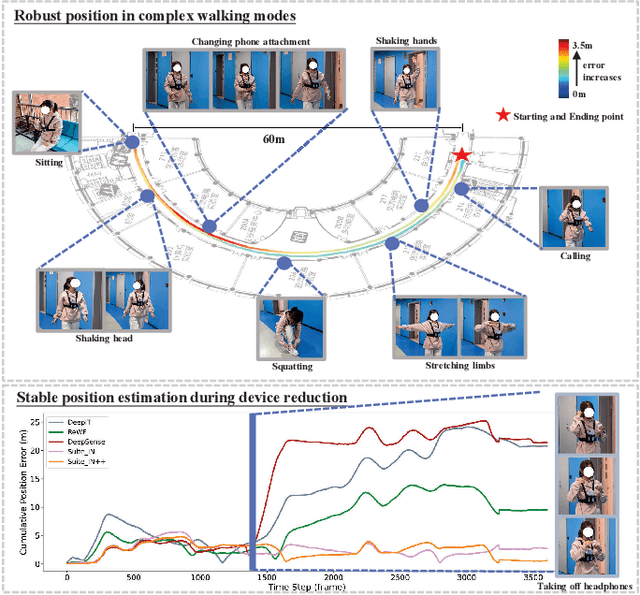
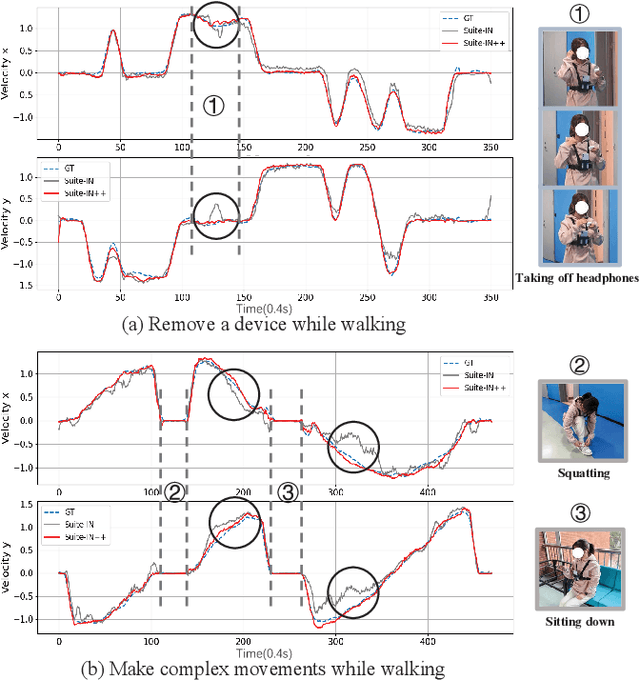
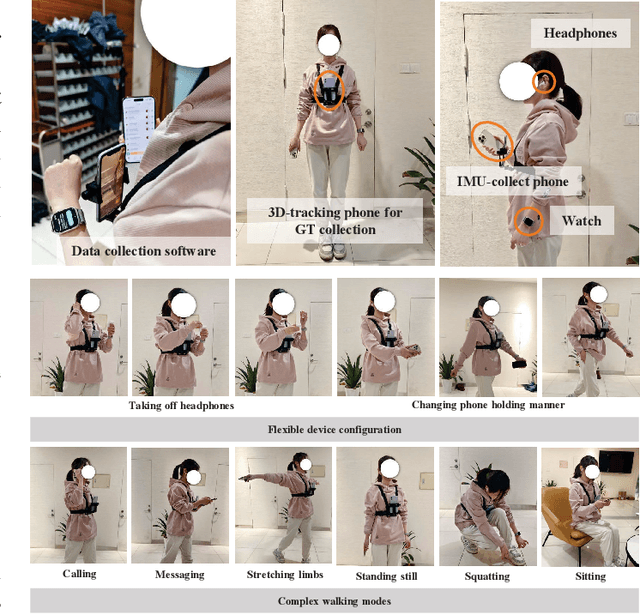
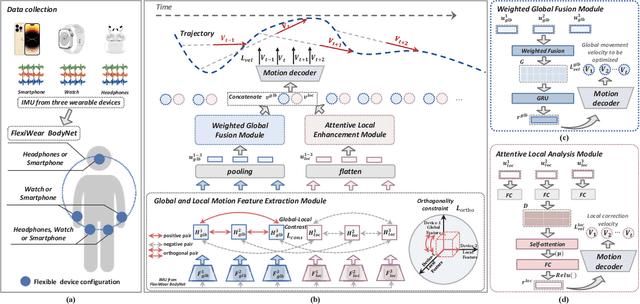
The proliferation of wearable technology has established multi-device ecosystems comprising smartphones, smartwatches, and headphones as critical enablers for ubiquitous pedestrian localization. However, traditional pedestrian dead reckoning (PDR) struggles with diverse motion modes, while data-driven methods, despite improving accuracy, often lack robustness due to their reliance on a single-device setup. Therefore, a promising solution is to fully leverage existing wearable devices to form a flexiwear bodynet for robust and accurate pedestrian localization. This paper presents Suite-IN++, a deep learning framework for flexiwear bodynet-based pedestrian localization. Suite-IN++ integrates motion data from wearable devices on different body parts, using contrastive learning to separate global and local motion features. It fuses global features based on the data reliability of each device to capture overall motion trends and employs an attention mechanism to uncover cross-device correlations in local features, extracting motion details helpful for accurate localization. To evaluate our method, we construct a real-life flexiwear bodynet dataset, incorporating Apple Suite (iPhone, Apple Watch, and AirPods) across diverse walking modes and device configurations. Experimental results demonstrate that Suite-IN++ achieves superior localization accuracy and robustness, significantly outperforming state-of-the-art models in real-life pedestrian tracking scenarios.