 Add to Chrome
 Add to Firefox
 Add to Edge
Yuvion LLM: An Adversarially-Aware Large Language Model for Content And AI Safety
Jun 26, 2026
As large language models are increasingly deployed in real-world systems, safety failures can still lead to harmful outputs and dangerous misuse. We argue that the essence of safety is adversarial: many failures arise not from natural inputs alone, but from strategic attempts to evade model policies and safeguards. However, existing general-purpose model development largely overlook this adversarial nature, and often remain insufficient for realistic safety scenarios involving planning, tool use, and multi-step reasoning, causing measured safety performance to overestimate real deployment robustness. To address this gap, we present Yuvion LLM, a large language model built for adversarially robust content safety and broader AI safety. Yuvion LLM treats adversarial robustness and agentic capability as first-class objectives. Its pipeline combines adversarially aware data construction, knowledge-enhanced continued pretraining, and policy-grounded multi-task safety post-training, including risk-aware supervised fine-tuning and reinforcement learning-based policy optimization, together with safety-aware agentic reinforcement learning for tool use and multi-step reasoning in complex safety scenarios. We further introduce the Yuvion LLM RiskEval (YLRE), a collection of 93 benchmarks across four evaluation categories, covering diverse open and internal evaluations with a focus on safety, adversarial robustness, and real-world capability requirements. Across these evaluations, Yuvion LLM demonstrates clear advantages on safety-focused benchmarks and particularly strong robustness under adversarial conditions, while maintaining solid overall capability. Notably, Yuvion-8B outperforms most state-of-the-art baselines, including substantially larger models such as GPT-5.4 and Qwen3-MAX, on several safety tasks.

Yuvion VL: A Multimodal Foundation Model for Adversarial Content and AI Safety
Jun 23, 2026General-purpose models often struggle to reliably identify and understand real-world multimodal risks, largely due to the inherent multimodal adversarial nature of content and AI safety. We present Yuvion VL, a family of multimodal large language models purpose-built for content and AI safety, with both instruction-tuned and reasoning-oriented variants. Yuvion VL addresses this gap by treating safety as an inherently adversarial and multimodal problem and designing the entire pipeline around adversarial robustness. For data construction, we develop an automated pipeline integrating adversarial-aware data synthesis with multi-stage quality control, producing large-scale, high-quality multimodal samples augmented with domain knowledge and reasoning annotations. For training, we adopt a three-stage pipeline that includes continued pretraining for risk-concept cross-modal alignment, instruct post-training for production-grade safety tasks, and reasoning post-training for enhanced interpretability and performance in complex tasks. We further introduce Confuse-then-Contrast Fine-Tuning, a contrastive framework that mines model-specific confusions and constructs multi-image contrastive groups to enforce explicit discrimination of fine-grained visual-semantic elements, enabling the model to distinguish between visually similar cases with different safety implications in adversarial safety tasks. To support rigorous evaluation, we further introduce Yuvion VL RiskEval (YVRE), a collection of benchmarks covering diverse open and internal evaluations, with a focus on content and AI safety, adversarial robustness, and real-world capability requirements. Experiments show that Yuvion VL-32B achieves industry-leading safety performance, surpassing comparably sized open-source models and best closed-source commercial models, while maintaining comparable general capabilities.
TC-Padé: Trajectory-Consistent Padé Approximation for Diffusion Acceleration
Mar 03, 2026Despite achieving state-of-the-art generation quality, diffusion models are hindered by the substantial computational burden of their iterative sampling process. While feature caching techniques achieve effective acceleration at higher step counts (e.g., 50 steps), they exhibit critical limitations in the practical low-step regime of 20-30 steps. As the interval between steps increases, polynomial-based extrapolators like TaylorSeer suffer from error accumulation and trajectory drift. Meanwhile, conventional caching strategies often overlook the distinct dynamical properties of different denoising phases. To address these challenges, we propose Trajectory-Consistent Padé approximation, a feature prediction framework grounded in Padé approximation. By modeling feature evolution through rational functions, our approach captures asymptotic and transitional behaviors more accurately than Taylor-based methods. To enable stable and trajectory-consistent sampling under reduced step counts, TC-Padé incorporates (1) adaptive coefficient modulation that leverages historical cached residuals to detect subtle trajectory transitions, and (2) step-aware prediction strategies tailored to the distinct dynamics of early, mid, and late sampling stages. Extensive experiments on DiT-XL/2, FLUX.1-dev, and Wan2.1 across both image and video generation demonstrate the effectiveness of TC-Padé. For instance, TC-Padé achieves 2.88x acceleration on FLUX.1-dev and 1.72x on Wan2.1 while maintaining high quality across FID, CLIP, Aesthetic, and VBench-2.0 metrics, substantially outperforming existing feature caching methods.
OmniSparse: Training-Aware Fine-Grained Sparse Attention for Long-Video MLLMs
Nov 18, 2025Existing sparse attention methods primarily target inference-time acceleration by selecting critical tokens under predefined sparsity patterns. However, they often fail to bridge the training-inference gap and lack the capacity for fine-grained token selection across multiple dimensions such as queries, key-values (KV), and heads, leading to suboptimal performance and limited acceleration gains. In this paper, we introduce OmniSparse, a training-aware fine-grained sparse attention framework for long-video MLLMs, which operates in both training and inference with dynamic token budget allocation. Specifically, OmniSparse contains three adaptive and complementary mechanisms: (1) query selection via lazy-active classification, retaining active queries that capture broad semantic similarity while discarding most lazy ones that focus on limited local context and exhibit high functional redundancy; (2) KV selection with head-level dynamic budget allocation, where a shared budget is determined based on the flattest head and applied uniformly across all heads to ensure attention recall; and (3) KV cache slimming to reduce head-level redundancy by selectively fetching visual KV cache according to the head-level decoding query pattern. Experimental results show that OmniSparse matches the performance of full attention while achieving up to 2.7x speedup during prefill and 2.4x memory reduction during decoding.
ZipAR: Accelerating Autoregressive Image Generation through Spatial Locality
Dec 05, 2024
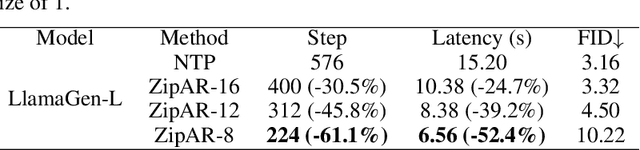
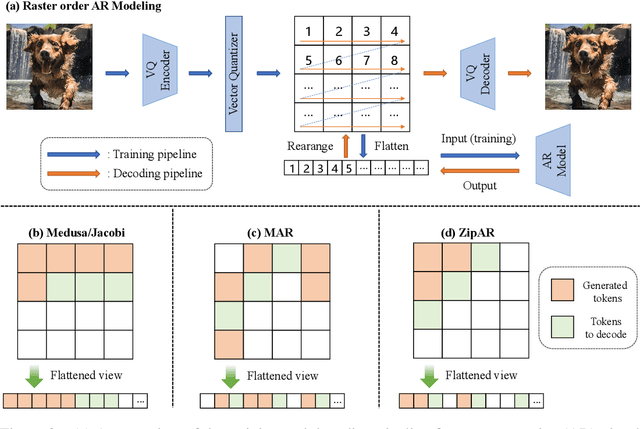
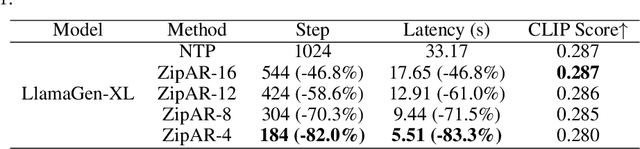
In this paper, we propose ZipAR, a training-free, plug-and-play parallel decoding framework for accelerating auto-regressive (AR) visual generation. The motivation stems from the observation that images exhibit local structures, and spatially distant regions tend to have minimal interdependence. Given a partially decoded set of visual tokens, in addition to the original next-token prediction scheme in the row dimension, the tokens corresponding to spatially adjacent regions in the column dimension can be decoded in parallel, enabling the ``next-set prediction'' paradigm. By decoding multiple tokens simultaneously in a single forward pass, the number of forward passes required to generate an image is significantly reduced, resulting in a substantial improvement in generation efficiency. Experiments demonstrate that ZipAR can reduce the number of model forward passes by up to 91% on the Emu3-Gen model without requiring any additional retraining.
Semantic Codebook Learning for Dynamic Recommendation Models
Jul 31, 2024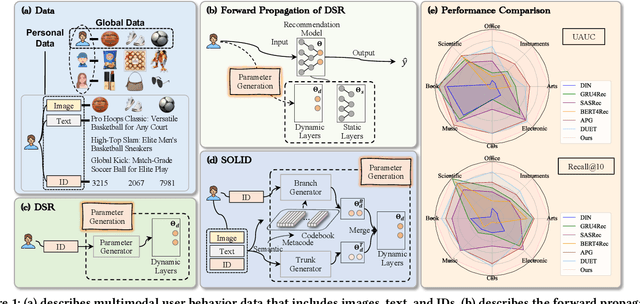
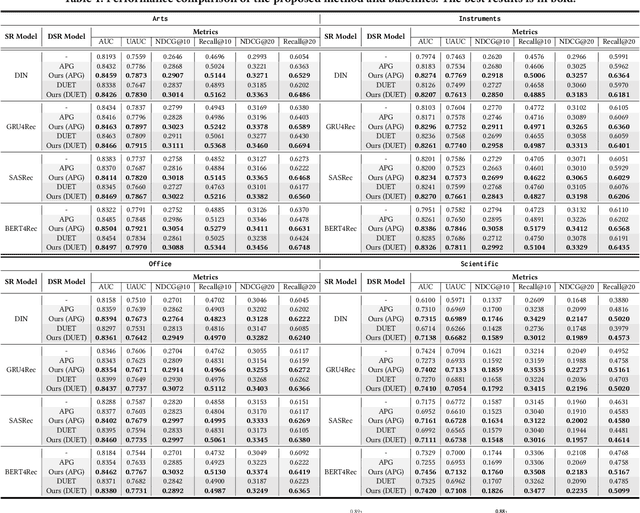
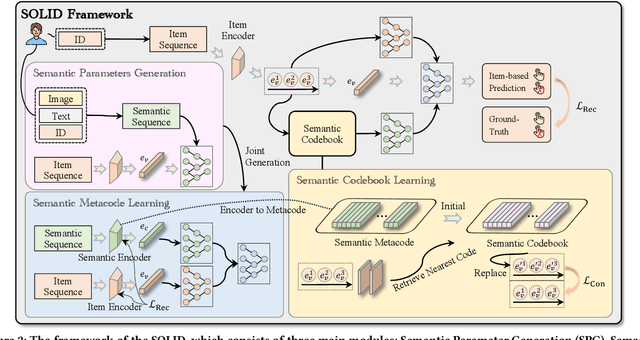
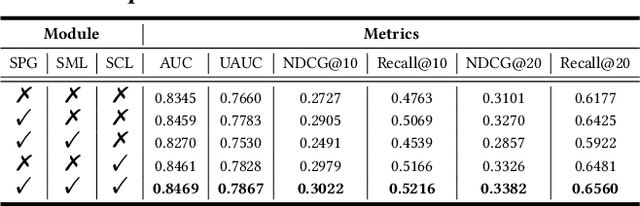
Dynamic sequential recommendation (DSR) can generate model parameters based on user behavior to improve the personalization of sequential recommendation under various user preferences. However, it faces the challenges of large parameter search space and sparse and noisy user-item interactions, which reduces the applicability of the generated model parameters. The Semantic Codebook Learning for Dynamic Recommendation Models (SOLID) framework presents a significant advancement in DSR by effectively tackling these challenges. By transforming item sequences into semantic sequences and employing a dual parameter model, SOLID compresses the parameter generation search space and leverages homogeneity within the recommendation system. The introduction of the semantic metacode and semantic codebook, which stores disentangled item representations, ensures robust and accurate parameter generation. Extensive experiments demonstrates that SOLID consistently outperforms existing DSR, delivering more accurate, stable, and robust recommendations.