 Add to Chrome
 Add to Firefox
 Add to Edge
Shopping Reasoning Bench: An Expert-Authored Benchmark for Multi-Turn Conversational Shopping Assistants
Jun 10, 2026
Conversational shopping assistants now serve hundreds of millions of customers, yet no existing benchmark jointly evaluates the open-ended multi-turn reasoning, domain expertise, and criterion-level quality that real shopping conversations demand. Shopping reasoning is unique among language model applications. Unlike factual question answering or verifiable code generation, it requires balancing subjective preferences, budget constraints, and cross-product trade-offs across multi-turn dialogue, capabilities absent from previous e-commerce and general-purpose benchmarks. We introduce the Shopping Reasoning Bench, an expert-authored benchmark of 525 missions (232 single-turn, 293 multi-turn) with 10863 importance-weighted binary rubrics authored by retail domain experts. These criteria are organized under a taxonomy of five reasoning categories and fifteen subcategories covering diverse demands such as preference refinement, trade-off analysis, and compatibility assessment. An evaluation of nine models across three families (GPT, Claude, Gemini) shows that pass rates reach only 57--77% overall. On multi-turn missions, all models score 13--29 points lower on optional above-and-beyond criteria than on required ones, and performance degrades 4--18 points as conversations progress. These gaps show that current models handle basic shopping assistance but fall short of expert-level advice, making Shopping Reasoning Bench a challenging testbed for future shopping assistant development.

Unlocking Latent Value: Taxonomy-Guided Recovery of High-Performing Data from Low-Tier Web Corpora
Jun 05, 2026Dominant web data curation pipelines for pretraining collapse document quality into a single composite score, systematically missing high-value content along dimensions the scorer underweights. We present a taxonomy-driven framework that recovers this value by filtering along semantically meaningful dimensions that composite scores fail to capture. First, building on the ESSENTIAL-WEB taxonomy, we introduce two novel dimensions: timeliness and cultural specificity, both of which show low pairwise NMI with existing ones. We annotate 14M documents using Qwen2.5 32B and distill into a lightweight 0.5B model. To enable rapid corpus-wide annotation, we additionally train a 73M multi-task MLP on E5 embeddings, achieving 50x inference throughput. Second, to navigate the combinatorial explosion of filter configurations, we introduce a compute-efficient two-pass framework: Pass 1 identifies the strongest dimension signals at small scale; Pass 2 constructs and evaluates conjunctive and disjunctive compound filters from the top performers - identifying high-performing configurations at a fraction of full scaling-law cost. Applying the selected filters to deprioritized web data, taxonomy-filtered subsets outperform their unfiltered baselines and even surpass the highest-quality tier. On mid-tier data, our best filter improves over its unfiltered baseline by 12.1% on reasoning, 9.5% on coding, and 2.0% on knowledge benchmarks, exceeding unfiltered top-tier data by 6.7% on reasoning and 13.7% on coding. Furthermore, filtered data from two tiers below the typical production threshold improves by 22.3% on reasoning and 19.5% on coding over its unfiltered baseline, surpassing top-tier data on coding benchmarks. These results establish that vast latent value remains locked in deprioritized web data, and that multi-dimensional taxonomy filtering is a principled, compute-efficient key to unlocking it.
Translate-R1: Cost-Aware Translation Tool Use via Reinforcement Learning
Jun 05, 2026The performance gap across languages in LLMs is well documented, and closing it natively requires pretraining or fine-tuning on corpora that, for most languages, do not exist. Translation offers an alternative: converting an input into the model's dominant language unlocks its full capabilities at once. Applying translation to every input, however, is wasteful for languages the model already handles, while leaving the choice to the model fails in the opposite way, as LLMs are overconfident and skip the tool even when they cannot understand the input. Prior work resolves this with language-specific rules, domain heuristics, language identifiers, or external routers, each requiring manual engineering. We instead learn a single policy that decides when to translate from reward alone, developing language- and domain-adaptive introspection that assesses its own comprehension and invokes translation only when it cannot solve a task natively. Using data built by our answer-preserving translation pipeline, we continue RL on the post-trained Qwen3-4B across 22 languages in 3 resource tiers (High, Low, XLow) and 5 domains, and introduce confidence-gated GSPO for cost-sensitive tool use. The gated policy lifts reward over the baseline by +4.6 on High, +23.5 on Low, and +17.5 on XLow. Against an unconstrained policy that almost always translates, it preserves full reward at 63% of the cost and is Pareto-optimal across 87% of the cost-sensitivity range. Additionally, to simulate behavior on a completely unseen language, we create 2 synthetic languages, where our gated policy improves +18.7 over the overconfident baseline that underutilizes the tool even on these incomprehensible inputs. The policy transfers zero-shot to 9 held-out languages, and we analyze how tool use emerges over training, per language and per domain.
QUBRIC: Co-Designing Queries and Rubrics for RL Beyond Verifiable Rewards
Jun 02, 2026Rubric-based RL is a promising route for extending reinforcement learning beyond verifiable rewards, yet existing methods optimize rubrics while treating the query distribution as fixed. We identify a structural bottleneck: rubric quality is constrained by query structure. Open-ended queries yield vague rubrics; naively narrowing them introduces fabricated references that no model can verify, so all responses fail and training receives no reward signal. We present QUBRIC, a framework that co-designs queries and rubrics. Teacher-derived key points ground the rewriting of open-ended queries into scenario-based, evaluable questions. Contrastive rubric generation then turns teacher-policy gaps into query-level criteria, and learnability filtering retains only informative query-rubric pairs for GRPO training. QUBRIC achieves a +5.5 point gain on ArenaHard over the SFT baseline. Trained only on instruction-following data, it further transfers to three held-out benchmarks spanning legal, moral, and narrative reasoning (+6.3 points on average), with improvements concentrated in reasoning-related dimensions. These results provide evidence that co-designing queries and rubrics can make rubric-based RL a practical complement to RLVR beyond strictly verifiable tasks.
Training LLMs for Multi-Step Tool Orchestration with Constrained Data Synthesis and Graduated Rewards
Mar 25, 2026Multi-step tool orchestration, where LLMs must invoke multiple dependent APIs in the correct order while propagating intermediate outputs, remains challenging. State-of-the-art models frequently fail on full sequence execution, with parameter value errors accounting for a significant portion of failures. Training models to handle such workflows faces two obstacles: existing environments focus on simple per-turn function calls with simulated data, and binary rewards provide no signal for partial correctness. We present a framework addressing both challenges. First, we construct a reinforcement learning environment backed by a large-scale cache of real API responses, enabling a data synthesis pipeline that samples valid multi-step orchestration traces with controllable complexity and significantly higher generation efficiency than unconstrained methods. Second, we propose a graduated reward design that decomposes correctness into atomic validity (individual function call correctness at increasing granularity) and orchestration (correct tool sequencing with dependency respect). On ComplexFuncBench, our approach demonstrates substantial improvements in turn accuracy. Ablation studies confirm both reward components are essential: using either alone significantly degrades performance.
Stepwise Penalization for Length-Efficient Chain-of-Thought Reasoning
Feb 27, 2026Large reasoning models improve with more test-time computation, but often overthink, producing unnecessarily long chains-of-thought that raise cost without improving accuracy. Prior reinforcement learning approaches typically rely on a single outcome reward with trajectory-level length penalties, which cannot distinguish essential from redundant reasoning steps and therefore yield blunt compression. Although recent work incorporates step-level signals, such as offline pruning, supervised data construction, or verifier-based intermediate rewards, reasoning length is rarely treated as an explicit step-level optimization objective during RL. We propose Step-wise Adaptive Penalization (SWAP), a fine-grained framework that allocates length reduction across steps based on intrinsic contribution. We estimate step importance from the model's on-policy log-probability improvement toward the correct answer, then treat excess length as a penalty mass redistributed to penalize low-importance steps more heavily while preserving high-importance reasoning. We optimize with a unified outcome-process advantage within group-relative policy optimization. Extensive experiments demonstrate that SWAP reduces reasoning length by 64.3% on average while improving accuracy by 5.7% relative to the base model.
HeaPA: Difficulty-Aware Heap Sampling and On-Policy Query Augmentation for LLM Reinforcement Learning
Jan 30, 2026RLVR is now a standard way to train LLMs on reasoning tasks with verifiable outcomes, but when rollout generation dominates the cost, efficiency depends heavily on which prompts you sample and when. In practice, prompt pools are often static or only loosely tied to the model's learning progress, so uniform sampling can't keep up with the shifting capability frontier and ends up wasting rollouts on prompts that are already solved or still out of reach. Existing approaches improve efficiency through filtering, curricula, adaptive rollout allocation, or teacher guidance, but they typically assume a fixed pool-which makes it hard to support stable on-policy pool growth-or they add extra teacher cost and latency. We introduce HeaPA (Heap Sampling and On-Policy Query Augmentation), which maintains a bounded, evolving pool, tracks the frontier using heap-based boundary sampling, expands the pool via on-policy augmentation with lightweight asynchronous validation, and stabilizes correlated queries through topology-aware re-estimation of pool statistics and controlled reinsertion. Across two training corpora, two training recipes, and seven benchmarks, HeaPA consistently improves accuracy and reaches target performance with fewer computations while keeping wall-clock time comparable. Our analyses suggest these gains come from frontier-focused sampling and on-policy pool growth, with the benefits becoming larger as model scale increases. Our code is available at https://github.com/horizon-rl/HeaPA.
Aligning Large Language Models with Implicit Preferences from User-Generated Content
Jun 04, 2025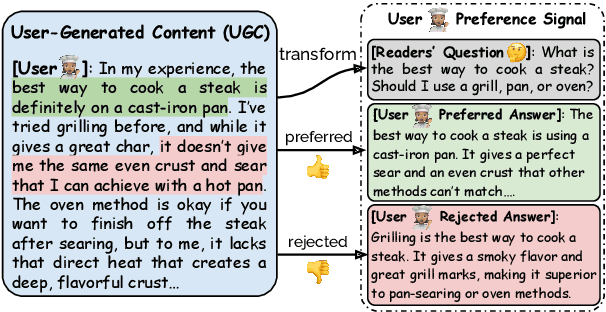
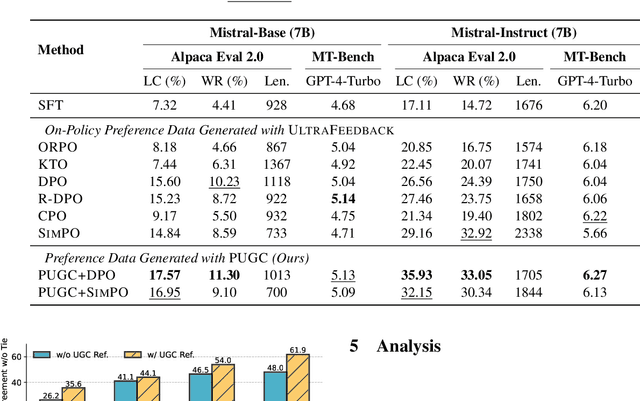
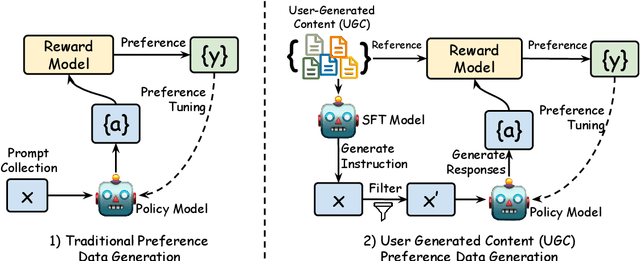
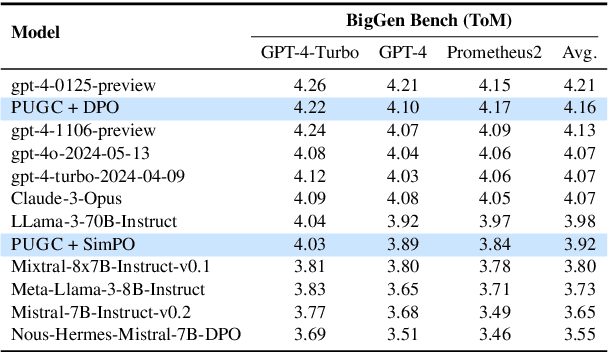
Learning from preference feedback is essential for aligning large language models (LLMs) with human values and improving the quality of generated responses. However, existing preference learning methods rely heavily on curated data from humans or advanced LLMs, which is costly and difficult to scale. In this work, we present PUGC, a novel framework that leverages implicit human Preferences in unlabeled User-Generated Content (UGC) to generate preference data. Although UGC is not explicitly created to guide LLMs in generating human-preferred responses, it often reflects valuable insights and implicit preferences from its creators that has the potential to address readers' questions. PUGC transforms UGC into user queries and generates responses from the policy model. The UGC is then leveraged as a reference text for response scoring, aligning the model with these implicit preferences. This approach improves the quality of preference data while enabling scalable, domain-specific alignment. Experimental results on Alpaca Eval 2 show that models trained with DPO and PUGC achieve a 9.37% performance improvement over traditional methods, setting a 35.93% state-of-the-art length-controlled win rate using Mistral-7B-Instruct. Further studies highlight gains in reward quality, domain-specific alignment effectiveness, robustness against UGC quality, and theory of mind capabilities. Our code and dataset are available at https://zhaoxuan.info/PUGC.github.io/
Hephaestus: Improving Fundamental Agent Capabilities of Large Language Models through Continual Pre-Training
Feb 10, 2025


Due to the scarcity of agent-oriented pre-training data, LLM-based autonomous agents typically rely on complex prompting or extensive fine-tuning, which often fails to introduce new capabilities while preserving strong generalizability. We introduce Hephaestus-Forge, the first large-scale pre-training corpus designed to enhance the fundamental capabilities of LLM agents in API function calling, intrinsic reasoning and planning, and adapting to environmental feedback. Hephaestus-Forge comprises 103B agent-specific data encompassing 76,537 APIs, including both tool documentation to introduce knowledge of API functions and function calling trajectories to strengthen intrinsic reasoning. To explore effective training protocols, we investigate scaling laws to identify the optimal recipe in data mixing ratios. By continual pre-training on Hephaestus-Forge, Hephaestus outperforms small- to medium-scale open-source LLMs and rivals commercial LLMs on three agent benchmarks, demonstrating the effectiveness of our pre-training corpus in enhancing fundamental agentic capabilities and generalization of LLMs to new tasks or environments.
Shopping MMLU: A Massive Multi-Task Online Shopping Benchmark for Large Language Models
Oct 28, 2024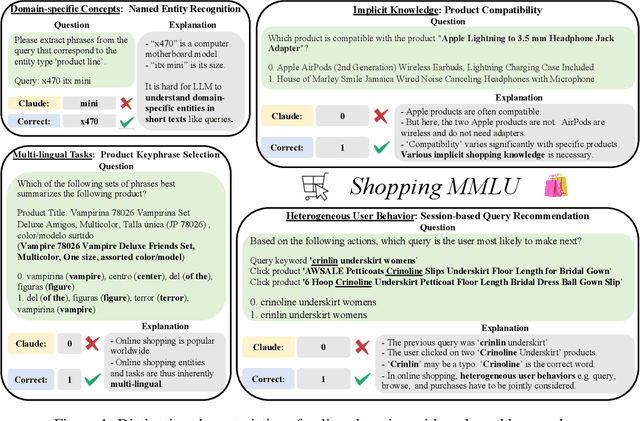
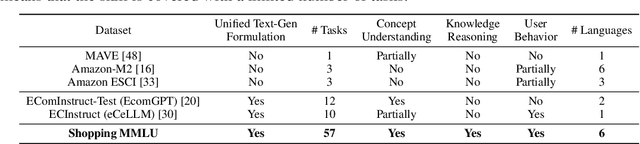
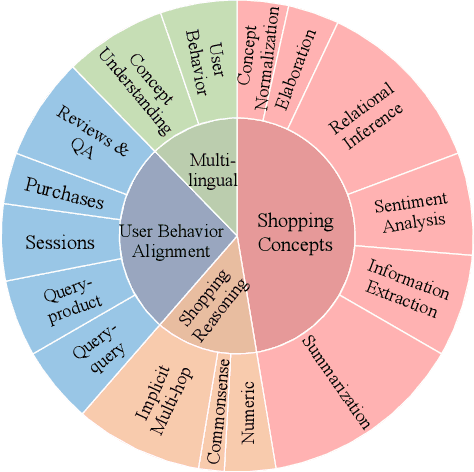
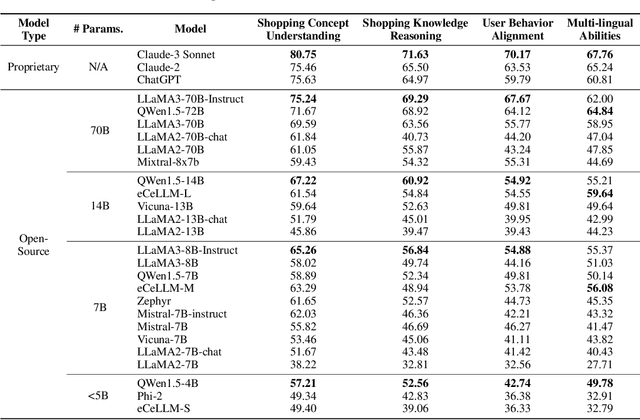
Online shopping is a complex multi-task, few-shot learning problem with a wide and evolving range of entities, relations, and tasks. However, existing models and benchmarks are commonly tailored to specific tasks, falling short of capturing the full complexity of online shopping. Large Language Models (LLMs), with their multi-task and few-shot learning abilities, have the potential to profoundly transform online shopping by alleviating task-specific engineering efforts and by providing users with interactive conversations. Despite the potential, LLMs face unique challenges in online shopping, such as domain-specific concepts, implicit knowledge, and heterogeneous user behaviors. Motivated by the potential and challenges, we propose Shopping MMLU, a diverse multi-task online shopping benchmark derived from real-world Amazon data. Shopping MMLU consists of 57 tasks covering 4 major shopping skills: concept understanding, knowledge reasoning, user behavior alignment, and multi-linguality, and can thus comprehensively evaluate the abilities of LLMs as general shop assistants. With Shopping MMLU, we benchmark over 20 existing LLMs and uncover valuable insights about practices and prospects of building versatile LLM-based shop assistants. Shopping MMLU can be publicly accessed at https://github.com/KL4805/ShoppingMMLU. In addition, with Shopping MMLU, we host a competition in KDD Cup 2024 with over 500 participating teams. The winning solutions and the associated workshop can be accessed at our website https://amazon-kddcup24.github.io/.