 Add to Chrome
 Add to Firefox
 Add to Edge
Is Human-Like Text Liked by Humans? Multilingual Human Detection and Preference Against AI
Feb 17, 2025
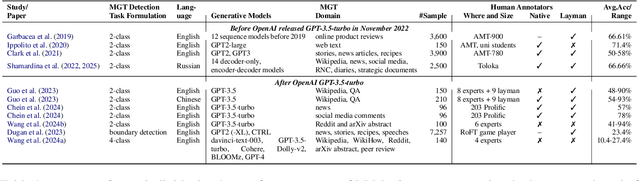
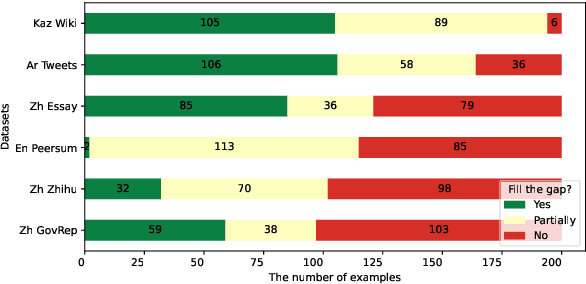
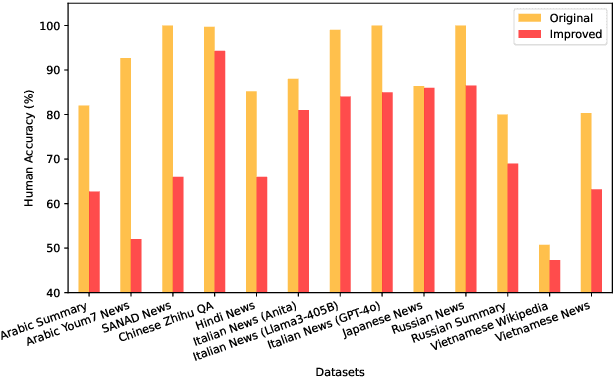
Prior studies have shown that distinguishing text generated by large language models (LLMs) from human-written one is highly challenging, and often no better than random guessing. To verify the generalizability of this finding across languages and domains, we perform an extensive case study to identify the upper bound of human detection accuracy. Across 16 datasets covering 9 languages and 9 domains, 19 annotators achieved an average detection accuracy of 87.6%, thus challenging previous conclusions. We find that major gaps between human and machine text lie in concreteness, cultural nuances, and diversity. Prompting by explicitly explaining the distinctions in the prompts can partially bridge the gaps in over 50% of the cases. However, we also find that humans do not always prefer human-written text, particularly when they cannot clearly identify its source.

Fast or Better? Balancing Accuracy and Cost in Retrieval-Augmented Generation with Flexible User Control
Feb 17, 2025Retrieval-Augmented Generation (RAG) has emerged as a powerful approach to mitigate large language model (LLM) hallucinations by incorporating external knowledge retrieval. However, existing RAG frameworks often apply retrieval indiscriminately,leading to inefficiencies-over-retrieving when unnecessary or failing to retrieve iteratively when required for complex reasoning. Recent adaptive retrieval strategies, though adaptively navigates these retrieval strategies, predict only based on query complexity and lacks user-driven flexibility, making them infeasible for diverse user application needs. In this paper, we introduce a novel user-controllable RAG framework that enables dynamic adjustment of the accuracy-cost trade-off. Our approach leverages two classifiers: one trained to prioritize accuracy and another to prioritize retrieval efficiency. Via an interpretable control parameter $\alpha$, users can seamlessly navigate between minimal-cost retrieval and high-accuracy retrieval based on their specific requirements. We empirically demonstrate that our approach effectively balances accuracy, retrieval cost, and user controllability, making it a practical and adaptable solution for real-world applications.
CoCoA: A Generalized Approach to Uncertainty Quantification by Integrating Confidence and Consistency of LLM Outputs
Feb 07, 2025Uncertainty quantification (UQ) methods for Large Language Models (LLMs) encompasses a variety of approaches, with two major types being particularly prominent: information-based, which focus on model confidence expressed as token probabilities, and consistency-based, which assess the semantic relationship between multiple outputs generated using repeated sampling. Several recent methods have combined these two approaches and shown impressive performance in various applications. However, they sometimes fail to outperform much simpler baseline methods. Our investigation reveals distinctive characteristics of LLMs as probabilistic models, which help to explain why these UQ methods underperform in certain tasks. Based on these findings, we propose a new way of synthesizing model confidence and output consistency that leads to a family of efficient and robust UQ methods. We evaluate our approach across a variety of tasks such as question answering, abstractive summarization, and machine translation, demonstrating sizable improvements over state-of-the-art UQ approaches.
GenAI Content Detection Task 1: English and Multilingual Machine-Generated Text Detection: AI vs. Human
Jan 19, 2025We present the GenAI Content Detection Task~1 -- a shared task on binary machine generated text detection, conducted as a part of the GenAI workshop at COLING 2025. The task consists of two subtasks: Monolingual (English) and Multilingual. The shared task attracted many participants: 36 teams made official submissions to the Monolingual subtask during the test phase and 26 teams -- to the Multilingual. We provide a comprehensive overview of the data, a summary of the results -- including system rankings and performance scores -- detailed descriptions of the participating systems, and an in-depth analysis of submissions. https://github.com/mbzuai-nlp/COLING-2025-Workshop-on-MGT-Detection-Task1
LLM360 K2: Building a 65B 360-Open-Source Large Language Model from Scratch
Jan 16, 2025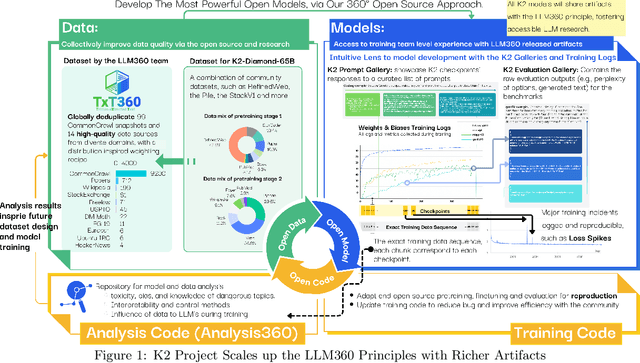
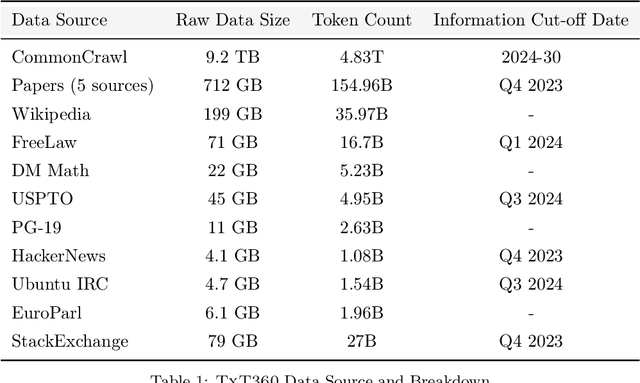
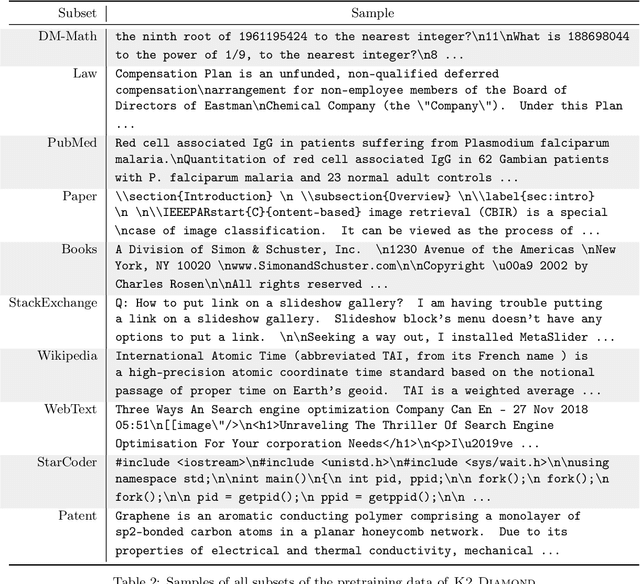
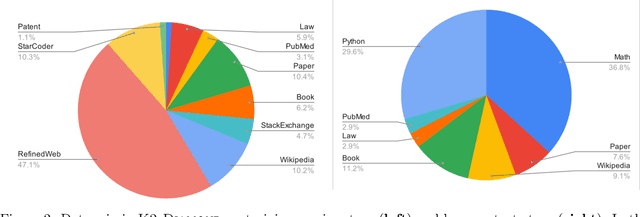
We detail the training of the LLM360 K2-65B model, scaling up our 360-degree OPEN SOURCE approach to the largest and most powerful models under project LLM360. While open-source LLMs continue to advance, the answer to "How are the largest LLMs trained?" remains unclear within the community. The implementation details for such high-capacity models are often protected due to business considerations associated with their high cost. This lack of transparency prevents LLM researchers from leveraging valuable insights from prior experience, e.g., "What are the best practices for addressing loss spikes?" The LLM360 K2 project addresses this gap by providing full transparency and access to resources accumulated during the training of LLMs at the largest scale. This report highlights key elements of the K2 project, including our first model, K2 DIAMOND, a 65 billion-parameter LLM that surpasses LLaMA-65B and rivals LLaMA2-70B, while requiring fewer FLOPs and tokens. We detail the implementation steps and present a longitudinal analysis of K2 DIAMOND's capabilities throughout its training process. We also outline ongoing projects such as TXT360, setting the stage for future models in the series. By offering previously unavailable resources, the K2 project also resonates with the 360-degree OPEN SOURCE principles of transparency, reproducibility, and accessibility, which we believe are vital in the era of resource-intensive AI research.
GenAI Content Detection Task 3: Cross-Domain Machine-Generated Text Detection Challenge
Jan 15, 2025
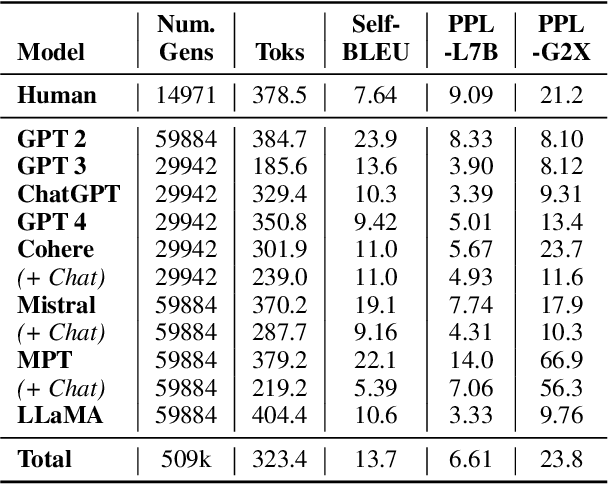

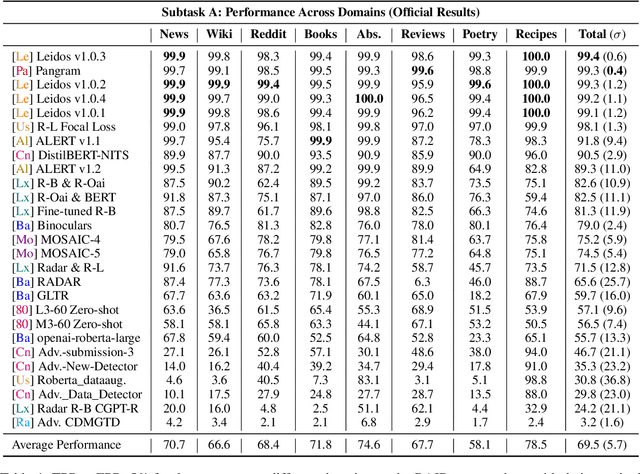
Recently there have been many shared tasks targeting the detection of generated text from Large Language Models (LLMs). However, these shared tasks tend to focus either on cases where text is limited to one particular domain or cases where text can be from many domains, some of which may not be seen during test time. In this shared task, using the newly released RAID benchmark, we aim to answer whether or not models can detect generated text from a large, yet fixed, number of domains and LLMs, all of which are seen during training. Over the course of three months, our task was attempted by 9 teams with 23 detector submissions. We find that multiple participants were able to obtain accuracies of over 99% on machine-generated text from RAID while maintaining a 5% False Positive Rate -- suggesting that detectors are able to robustly detect text from many domains and models simultaneously. We discuss potential interpretations of this result and provide directions for future research.
Libra-Leaderboard: Towards Responsible AI through a Balanced Leaderboard of Safety and Capability
Dec 24, 2024


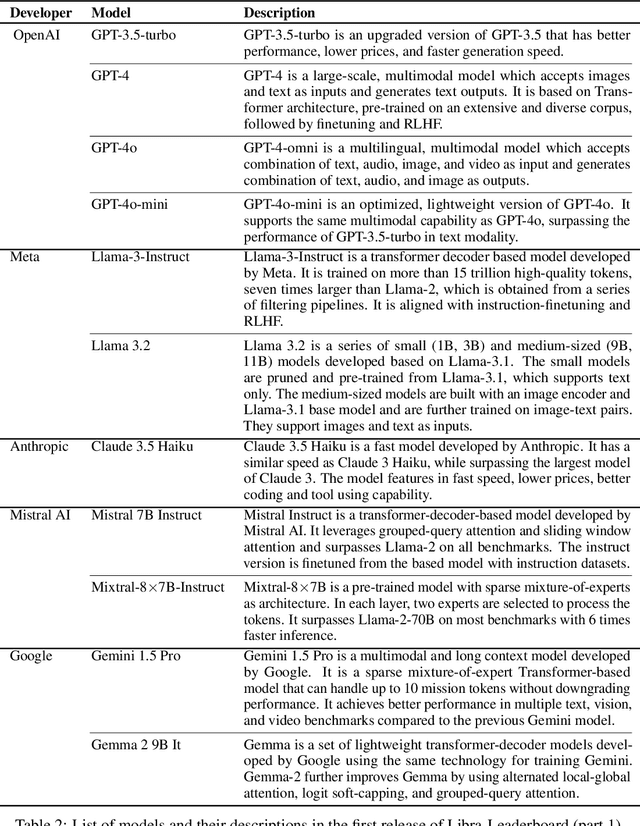
To address this gap, we introduce Libra-Leaderboard, a comprehensive framework designed to rank LLMs through a balanced evaluation of performance and safety. Combining a dynamic leaderboard with an interactive LLM arena, Libra-Leaderboard encourages the joint optimization of capability and safety. Unlike traditional approaches that average performance and safety metrics, Libra-Leaderboard uses a distance-to-optimal-score method to calculate the overall rankings. This approach incentivizes models to achieve a balance rather than excelling in one dimension at the expense of some other ones. In the first release, Libra-Leaderboard evaluates 26 mainstream LLMs from 14 leading organizations, identifying critical safety challenges even in state-of-the-art models.
Shaping the Safety Boundaries: Understanding and Defending Against Jailbreaks in Large Language Models
Dec 22, 2024


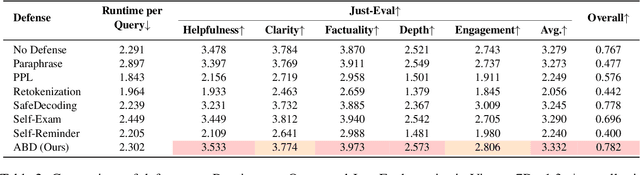
Jailbreaking in Large Language Models (LLMs) is a major security concern as it can deceive LLMs to generate harmful text. Yet, there is still insufficient understanding of how jailbreaking works, which makes it hard to develop effective defense strategies. We aim to shed more light into this issue: we conduct a detailed large-scale analysis of seven different jailbreak methods and find that these disagreements stem from insufficient observation samples. In particular, we introduce \textit{safety boundary}, and we find that jailbreaks shift harmful activations outside that safety boundary, where LLMs are less sensitive to harmful information. We also find that the low and the middle layers are critical in such shifts, while deeper layers have less impact. Leveraging on these insights, we propose a novel defense called \textbf{Activation Boundary Defense} (ABD), which adaptively constrains the activations within the safety boundary. We further use Bayesian optimization to selectively apply the defense method to the low and the middle layers. Our experiments on several benchmarks show that ABD achieves an average DSR of over 98\% against various forms of jailbreak attacks, with less than 2\% impact on the model's general capabilities.
Aristotle: Mastering Logical Reasoning with A Logic-Complete Decompose-Search-Resolve Framework
Dec 22, 2024In the context of large language models (LLMs), current advanced reasoning methods have made impressive strides in various reasoning tasks. However, when it comes to logical reasoning tasks, major challenges remain in both efficacy and efficiency. This is rooted in the fact that these systems fail to fully leverage the inherent structure of logical tasks throughout the reasoning processes such as decomposition, search, and resolution. To address this, we propose a logic-complete reasoning framework, Aristotle, with three key components: Logical Decomposer, Logical Search Router, and Logical Resolver. In our framework, symbolic expressions and logical rules are comprehensively integrated into the entire reasoning process, significantly alleviating the bottlenecks of logical reasoning, i.e., reducing sub-task complexity, minimizing search errors, and resolving logical contradictions. The experimental results on several datasets demonstrate that Aristotle consistently outperforms state-of-the-art reasoning frameworks in both accuracy and efficiency, particularly excelling in complex logical reasoning scenarios. We will open-source all our code at https://github.com/Aiden0526/Aristotle.
Towards More Robust Retrieval-Augmented Generation: Evaluating RAG Under Adversarial Poisoning Attacks
Dec 21, 2024Retrieval-Augmented Generation (RAG) systems have emerged as a promising solution to mitigate LLM hallucinations and enhance their performance in knowledge-intensive domains. However, these systems are vulnerable to adversarial poisoning attacks, where malicious passages injected into retrieval databases can mislead the model into generating factually incorrect outputs. In this paper, we investigate both the retrieval and the generation components of RAG systems to understand how to enhance their robustness against such attacks. From the retrieval perspective, we analyze why and how the adversarial contexts are retrieved and assess how the quality of the retrieved passages impacts downstream generation. From a generation perspective, we evaluate whether LLMs' advanced critical thinking and internal knowledge capabilities can be leveraged to mitigate the impact of adversarial contexts, i.e., using skeptical prompting as a self-defense mechanism. Our experiments and findings provide actionable insights into designing safer and more resilient retrieval-augmented frameworks, paving the way for their reliable deployment in real-world applications.