 Add to Chrome
 Add to Firefox
 Add to Edge
Uncovering Temporal Framing in the News
May 29, 2026
Temporal language does more than place events on a timeline. In news discourse, references to the past, present, and future can function as rhetorical devices that shape interpretation and persuasion. Here, we study temporal framing, defined as the persuasive use of time-related language to structure meaning rather than to report chronology. We propose a taxonomy of eight temporal frames grounded in prior work on temporality and framing, and we realize it through expert annotation of a multilingual news corpus. The resulting dataset includes 458 English and German news articles, with over 2K temporally framed sentences and approximately 3K temporal framing annotations identified from a corpus of more than 20K sentences. We analyze frame prevalence, co-occurrence patterns, and lexical cues, and evaluate temporal framing detection using supervised fine-tuning and zero-shot classification. Our experiments show that temporal framing is learnable at the sentence level, with supervised models substantially outperforming zero-shot approaches. We publicly release the corpus to support future research on temporal framing: https://mbzuai-nlp.github.io/temporal-framing/.

Is Human-Like Text Liked by Humans? Multilingual Human Detection and Preference Against AI
Feb 17, 2025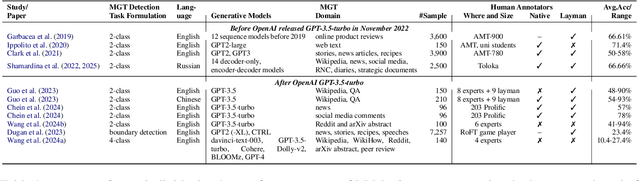
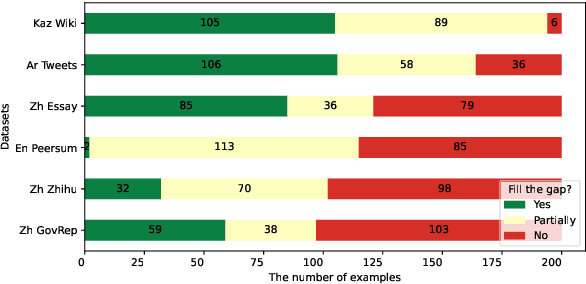
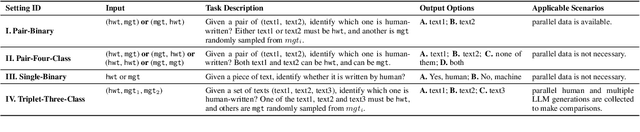
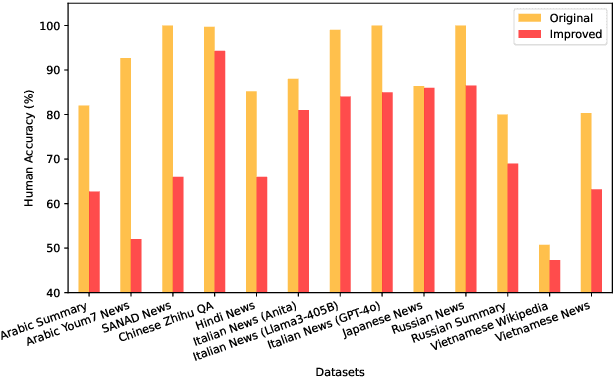
Prior studies have shown that distinguishing text generated by large language models (LLMs) from human-written one is highly challenging, and often no better than random guessing. To verify the generalizability of this finding across languages and domains, we perform an extensive case study to identify the upper bound of human detection accuracy. Across 16 datasets covering 9 languages and 9 domains, 19 annotators achieved an average detection accuracy of 87.6%, thus challenging previous conclusions. We find that major gaps between human and machine text lie in concreteness, cultural nuances, and diversity. Prompting by explicitly explaining the distinctions in the prompts can partially bridge the gaps in over 50% of the cases. However, we also find that humans do not always prefer human-written text, particularly when they cannot clearly identify its source.
GenAI Content Detection Task 1: English and Multilingual Machine-Generated Text Detection: AI vs. Human
Jan 19, 2025We present the GenAI Content Detection Task~1 -- a shared task on binary machine generated text detection, conducted as a part of the GenAI workshop at COLING 2025. The task consists of two subtasks: Monolingual (English) and Multilingual. The shared task attracted many participants: 36 teams made official submissions to the Monolingual subtask during the test phase and 26 teams -- to the Multilingual. We provide a comprehensive overview of the data, a summary of the results -- including system rankings and performance scores -- detailed descriptions of the participating systems, and an in-depth analysis of submissions. https://github.com/mbzuai-nlp/COLING-2025-Workshop-on-MGT-Detection-Task1
LLM-DetectAIve: a Tool for Fine-Grained Machine-Generated Text Detection
Aug 08, 2024


The widespread accessibility of large language models (LLMs) to the general public has significantly amplified the dissemination of machine-generated texts (MGTs). Advancements in prompt manipulation have exacerbated the difficulty in discerning the origin of a text (human-authored vs machinegenerated). This raises concerns regarding the potential misuse of MGTs, particularly within educational and academic domains. In this paper, we present $\textbf{LLM-DetectAIve}$ -- a system designed for fine-grained MGT detection. It is able to classify texts into four categories: human-written, machine-generated, machine-written machine-humanized, and human-written machine-polished. Contrary to previous MGT detectors that perform binary classification, introducing two additional categories in LLM-DetectiAIve offers insights into the varying degrees of LLM intervention during the text creation. This might be useful in some domains like education, where any LLM intervention is usually prohibited. Experiments show that LLM-DetectAIve can effectively identify the authorship of textual content, proving its usefulness in enhancing integrity in education, academia, and other domains. LLM-DetectAIve is publicly accessible at https://huggingface.co/spaces/raj-tomar001/MGT-New. The video describing our system is available at https://youtu.be/E8eT_bE7k8c.