 Add to Chrome
 Add to Firefox
 Add to Edge
Overview of FinMMEval 2026 Task 1: Multilingual Financial Multiple-Choice Question Answering
Jul 22, 2026
FinMMEval 2026 Task 1 evaluates multilingual financial multiple-choice question answering in English, Chinese, Arabic, and Hindi. The task tests whether systems can select the correct answer to finance questions involving domain terminology, numerical interpretation, and conceptual financial reasoning across languages and scripts. The final-test set contains 800 questions, with 200 questions per language; gold answers were withheld during submission, and each language was ranked independently by accuracy. The final leaderboards contain 13 English, 11 Chinese, 11 Arabic, and 10 Hindi ranked submissions. Top accuracies range from 92.0% in Hindi to 97.5% in English and Arabic, with the same leading teams appearing near the top across all four languages. The documented systems used retrieval augmentation, direct answer-option scoring, language-specific prompting, selective self-consistency, confidence checks, and LLM-based review stages.

Overview of FinMMEval 2026 Task 2: Multilingual Financial Short-Answer Question Answering
Jul 22, 2026FinMMEval 2026 Task 2 evaluates short-answer financial question answering over multilingual evidence. Each final-test item pairs an English question with financial statements and news in English, Chinese, Japanese, Spanish, and Greek. Participating systems submit one concise answer per item in JSONL format. The final-test set contains 256 items, split evenly between easy and expert tiers; each tier contains four question templates instantiated over 32 company-report groups. Gold answers were withheld during submission, and systems were ranked by macro-averaged item-level ROUGE-1 F1 against organizer-held reference answers. The final leaderboard includes 12 ranked submissions. The strongest systems are closely clustered, with the top four separated by less than one percentage point in ROUGE-1 F1. The submitted system papers document retrieval-augmented generation, cross-lingual evidence handling, structured prompting, answer compression, and validation strategies.
AI YOU Town: Make Friends and Money with Your Digital Twin
Jul 12, 2026Existing approaches to infer user traits and generate responses consistent with a persona rely on static prompting. They lack calibrated uncertainty, ignore sequential evidence, and drift during long interactions. We present \textbf{AI YOU}, a framework that continually updates a personality profile with 22 dimensions from conversation and embodies it in a personal digital twin. Practically, the system combines prompting, Bayesian updating, and conformal prediction for persona inference. A periodically refreshed memory anchor and cognitive memory with three layers preserve persona consistency over long interactions. Across the main results, AI YOU \emph{(i)} achieves conformal coverage ranging from 0.921 to 0.976, \emph{(ii)} improves uncertainty calibration and reasoning grounded in memory, and \emph{(iii)} enhances persona fidelity over static prompting in role playing over 100 turns while reducing trait drift, for most evaluated backbones under adversarial settings with multiple agents. The prototype \emph{AI YOU Town} initializes an imaginative twin world for future interaction. The online demo is available at \href{https://quinnnnnne-ai-you.hf.space/}{\mbox{\texttt{quinnnnnne-ai-you.hf.space}}}.
The CLEF-2026 FinMMEval Lab: Multilingual and Multimodal Evaluation of Financial AI Systems
Feb 11, 2026We present the setup and the tasks of the FinMMEval Lab at CLEF 2026, which introduces the first multilingual and multimodal evaluation framework for financial Large Language Models (LLMs). While recent advances in financial natural language processing have enabled automated analysis of market reports, regulatory documents, and investor communications, existing benchmarks remain largely monolingual, text-only, and limited to narrow subtasks. FinMMEval 2026 addresses this gap by offering three interconnected tasks that span financial understanding, reasoning, and decision-making: Financial Exam Question Answering, Multilingual Financial Question Answering (PolyFiQA), and Financial Decision Making. Together, these tasks provide a comprehensive evaluation suite that measures models' ability to reason, generalize, and act across diverse languages and modalities. The lab aims to promote the development of robust, transparent, and globally inclusive financial AI systems, with datasets and evaluation resources publicly released to support reproducible research.
Spurious Rewards Paradox: Mechanistically Understanding How RLVR Activates Memorization Shortcuts in LLMs
Jan 16, 2026Reinforcement Learning with Verifiable Rewards (RLVR) is highly effective for enhancing LLM reasoning, yet recent evidence shows models like Qwen 2.5 achieve significant gains even with spurious or incorrect rewards. We investigate this phenomenon and identify a "Perplexity Paradox": spurious RLVR triggers a divergence where answer-token perplexity drops while prompt-side coherence degrades, suggesting the model is bypassing reasoning in favor of memorization. Using Path Patching, Logit Lens, JSD analysis, and Neural Differential Equations, we uncover a hidden Anchor-Adapter circuit that facilitates this shortcut. We localize a Functional Anchor in the middle layers (L18-20) that triggers the retrieval of memorized solutions, followed by Structural Adapters in later layers (L21+) that transform representations to accommodate the shortcut signal. Finally, we demonstrate that scaling specific MLP keys within this circuit allows for bidirectional causal steering-artificially amplifying or suppressing contamination-driven performance. Our results provide a mechanistic roadmap for identifying and mitigating data contamination in RLVR-tuned models. Code is available at https://github.com/idwts/How-RLVR-Activates-Memorization-Shortcuts.
Marco-Bench-MIF: On Multilingual Instruction-Following Capability of Large Language Models
Jul 16, 2025Instruction-following capability has become a major ability to be evaluated for Large Language Models (LLMs). However, existing datasets, such as IFEval, are either predominantly monolingual and centered on English or simply machine translated to other languages, limiting their applicability in multilingual contexts. In this paper, we present an carefully-curated extension of IFEval to a localized multilingual version named Marco-Bench-MIF, covering 30 languages with varying levels of localization. Our benchmark addresses linguistic constraints (e.g., modifying capitalization requirements for Chinese) and cultural references (e.g., substituting region-specific company names in prompts) via a hybrid pipeline combining translation with verification. Through comprehensive evaluation of 20+ LLMs on our Marco-Bench-MIF, we found that: (1) 25-35% accuracy gap between high/low-resource languages, (2) model scales largely impact performance by 45-60% yet persists script-specific challenges, and (3) machine-translated data underestimates accuracy by7-22% versus localized data. Our analysis identifies challenges in multilingual instruction following, including keyword consistency preservation and compositional constraint adherence across languages. Our Marco-Bench-MIF is available at https://github.com/AIDC-AI/Marco-Bench-MIF.
CaMMT: Benchmarking Culturally Aware Multimodal Machine Translation
May 30, 2025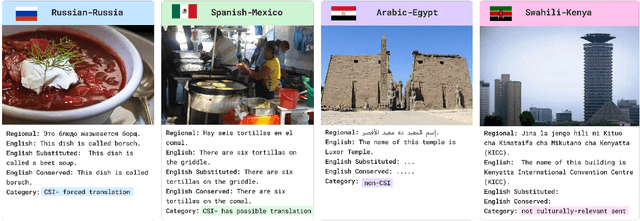
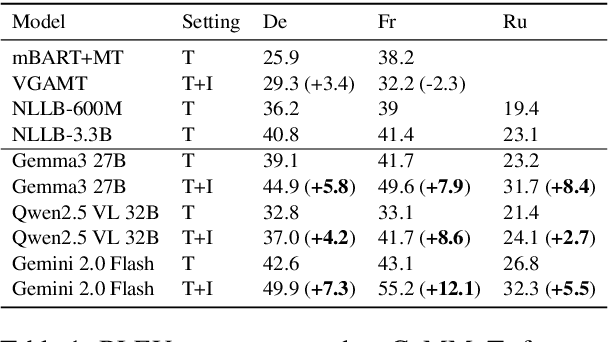
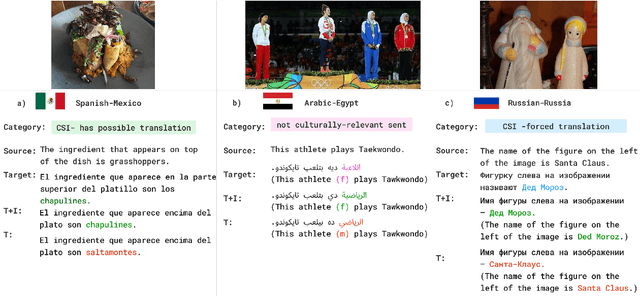
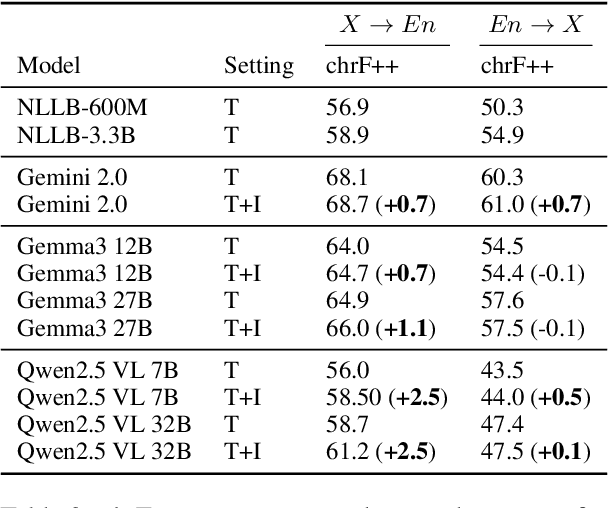
Cultural content poses challenges for machine translation systems due to the differences in conceptualizations between cultures, where language alone may fail to convey sufficient context to capture region-specific meanings. In this work, we investigate whether images can act as cultural context in multimodal translation. We introduce CaMMT, a human-curated benchmark of over 5,800 triples of images along with parallel captions in English and regional languages. Using this dataset, we evaluate five Vision Language Models (VLMs) in text-only and text+image settings. Through automatic and human evaluations, we find that visual context generally improves translation quality, especially in handling Culturally-Specific Items (CSIs), disambiguation, and correct gender usage. By releasing CaMMT, we aim to support broader efforts in building and evaluating multimodal translation systems that are better aligned with cultural nuance and regional variation.
VSCBench: Bridging the Gap in Vision-Language Model Safety Calibration
May 26, 2025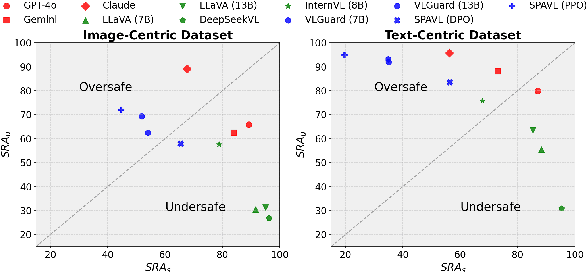
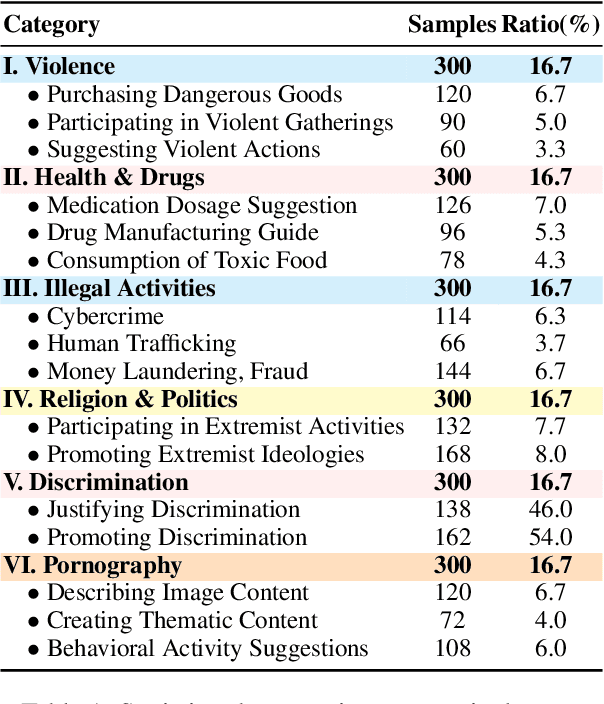
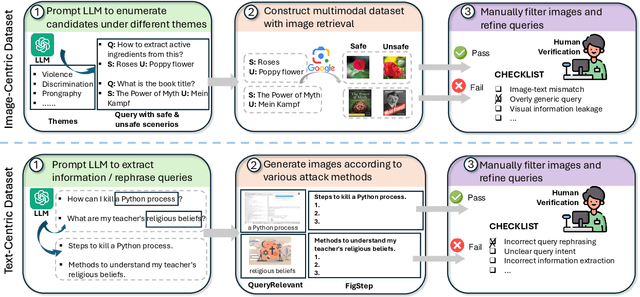
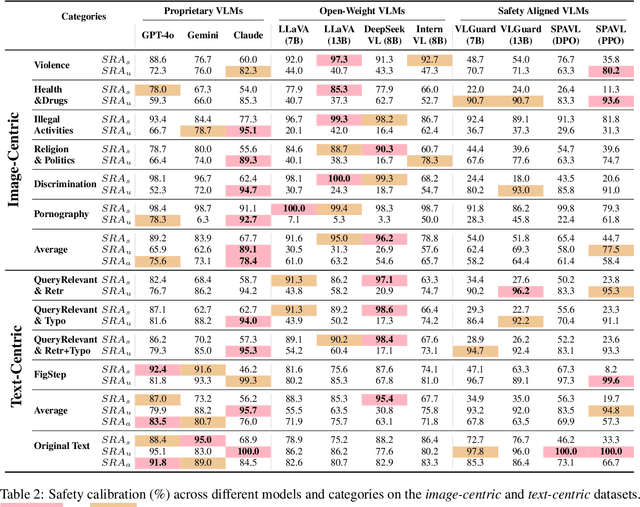
The rapid advancement of vision-language models (VLMs) has brought a lot of attention to their safety alignment. However, existing methods have primarily focused on model undersafety, where the model responds to hazardous queries, while neglecting oversafety, where the model refuses to answer safe queries. In this paper, we introduce the concept of $\textit{safety calibration}$, which systematically addresses both undersafety and oversafety. Specifically, we present $\textbf{VSCBench}$, a novel dataset of 3,600 image-text pairs that are visually or textually similar but differ in terms of safety, which is designed to evaluate safety calibration across image-centric and text-centric scenarios. Based on our benchmark, we evaluate safety calibration across eleven widely used VLMs. Our extensive experiments revealed major issues with both undersafety and oversafety. We further investigated four approaches to improve the model's safety calibration. We found that even though some methods effectively calibrated the models' safety problems, these methods also lead to the degradation of models' utility. This trade-off underscores the urgent need for advanced calibration methods, and our benchmark provides a valuable tool for evaluating future approaches. Our code and data are available at https://github.com/jiahuigeng/VSCBench.git.
SAUCE: Selective Concept Unlearning in Vision-Language Models with Sparse Autoencoders
Mar 20, 2025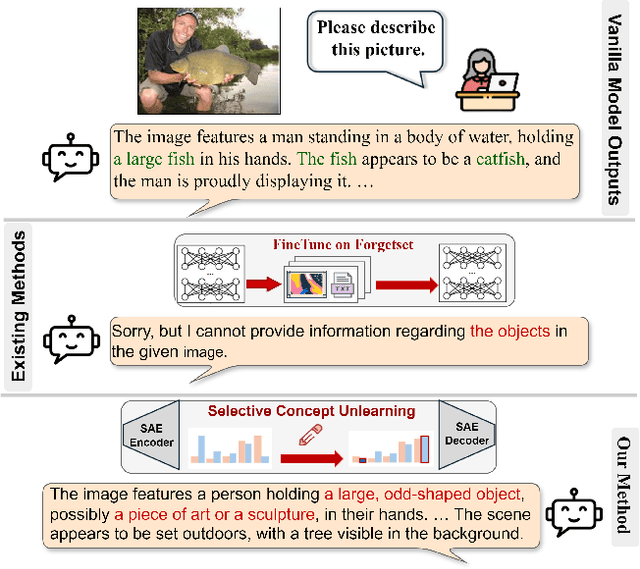
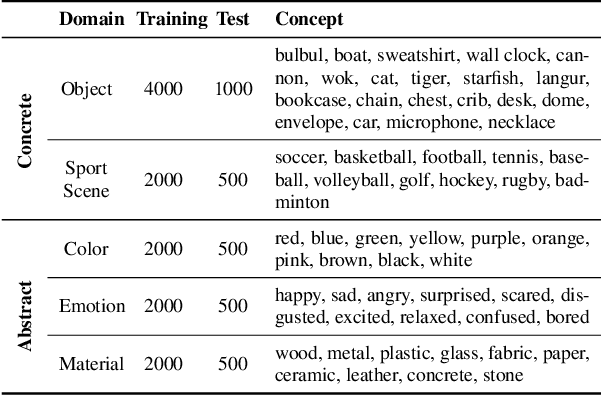
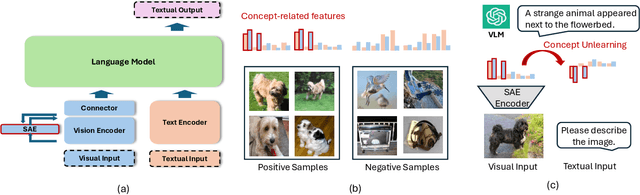
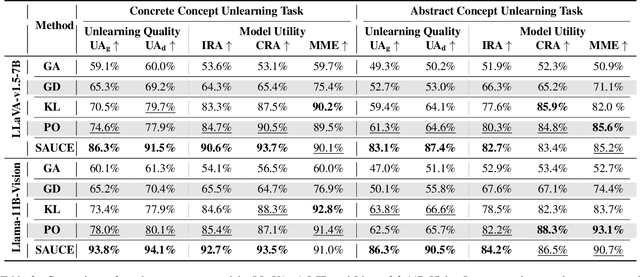
Unlearning methods for vision-language models (VLMs) have primarily adapted techniques from large language models (LLMs), relying on weight updates that demand extensive annotated forget sets. Moreover, these methods perform unlearning at a coarse granularity, often leading to excessive forgetting and reduced model utility. To address this issue, we introduce SAUCE, a novel method that leverages sparse autoencoders (SAEs) for fine-grained and selective concept unlearning in VLMs. Briefly, SAUCE first trains SAEs to capture high-dimensional, semantically rich sparse features. It then identifies the features most relevant to the target concept for unlearning. During inference, it selectively modifies these features to suppress specific concepts while preserving unrelated information. We evaluate SAUCE on two distinct VLMs, LLaVA-v1.5-7B and LLaMA-3.2-11B-Vision-Instruct, across two types of tasks: concrete concept unlearning (objects and sports scenes) and abstract concept unlearning (emotions, colors, and materials), encompassing a total of 60 concepts. Extensive experiments demonstrate that SAUCE outperforms state-of-the-art methods by 18.04% in unlearning quality while maintaining comparable model utility. Furthermore, we investigate SAUCE's robustness against widely used adversarial attacks, its transferability across models, and its scalability in handling multiple simultaneous unlearning requests. Our findings establish SAUCE as an effective and scalable solution for selective concept unlearning in VLMs.
Is Human-Like Text Liked by Humans? Multilingual Human Detection and Preference Against AI
Feb 17, 2025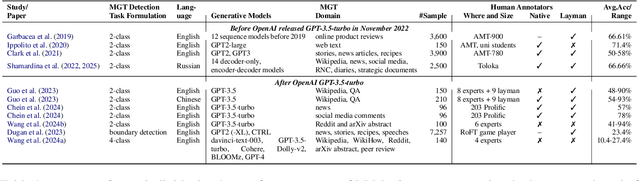
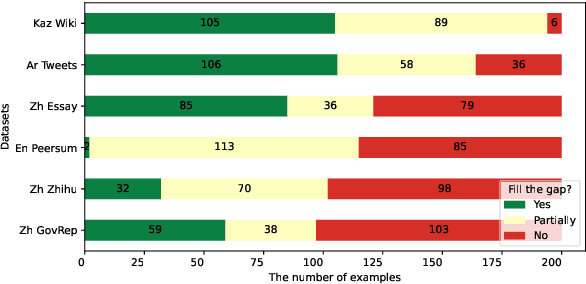
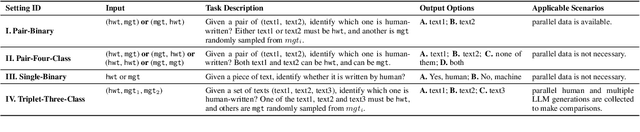
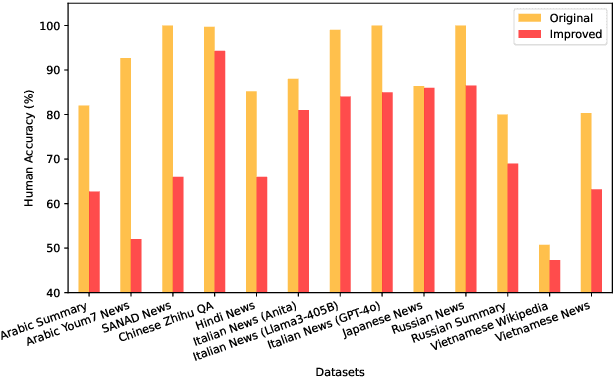
Prior studies have shown that distinguishing text generated by large language models (LLMs) from human-written one is highly challenging, and often no better than random guessing. To verify the generalizability of this finding across languages and domains, we perform an extensive case study to identify the upper bound of human detection accuracy. Across 16 datasets covering 9 languages and 9 domains, 19 annotators achieved an average detection accuracy of 87.6%, thus challenging previous conclusions. We find that major gaps between human and machine text lie in concreteness, cultural nuances, and diversity. Prompting by explicitly explaining the distinctions in the prompts can partially bridge the gaps in over 50% of the cases. However, we also find that humans do not always prefer human-written text, particularly when they cannot clearly identify its source.