 Add to Chrome
 Add to Firefox
 Add to Edge
PRESTO: Fast motion planning using diffusion models based on key-configuration environment representation
Sep 24, 2024
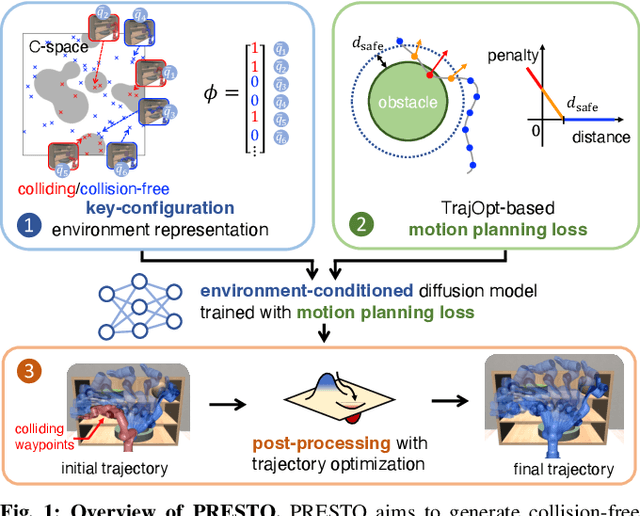


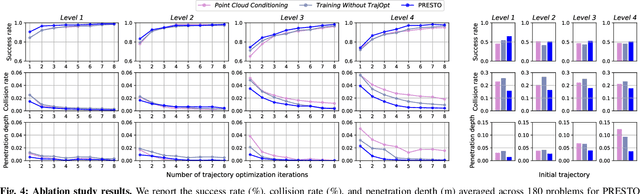
We introduce a learning-guided motion planning framework that provides initial seed trajectories using a diffusion model for trajectory optimization. Given a workspace, our method approximates the configuration space (C-space) obstacles through a key-configuration representation that consists of a sparse set of task-related key configurations, and uses this as an input to the diffusion model. The diffusion model integrates regularization terms that encourage collision avoidance and smooth trajectories during training, and trajectory optimization refines the generated seed trajectories to further correct any colliding segments. Our experimental results demonstrate that using high-quality trajectory priors, learned through our C-space-grounded diffusion model, enables efficient generation of collision-free trajectories in narrow-passage environments, outperforming prior learning- and planning-based baselines. Videos and additional materials can be found on the project page: https://kiwi-sherbet.github.io/PRESTO.

Deep Reinforcement Learning for Robotics: A Survey of Real-World Successes
Aug 07, 2024Reinforcement learning (RL), particularly its combination with deep neural networks referred to as deep RL (DRL), has shown tremendous promise across a wide range of applications, suggesting its potential for enabling the development of sophisticated robotic behaviors. Robotics problems, however, pose fundamental difficulties for the application of RL, stemming from the complexity and cost of interacting with the physical world. This article provides a modern survey of DRL for robotics, with a particular focus on evaluating the real-world successes achieved with DRL in realizing several key robotic competencies. Our analysis aims to identify the key factors underlying those exciting successes, reveal underexplored areas, and provide an overall characterization of the status of DRL in robotics. We highlight several important avenues for future work, emphasizing the need for stable and sample-efficient real-world RL paradigms, holistic approaches for discovering and integrating various competencies to tackle complex long-horizon, open-world tasks, and principled development and evaluation procedures. This survey is designed to offer insights for both RL practitioners and roboticists toward harnessing RL's power to create generally capable real-world robotic systems.
Longhorn: State Space Models are Amortized Online Learners
Jul 19, 2024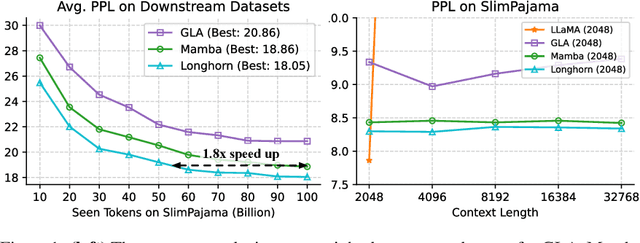
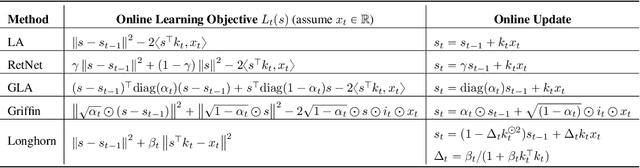
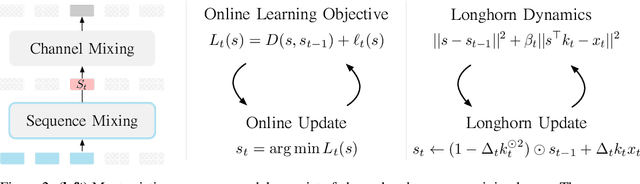

The most fundamental capability of modern AI methods such as Large Language Models (LLMs) is the ability to predict the next token in a long sequence of tokens, known as ``sequence modeling." Although the Transformers model is the current dominant approach to sequence modeling, its quadratic computational cost with respect to sequence length is a significant drawback. State-space models (SSMs) offer a promising alternative due to their linear decoding efficiency and high parallelizability during training. However, existing SSMs often rely on seemingly ad hoc linear recurrence designs. In this work, we explore SSM design through the lens of online learning, conceptualizing SSMs as meta-modules for specific online learning problems. This approach links SSM design to formulating precise online learning objectives, with state transition rules derived from optimizing these objectives. Based on this insight, we introduce a novel deep SSM architecture based on the implicit update for optimizing an online regression objective. Our experimental results show that our models outperform state-of-the-art SSMs, including the Mamba model, on standard sequence modeling benchmarks and language modeling tasks.
MEReQ: Max-Ent Residual-Q Inverse RL for Sample-Efficient Alignment from Intervention
Jun 24, 2024Aligning robot behavior with human preferences is crucial for deploying embodied AI agents in human-centered environments. A promising solution is interactive imitation learning from human intervention, where a human expert observes the policy's execution and provides interventions as feedback. However, existing methods often fail to utilize the prior policy efficiently to facilitate learning, thus hindering sample efficiency. In this work, we introduce MEReQ (Maximum-Entropy Residual-Q Inverse Reinforcement Learning), designed for sample-efficient alignment from human intervention. Instead of inferring the complete human behavior characteristics, MEReQ infers a residual reward function that captures the discrepancy between the human expert's and the prior policy's underlying reward functions. It then employs Residual Q-Learning (RQL) to align the policy with human preferences using this residual reward function. Extensive evaluations on simulated and real-world tasks demonstrate that MEReQ achieves sample-efficient policy alignment from human intervention.
A Super-human Vision-based Reinforcement Learning Agent for Autonomous Racing in Gran Turismo
Jun 18, 2024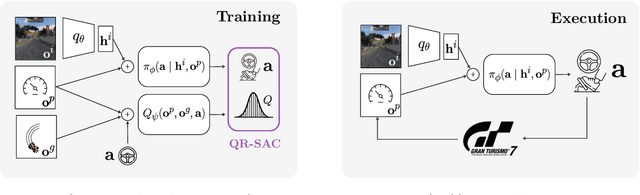


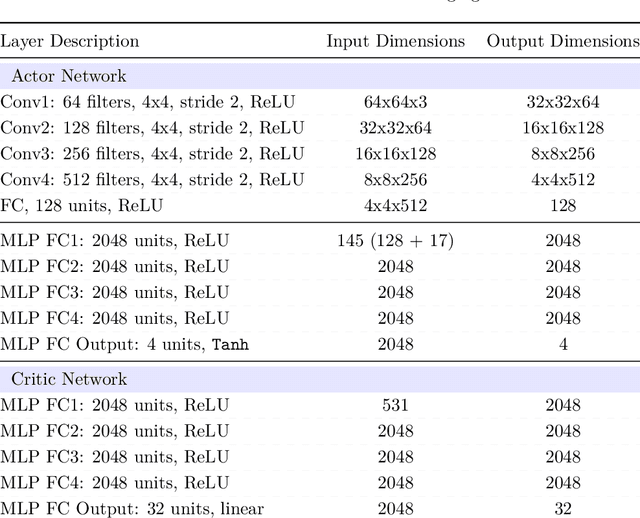
Racing autonomous cars faster than the best human drivers has been a longstanding grand challenge for the fields of Artificial Intelligence and robotics. Recently, an end-to-end deep reinforcement learning agent met this challenge in a high-fidelity racing simulator, Gran Turismo. However, this agent relied on global features that require instrumentation external to the car. This paper introduces, to the best of our knowledge, the first super-human car racing agent whose sensor input is purely local to the car, namely pixels from an ego-centric camera view and quantities that can be sensed from on-board the car, such as the car's velocity. By leveraging global features only at training time, the learned agent is able to outperform the best human drivers in time trial (one car on the track at a time) races using only local input features. The resulting agent is evaluated in Gran Turismo 7 on multiple tracks and cars. Detailed ablation experiments demonstrate the agent's strong reliance on visual inputs, making it the first vision-based super-human car racing agent.
Vision-based Manipulation from Single Human Video with Open-World Object Graphs
May 30, 2024We present an object-centric approach to empower robots to learn vision-based manipulation skills from human videos. We investigate the problem of imitating robot manipulation from a single human video in the open-world setting, where a robot must learn to manipulate novel objects from one video demonstration. We introduce ORION, an algorithm that tackles the problem by extracting an object-centric manipulation plan from a single RGB-D video and deriving a policy that conditions on the extracted plan. Our method enables the robot to learn from videos captured by daily mobile devices such as an iPad and generalize the policies to deployment environments with varying visual backgrounds, camera angles, spatial layouts, and novel object instances. We systematically evaluate our method on both short-horizon and long-horizon tasks, demonstrating the efficacy of ORION in learning from a single human video in the open world. Videos can be found in the project website https://ut-austin-rpl.github.io/ORION-release.
Towards Imitation Learning in Real World Unstructured Social Mini-Games in Pedestrian Crowds
May 26, 2024Imitation Learning (IL) strategies are used to generate policies for robot motion planning and navigation by learning from human trajectories. Recently, there has been a lot of excitement in applying IL in social interactions arising in urban environments such as university campuses, restaurants, grocery stores, and hospitals. However, obtaining numerous expert demonstrations in social settings might be expensive, risky, or even impossible. Current approaches therefore, focus only on simulated social interaction scenarios. This raises the question: \textit{How can a robot learn to imitate an expert demonstrator from real world multi-agent social interaction scenarios}? It remains unknown which, if any, IL methods perform well and what assumptions they require. We benchmark representative IL methods in real world social interaction scenarios on a motion planning task, using a novel pedestrian intersection dataset collected at the University of Texas at Austin campus. Our evaluation reveals two key findings: first, learning multi-agent cost functions is required for learning the diverse behavior modes of agents in tightly coupled interactions and second, conditioning the training of IL methods on partial state information or providing global information in simulation can improve imitation learning, especially in real world social interaction scenarios.
Robot Air Hockey: A Manipulation Testbed for Robot Learning with Reinforcement Learning
May 06, 2024


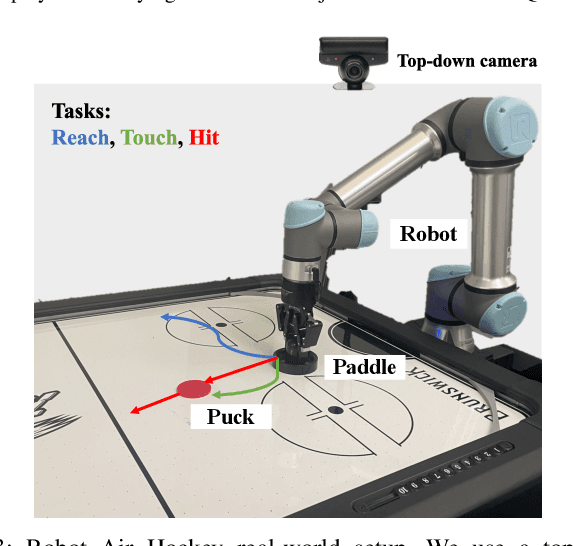
Reinforcement Learning is a promising tool for learning complex policies even in fast-moving and object-interactive domains where human teleoperation or hard-coded policies might fail. To effectively reflect this challenging category of tasks, we introduce a dynamic, interactive RL testbed based on robot air hockey. By augmenting air hockey with a large family of tasks ranging from easy tasks like reaching, to challenging ones like pushing a block by hitting it with a puck, as well as goal-based and human-interactive tasks, our testbed allows a varied assessment of RL capabilities. The robot air hockey testbed also supports sim-to-real transfer with three domains: two simulators of increasing fidelity and a real robot system. Using a dataset of demonstration data gathered through two teleoperation systems: a virtualized control environment, and human shadowing, we assess the testbed with behavior cloning, offline RL, and RL from scratch.
N-Agent Ad Hoc Teamwork
Apr 16, 2024Current approaches to learning cooperative behaviors in multi-agent settings assume relatively restrictive settings. In standard fully cooperative multi-agent reinforcement learning, the learning algorithm controls \textit{all} agents in the scenario, while in ad hoc teamwork, the learning algorithm usually assumes control over only a $\textit{single}$ agent in the scenario. However, many cooperative settings in the real world are much less restrictive. For example, in an autonomous driving scenario, a company might train its cars with the same learning algorithm, yet once on the road, these cars must cooperate with cars from another company. Towards generalizing the class of scenarios that cooperative learning methods can address, we introduce $N$-agent ad hoc teamwork, in which a set of autonomous agents must interact and cooperate with dynamically varying numbers and types of teammates at evaluation time. This paper formalizes the problem, and proposes the $\textit{Policy Optimization with Agent Modelling}$ (POAM) algorithm. POAM is a policy gradient, multi-agent reinforcement learning approach to the NAHT problem, that enables adaptation to diverse teammate behaviors by learning representations of teammate behaviors. Empirical evaluation on StarCraft II tasks shows that POAM improves cooperative task returns compared to baseline approaches, and enables out-of-distribution generalization to unseen teammates.
Dyna-LfLH: Learning Agile Navigation in Dynamic Environments from Learned Hallucination
Mar 25, 2024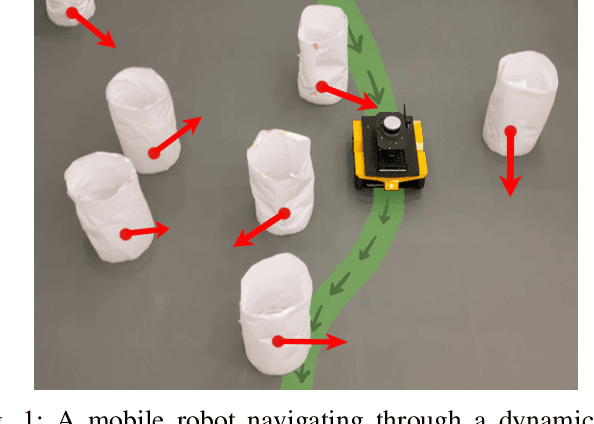
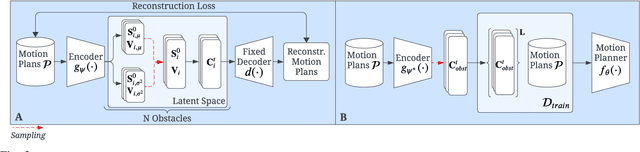

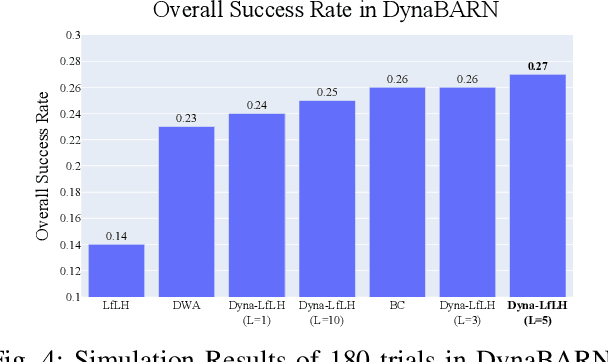
This paper presents a self-supervised learning method to safely learn a motion planner for ground robots to navigate environments with dense and dynamic obstacles. When facing highly-cluttered, fast-moving, hard-to-predict obstacles, classical motion planners may not be able to keep up with limited onboard computation. For learning-based planners, high-quality demonstrations are difficult to acquire for imitation learning while reinforcement learning becomes inefficient due to the high probability of collision during exploration. To safely and efficiently provide training data, the Learning from Hallucination (LfH) approaches synthesize difficult navigation environments based on past successful navigation experiences in relatively easy or completely open ones, but unfortunately cannot address dynamic obstacles. In our new Dynamic Learning from Learned Hallucination (Dyna-LfLH), we design and learn a novel latent distribution and sample dynamic obstacles from it, so the generated training data can be used to learn a motion planner to navigate in dynamic environments. Dyna-LfLH is evaluated on a ground robot in both simulated and physical environments and achieves up to 25% better success rate compared to baselines.