 Add to Chrome
 Add to Firefox
 Add to Edge
Learning Sampling Parameters for Diffusion Models
Jul 26, 2026
Text-to-image diffusion models expose many inference-time sampling parameters, including prompts, negative prompts, classifier-free guidance scales, and noise schedules. These parameters are typically manually chosen once and then held fixed across prompts and denoising timesteps, even though different prompts and stages of generation can benefit from different parameter values. We introduce LeSAMP, a framework for learning prompt-conditioned, timestep-varying sampling parameters. We formulate parameter selection as a reinforcement learning problem: Given a user prompt, a large language model is trained to emit schedules for the chosen sampling parameters. We optimize our model using rewards from human preference models and VLM-as-a-judge. We evaluate our model on Flux.1 [dev] and Stable Diffusion 3.5, and find that compared to baselines, LeSAMP has a win rate of up to 68.12% using human preference scores and 73.37% using VLM-as-a-judge. These gains are validated in a user study where we achieve win rates of up to 59.46% over previous baselines. Our results suggest that learned sampling-parameter policies provide a complementary approach to existing post-training methods for improving diffusion model outputs.

Reinforcement Learning for Dynamic Memory Allocation
Oct 20, 2024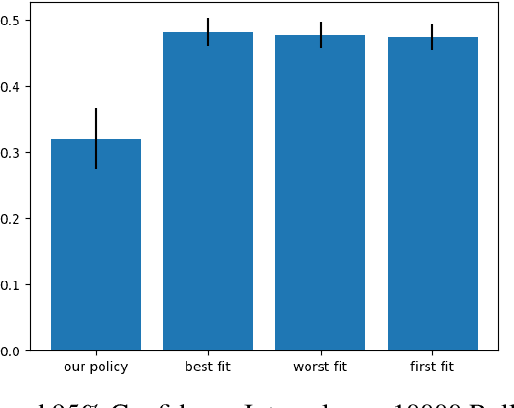
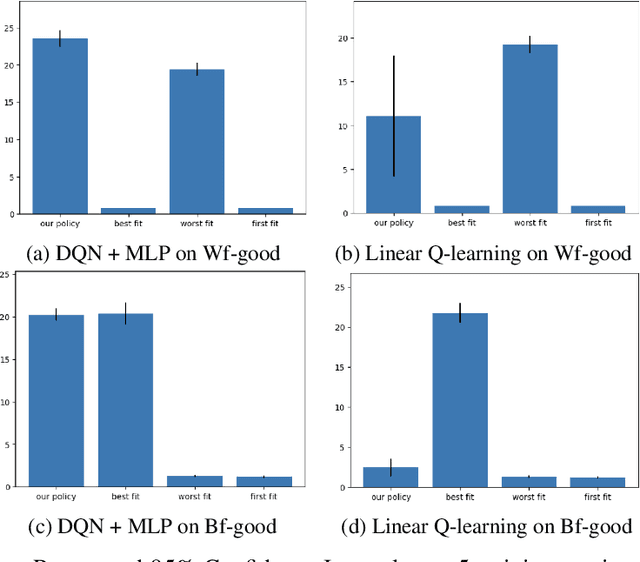
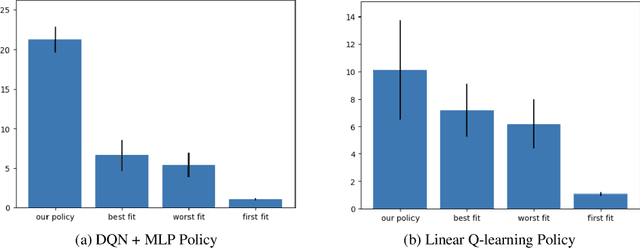
In recent years, reinforcement learning (RL) has gained popularity and has been applied to a wide range of tasks. One such popular domain where RL has been effective is resource management problems in systems. We look to extend work on RL for resource management problems by considering the novel domain of dynamic memory allocation management. We consider dynamic memory allocation to be a suitable domain for RL since current algorithms like first-fit, best-fit, and worst-fit can fail to adapt to changing conditions and can lead to fragmentation and suboptimal efficiency. In this paper, we present a framework in which an RL agent continuously learns from interactions with the system to improve memory management tactics. We evaluate our approach through various experiments using high-level and low-level action spaces and examine different memory allocation patterns. Our results show that RL can successfully train agents that can match and surpass traditional allocation strategies, particularly in environments characterized by adversarial request patterns. We also explore the potential of history-aware policies that leverage previous allocation requests to enhance the allocator's ability to handle complex request patterns. Overall, we find that RL offers a promising avenue for developing more adaptive and efficient memory allocation strategies, potentially overcoming limitations of hardcoded allocation algorithms.
Vision-based Manipulation from Single Human Video with Open-World Object Graphs
May 30, 2024We present an object-centric approach to empower robots to learn vision-based manipulation skills from human videos. We investigate the problem of imitating robot manipulation from a single human video in the open-world setting, where a robot must learn to manipulate novel objects from one video demonstration. We introduce ORION, an algorithm that tackles the problem by extracting an object-centric manipulation plan from a single RGB-D video and deriving a policy that conditions on the extracted plan. Our method enables the robot to learn from videos captured by daily mobile devices such as an iPad and generalize the policies to deployment environments with varying visual backgrounds, camera angles, spatial layouts, and novel object instances. We systematically evaluate our method on both short-horizon and long-horizon tasks, demonstrating the efficacy of ORION in learning from a single human video in the open world. Videos can be found in the project website https://ut-austin-rpl.github.io/ORION-release.