 Add to Chrome
 Add to Firefox
 Add to Edge
Tail-Aware HiFloat4: W4A4 Post-Training Quantization for Wan2.2
May 26, 2026
This report describes Tail-Aware HiFloat4, our submission to the low-bit text-to-video generation quantization challenge. Our method adapts the public ViDiT-Q post-training quantization pipeline to Wan2.2 under the HiFloat4 numerical format. We quantize the main linear layers in both Wan2.2 transformer modules with W4A4 HiFloat4 fake quantization, keep numerically sensitive boundary modules in high precision, and introduce an activation-tail-aware percentile calibration module for channel-mask construction. Together with compact PTQ-state restoration, this design reduces the influence of rare calibration outliers while keeping the runtime HiFloat4 arithmetic and sampling pipeline unchanged.

GS-STVSR: Ultra-Efficient Continuous Spatio-Temporal Video Super-Resolution via 2D Gaussian Splatting
Apr 20, 2026Continuous Spatio-Temporal Video Super-Resolution (C-STVSR) aims to simultaneously enhance the spatial resolution and frame rate of videos by arbitrary scale factors, offering greater flexibility than fixed-scale methods that are constrained by predefined upsampling ratios. In recent years, methods based on Implicit Neural Representations (INR) have made significant progress in C-STVSR by learning continuous mappings from spatio-temporal coordinates to pixel values. However, these methods fundamentally rely on dense pixel-wise grid queries, causing computational cost to scale linearly with the number of interpolated frames and severely limiting inference efficiency. We propose GS-STVSR, an ultra-efficient C-STVSR framework based on 2D Gaussian Splatting (2D-GS) that drives the spatiotemporal evolution of Gaussian kernels through continuous motion modeling, bypassing dense grid queries entirely. We exploit the strong temporal stability of covariance parameters for lightweight intermediate fitting, design an optical flow-guided motion module to derive Gaussian position and color at arbitrary time steps, introduce a Covariance resampling alignment module to prevent covariance drift, and propose an adaptive offset window for large-scale motion. Extensive experiments on Vid4, GoPro, and Adobe240 show that GS-STVSR achieves state-of-the-art quality across all benchmarks. Moreover, its inference time remains nearly constant at conventional temporal scales (X2--X8) and delivers over X3 speedup at extreme scales X32, demonstrating strong practical applicability.
Directing Mamba to Complex Textures: An Efficient Texture-Aware State Space Model for Image Restoration
Jan 27, 2025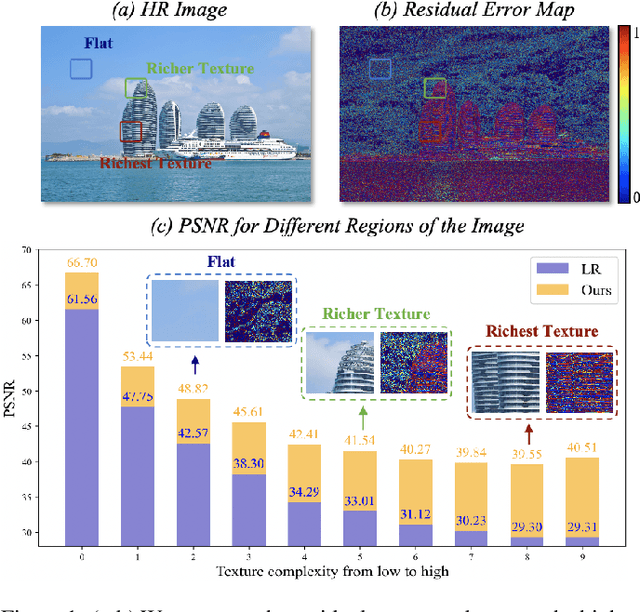


Image restoration aims to recover details and enhance contrast in degraded images. With the growing demand for high-quality imaging (\textit{e.g.}, 4K and 8K), achieving a balance between restoration quality and computational efficiency has become increasingly critical. Existing methods, primarily based on CNNs, Transformers, or their hybrid approaches, apply uniform deep representation extraction across the image. However, these methods often struggle to effectively model long-range dependencies and largely overlook the spatial characteristics of image degradation (regions with richer textures tend to suffer more severe damage), making it hard to achieve the best trade-off between restoration quality and efficiency. To address these issues, we propose a novel texture-aware image restoration method, TAMambaIR, which simultaneously perceives image textures and achieves a trade-off between performance and efficiency. Specifically, we introduce a novel Texture-Aware State Space Model, which enhances texture awareness and improves efficiency by modulating the transition matrix of the state-space equation and focusing on regions with complex textures. Additionally, we design a {Multi-Directional Perception Block} to improve multi-directional receptive fields while maintaining low computational overhead. Extensive experiments on benchmarks for image super-resolution, deraining, and low-light image enhancement demonstrate that TAMambaIR achieves state-of-the-art performance with significantly improved efficiency, establishing it as a robust and efficient framework for image restoration.