 Add to Chrome
 Add to Firefox
 Add to Edge
Improving Diffusion-based Data Augmentation with Inversion Spherical Interpolation
Aug 29, 2024
Data Augmentation (DA), \ie, synthesizing faithful and diverse samples to expand the original training set, is a prevalent and effective strategy to improve various visual recognition tasks. With the powerful image generation ability, diffusion-based DA has shown strong performance gains on different benchmarks. In this paper, we analyze today's diffusion-based DA methods, and argue that they cannot take account of both faithfulness and diversity, which are two critical keys for generating high-quality samples and boosting final classification performance. To this end, we propose a novel Diffusion-based Inversion Interpolation DA method: Diff-II. Specifically, Diff-II consists of three main steps: 1) Category concepts learning: Learning concept embeddings for each category. 2) Inversion interpolation: Calculating the inversion for each image, and conducting spherical interpolation for two randomly sampled inversions from the same category. 3) Two-stage denoising: Using different prompts to generate synthesized images in a coarse-to-fine manner. Extensive experiments on multiple image classification tasks (\eg, few-shot, long-tailed, and out-of-distribution classification) have demonstrated its effectiveness over state-of-the-art diffusion-based DA methods.

LLaVA-MoD: Making LLaVA Tiny via MoE Knowledge Distillation
Aug 28, 2024We introduce LLaVA-MoD, a novel framework designed to enable the efficient training of small-scale Multimodal Language Models (s-MLLM) by distilling knowledge from large-scale MLLM (l-MLLM). Our approach tackles two fundamental challenges in MLLM distillation. First, we optimize the network structure of s-MLLM by integrating a sparse Mixture of Experts (MoE) architecture into the language model, striking a balance between computational efficiency and model expressiveness. Second, we propose a progressive knowledge transfer strategy to ensure comprehensive knowledge migration. This strategy begins with mimic distillation, where we minimize the Kullback-Leibler (KL) divergence between output distributions to enable the student model to emulate the teacher network's understanding. Following this, we introduce preference distillation via Direct Preference Optimization (DPO), where the key lies in treating l-MLLM as the reference model. During this phase, the s-MLLM's ability to discriminate between superior and inferior examples is significantly enhanced beyond l-MLLM, leading to a better student that surpasses its teacher, particularly in hallucination benchmarks. Extensive experiments demonstrate that LLaVA-MoD outperforms existing models across various multimodal benchmarks while maintaining a minimal number of activated parameters and low computational costs. Remarkably, LLaVA-MoD, with only 2B activated parameters, surpasses Qwen-VL-Chat-7B by an average of 8.8% across benchmarks, using merely 0.3% of the training data and 23% trainable parameters. These results underscore LLaVA-MoD's ability to effectively distill comprehensive knowledge from its teacher model, paving the way for the development of more efficient MLLMs. The code will be available on: https://github.com/shufangxun/LLaVA-MoD.
Co-Fix3D: Enhancing 3D Object Detection with Collaborative Refinement
Aug 15, 2024In the realm of autonomous driving,accurately detecting occluded or distant objects,referred to as weak positive sample ,presents significant challenges. These challenges predominantly arise during query initialization, where an over-reliance on heatmap confidence often results in a high rate of false positives, consequently masking weaker detections and impairing system performance. To alleviate this issue, we propose a novel approach, Co-Fix3D, which employs a collaborative hybrid multi-stage parallel query generation mechanism for BEV representations. Our method incorporates the Local-Global Feature Enhancement (LGE) module, which refines BEV features to more effectively highlight weak positive samples. It uniquely leverages the Discrete Wavelet Transform (DWT) for accurate noise reduction and features refinement in localized areas, and incorporates an attention mechanism to more comprehensively optimize global BEV features. Moreover, our method increases the volume of BEV queries through a multi-stage parallel processing of the LGE, significantly enhancing the probability of selecting weak positive samples. This enhancement not only improves training efficiency within the decoder framework but also boosts overall system performance. Notably, Co-Fix3D achieves superior results on the stringent nuScenes benchmark, outperforming all previous models with a 69.1% mAP and 72.9% NDS on the LiDAR-based benchmark, and 72.3% mAP and 74.1% NDS on the multi-modality benchmark, without relying on test-time augmentation or additional datasets. The source code will be made publicly available upon acceptance.
An Efficient and Effective Transformer Decoder-Based Framework for Multi-Task Visual Grounding
Aug 02, 2024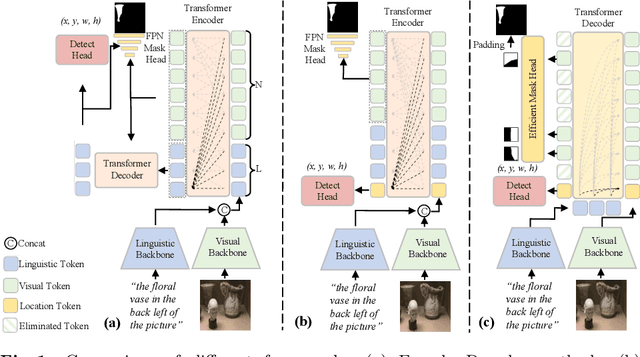
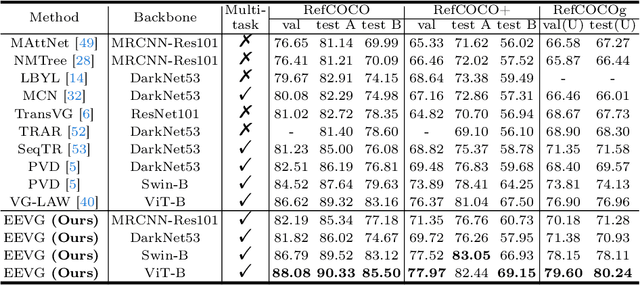
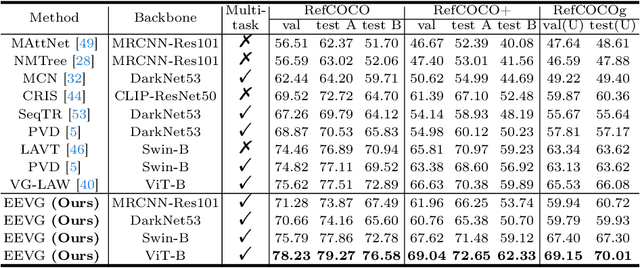
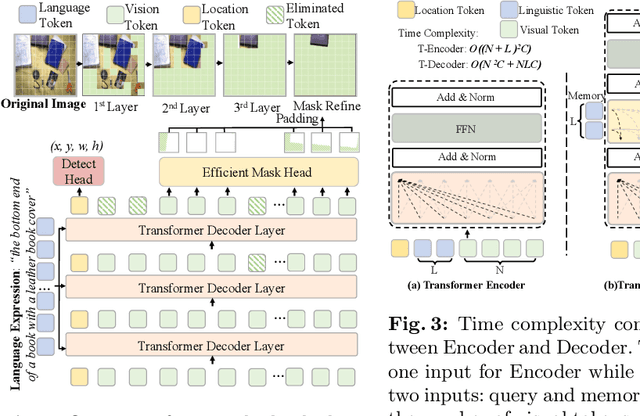
Most advanced visual grounding methods rely on Transformers for visual-linguistic feature fusion. However, these Transformer-based approaches encounter a significant drawback: the computational costs escalate quadratically due to the self-attention mechanism in the Transformer Encoder, particularly when dealing with high-resolution images or long context sentences. This quadratic increase in computational burden restricts the applicability of visual grounding to more intricate scenes, such as conversation-based reasoning segmentation, which involves lengthy language expressions. In this paper, we propose an efficient and effective multi-task visual grounding (EEVG) framework based on Transformer Decoder to address this issue, which reduces the cost in both language and visual aspects. In the language aspect, we employ the Transformer Decoder to fuse visual and linguistic features, where linguistic features are input as memory and visual features as queries. This allows fusion to scale linearly with language expression length. In the visual aspect, we introduce a parameter-free approach to reduce computation by eliminating background visual tokens based on attention scores. We then design a light mask head to directly predict segmentation masks from the remaining sparse feature maps. Extensive results and ablation studies on benchmarks demonstrate the efficiency and effectiveness of our approach. Code is available in https://github.com/chenwei746/EEVG.
From Easy to Hard: Learning Curricular Shape-aware Features for Robust Panoptic Scene Graph Generation
Jul 12, 2024Panoptic Scene Graph Generation (PSG) aims to generate a comprehensive graph-structure representation based on panoptic segmentation masks. Despite remarkable progress in PSG, almost all existing methods neglect the importance of shape-aware features, which inherently focus on the contours and boundaries of objects. To bridge this gap, we propose a model-agnostic Curricular shApe-aware FEature (CAFE) learning strategy for PSG. Specifically, we incorporate shape-aware features (i.e., mask features and boundary features) into PSG, moving beyond reliance solely on bbox features. Furthermore, drawing inspiration from human cognition, we propose to integrate shape-aware features in an easy-to-hard manner. To achieve this, we categorize the predicates into three groups based on cognition learning difficulty and correspondingly divide the training process into three stages. Each stage utilizes a specialized relation classifier to distinguish specific groups of predicates. As the learning difficulty of predicates increases, these classifiers are equipped with features of ascending complexity. We also incorporate knowledge distillation to retain knowledge acquired in earlier stages. Due to its model-agnostic nature, CAFE can be seamlessly incorporated into any PSG model. Extensive experiments and ablations on two PSG tasks under both robust and zero-shot PSG have attested to the superiority and robustness of our proposed CAFE, which outperforms existing state-of-the-art methods by a large margin.
SHERL: Synthesizing High Accuracy and Efficient Memory for Resource-Limited Transfer Learning
Jul 10, 2024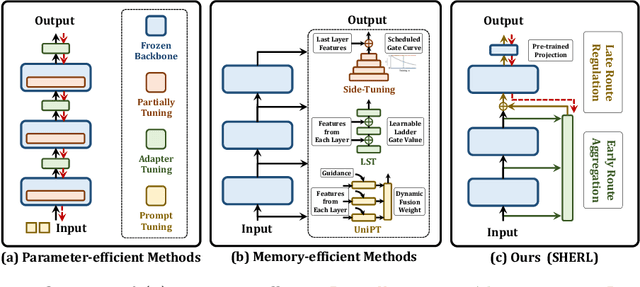
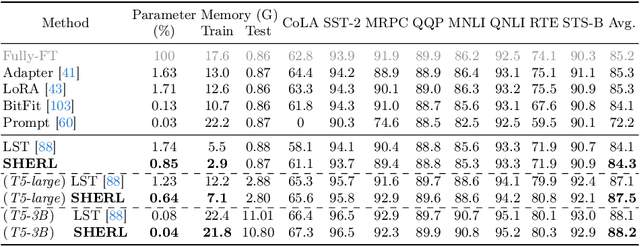
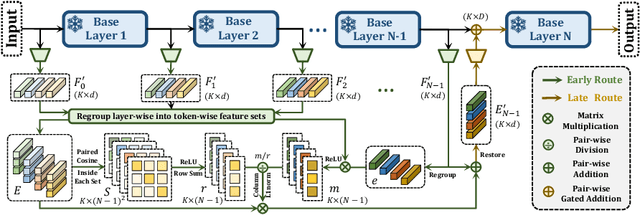
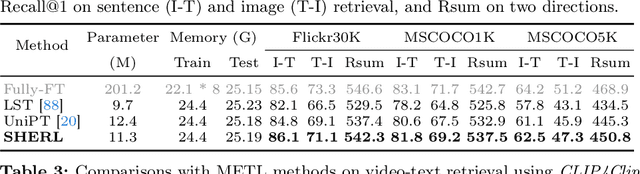
Parameter-efficient transfer learning (PETL) has emerged as a flourishing research field for adapting large pre-trained models to downstream tasks, greatly reducing trainable parameters while grappling with memory challenges during fine-tuning. To address it, memory-efficient series (METL) avoid backpropagating gradients through the large backbone. However, they compromise by exclusively relying on frozen intermediate outputs and limiting the exhaustive exploration of prior knowledge from pre-trained models. Moreover, the dependency and redundancy between cross-layer features are frequently overlooked, thereby submerging more discriminative representations and causing an inherent performance gap (vs. conventional PETL methods). Hence, we propose an innovative METL strategy called SHERL for resource-limited scenarios to decouple the entire adaptation into two successive and complementary processes. In the early route, intermediate outputs are consolidated via an anti-redundancy operation, enhancing their compatibility for subsequent interactions; thereby in the late route, utilizing minimal late pre-trained layers could alleviate the peak demand on memory overhead and regulate these fairly flexible features into more adaptive and powerful representations for new domains. Extensive ablations on vision-and-language and language-only tasks show that SHERL combines the strengths of both parameter and memory-efficient techniques, performing on-par or better across diverse architectures with lower memory during fine-tuning. Our code is publicly available at: https://github.com/Paranioar/SHERL.
LightStereo: Channel Boost Is All Your Need for Efficient 2D Cost Aggregation
Jun 28, 2024We present LightStereo, a cutting-edge stereo-matching network crafted to accelerate the matching process. Departing from conventional methodologies that rely on aggregating computationally intensive 4D costs, LightStereo adopts the 3D cost volume as a lightweight alternative. While similar approaches have been explored previously, our breakthrough lies in enhancing performance through a dedicated focus on the channel dimension of the 3D cost volume, where the distribution of matching costs is encapsulated. Our exhaustive exploration has yielded plenty of strategies to amplify the capacity of the pivotal dimension, ensuring both precision and efficiency. We compare the proposed LightStereo with existing state-of-the-art methods across various benchmarks, which demonstrate its superior performance in speed, accuracy, and resource utilization. LightStereo achieves a competitive EPE metric in the SceneFlow datasets while demanding a minimum of only 22 GFLOPs, with an inference time of just 17 ms. Our comprehensive analysis reveals the effect of 2D cost aggregation for stereo matching, paving the way for real-world applications of efficient stereo systems. Code will be available at \url{https://github.com/XiandaGuo/OpenStereo}.
TemPrompt: Multi-Task Prompt Learning for Temporal Relation Extraction in RAG-based Crowdsourcing Systems
Jun 25, 2024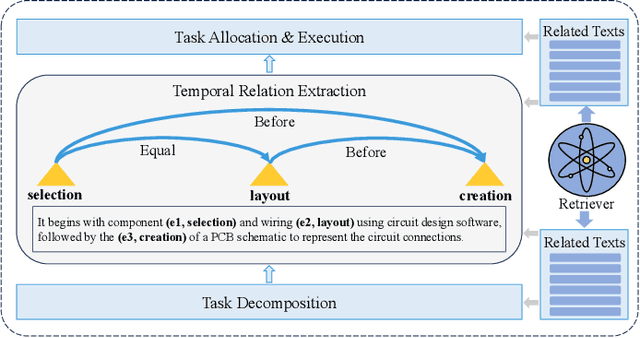
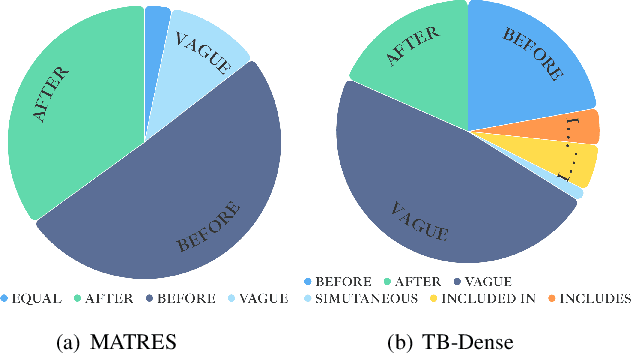
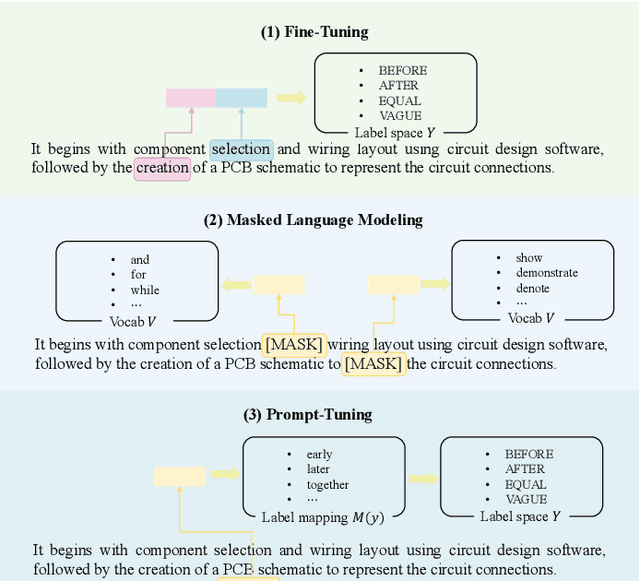
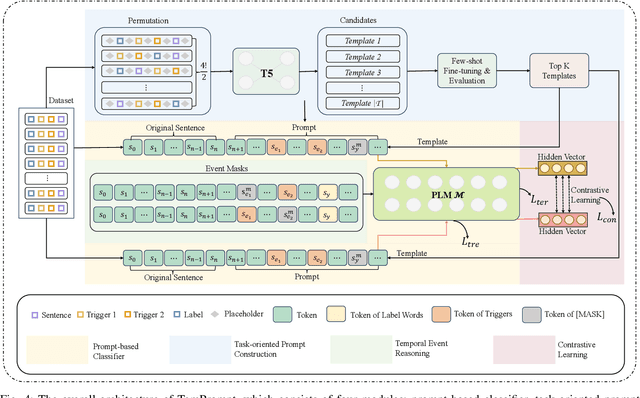
Temporal relation extraction (TRE) aims to grasp the evolution of events or actions, and thus shape the workflow of associated tasks, so it holds promise in helping understand task requests initiated by requesters in crowdsourcing systems. However, existing methods still struggle with limited and unevenly distributed annotated data. Therefore, inspired by the abundant global knowledge stored within pre-trained language models (PLMs), we propose a multi-task prompt learning framework for TRE (TemPrompt), incorporating prompt tuning and contrastive learning to tackle these issues. To elicit more effective prompts for PLMs, we introduce a task-oriented prompt construction approach that thoroughly takes the myriad factors of TRE into consideration for automatic prompt generation. In addition, we present temporal event reasoning as a supplement to bolster the model's focus on events and temporal cues. The experimental results demonstrate that TemPrompt outperforms all compared baselines across the majority of metrics under both standard and few-shot settings. A case study is provided to validate its effectiveness in crowdsourcing scenarios.
MIND: Multimodal Shopping Intention Distillation from Large Vision-language Models for E-commerce Purchase Understanding
Jun 15, 2024

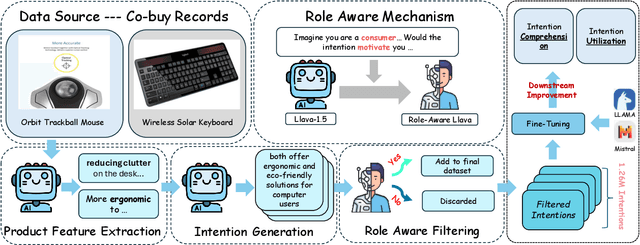

Improving user experience and providing personalized search results in E-commerce platforms heavily rely on understanding purchase intention. However, existing methods for acquiring large-scale intentions bank on distilling large language models with human annotation for verification. Such an approach tends to generate product-centric intentions, overlook valuable visual information from product images, and incurs high costs for scalability. To address these issues, we introduce MIND, a multimodal framework that allows Large Vision-Language Models (LVLMs) to infer purchase intentions from multimodal product metadata and prioritize human-centric ones. Using Amazon Review data, we apply MIND and create a multimodal intention knowledge base, which contains 1,264,441 million intentions derived from 126,142 co-buy shopping records across 107,215 products. Extensive human evaluations demonstrate the high plausibility and typicality of our obtained intentions and validate the effectiveness of our distillation framework and filtering mechanism. Additional experiments reveal that our obtained intentions significantly enhance large language models in two intention comprehension tasks.
CoMM: A Coherent Interleaved Image-Text Dataset for Multimodal Understanding and Generation
Jun 15, 2024
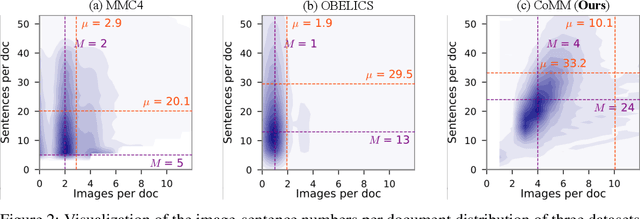
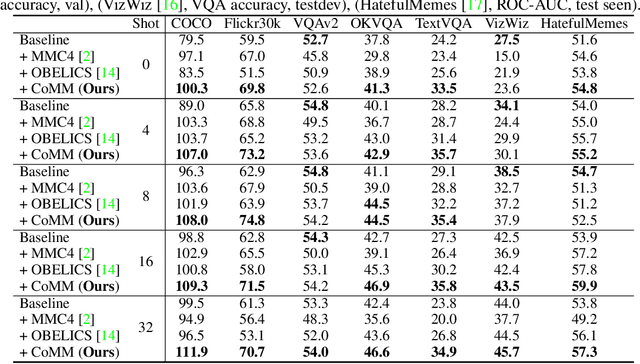
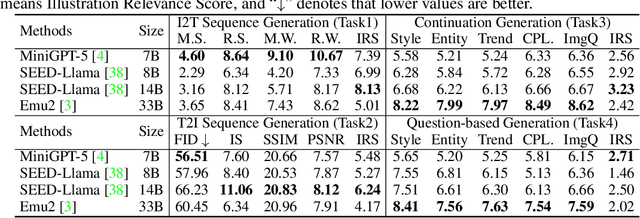
Interleaved image-text generation has emerged as a crucial multimodal task, aiming at creating sequences of interleaved visual and textual content given a query. Despite notable advancements in recent multimodal large language models (MLLMs), generating integrated image-text sequences that exhibit narrative coherence and entity and style consistency remains challenging due to poor training data quality. To address this gap, we introduce CoMM, a high-quality Coherent interleaved image-text MultiModal dataset designed to enhance the coherence, consistency, and alignment of generated multimodal content. Initially, CoMM harnesses raw data from diverse sources, focusing on instructional content and visual storytelling, establishing a foundation for coherent and consistent content. To further refine the data quality, we devise a multi-perspective filter strategy that leverages advanced pre-trained models to ensure the development of sentences, consistency of inserted images, and semantic alignment between them. Various quality evaluation metrics are designed to prove the high quality of the filtered dataset. Meanwhile, extensive few-shot experiments on various downstream tasks demonstrate CoMM's effectiveness in significantly enhancing the in-context learning capabilities of MLLMs. Moreover, we propose four new tasks to evaluate MLLMs' interleaved generation abilities, supported by a comprehensive evaluation framework. We believe CoMM opens a new avenue for advanced MLLMs with superior multimodal in-context learning and understanding ability.