 Add to Chrome
 Add to Firefox
 Add to Edge
Enhancing Multi-hop Reasoning through Knowledge Erasure in Large Language Model Editing
Aug 22, 2024
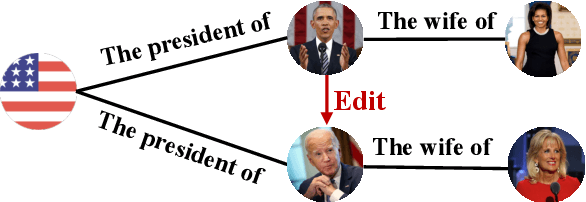


Large language models (LLMs) face challenges with internal knowledge inaccuracies and outdated information. Knowledge editing has emerged as a pivotal approach to mitigate these issues. Although current knowledge editing techniques exhibit promising performance in single-hop reasoning tasks, they show limitations when applied to multi-hop reasoning. Drawing on cognitive neuroscience and the operational mechanisms of LLMs, we hypothesize that the residual single-hop knowledge after editing causes edited models to revert to their original answers when processing multi-hop questions, thereby undermining their performance in multihop reasoning tasks. To validate this hypothesis, we conduct a series of experiments that empirically confirm our assumptions. Building on the validated hypothesis, we propose a novel knowledge editing method that incorporates a Knowledge Erasure mechanism for Large language model Editing (KELE). Specifically, we design an erasure function for residual knowledge and an injection function for new knowledge. Through joint optimization, we derive the optimal recall vector, which is subsequently utilized within a rank-one editing framework to update the parameters of targeted model layers. Extensive experiments on GPT-J and GPT-2 XL demonstrate that KELE substantially enhances the multi-hop reasoning capability of edited LLMs.

A Systematic Evaluation of Generated Time Series and Their Effects in Self-Supervised Pretraining
Aug 15, 2024


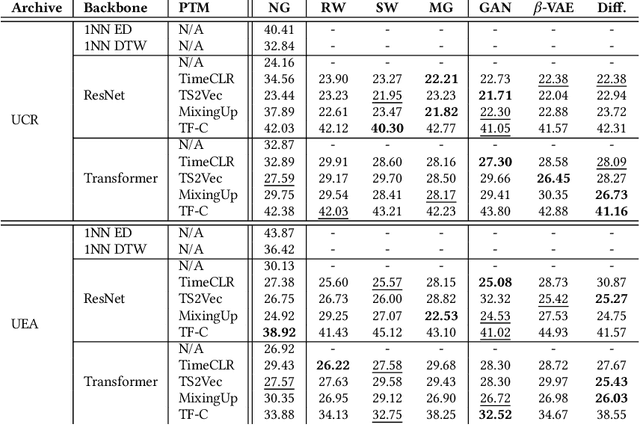
Self-supervised Pretrained Models (PTMs) have demonstrated remarkable performance in computer vision and natural language processing tasks. These successes have prompted researchers to design PTMs for time series data. In our experiments, most self-supervised time series PTMs were surpassed by simple supervised models. We hypothesize this undesired phenomenon may be caused by data scarcity. In response, we test six time series generation methods, use the generated data in pretraining in lieu of the real data, and examine the effects on classification performance. Our results indicate that replacing a real-data pretraining set with a greater volume of only generated samples produces noticeable improvement.
Hierarchical Structured Neural Network for Retrieval
Aug 13, 2024
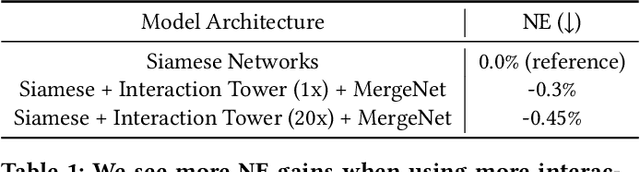
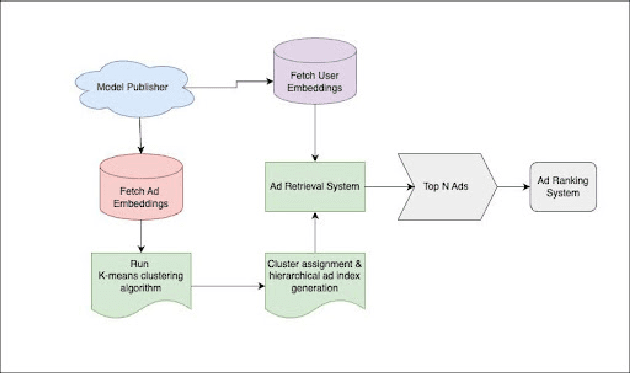

Embedding Based Retrieval (EBR) is a crucial component of the retrieval stage in (Ads) Recommendation System that utilizes Two Tower or Siamese Networks to learn embeddings for both users and items (ads). It then employs an Approximate Nearest Neighbor Search (ANN) to efficiently retrieve the most relevant ads for a specific user. Despite the recent rise to popularity in the industry, they have a couple of limitations. Firstly, Two Tower model architecture uses a single dot product interaction which despite their efficiency fail to capture the data distribution in practice. Secondly, the centroid representation and cluster assignment, which are components of ANN, occur after the training process has been completed. As a result, they do not take into account the optimization criteria used for retrieval model. In this paper, we present Hierarchical Structured Neural Network (HSNN), a deployed jointly optimized hierarchical clustering and neural network model that can take advantage of sophisticated interactions and model architectures that are more common in the ranking stages while maintaining a sub-linear inference cost. We achieve 6.5% improvement in offline evaluation and also demonstrate 1.22% online gains through A/B experiments. HSNN has been successfully deployed into the Ads Recommendation system and is currently handling major portion of the traffic. The paper shares our experience in developing this system, dealing with challenges like freshness, volatility, cold start recommendations, cluster collapse and lessons deploying the model in a large scale retrieval production system.
DIVE: Subgraph Disagreement for Graph Out-of-Distribution Generalization
Aug 08, 2024This paper addresses the challenge of out-of-distribution (OOD) generalization in graph machine learning, a field rapidly advancing yet grappling with the discrepancy between source and target data distributions. Traditional graph learning algorithms, based on the assumption of uniform distribution between training and test data, falter in real-world scenarios where this assumption fails, resulting in suboptimal performance. A principal factor contributing to this suboptimal performance is the inherent simplicity bias of neural networks trained through Stochastic Gradient Descent (SGD), which prefer simpler features over more complex yet equally or more predictive ones. This bias leads to a reliance on spurious correlations, adversely affecting OOD performance in various tasks such as image recognition, natural language understanding, and graph classification. Current methodologies, including subgraph-mixup and information bottleneck approaches, have achieved partial success but struggle to overcome simplicity bias, often reinforcing spurious correlations. To tackle this, we propose DIVE, training a collection of models to focus on all label-predictive subgraphs by encouraging the models to foster divergence on the subgraph mask, which circumvents the limitation of a model solely focusing on the subgraph corresponding to simple structural patterns. Specifically, we employs a regularizer to punish overlap in extracted subgraphs across models, thereby encouraging different models to concentrate on distinct structural patterns. Model selection for robust OOD performance is achieved through validation accuracy. Tested across four datasets from GOOD benchmark and one dataset from DrugOOD benchmark, our approach demonstrates significant improvement over existing methods, effectively addressing the simplicity bias and enhancing generalization in graph machine learning.
SAM2-PATH: A better segment anything model for semantic segmentation in digital pathology
Aug 07, 2024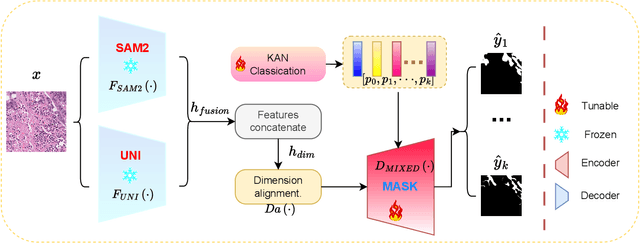
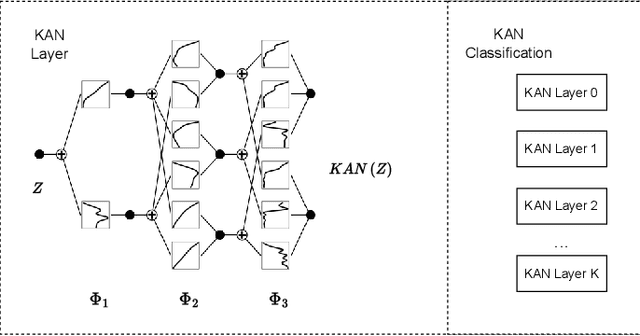
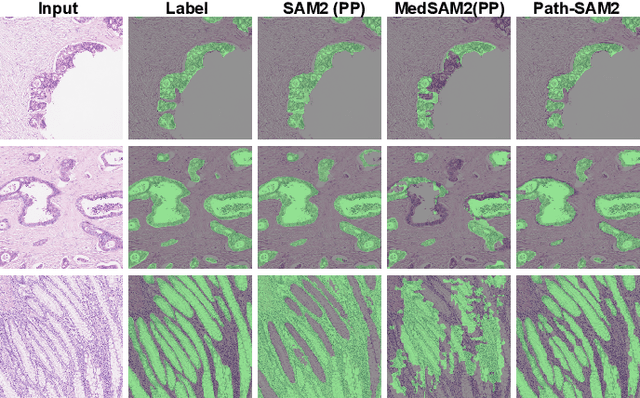
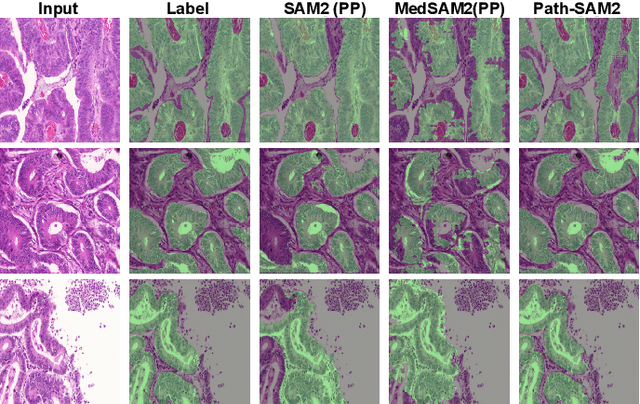
The semantic segmentation task in pathology plays an indispensable role in assisting physicians in determining the condition of tissue lesions. Foundation models, such as the SAM (Segment Anything Model) and SAM2, exhibit exceptional performance in instance segmentation within everyday natural scenes. SAM-PATH has also achieved impressive results in semantic segmentation within the field of pathology. However, in computational pathology, the models mentioned above still have the following limitations. The pre-trained encoder models suffer from a scarcity of pathology image data; SAM and SAM2 are not suitable for semantic segmentation. In this paper, we have designed a trainable Kolmogorov-Arnold Networks(KAN) classification module within the SAM2 workflow, and we have introduced the largest pretrained vision encoder for histopathology (UNI) to date. Our proposed framework, SAM2-PATH, augments SAM2's capability to perform semantic segmentation in digital pathology autonomously, eliminating the need for human provided input prompts. The experimental results demonstrate that, after fine-tuning the KAN classification module and decoder, Our dataset has achieved competitive results on publicly available pathology data. The code has been open-sourced and can be found at the following address: https://github.com/simzhangbest/SAM2PATH.
Quantum Long Short-Term Memory for Drug Discovery
Jul 29, 2024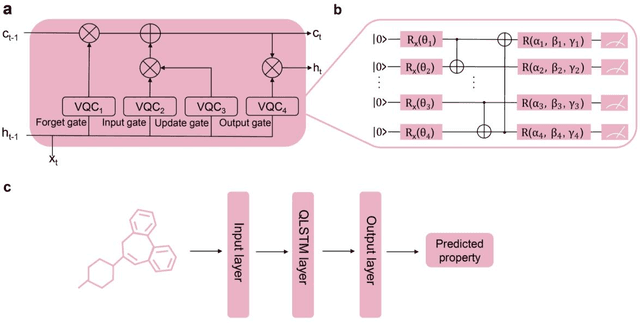


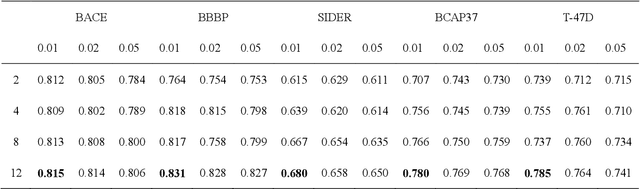
Quantum computing combined with machine learning (ML) is an extremely promising research area, with numerous studies demonstrating that quantum machine learning (QML) is expected to solve scientific problems more effectively than classical ML. In this work, we successfully apply QML to drug discovery, showing that QML can significantly improve model performance and achieve faster convergence compared to classical ML. Moreover, we demonstrate that the model accuracy of the QML improves as the number of qubits increases. We also introduce noise to the QML model and find that it has little effect on our experimental conclusions, illustrating the high robustness of the QML model. This work highlights the potential application of quantum computing to yield significant benefits for scientific advancement as the qubit quantity increase and quality improvement in the future.
Navigating the Noisy Crowd: Finding Key Information for Claim Verification
Jul 17, 2024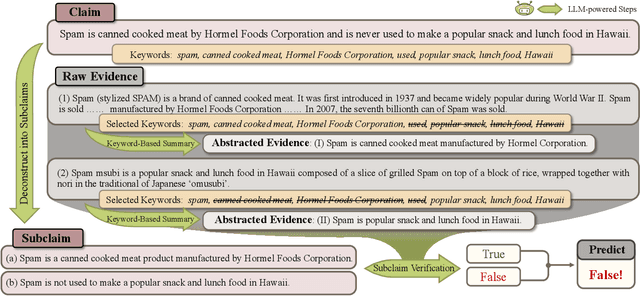
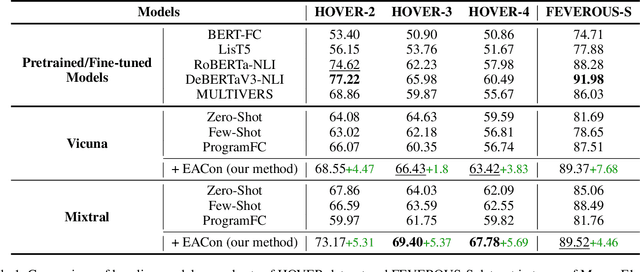
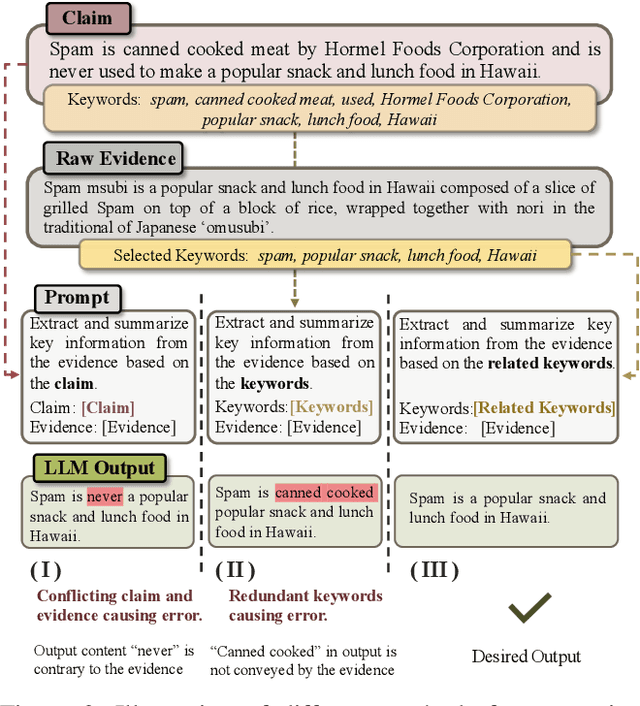
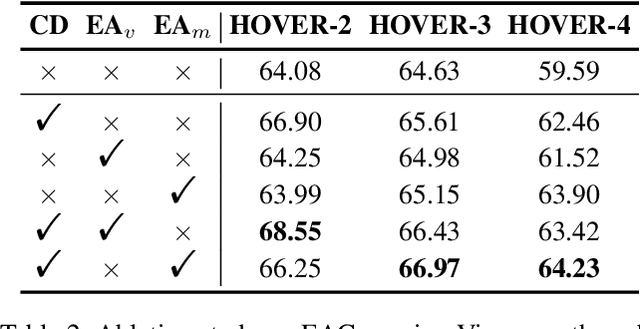
Claim verification is a task that involves assessing the truthfulness of a given claim based on multiple evidence pieces. Using large language models (LLMs) for claim verification is a promising way. However, simply feeding all the evidence pieces to an LLM and asking if the claim is factual does not yield good results. The challenge lies in the noisy nature of both the evidence and the claim: evidence passages typically contain irrelevant information, with the key facts hidden within the context, while claims often convey multiple aspects simultaneously. To navigate this "noisy crowd" of information, we propose EACon (Evidence Abstraction and Claim Deconstruction), a framework designed to find key information within evidence and verify each aspect of a claim separately. EACon first finds keywords from the claim and employs fuzzy matching to select relevant keywords for each raw evidence piece. These keywords serve as a guide to extract and summarize critical information into abstracted evidence. Subsequently, EACon deconstructs the original claim into subclaims, which are then verified against both abstracted and raw evidence individually. We evaluate EACon using two open-source LLMs on two challenging datasets. Results demonstrate that EACon consistently and substantially improve LLMs' performance in claim verification.
SliceMamba for Medical Image Segmentation
Jul 11, 2024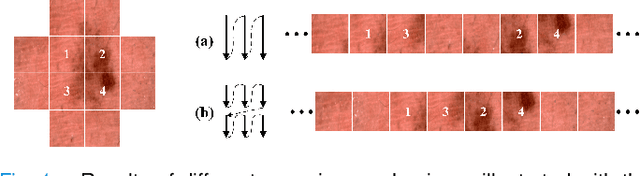
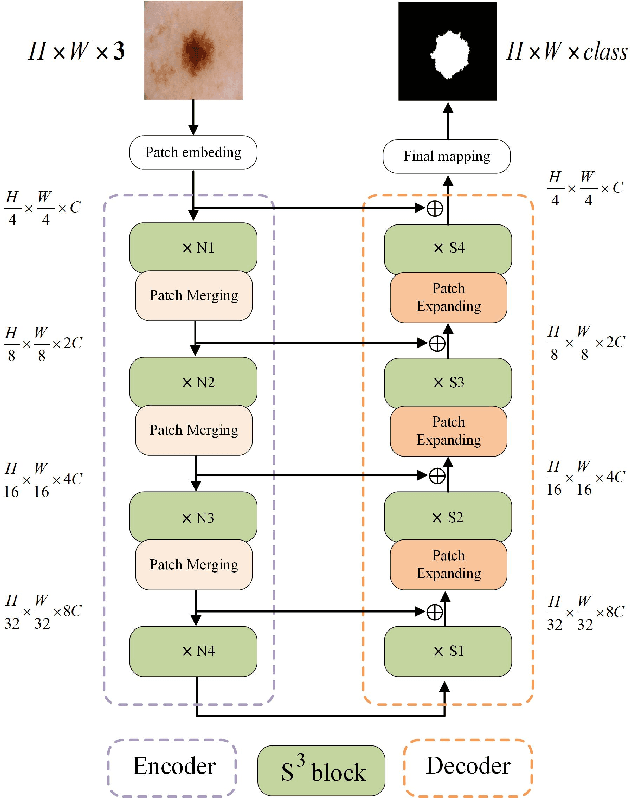
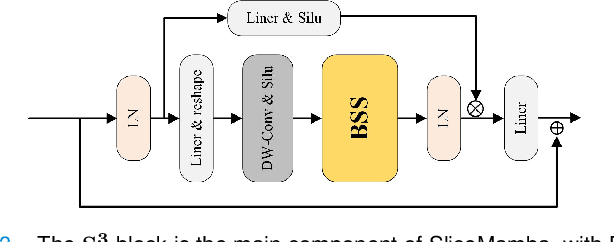
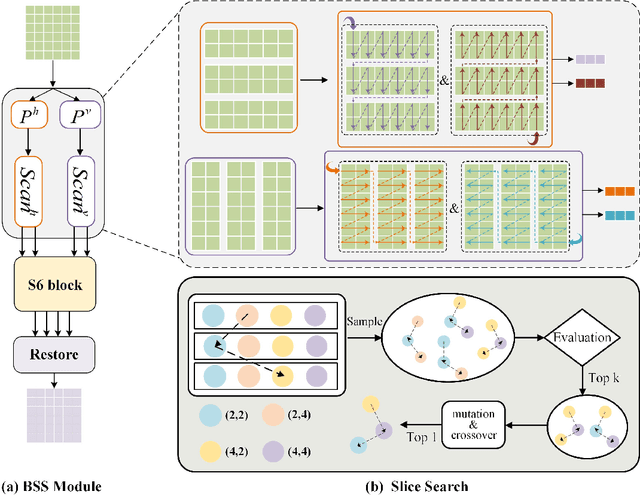
Despite the progress made in Mamba-based medical image segmentation models, current methods utilizing unidirectional or multi-directional feature scanning mechanisms fail to well model dependencies between neighboring positions in the image, hindering the effective modeling of local features. However, local features are crucial for medical image segmentation as they provide vital information about lesions and tissue structures. To address this limitation, we propose a simple yet effective method named SliceMamba, a locally sensitive pure Mamba medical image segmentation model. The proposed SliceMamba includes an efffcient Bidirectional Slice Scan module (BSS), which performs bidirectional feature segmentation while employing varied scanning mechanisms for distinct features. This ensures that spatially adjacent features maintain proximity in the scanning sequence, thereby enhancing segmentation performance. Extensive experiments on skin lesion and polyp segmentation datasets validate the effectiveness of our method.
Parametric Primitive Analysis of CAD Sketches with Vision Transformer
Jun 29, 2024


The design and analysis of Computer-Aided Design (CAD) sketches play a crucial role in industrial product design, primarily involving CAD primitives and their inter-primitive constraints. To address challenges related to error accumulation in autoregressive models and the complexities associated with self-supervised model design for this task, we propose a two-stage network framework. This framework consists of a primitive network and a constraint network, transforming the sketch analysis task into a set prediction problem to enhance the effective handling of primitives and constraints. By decoupling target types from parameters, the model gains increased flexibility and optimization while reducing complexity. Additionally, the constraint network incorporates a pointer module to explicitly indicate the relationship between constraint parameters and primitive indices, enhancing interpretability and performance. Qualitative and quantitative analyses on two publicly available datasets demonstrate the superiority of this method.
Beyond LLaVA-HD: Diving into High-Resolution Large Multimodal Models
Jun 12, 2024Seeing clearly with high resolution is a foundation of Large Multimodal Models (LMMs), which has been proven to be vital for visual perception and reasoning. Existing works usually employ a straightforward resolution upscaling method, where the image consists of global and local branches, with the latter being the sliced image patches but resized to the same resolution as the former. This means that higher resolution requires more local patches, resulting in exorbitant computational expenses, and meanwhile, the dominance of local image tokens may diminish the global context. In this paper, we dive into the problems and propose a new framework as well as an elaborate optimization strategy. Specifically, we extract contextual information from the global view using a mixture of adapters, based on the observation that different adapters excel at different tasks. With regard to local patches, learnable query embeddings are introduced to reduce image tokens, the most important tokens accounting for the user question will be further selected by a similarity-based selector. Our empirical results demonstrate a `less is more' pattern, where \textit{utilizing fewer but more informative local image tokens leads to improved performance}. Besides, a significant challenge lies in the training strategy, as simultaneous end-to-end training of the global mining block and local compression block does not yield optimal results. We thus advocate for an alternating training way, ensuring balanced learning between global and local aspects. Finally, we also introduce a challenging dataset with high requirements for image detail, enhancing the training of the local compression layer. The proposed method, termed LMM with Sophisticated Tasks, Local image compression, and Mixture of global Experts (SliME), achieves leading performance across various benchmarks with only 2 million training data.