 Add to Chrome
 Add to Firefox
 Add to Edge
ConDense: Consistent 2D/3D Pre-training for Dense and Sparse Features from Multi-View Images
Aug 30, 2024

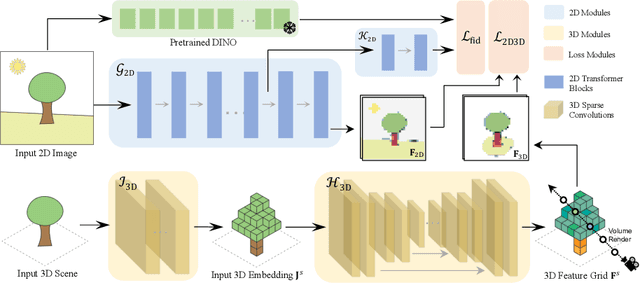
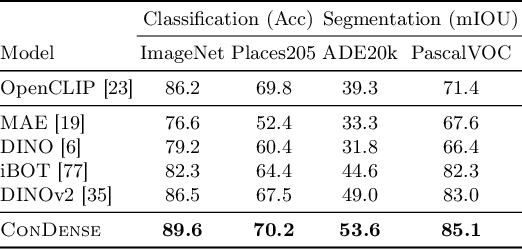
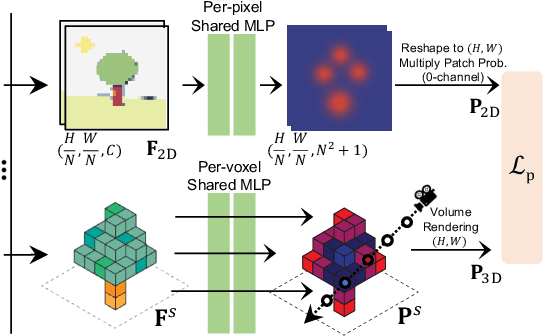
To advance the state of the art in the creation of 3D foundation models, this paper introduces the ConDense framework for 3D pre-training utilizing existing pre-trained 2D networks and large-scale multi-view datasets. We propose a novel 2D-3D joint training scheme to extract co-embedded 2D and 3D features in an end-to-end pipeline, where 2D-3D feature consistency is enforced through a volume rendering NeRF-like ray marching process. Using dense per pixel features we are able to 1) directly distill the learned priors from 2D models to 3D models and create useful 3D backbones, 2) extract more consistent and less noisy 2D features, 3) formulate a consistent embedding space where 2D, 3D, and other modalities of data (e.g., natural language prompts) can be jointly queried. Furthermore, besides dense features, ConDense can be trained to extract sparse features (e.g., key points), also with 2D-3D consistency -- condensing 3D NeRF representations into compact sets of decorated key points. We demonstrate that our pre-trained model provides good initialization for various 3D tasks including 3D classification and segmentation, outperforming other 3D pre-training methods by a significant margin. It also enables, by exploiting our sparse features, additional useful downstream tasks, such as matching 2D images to 3D scenes, detecting duplicate 3D scenes, and querying a repository of 3D scenes through natural language -- all quite efficiently and without any per-scene fine-tuning.

PhysPart: Physically Plausible Part Completion for Interactable Objects
Aug 25, 2024

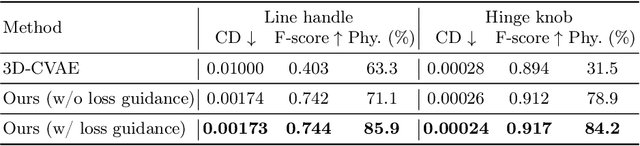

Interactable objects are ubiquitous in our daily lives. Recent advances in 3D generative models make it possible to automate the modeling of these objects, benefiting a range of applications from 3D printing to the creation of robot simulation environments. However, while significant progress has been made in modeling 3D shapes and appearances, modeling object physics, particularly for interactable objects, remains challenging due to the physical constraints imposed by inter-part motions. In this paper, we tackle the problem of physically plausible part completion for interactable objects, aiming to generate 3D parts that not only fit precisely into the object but also allow smooth part motions. To this end, we propose a diffusion-based part generation model that utilizes geometric conditioning through classifier-free guidance and formulates physical constraints as a set of stability and mobility losses to guide the sampling process. Additionally, we demonstrate the generation of dependent parts, paving the way toward sequential part generation for objects with complex part-whole hierarchies. Experimentally, we introduce a new metric for measuring physical plausibility based on motion success rates. Our model outperforms existing baselines over shape and physical metrics, especially those that do not adequately model physical constraints. We also demonstrate our applications in 3D printing, robot manipulation, and sequential part generation, showing our strength in realistic tasks with the demand for high physical plausibility.
ArtVLM: Attribute Recognition Through Vision-Based Prefix Language Modeling
Aug 07, 2024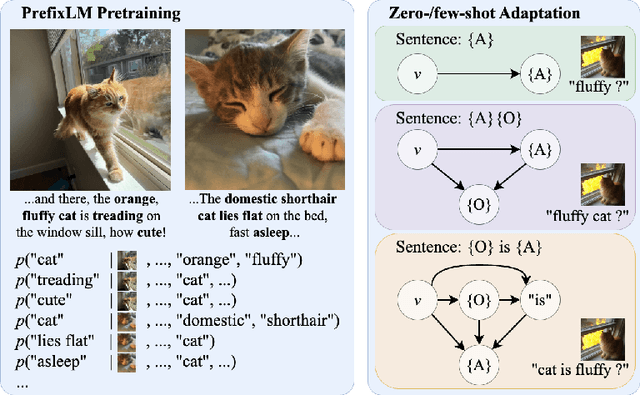
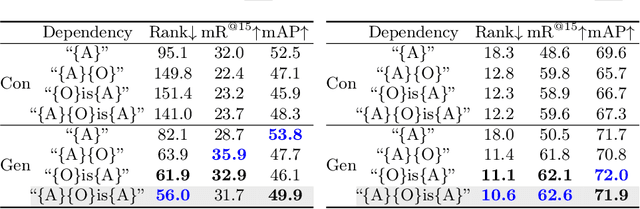
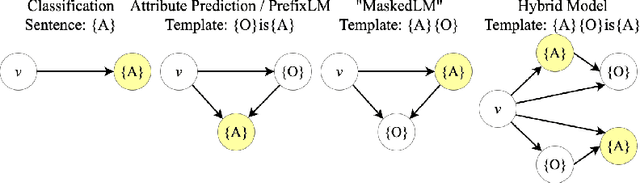

Recognizing and disentangling visual attributes from objects is a foundation to many computer vision applications. While large vision language representations like CLIP had largely resolved the task of zero-shot object recognition, zero-shot visual attribute recognition remains a challenge because CLIP's contrastively-learned vision-language representation cannot effectively capture object-attribute dependencies. In this paper, we target this weakness and propose a sentence generation-based retrieval formulation for attribute recognition that is novel in 1) explicitly modeling a to-be-measured and retrieved object-attribute relation as a conditional probability graph, which converts the recognition problem into a dependency-sensitive language-modeling problem, and 2) applying a large pretrained Vision-Language Model (VLM) on this reformulation and naturally distilling its knowledge of image-object-attribute relations to use towards attribute recognition. Specifically, for each attribute to be recognized on an image, we measure the visual-conditioned probability of generating a short sentence encoding the attribute's relation to objects on the image. Unlike contrastive retrieval, which measures likelihood by globally aligning elements of the sentence to the image, generative retrieval is sensitive to the order and dependency of objects and attributes in the sentence. We demonstrate through experiments that generative retrieval consistently outperforms contrastive retrieval on two visual reasoning datasets, Visual Attribute in the Wild (VAW), and our newly-proposed Visual Genome Attribute Ranking (VGARank).
Img2CAD: Reverse Engineering 3D CAD Models from Images through VLM-Assisted Conditional Factorization
Jul 19, 2024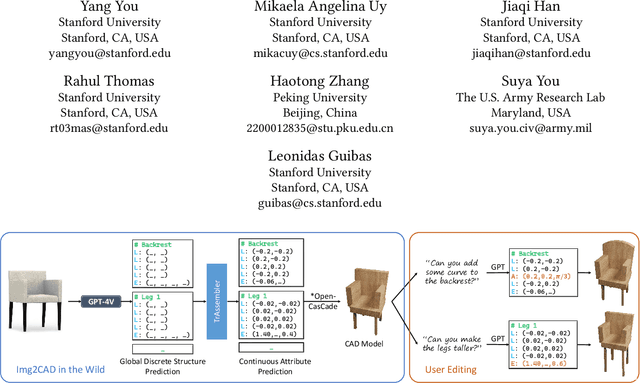
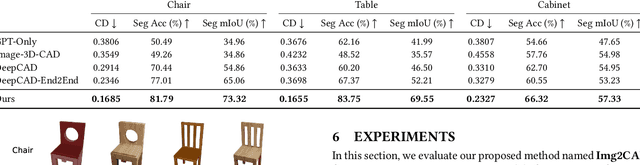
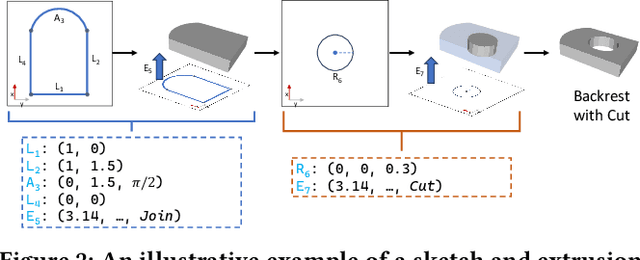

Reverse engineering 3D computer-aided design (CAD) models from images is an important task for many downstream applications including interactive editing, manufacturing, architecture, robotics, etc. The difficulty of the task lies in vast representational disparities between the CAD output and the image input. CAD models are precise, programmatic constructs that involves sequential operations combining discrete command structure with continuous attributes -- making it challenging to learn and optimize in an end-to-end fashion. Concurrently, input images introduce inherent challenges such as photo-metric variability and sensor noise, complicating the reverse engineering process. In this work, we introduce a novel approach that conditionally factorizes the task into two sub-problems. First, we leverage large foundation models, particularly GPT-4V, to predict the global discrete base structure with semantic information. Second, we propose TrAssembler that conditioned on the discrete structure with semantics predicts the continuous attribute values. To support the training of our TrAssembler, we further constructed an annotated CAD dataset of common objects from ShapeNet. Putting all together, our approach and data demonstrate significant first steps towards CAD-ifying images in the wild. Our project page: https://anonymous123342.github.io/
Streetscapes: Large-scale Consistent Street View Generation Using Autoregressive Video Diffusion
Jul 18, 2024

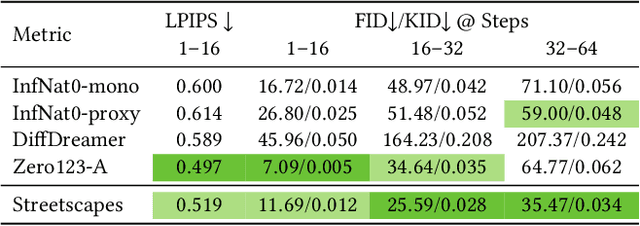

We present a method for generating Streetscapes-long sequences of views through an on-the-fly synthesized city-scale scene. Our generation is conditioned by language input (e.g., city name, weather), as well as an underlying map/layout hosting the desired trajectory. Compared to recent models for video generation or 3D view synthesis, our method can scale to much longer-range camera trajectories, spanning several city blocks, while maintaining visual quality and consistency. To achieve this goal, we build on recent work on video diffusion, used within an autoregressive framework that can easily scale to long sequences. In particular, we introduce a new temporal imputation method that prevents our autoregressive approach from drifting from the distribution of realistic city imagery. We train our Streetscapes system on a compelling source of data-posed imagery from Google Street View, along with contextual map data-which allows users to generate city views conditioned on any desired city layout, with controllable camera poses. Please see more results at our project page at https://boyangdeng.com/streetscapes.
PASTA: Controllable Part-Aware Shape Generation with Autoregressive Transformers
Jul 18, 2024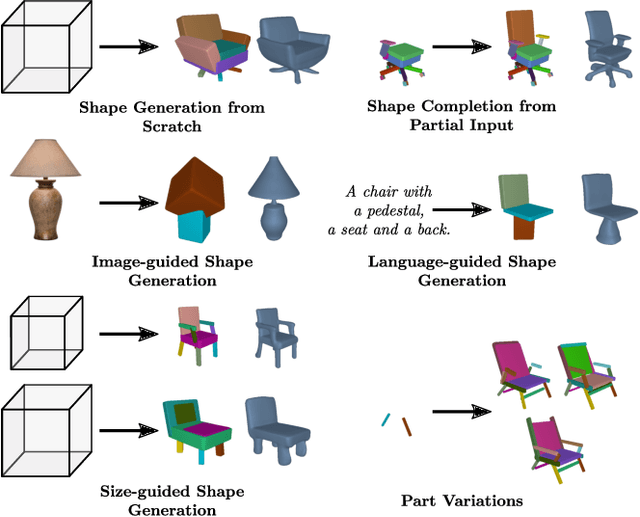
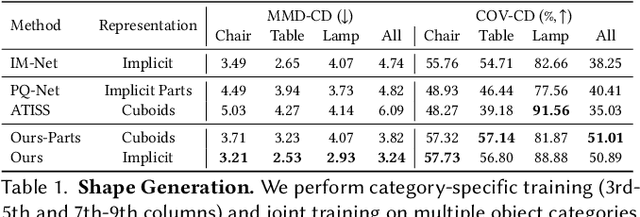

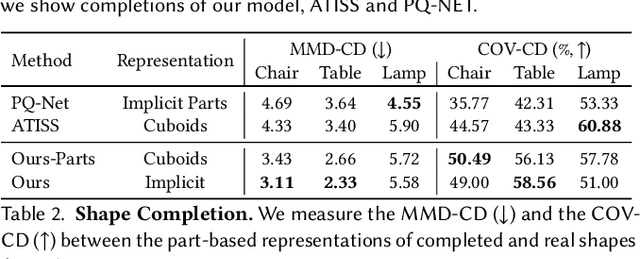
The increased demand for tools that automate the 3D content creation process led to tremendous progress in deep generative models that can generate diverse 3D objects of high fidelity. In this paper, we present PASTA, an autoregressive transformer architecture for generating high quality 3D shapes. PASTA comprises two main components: An autoregressive transformer that generates objects as a sequence of cuboidal primitives and a blending network, implemented with a transformer decoder that composes the sequences of cuboids and synthesizes high quality meshes for each object. Our model is trained in two stages: First we train our autoregressive generative model using only annotated cuboidal parts as supervision and next, we train our blending network using explicit 3D supervision, in the form of watertight meshes. Evaluations on various ShapeNet objects showcase the ability of our model to perform shape generation from diverse inputs \eg from scratch, from a partial object, from text and images, as well size-guided generation, by explicitly conditioning on a bounding box that defines the object's boundaries. Moreover, as our model considers the underlying part-based structure of a 3D object, we are able to select a specific part and produce shapes with meaningful variations of this part. As evidenced by our experiments, our model generates 3D shapes that are both more realistic and diverse than existing part-based and non part-based methods, while at the same time is simpler to implement and train.
RAM: Retrieval-Based Affordance Transfer for Generalizable Zero-Shot Robotic Manipulation
Jul 05, 2024

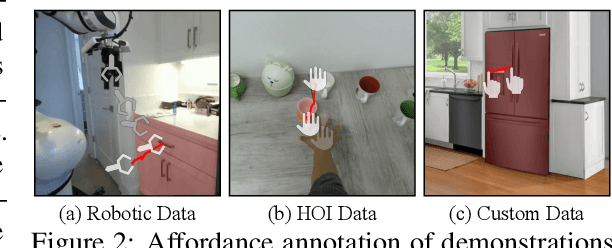

This work proposes a retrieve-and-transfer framework for zero-shot robotic manipulation, dubbed RAM, featuring generalizability across various objects, environments, and embodiments. Unlike existing approaches that learn manipulation from expensive in-domain demonstrations, RAM capitalizes on a retrieval-based affordance transfer paradigm to acquire versatile manipulation capabilities from abundant out-of-domain data. First, RAM extracts unified affordance at scale from diverse sources of demonstrations including robotic data, human-object interaction (HOI) data, and custom data to construct a comprehensive affordance memory. Then given a language instruction, RAM hierarchically retrieves the most similar demonstration from the affordance memory and transfers such out-of-domain 2D affordance to in-domain 3D executable affordance in a zero-shot and embodiment-agnostic manner. Extensive simulation and real-world evaluations demonstrate that our RAM consistently outperforms existing works in diverse daily tasks. Additionally, RAM shows significant potential for downstream applications such as automatic and efficient data collection, one-shot visual imitation, and LLM/VLM-integrated long-horizon manipulation. For more details, please check our website at https://yxkryptonite.github.io/RAM/.
SpotlessSplats: Ignoring Distractors in 3D Gaussian Splatting
Jun 28, 2024


3D Gaussian Splatting (3DGS) is a promising technique for 3D reconstruction, offering efficient training and rendering speeds, making it suitable for real-time applications.However, current methods require highly controlled environments (no moving people or wind-blown elements, and consistent lighting) to meet the inter-view consistency assumption of 3DGS. This makes reconstruction of real-world captures problematic. We present SpotlessSplats, an approach that leverages pre-trained and general-purpose features coupled with robust optimization to effectively ignore transient distractors. Our method achieves state-of-the-art reconstruction quality both visually and quantitatively, on casual captures.
Dynamic Gaussian Marbles for Novel View Synthesis of Casual Monocular Videos
Jun 26, 2024


Gaussian splatting has become a popular representation for novel-view synthesis, exhibiting clear strengths in efficiency, photometric quality, and compositional edibility. Following its success, many works have extended Gaussians to 4D, showing that dynamic Gaussians maintain these benefits while also tracking scene geometry far better than alternative representations. Yet, these methods assume dense multi-view videos as supervision, constraining their use to controlled capture settings. In this work, we extend the capability of Gaussian scene representations to casually captured monocular videos. We show that existing 4D Gaussian methods dramatically fail in this setup because the monocular setting is underconstrained. Building off this finding, we propose Dynamic Gaussian Marbles (DGMarbles), consisting of three core modifications that target the difficulties of the monocular setting. First, DGMarbles uses isotropic Gaussian "marbles", reducing the degrees of freedom of each Gaussian, and constraining the optimization to focus on motion and appearance over local shape. Second, DGMarbles employs a hierarchical divide-and-conquer learning strategy to guide the optimization towards solutions with coherent motion. Finally, DGMarbles adds image-level and geometry-level priors into the optimization, including a tracking loss that takes advantage of recent progress in point tracking. By constraining the optimization in these ways, DGMarbles learns Gaussian trajectories that enable novel-view rendering and accurately capture the 3D motion of the scene elements. We evaluate on the (monocular) Nvidia Dynamic Scenes dataset and the Dycheck iPhone dataset, and show that DGMarbles significantly outperforms other Gaussian baselines in quality, and is on-par with non-Gaussian representations, all while maintaining the efficiency, compositionality, editability, and tracking benefits of Gaussians.
InfoGaussian: Structure-Aware Dynamic Gaussians through Lightweight Information Shaping
Jun 09, 20243D Gaussians, as a low-level scene representation, typically involve thousands to millions of Gaussians. This makes it difficult to control the scene in ways that reflect the underlying dynamic structure, where the number of independent entities is typically much smaller. In particular, it can be challenging to animate and move objects in the scene, which requires coordination among many Gaussians. To address this issue, we develop a mutual information shaping technique that enforces movement resonance between correlated Gaussians in a motion network. Such correlations can be learned from putative 2D object masks in different views. By approximating the mutual information with the Jacobians of the motions, our method ensures consistent movements of the Gaussians composing different objects under various perturbations. In particular, we develop an efficient contrastive training pipeline with lightweight optimization to shape the motion network, avoiding the need for re-shaping throughout the motion sequence. Notably, our training only touches a small fraction of all Gaussians in the scene yet attains the desired compositional behavior according to the underlying dynamic structure. The proposed technique is evaluated on challenging scenes and demonstrates significant performance improvement in promoting consistent movements and 3D object segmentation while inducing low computation and memory requirements.