 Add to Chrome
 Add to Firefox
 Add to Edge
Neural Network-based High-index Saddle Dynamics Method for Searching Saddle Points and Solution Landscape
Nov 25, 2024
The high-index saddle dynamics (HiSD) method is a powerful approach for computing saddle points and solution landscape. However, its practical applicability is constrained by the need for the explicit energy function expression. To overcome this challenge, we propose a neural network-based high-index saddle dynamics (NN-HiSD) method. It utilizes neural network-based surrogate model to approximates the energy function, allowing the use of the HiSD method in the cases where the energy function is either unavailable or computationally expensive. We further enhance the efficiency of the NN-HiSD method by incorporating momentum acceleration techniques, specifically Nesterov's acceleration and the heavy-ball method. We also provide a rigorous convergence analysis of the NN-HiSD method. We conduct numerical experiments on systems with and without explicit energy functions, specifically including the alanine dipeptide model and bacterial ribosomal assembly intermediates for the latter, demonstrating the effectiveness and reliability of the proposed method.

OSMamba: Omnidirectional Spectral Mamba with Dual-Domain Prior Generator for Exposure Correction
Nov 22, 2024
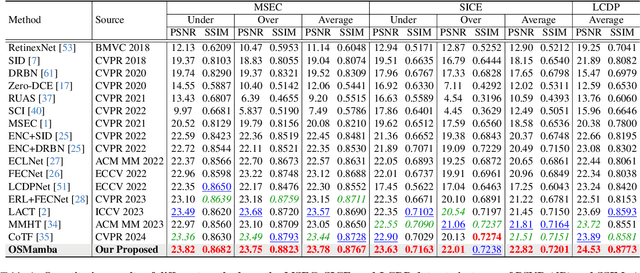
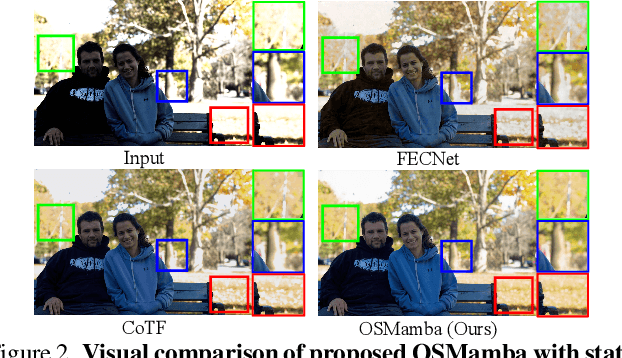
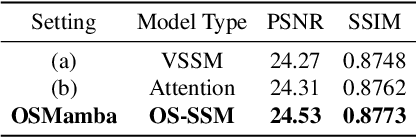
Exposure correction is a fundamental problem in computer vision and image processing. Recently, frequency domain-based methods have achieved impressive improvement, yet they still struggle with complex real-world scenarios under extreme exposure conditions. This is due to the local convolutional receptive fields failing to model long-range dependencies in the spectrum, and the non-generative learning paradigm being inadequate for retrieving lost details from severely degraded regions. In this paper, we propose Omnidirectional Spectral Mamba (OSMamba), a novel exposure correction network that incorporates the advantages of state space models and generative diffusion models to address these limitations. Specifically, OSMamba introduces an omnidirectional spectral scanning mechanism that adapts Mamba to the frequency domain to capture comprehensive long-range dependencies in both the amplitude and phase spectra of deep image features, hence enhancing illumination correction and structure recovery. Furthermore, we develop a dual-domain prior generator that learns from well-exposed images to generate a degradation-free diffusion prior containing correct information about severely under- and over-exposed regions for better detail restoration. Extensive experiments on multiple-exposure and mixed-exposure datasets demonstrate that the proposed OSMamba achieves state-of-the-art performance both quantitatively and qualitatively.
DINO-X: A Unified Vision Model for Open-World Object Detection and Understanding
Nov 21, 2024


In this paper, we introduce DINO-X, which is a unified object-centric vision model developed by IDEA Research with the best open-world object detection performance to date. DINO-X employs the same Transformer-based encoder-decoder architecture as Grounding DINO 1.5 to pursue an object-level representation for open-world object understanding. To make long-tailed object detection easy, DINO-X extends its input options to support text prompt, visual prompt, and customized prompt. With such flexible prompt options, we develop a universal object prompt to support prompt-free open-world detection, making it possible to detect anything in an image without requiring users to provide any prompt. To enhance the model's core grounding capability, we have constructed a large-scale dataset with over 100 million high-quality grounding samples, referred to as Grounding-100M, for advancing the model's open-vocabulary detection performance. Pre-training on such a large-scale grounding dataset leads to a foundational object-level representation, which enables DINO-X to integrate multiple perception heads to simultaneously support multiple object perception and understanding tasks, including detection, segmentation, pose estimation, object captioning, object-based QA, etc. Experimental results demonstrate the superior performance of DINO-X. Specifically, the DINO-X Pro model achieves 56.0 AP, 59.8 AP, and 52.4 AP on the COCO, LVIS-minival, and LVIS-val zero-shot object detection benchmarks, respectively. Notably, it scores 63.3 AP and 56.5 AP on the rare classes of LVIS-minival and LVIS-val benchmarks, both improving the previous SOTA performance by 5.8 AP. Such a result underscores its significantly improved capacity for recognizing long-tailed objects.
Adversarial Diffusion Compression for Real-World Image Super-Resolution
Nov 20, 2024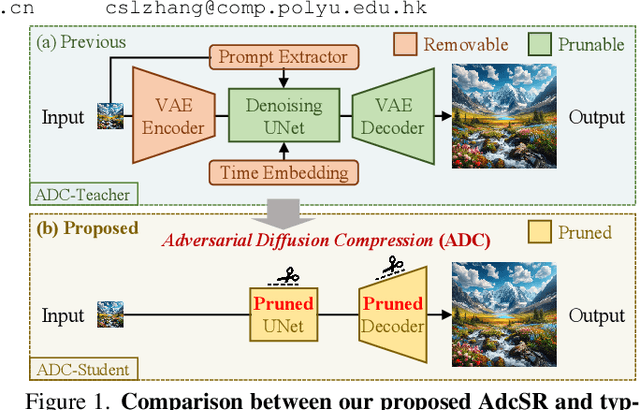
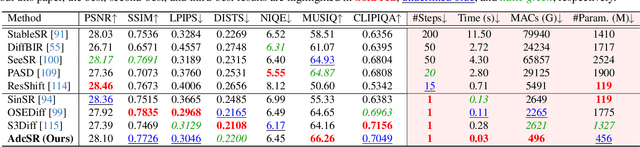
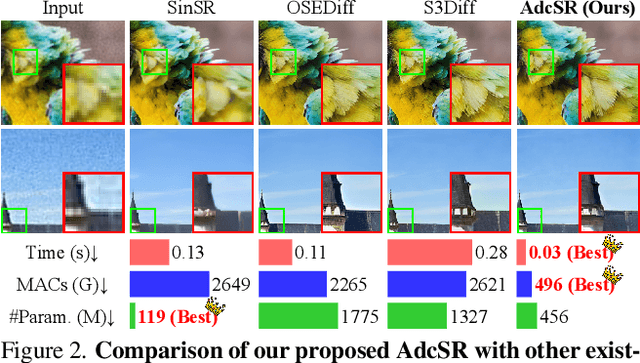
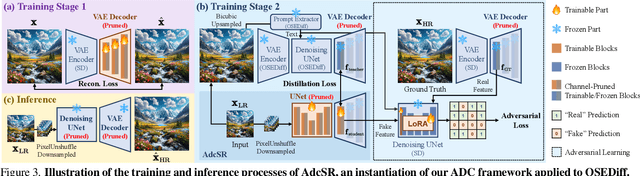
Real-world image super-resolution (Real-ISR) aims to reconstruct high-resolution images from low-resolution inputs degraded by complex, unknown processes. While many Stable Diffusion (SD)-based Real-ISR methods have achieved remarkable success, their slow, multi-step inference hinders practical deployment. Recent SD-based one-step networks like OSEDiff and S3Diff alleviate this issue but still incur high computational costs due to their reliance on large pretrained SD models. This paper proposes a novel Real-ISR method, AdcSR, by distilling the one-step diffusion network OSEDiff into a streamlined diffusion-GAN model under our Adversarial Diffusion Compression (ADC) framework. We meticulously examine the modules of OSEDiff, categorizing them into two types: (1) Removable (VAE encoder, prompt extractor, text encoder, etc.) and (2) Prunable (denoising UNet and VAE decoder). Since direct removal and pruning can degrade the model's generation capability, we pretrain our pruned VAE decoder to restore its ability to decode images and employ adversarial distillation to compensate for performance loss. This ADC-based diffusion-GAN hybrid design effectively reduces complexity by 73% in inference time, 78% in computation, and 74% in parameters, while preserving the model's generation capability. Experiments manifest that our proposed AdcSR achieves competitive recovery quality on both synthetic and real-world datasets, offering up to 9.3$\times$ speedup over previous one-step diffusion-based methods. Code and models will be made available.
Channel Capacity-Aware Distributed Encoding for Multi-View Sensing and Edge Inference
Nov 18, 2024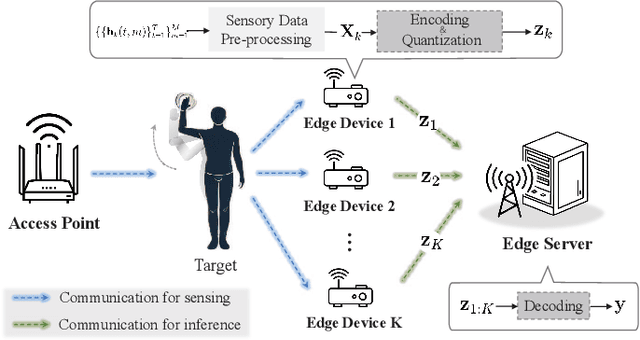
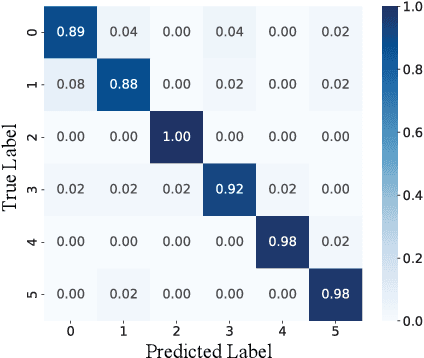
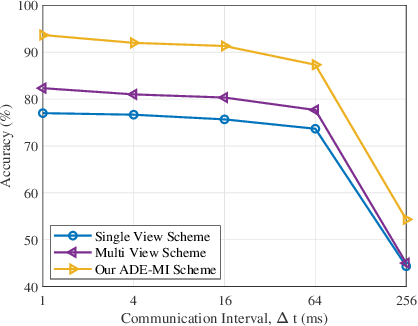
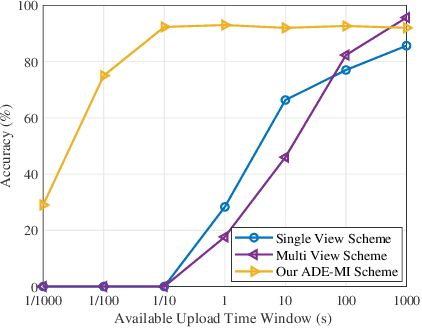
Integrated sensing and communication (ISAC) unifies wireless communication and sensing by sharing spectrum and hardware, which often incurs trade-offs between two functions due to limited resources. However, this paper shifts focus to exploring the synergy between communication and sensing, using WiFi sensing as an exemplary scenario where communication signals are repurposed to probe the environment without dedicated sensing waveforms, followed by data uploading to the edge server for inference. While increased device participation enhances multi-view sensing data, it also imposes significant communication overhead between devices and the edge server. To address this challenge, we aim to maximize the sensing task performance, measured by mutual information, under the channel capacity constraint. The information-theoretic optimization problem is solved by the proposed ADE-MI, a novel framework that employs a two-stage optimization two-stage optimization approach: (1) adaptive distributed encoding (ADE) at the device, which ensures transmitted bits are most relevant to sensing tasks, and (2) multi-view Inference (MI) at the edge server, which orchestrates multi-view data from distributed devices. Our experimental results highlight the synergy between communication and sensing, showing that more frequent communication from WiFi access points to edge devices improves sensing inference accuracy. The proposed ADE-MI achieves 92\% recognition accuracy with over $10^4$-fold reduction in latency compared to schemes with raw data communication, achieving both high sensing inference accuracy and low communication latency simultaneously.
Image Forgery Localization via Guided Noise and Multi-Scale Feature Aggregation
Nov 17, 2024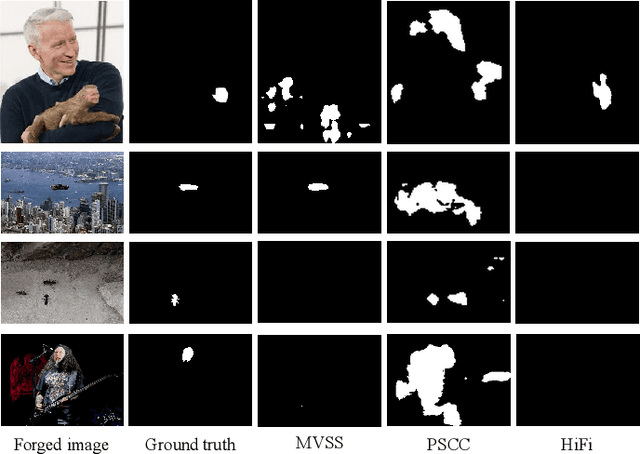
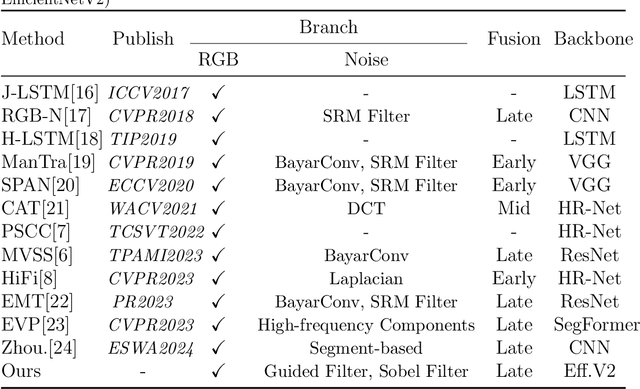
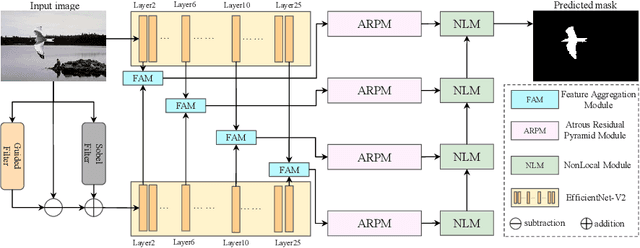
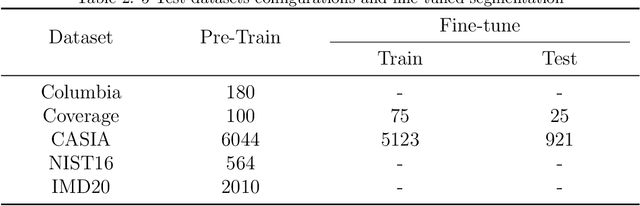
Image Forgery Localization (IFL) technology aims to detect and locate the forged areas in an image, which is very important in the field of digital forensics. However, existing IFL methods suffer from feature degradation during training using multi-layer convolutions or the self-attention mechanism, and perform poorly in detecting small forged regions and in robustness against post-processing. To tackle these, we propose a guided and multi-scale feature aggregated network for IFL. Spectifically, in order to comprehensively learn the noise feature under different types of forgery, we develop an effective noise extraction module in a guided way. Then, we design a Feature Aggregation Module (FAM) that uses dynamic convolution to adaptively aggregate RGB and noise features over multiple scales. Moreover, we propose an Atrous Residual Pyramid Module (ARPM) to enhance features representation and capture both global and local features using different receptive fields to improve the accuracy and robustness of forgery localization. Expensive experiments on 5 public datasets have shown that our proposed model outperforms several the state-of-the-art methods, specially on small region forged image.
Advancing Sustainability via Recommender Systems: A Survey
Nov 12, 2024

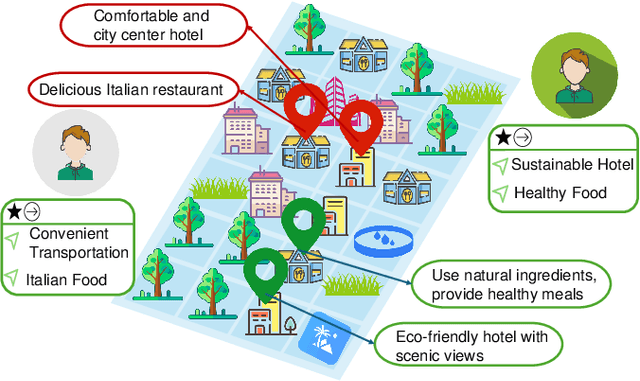

Human behavioral patterns and consumption paradigms have emerged as pivotal determinants in environmental degradation and climate change, with quotidian decisions pertaining to transportation, energy utilization, and resource consumption collectively precipitating substantial ecological impacts. Recommender systems, which generate personalized suggestions based on user preferences and historical interaction data, exert considerable influence on individual behavioral trajectories. However, conventional recommender systems predominantly optimize for user engagement and economic metrics, inadvertently neglecting the environmental and societal ramifications of their recommendations, potentially catalyzing over-consumption and reinforcing unsustainable behavioral patterns. Given their instrumental role in shaping user decisions, there exists an imperative need for sustainable recommender systems that incorporate sustainability principles to foster eco-conscious and socially responsible choices. This comprehensive survey addresses this critical research gap by presenting a systematic analysis of sustainable recommender systems. As these systems can simultaneously advance multiple sustainability objectives--including resource conservation, sustainable consumer behavior, and social impact enhancement--examining their implementations across distinct application domains provides a more rigorous analytical framework. Through a methodological analysis of domain-specific implementations encompassing transportation, food, buildings, and auxiliary sectors, we can better elucidate how these systems holistically advance sustainability objectives while addressing sector-specific constraints and opportunities. Moreover, we delineate future research directions for evolving recommender systems beyond sustainability advocacy toward fostering environmental resilience and social consciousness in society.
A Learned Proximal Alternating Minimization Algorithm and Its Induced Network for a Class of Two-block Nonconvex and Nonsmooth Optimization
Nov 10, 2024


This work proposes a general learned proximal alternating minimization algorithm, LPAM, for solving learnable two-block nonsmooth and nonconvex optimization problems. We tackle the nonsmoothness by an appropriate smoothing technique with automatic diminishing smoothing effect. For smoothed nonconvex problems we modify the proximal alternating linearized minimization (PALM) scheme by incorporating the residual learning architecture, which has proven to be highly effective in deep network training, and employing the block coordinate decent (BCD) iterates as a safeguard for the convergence of the algorithm. We prove that there is a subsequence of the iterates generated by LPAM, which has at least one accumulation point and each accumulation point is a Clarke stationary point. Our method is widely applicable as one can employ various learning problems formulated as two-block optimizations, and is also easy to be extended for solving multi-block nonsmooth and nonconvex optimization problems. The network, whose architecture follows the LPAM exactly, namely LPAM-net, inherits the convergence properties of the algorithm to make the network interpretable. As an example application of LPAM-net, we present the numerical and theoretical results on the application of LPAM-net for joint multi-modal MRI reconstruction with significantly under-sampled k-space data. The experimental results indicate the proposed LPAM-net is parameter-efficient and has favourable performance in comparison with some state-of-the-art methods.
Minder: Faulty Machine Detection for Large-scale Distributed Model Training
Nov 04, 2024


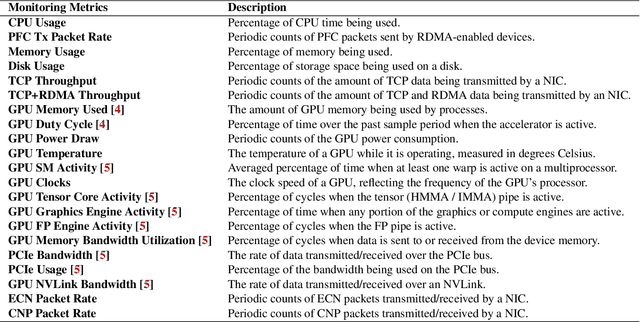
Large-scale distributed model training requires simultaneous training on up to thousands of machines. Faulty machine detection is critical when an unexpected fault occurs in a machine. From our experience, a training task can encounter two faults per day on average, possibly leading to a halt for hours. To address the drawbacks of the time-consuming and labor-intensive manual scrutiny, we propose Minder, an automatic faulty machine detector for distributed training tasks. The key idea of Minder is to automatically and efficiently detect faulty distinctive monitoring metric patterns, which could last for a period before the entire training task comes to a halt. Minder has been deployed in our production environment for over one year, monitoring daily distributed training tasks where each involves up to thousands of machines. In our real-world fault detection scenarios, Minder can accurately and efficiently react to faults within 3.6 seconds on average, with a precision of 0.904 and F1-score of 0.893.
Optical Flow Representation Alignment Mamba Diffusion Model for Medical Video Generation
Nov 03, 2024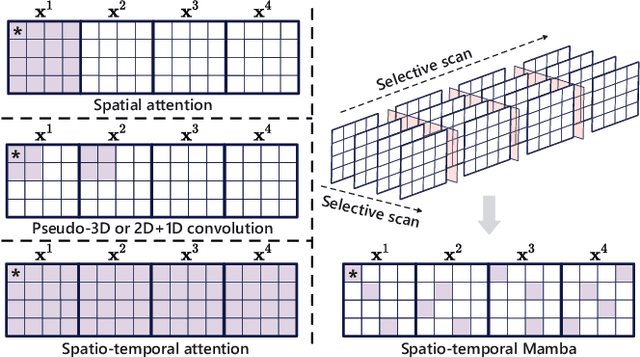
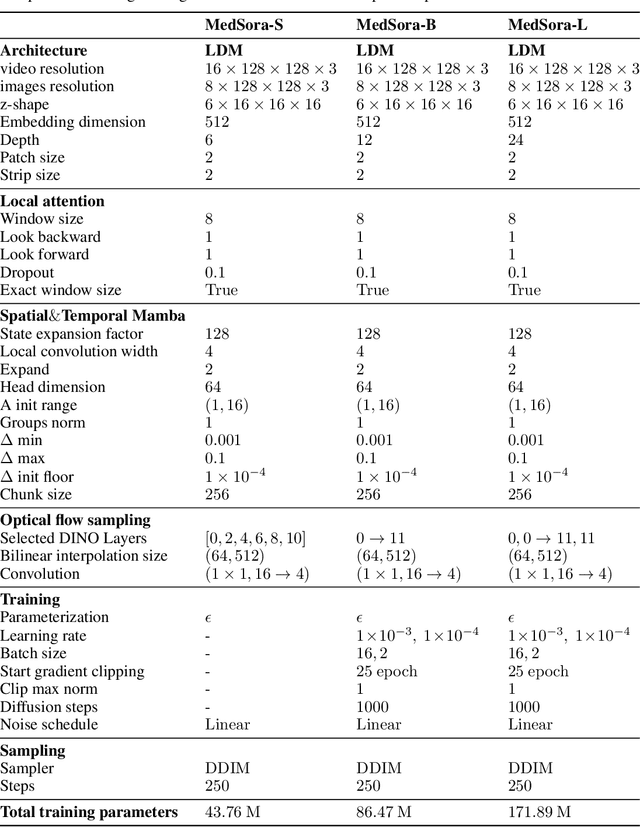
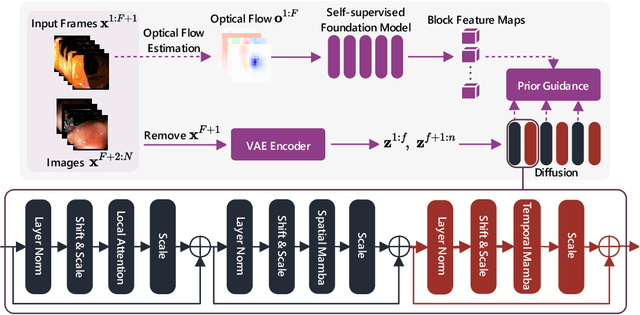
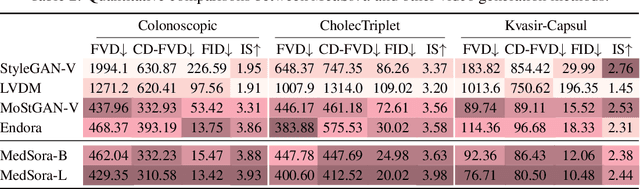
Medical video generation models are expected to have a profound impact on the healthcare industry, including but not limited to medical education and training, surgical planning, and simulation. Current video diffusion models typically build on image diffusion architecture by incorporating temporal operations (such as 3D convolution and temporal attention). Although this approach is effective, its oversimplification limits spatio-temporal performance and consumes substantial computational resources. To counter this, we propose Medical Simulation Video Generator (MedSora), which incorporates three key elements: i) a video diffusion framework integrates the advantages of attention and Mamba, balancing low computational load with high-quality video generation, ii) an optical flow representation alignment method that implicitly enhances attention to inter-frame pixels, and iii) a video variational autoencoder (VAE) with frequency compensation addresses the information loss of medical features that occurs when transforming pixel space into latent features and then back to pixel frames. Extensive experiments and applications demonstrate that MedSora exhibits superior visual quality in generating medical videos, outperforming the most advanced baseline methods. Further results and code are available at https://wongzbb.github.io/MedSora